
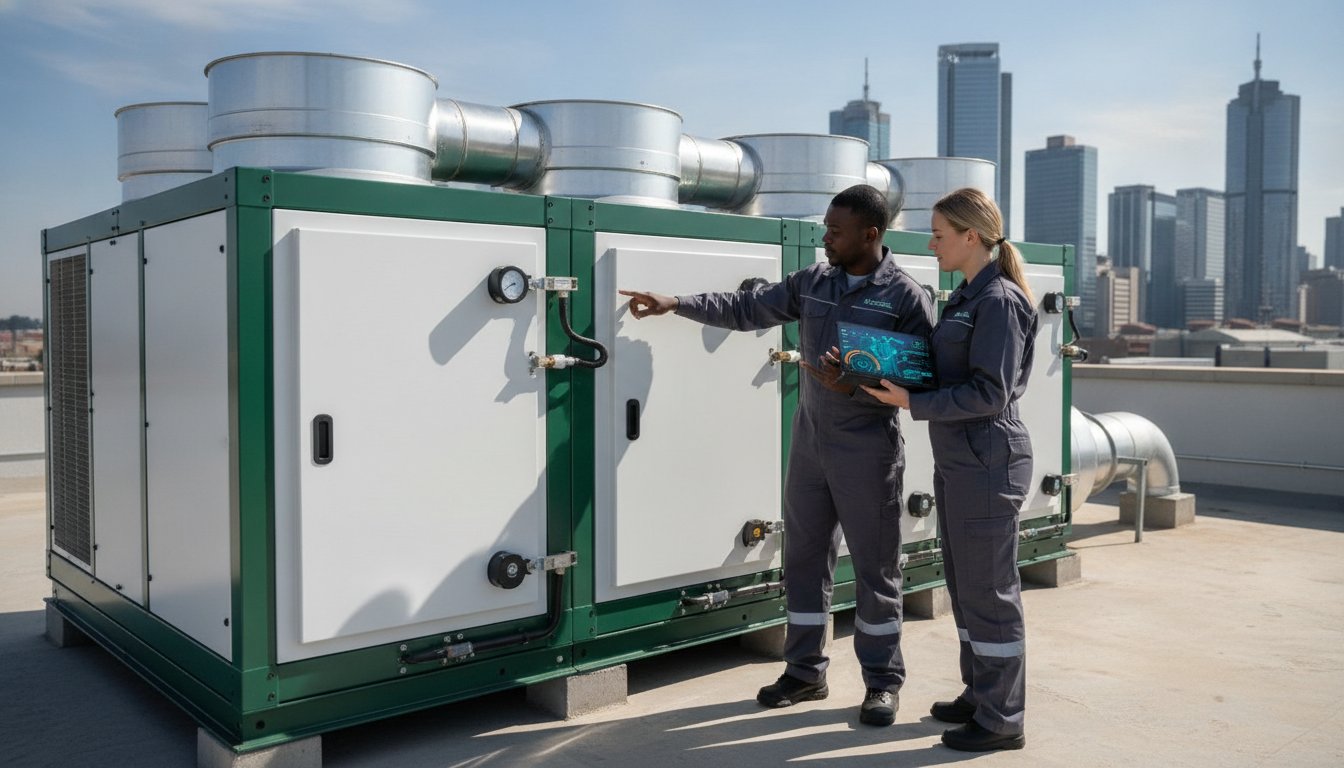
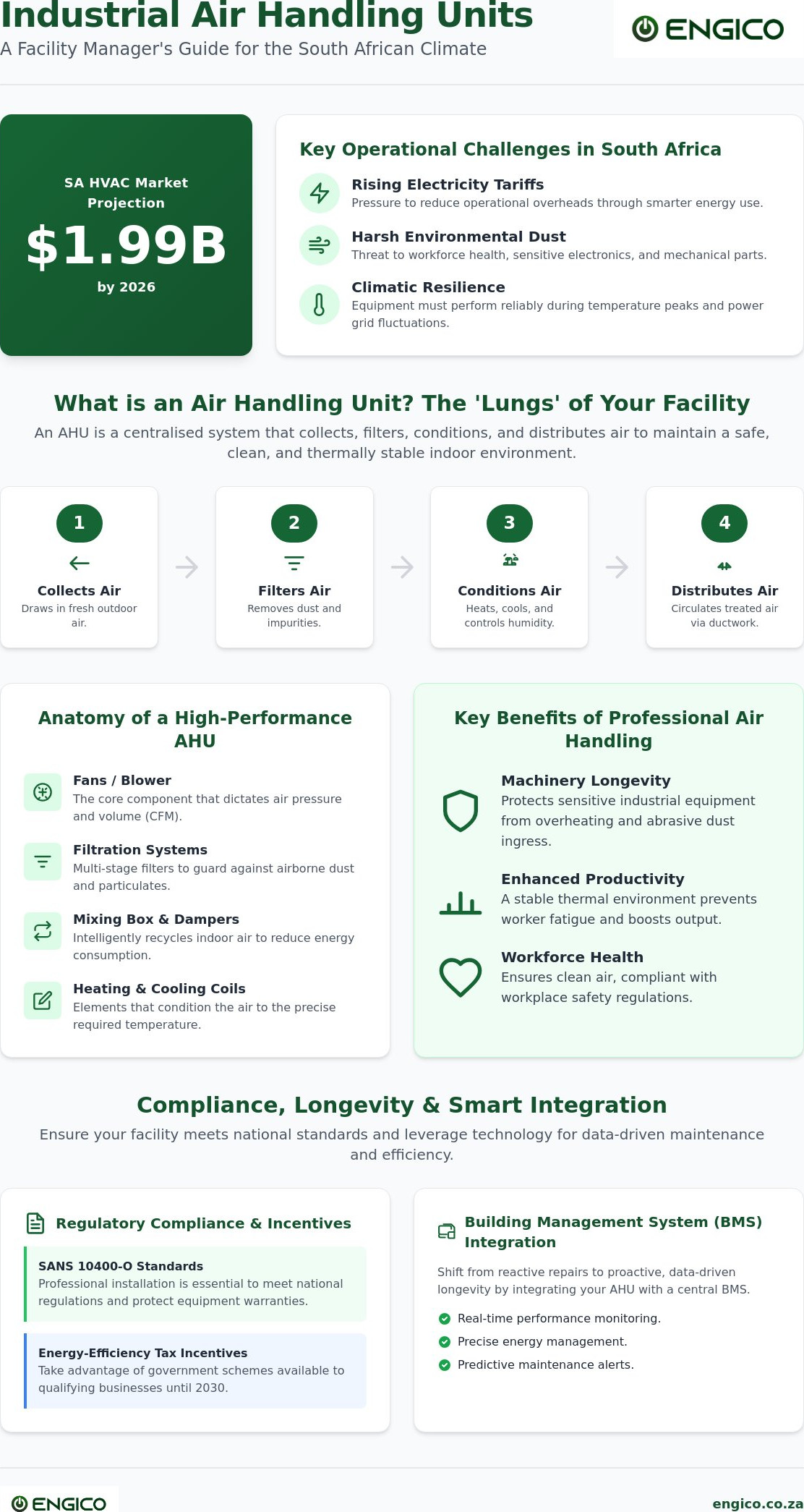
With the South African HVAC market projected to grow to 1.99 billion dollars in 2026, the pressure on facility managers to maintain high-performance infrastructure has reached a critical point. You likely recognise that keeping a large-scale plant ventilated is no longer just about comfort; it’s a complex battle against rising electricity tariffs and the harsh reality of environmental dust. Choosing the right industrial air handling units South Africa requires demands a focus on climatic resilience to ensure that equipment doesn’t fail when the external temperature peaks or the power grid fluctuates.
We understand that your primary goals are to protect your workforce’s health and reduce operational overheads through smarter energy use. This guide provides a clear path to achieving those outcomes by explaining how modern units function within our specific regional context. You’ll learn about the latest energy-efficiency tax incentives available until 2030 and the essential SANS regulations you must meet this year. We will also provide a methodical framework for selecting a system that integrates seamlessly with your building management protocols to deliver lasting value and reliability.
Key Takeaways
- Understand the fundamental role of AHUs as the ‘lungs’ of your facility, managing filtration and humidity to maintain a productive environment.
- Learn how to evaluate industrial air handling units South Africa requires by calculating specific CFM needs and choosing between centralised or decentralised configurations.
- Discover the core components that drive performance, including the critical role of mixing boxes in reducing energy consumption through efficient air recycling.
- Ensure your facility remains compliant with SANS 10400-O standards whilst protecting your equipment warranties through professional installation and technical oversight.
- Shift from reactive repairs to data-driven longevity by integrating your HVAC system with a Building Management System (BMS) for real-time performance monitoring.
What are Industrial Air Handling Units and Why are They Essential in South Africa?
An Air Handling Unit (AHU) serves as the primary respiratory system for a large-scale facility. Whilst a standard air conditioner might cool a single office, the industrial air handling units South Africa businesses utilise are designed to regulate the atmosphere of entire factories, warehouses, or hospitals. These systems do far more than just change the temperature. They act as a central hub where outdoor air is collected, filtered for impurities, conditioned to the correct thermal state, and then distributed throughout the building via ductwork.
To understand the technical foundation of these systems, one might ask, What is an Air Handling Unit? in its simplest form. It’s a robust metal housing containing a blower, heating or cooling elements, filter racks, and sound attenuators. In our local context, where environmental conditions vary from the humid coastal regions to the dry, high-altitude plains of the Highveld, the AHU’s ability to control humidity and air quality is as vital as its cooling capacity. It’s a comprehensive solution that ensures the air circulating within a facility is safe, clean, and thermally stable.
The Role of AHUs in South African Industrial Environments
Industrial sectors in Gauteng and beyond face specific challenges that standard ventilation can’t solve. High heat loads in manufacturing plants often lead to rapid equipment degradation and worker fatigue. A robust AHU system manages these loads by continuously introducing fresh, treated air whilst exhausting stale air. In mining and heavy industry, the focus shifts to air quality. High levels of airborne dust aren’t just a health hazard; they’re a threat to sensitive electronics and mechanical components. By using multi-stage filtration, these units ensure that internal environments remain clean and compliant with local workplace safety regulations.
Key Benefits of Professional Air Handling
Investing in a professional-grade system offers more than just compliance. It directly impacts your bottom line through several key avenues:
- Enhanced Productivity: Maintaining a stable thermal environment prevents the midday slump in productivity often seen in poorly ventilated South African facilities.
- Machinery Longevity: High-performance units protect sensitive industrial machinery from overheating and the ingress of abrasive particulate matter.
- Operational Efficiency: Centralised air handling allows for more precise energy management, especially when integrated with a Building Management System (BMS).
This methodical approach to air management ensures that your facility remains a safe, efficient, and reliable environment for both your workforce and your equipment.
The Anatomy of a High-Performance Industrial AHU
A high-performance unit is far more than a simple metal box; it’s an assembly of precision components engineered to work in unison. The industrial air handling units South Africa requires must be robust enough to handle high-volume air movement whilst remaining energy-efficient. At the core of this system are the centrifugal or plug fans, which dictate the pressure and volume of air delivered. Engineers often choose between ‘draw-through’ configurations, where the fan pulls air through the coils, and ‘blow-through’ setups, where air is pushed through. Each has specific benefits depending on the moisture control and spatial requirements of the facility.
Control is managed through a series of dampers and a mixing box. The dampers act as precision valves to regulate air volume and direction, whilst the mixing box allows for the intelligent recycling of indoor air. By mixing return air with fresh outdoor air, the system reduces the load on cooling coils. This is a fundamental aspect of industrial HVAC best practices for reducing operational costs in large-scale plants. If you are unsure which configuration suits your plant, you can consult with our technical team for a detailed assessment of your requirements.
Filtration Systems: Guarding Against South African Dust
In many local industrial zones, particularly near mining operations or unpaved infrastructure, airborne particulate matter is a constant threat. High-performance AHUs utilise a multi-stage filtration approach, starting with pre-filters to catch larger debris and moving to HEPA filters for microscopic contaminants. This staged approach prevents the primary filters from clogging prematurely and protects the internal fan motor and coils from abrasive wear. For most industrial applications, a MERV rating of 13 or higher is the standard for ensuring the removal of fine dust and bacteria from the airflow.
Coils and Heat Exchangers
The choice between Direct Expansion (DX) and Chilled Water systems often depends on the scale of the facility. DX systems are typically more straightforward for smaller industrial plants, whereas Chilled Water systems offer superior efficiency for large-scale operations. Geography plays a significant role in performance. In high-altitude regions like Gauteng, the thinner air has a lower heat capacity. This means heat exchangers must be sized appropriately to compensate for reduced transfer efficiency. Conversely, coastal facilities require specialised anti-corrosion coatings on aluminium fins and copper tubes to withstand the salt-laden air. This methodical attention to component selection ensures that the unit remains reliable regardless of the local environment.
Selecting the Right Industrial Air Handling Units for South Africa
Choosing the correct specification for industrial air handling units South Africa demands a methodical evaluation of both technical requirements and economic realities. Two primary metrics dictate performance: Cubic Feet per Minute (CFM) and static pressure. CFM determines the volume of air moved per minute, whilst static pressure measures the resistance the fan must overcome within the ductwork and filtration stages. If these are miscalculated, the system will either fail to reach the required zones or consume excessive power to compensate for resistance.
You must also decide between a centralised AHU or a decentralised ventilation strategy. A centralised system simplifies maintenance by housing components in one location, whereas decentralised systems provide redundancy; if one unit requires repair, the others continue to operate. This choice impacts your facility’s resilience and long-term service schedule.
With South African electricity tariffs increasing consistently, the Energy Efficiency Rating (EER) of a unit is no longer a secondary concern. High-efficiency motors and variable speed drives (VSDs) are essential to ensure the system remains affordable to operate. Modularity is another critical factor. Selecting a modular system allows you to add cooling or filtration sections as your facility expands, avoiding the need for a total system replacement in the future. This forward-thinking approach ensures your infrastructure remains a stable asset rather than a limiting factor. For facilities with large open floorplates, understanding the principles of warehouse ventilation design South Africa requires is an essential complement to selecting the right AHU specification.
System Type Comparison: DX vs. Chilled Water
The choice between Direct Expansion (DX) and Chilled Water systems often comes down to the scale of the facility and available maintenance resources. DX systems generally have lower initial installation costs and are well-suited for medium-sized factories or commercial buildings. However, for large-scale operations like shopping malls or expansive industrial plants, Chilled Water systems offer superior long-term efficiency and more precise temperature control. These units provide a ducted cooling for large scale projects that can be scaled across massive floorplates whilst keeping maintenance centralised at the chiller plant.
Acoustic Considerations and Space Constraints
In densely populated urban industrial hubs such as Sandton or Menlyn, noise pollution is a significant regulatory concern. High-performance AHUs can be fitted with sound attenuators and double-skinned panels to dampen vibration and fan noise. Space is another frequent hurdle, especially when retrofitting older Gauteng buildings. Whilst rooftop installations save valuable internal floor space, they require a structural assessment to ensure the roof can support the unit’s weight. For sites with restricted access, compact indoor units with a smaller footprint are often the most practical solution, provided the plant room has adequate access for routine servicing.
Installation, Compliance, and Local Challenges
In South Africa, all commercial buildings are legally required to provide a minimum level of fresh air ventilation as specified by the National Building Regulations to ensure occupant health and safety. Adhering to this mandate involves more than just placing equipment on a roof; it requires a precise installation process that aligns with SANS 10400-O. The industrial air handling units South Africa depends on for large-scale climate control are intricate machines that require expert commissioning to function correctly. A professional installation ensures that the unit operates within its designed fan curves and pressure parameters. This is also vital for protecting your investment. Most manufacturers will only honour warranty claims if the system was commissioned and signed off by a recognised specialist.
Beyond basic functionality, the installation must account for the specific environmental stresses of the region. This includes the high-altitude performance adjustments mentioned in previous sections and the integration of safety protocols. If you require assistance with a new project or a compliant upgrade, you can contact Engico Air Conditioning for professional AHU installation and compliance support.
Navigating SANS Regulations and Safety Standards
Compliance with SANS 10400-O is a foundational requirement, but modern industrial facilities must also integrate fire safety protocols into their air handling strategy. This involves the installation of motorised smoke dampers that automatically seal off sections of the ductwork during an emergency to prevent the spread of toxic fumes. Additionally, new commercial developments must meet stricter energy efficiency mandates under SANS 10400-XA. Working with certified HVAC specialists in the Gauteng Province is essential to ensure that your system remains fully compliant with these evolving legal frameworks whilst maintaining peak operational standards.
Load Shedding and Power Quality Management
The persistent challenge of load shedding in South Africa poses a direct threat to the sensitive electronics and heavy-duty motors within an AHU. Frequent power surges and sudden shutdowns can lead to premature motor failure and corrupted control logic. To mitigate this, we recommend the use of soft-starters and specialised surge protection devices for all large AHU motors. These components manage the inrush of current when power returns, preventing unnecessary mechanical stress. Integrating your industrial climate control with backup power systems, such as generators or a dedicated UPS for the control panel, is no longer optional. It’s a necessary step to protect the lifespan of your equipment and ensure continuous air quality during power fluctuations.
Optimising Longevity: Maintenance and BMS Integration
To ensure the long-term viability of your infrastructure, you must move away from reactive repairs. Waiting for a component to fail before intervening often leads to unexpected downtime and inflated operational costs. Instead, a disciplined strategy of preventative HVAC maintenance allows you to identify minor issues before they escalate into catastrophic system failures. This approach is particularly crucial for the industrial air handling units South Africa relies on, as our local environmental dust and power instabilities place unique stress on fan motors and filtration banks.
Engico Air Conditioning positions itself as a methodical partner in this process, acting as a safe pair of hands for your facility’s technical needs. By adopting predictive maintenance protocols, we help you transition from simply fixing machines to managing a high-performance asset. This ensures that your climate control system remains a dependable part of your production chain rather than a source of operational risk.
Building Management System (BMS) Integration
A Building Management System (BMS) serves as the central intelligence for your facility, providing real-time data that traditional thermostats cannot offer. By integrating your AHU with a BMS, you can automate temperature set-points based on occupancy levels and time-of-use electricity tariffs. This ensures the system doesn’t run at full capacity when the building is empty or when power costs are at their peak. Remote monitoring allows your technical team to track filter health and motor efficiency from a central dashboard, enabling data-driven decisions. For larger sites, linking these units with warehouse ventilation systems creates a unified climate control network that optimises energy consumption across the entire floorplate.
Routine Maintenance Checklist for Industrial Units
Reliability in the South African climate requires a structured approach to servicing. A professional maintenance contract provides a clear cost-benefit advantage by extending equipment lifespan and ensuring safety compliance. Your service schedule should include:
- Monthly Inspections: Check filter pressure drops and verify drive belt tension to prevent slippage and energy waste.
- Coil Cleaning: Regularly remove dust and debris from cooling and heating coils to maintain optimal heat transfer efficiency.
- Electrical Audits: Inspect contactors and control logic for signs of wear or pitting caused by frequent power surges and load shedding.
- Bearing Lubrication: Ensure fan and motor bearings are correctly lubricated to reduce friction and prevent overheating.
This methodical attention to detail ensures that your industrial air handling units continue to provide clean, conditioned air whilst maintaining the energy efficiency standards required for modern South African industry.
Future-Proofing Your Facility’s Environmental Standards
Managing the atmosphere of a large-scale plant requires a methodical balance between technical precision and regulatory adherence. By prioritising the high-efficiency industrial air handling units South Africa demands, you ensure that your facility remains resilient against fluctuating energy costs and the specific challenges of our local environment. The integration of modern Building Management Systems (BMS) and a disciplined preventative maintenance schedule are no longer optional extras; they’re the standard for operational excellence in 2026.
Engico Air Conditioning has served as a specialist in Gauteng’s industrial HVAC sector since 2022, providing a safe pair of hands for complex installations and comprehensive repair services. Our expertise in BMS integration ensures that your infrastructure operates at maximum efficiency whilst maintaining full compliance with SANS regulations. We invite you to contact Engico Air Conditioning for a professional industrial AHU consultation to discuss how we can optimise your facility’s climate control. Investing in the right systems today provides the stable foundation your operations need for the years ahead.
Frequently Asked Questions
What is the average lifespan of an industrial air handling unit in South Africa?
An industrial air handling unit typically lasts between 15 and 20 years when supported by a consistent maintenance schedule. In South Africa, this lifespan can be shortened by external factors such as coastal corrosion or high particulate levels in heavy industrial hubs. Regular servicing ensures that mechanical components like fan bearings and motors operate within their intended parameters, preventing the premature degradation often caused by local environmental stress.
How often should filters be replaced in a dusty industrial environment like Gauteng?
In high-dust environments like Gauteng, you should inspect filters monthly and replace them every one to three months. The abrasive nature of Highveld dust can quickly clog standard pre-filters, which increases the static pressure on the fan motor and leads to higher energy consumption. Maintaining clean filtration is essential for protecting the internal components of industrial air handling units South Africa relies on for consistent air quality.
Can an existing AHU be retrofitted with a Building Management System (BMS)?
Yes, almost any existing AHU can be retrofitted with a Building Management System through the installation of modern sensors, actuators, and controllers. This upgrade allows for real-time monitoring of energy use and automated adjustments based on occupancy or external temperatures. Retrofitting is a cost-effective way to improve the efficiency of older infrastructure without the high cost and disruption of a full system replacement.
What is the difference between an AHU and a standard rooftop packaged unit?
An AHU is a modular component that requires an external source for heating or cooling, such as a chiller or boiler. In contrast, a standard rooftop packaged unit is a self-contained system that includes its own compressors and condensers. AHUs offer much higher levels of customisation for air filtration and humidity control, making them better suited for complex industrial applications that require precise environmental management.
How does high altitude in Johannesburg affect AHU performance?
The high altitude in Johannesburg means the air is less dense, which directly reduces the heat-carrying capacity of the airflow. To achieve the same cooling effect as a sea-level installation, fans must move a higher volume of air. This often requires larger fan sizes or higher motor speeds to compensate for the reduced efficiency of heat transfer across the cooling coils in thin-air environments.
What are the most common causes of AHU failure in South African industrial sites?
The most frequent causes of failure include power surges from load shedding, motor burnout due to clogged filters, and bearing failure from lack of lubrication. Power fluctuations can corrupt control logic and damage sensitive electronic components. Additionally, the ingress of fine industrial dust into the motor housing often leads to overheating, which is why routine cleaning is a non-negotiable requirement for protecting local equipment.
Are there energy-saving rebates available for efficient industrial HVAC systems in ZA?
Yes, the Section 12L tax incentive for energy-efficiency savings has been extended to 31 December 2030. This allows businesses to claim a tax deduction for verified energy savings achieved through system upgrades. Additionally, the Energy Efficiency and Demand Side Management (EEDSM) programme provides grants to certain sectors for the adoption of more efficient technologies, provided they meet the SANS 50010 measurement and verification standards.
How do I calculate the required capacity for my facility’s air handling unit?
Capacity is calculated by determining the total heat load of the space, the internal volume, and the required Air Changes per Hour (ACH) for your specific industry. You must account for heat generated by machinery, lighting, and personnel. A professional assessment ensures that the industrial air handling units South Africa facilities use are sized correctly to maintain the required static pressure whilst avoiding the energy waste associated with over-specified equipment. For storage and distribution facilities, reviewing the latest guidance on warehouse ventilation systems South Africa requires in 2026 can provide additional technical benchmarks for your capacity calculations.
Recent Comments