
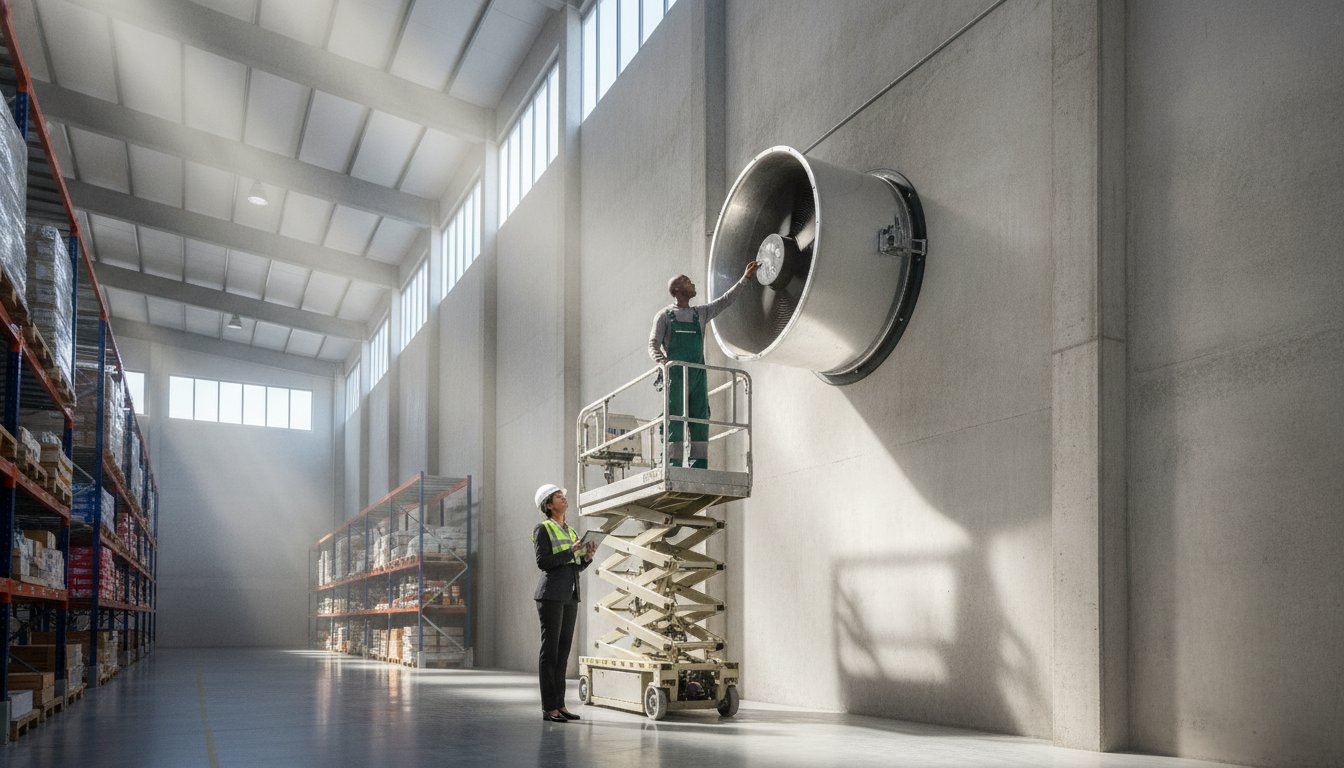
By September 2026, the implementation of the new Physical Agents Regulations will transform warehouse climate control from an operational preference into a strict legal requirement. You likely recognise the challenge of maintaining productivity when Highveld summers trap excessive heat within large volumes, making the selection of warehouse ventilation systems South Africa a critical priority for the coming year. It’s a common frustration for facility managers who must balance the need for fresh air with the reality of dust accumulation and strict budgetary constraints.
This guide helps you master the technical selection criteria for industrial extraction fans and louvres to ensure your facility remains a safe pair of hands for your operations. We’ll show you how to optimise your workspace by combining mechanical extraction with passive intake to create a reliable, temperature-controlled environment. You’ll learn to navigate the latest SANS health and safety standards whilst reducing energy expenditure through smart ventilation strategies and building management integration. This methodical approach ensures your warehouse stays compliant, efficient, and comfortable through the most demanding seasons.
Key Takeaways
- Understand how South Africa’s unique thermal loads and the updated 2026 regulatory framework necessitate a more robust approach to industrial air exchange.
- Learn to evaluate the technical performance of mechanical extraction fans versus passive louvre systems to achieve the most efficient air movement for your floor plan.
- Master the essential selection criteria for warehouse ventilation systems South Africa, prioritising hardware that remains durable against Highveld dust and intense summer thunderstorms.
- Discover how to map airflow patterns to eliminate dead air zones and utilise cross-ventilation to maintain a stable, productive internal temperature.
- Explore the long-term value of integrating ventilation with Building Management Systems (BMS) to automate climate control and reduce overall energy expenditure.
The Critical Role of Warehouse Ventilation in South Africa’s Industrial Sector
Effective warehouse ventilation is defined as the systematic exchange of indoor air with fresh outdoor air to regulate internal temperatures and maintain air purity. In the context of the industrial sector, installing robust warehouse ventilation systems South Africa is not merely about comfort; it’s a technical necessity that ensures operational continuity. This process involves the strategic movement of air to displace contaminants and manage the thermal energy that accumulates within large-scale facilities.
South Africa’s climate, particularly in industrial hubs like Midrand and Silverton, subjects large-scale buildings to intense solar gain. When sunlight hits vast metal roof surfaces, the heat is transferred to the air inside. This leads to thermal stratification, where heat layers build up and remain trapped under the ceiling. Without a planned exchange of air, these environments become heat traps that compromise both the building’s utility and the safety of those working within it.
By 2026, facility managers are increasingly concerned with Sick Building Syndrome (SBS). Poorly ventilated spaces accumulate dust, volatile organic compounds (VOCs), and carbon dioxide, which can lead to chronic respiratory issues and lethargy amongst staff. Beyond human health, stagnant air accelerates the degradation of sensitive inventory and places additional strain on heavy machinery, leading to more frequent repairs and shortened equipment lifespans. Maintaining a consistent flow of fresh air is the primary defence against these costly operational risks.
Heat Management and Worker Productivity
During Highveld summer afternoons, indoor temperatures can easily exceed 35 degrees Celsius without proper airflow. Research into architectural ventilation principles shows that excessive heat directly impairs cognitive function and increases the risk of physical accidents. High-ceiling warehouses often suffer from the “Stack Effect,” where hot air rises and creates a high-pressure zone near the roof. Thermal stratification is the process where air temperature increases progressively from the floor to the ceiling, creating distinct horizontal layers of heat that can leave floor-level workspaces stiflingly hot.
Regulatory Compliance and SANS Standards
Compliance with South African National Standards is mandatory for any modern industrial operation. SANS 10400-O provides the framework for both natural and mechanical ventilation, ensuring that buildings provide a minimum volume of fresh air to occupants. For industrial settings, legal obligations typically require a specific number of air changes per hour (ACH) to prevent the buildup of contaminants, often following guidelines of 5 to 8 litres of air per person per second. Properly designed warehouse ventilation systems South Africa also play a vital role in fire safety. In the event of a fire, these systems are integrated into smoke extraction protocols to clear toxic fumes, allowing for safer evacuation and protecting the structural integrity of the building.
Evaluating Industrial Extraction Fans and Ventilation Louvres
Selecting the right components for warehouse ventilation systems South Africa requires a clear understanding of the interplay between active and passive air movement. Mechanical extraction fans are engineered to force stale, heated air out of the building, whilst passive louvres act as essential intake points. If you don’t provide these intake points, a warehouse can develop negative pressure. This reduces fan efficiency and can cause doors to whistle or become difficult to operate, compromising the safety of the workspace.
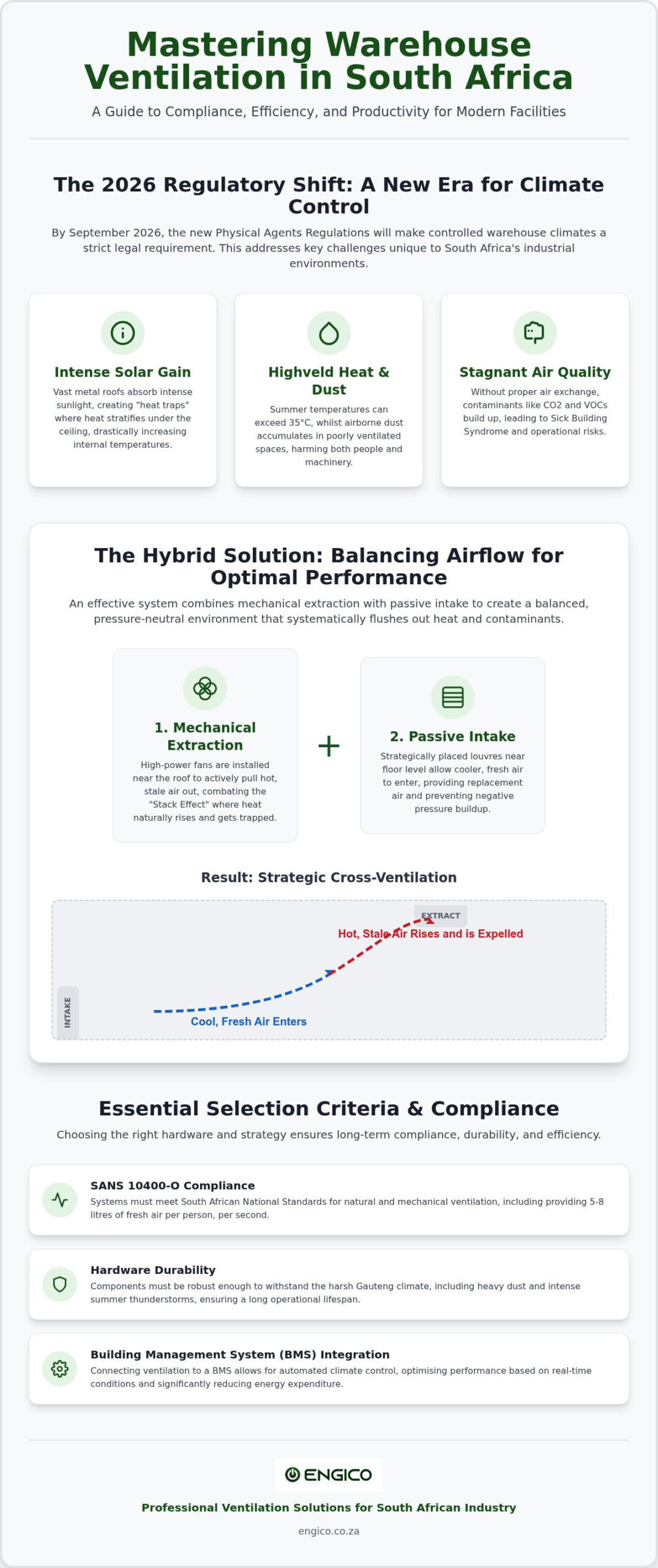
A hybrid approach is often the most effective strategy for South African facilities. By combining high-performance fans with strategically placed louvres, facility managers can achieve a balanced pressure environment that complies with the SANS 10400-O building regulations. This setup ensures that for every cubic metre of air extracted from the roof, a corresponding volume of fresh, cooler air enters at floor level. This methodical flushing of the thermal load is far more effective than relying on fans alone.
Industrial Extraction Fans: Power and Performance
Choosing the right fan mechanism depends on your warehouse’s specific volume and layout. Axial fans are ideal for moving large volumes of air at low pressure, typically mounted directly on walls or roof peaks. If your ventilation requires ducting or must overcome significant resistance, centrifugal fans provide the necessary static pressure to maintain flow. Calculating the required Cubic Feet per Minute (CFM) is vital; this figure is derived from the total floor area and ceiling height to ensure the air changes meet health standards. We recommend using Variable Speed Drives (VSD) on all mechanical units. These allow for precise control over extraction rates, which significantly reduces energy consumption during cooler morning hours or periods of lower activity.
Ventilation Louvres: Passive Control and Protection
Louvres serve as the lungs of the warehouse, providing the necessary path for fresh air to enter. Fixed louvres are a dependable, low-maintenance choice for constant airflow, but adjustable versions offer greater control during Gauteng’s intense afternoon thunderstorms. The material choice is equally critical for longevity. Whilst aluminium offers excellent corrosion resistance, galvanised steel provides the rugged durability needed in heavy industrial zones like Randburg or Silverton. Beyond functionality, modern louvre designs integrate seamlessly into the building’s facade, maintaining a professional aesthetic without compromising on performance. Professional service of industrial fans and louvres ensures these components continue to operate at peak efficiency throughout their service life.
Essential Selection Criteria: Choosing Hardware for the Gauteng Climate
Selecting the right hardware for warehouse ventilation systems South Africa involves more than just matching fan capacity to floor area. In Gauteng’s major industrial hubs like Midrand, Silverton, and Randburg, the local environment presents unique challenges that differ significantly from coastal regions. Facility managers must prioritise equipment that can withstand intense solar radiation and the sudden, high-volume rainfall characteristic of Highveld thunderstorms. Choosing a system that isn’t properly rated for these conditions leads to premature mechanical wear and increased risk of water ingress during the summer months.
Noise levels are an equally important consideration, particularly for warehouses located near commercial office parks or residential boundaries in areas like Sandton. High-capacity extraction fans can generate significant sound pressure, which may lead to compliance issues with municipal noise bylaws. Selecting fans with lower decibel ratings or integrating acoustic silencers helps maintain a professional environment for both your staff and the surrounding community. This methodical approach to hardware selection ensures that your ventilation solution remains a quiet, dependable background asset rather than a source of operational friction.
Energy efficiency should be evaluated by balancing initial capital expenditure (CAPEX) with long-term operational costs. Whilst high-efficiency motors and smart controllers may require a larger upfront investment, the reduction in monthly electricity expenditure often provides a rapid return on investment. In an era of rising energy costs, selecting hardware that delivers maximum airflow for every kilowatt consumed is a hallmark of a well-planned industrial facility.
Material Resilience and Corrosion Resistance
Gauteng’s dry, dusty air creates a specific set of challenges for moving parts. Unlike coastal sites that battle salt spray, inland facilities must guard against the accumulation of fine particulate matter that can unbalance fan blades and seize louvre mechanisms. Industrial pollutants in heavy manufacturing zones can also be surprisingly corrosive, necessitating specialised finishes or the use of high-grade aluminium and galvanised steel. We recommend strict maintenance schedules to prevent mechanical failure in these dusty environments. Regular cleaning of fan impellers and lubrication of pivot points on adjustable louvres ensures the system survives the abrasive nature of the local atmosphere.
Smart Integration and BMS Compatibility
Modern industrial facilities increasingly rely on Building Management Systems (BMS) to automate ventilation based on real-time environmental data. By integrating CO2 and temperature sensors, extraction fans are programmed to trigger only when specific thresholds are exceeded. This ensures that energy isn’t wasted when the warehouse is empty or when natural airflow is sufficient to maintain the desired temperature. Engico Air Conditioning specialises in Building Management System Integration, providing facility managers with remote monitoring and control capabilities. This level of automation transforms a simple fan into a sophisticated, energy-efficient climate control tool that responds dynamically to changing internal conditions.
Strategic Design and Placement for Industrial Ventilation Systems
The performance of warehouse ventilation systems South Africa depends heavily on the strategic placement of hardware to facilitate a continuous path of air. Effective design requires more than just high-capacity fans; it involves a calculated understanding of how air enters, moves through, and exits the building. To achieve maximum throughput, engineers prioritise cross-ventilation by positioning intake louvres on the windward side or at lower levels, whilst extraction fans are situated on the opposite wall or at the highest point of the roof. This configuration ensures that fresh air travels across the entire floor area before it is exhausted.
Deciding between roof-mounted and wall-mounted extraction is a structural consideration that impacts efficiency. Roof-mounted fans are technically superior for removing the hottest air that accumulates at the ceiling peak due to thermal stratification. Wall-mounted units are often preferred for their ease of access during maintenance and their ability to create a direct horizontal air path in narrower facilities. Regardless of the mounting style, calculating the required Air Change Rate is the first step in any design. This involves determining the total volume of the warehouse and multiplying it by the recommended air changes per hour (ACH) for your specific industrial activity, ensuring the system can handle the internal heat and contaminant load.
Airflow Mapping and Dead Zone Prevention
Large storage facilities with high-density racking often suffer from “dead air” zones where circulation stalls. By applying principles of Computational Fluid Dynamics (CFD), designers can predict how air will flow around internal obstructions. Racking acts as a series of baffles that can trap heat if the ventilation is not correctly aligned with the aisles. Positioning louvres near floor level is a deliberate choice to facilitate the natural rising of hot air, creating a consistent vertical draft that pulls fresh air into stagnant corners. If you require a detailed site assessment to identify these zones, you can enquire about industrial ventilation fans and louvres tailored to your facility’s layout.
Designing for Future Scalability
A well-designed system must remain functional even as your business evolves. If you increase inventory density or change the warehouse layout, the airflow requirements will shift. Implementing modular fan installations allows for the system to be expanded without a total overhaul of the existing infrastructure. Oversized louvres provide a significant advantage for future-proofing airflow because they allow for increased intake capacity if additional extraction fans are added at a later date. This methodical approach ensures your initial investment remains relevant as your operational needs grow.
Implementing Professional Ventilation Solutions with Engico Air Conditioning
Engico Air Conditioning provides a comprehensive service that manages every technical aspect of warehouse ventilation systems South Africa from the initial design phase through to final commissioning. We don’t just sell hardware; we act as a methodical specialist that understands the nuances of industrial air movement. This inception to completion philosophy ensures that no detail is overlooked, from the initial airflow mapping to the final integration with your existing infrastructure. Our approach is grounded in professional reliability, ensuring that each configuration of industrial ventilation fans and louvres is tailored to the specific thermal and dust profiles of the Gauteng region.
We specialise in Air Handling Units (AHU) and fan configurations that are built to survive the unique stresses of the South African industrial environment whilst maintaining peak efficiency. These units are often customised to handle the specific air purity requirements of your sector, whether you’re managing a sensitive pharmaceutical store or a high-dust manufacturing plant. Local expertise in major hubs like Pretoria and Johannesburg is a fundamental part of our service. It allows for a rapid response should repairs or adjustments be required, minimising the risk of operational downtime for our clients. This grounded approach avoids the pitfalls of generic, one-size-fits-all solutions that often fail during the peak of the Highveld summer.
The Engico Air Conditioning Installation Process
From conducting a thorough site assessment in Sandton to the final commissioning of a system in Midrand, the Engico Air Conditioning installation process is methodical and disciplined. We ensure that every component, from the fan motors to the louvre blades, meets the latest SANS 10400 compliance standards for safety and performance. This thoroughness ensures that your facility is fully compliant with national regulations from the first day of operation. You’re in a safe pair of hands throughout the project lifecycle, as we prioritise transparency and long-term value over short-term excitement. You can learn more about regional requirements in our Pretoria Warehouse Ventilation Systems Guide.
Long-Term Maintenance and Reliability
Long-term reliability is achieved through preventative maintenance programs that address wear and tear before they become critical failures. The Engico Air Conditioning team manages the professional service and repair of extraction fans and louvre actuators, ensuring that these systems continue to provide a stable, temperature-controlled environment for years. Regular maintenance is the most effective way to avoid costly industrial downtime and preserve the efficiency of your building’s climate control. It’s a conscientious approach that reflects our commitment to professional excellence and environmental responsibility. For detailed insights on protecting your assets, read about our HVAC Maintenance Services for Gauteng Properties.
Securing Your Industrial Environment for 2026 and Beyond
Managing a modern industrial facility requires a disciplined approach to both worker safety and operational efficiency. We’ve explored how a strategic hybrid approach, combining mechanical extraction with passive intake, effectively clears thermal loads and prevents the accumulation of contaminants. By prioritising precise airflow mapping and smart automation, you ensure that your workspace remains productive regardless of the Highveld’s seasonal extremes. This methodical investment in warehouse ventilation systems South Africa not only keeps your facility compliant with SANS 10400 standards but also reduces long-term energy expenditure through high-performance hardware and intelligent control.
Engico Air Conditioning has operated as a specialist HVAC provider for Gauteng industrial hubs since 2022, delivering deep expertise in BMS integration and automated climate control. With dedicated local support across Pretoria, Johannesburg, and Midrand, we provide the technical stability your operation requires. You can Request a Professional Ventilation Site Assessment from Engico Air Conditioning to determine the most efficient configuration for your specific volume and layout. Taking these proactive steps today ensures your warehouse remains a safe, reliable, and high-performing asset for years to come.
Frequently Asked Questions
What are the main benefits of industrial extraction fans and louvres in a warehouse?
Industrial extraction fans and louvres work together to regulate internal temperatures and maintain high air quality by removing stagnant air. These components reduce heat buildup from solar gain and machinery, which directly improves worker productivity and safety. By facilitating a constant exchange of air, they also prevent the accumulation of dust and volatile organic compounds that can damage inventory.
How many air changes per hour does a South African warehouse require?
Most industrial facilities require between 1 and 10 air changes per hour (ACH), depending on the specific activities performed on-site. For general storage, a lower rate may suffice, whilst manufacturing zones with high heat or contaminant output require more frequent exchanges. It is vital to consult SANS 10400 guidelines to ensure your facility provides the minimum fresh air volume of 5 to 8 litres per person per second.
Can I use passive louvres alone for warehouse ventilation in Gauteng?
Passive louvres are rarely sufficient on their own for warehouse ventilation systems South Africa due to the intense thermal loads experienced during Highveld summers. Whilst they provide essential intake points, they lack the force required to displace the large volumes of hot air that accumulate near the ceiling. A hybrid approach that combines passive louvres with mechanical extraction fans is the most reliable way to achieve consistent airflow.
What is the difference between axial and centrifugal extraction fans?
Axial fans move large volumes of air at low pressure and are typically installed directly into walls or roofs for general extraction. Centrifugal fans are designed to handle higher static pressure, making them suitable for systems that require ducting or must overcome significant resistance. Choosing the correct mechanism depends on whether you need a direct horizontal air path or a more complex ducted configuration.
How does a Building Management System (BMS) improve warehouse ventilation efficiency?
A Building Management System (BMS) improves efficiency by automating fan speeds and louvre positions based on real-time data from temperature and CO2 sensors. This ensures that mechanical extraction only operates when necessary, which significantly reduces energy expenditure. Facility managers also benefit from remote monitoring and diagnostic capabilities, allowing for more precise control over the warehouse environment without manual intervention.
What maintenance is required for industrial ventilation systems in dusty environments?
Systems in dusty environments require regular cleaning of fan impellers to prevent imbalances that can lead to motor failure. It is also essential to lubricate the pivot points of adjustable louvres and inspect fan belts for wear and tear. A preventative maintenance schedule ensures that dust buildup doesn’t compromise airflow or lead to costly industrial downtime during peak operational periods.
Do I need to comply with specific SANS regulations for warehouse ventilation?
All industrial buildings must comply with SANS 10400-O, which dictates the requirements for lighting and ventilation in South African structures. These regulations ensure that workspaces have adequate fresh air for occupant health and safety. Additionally, ventilation systems must often integrate with SANS 10400-T fire protection protocols to provide effective smoke extraction in the event of an emergency.
How much does it cost to install a warehouse ventilation system in South Africa?
The cost of installing warehouse ventilation systems South Africa varies significantly based on the floor area, ceiling height, and the complexity of the hardware required. Factors such as the number of extraction fans, the total area of louvre coverage, and the level of BMS integration all influence the final investment. Because each industrial facility has unique thermal profiles and structural requirements, a professional site assessment is necessary to determine an accurate project scope.
Recent Comments