
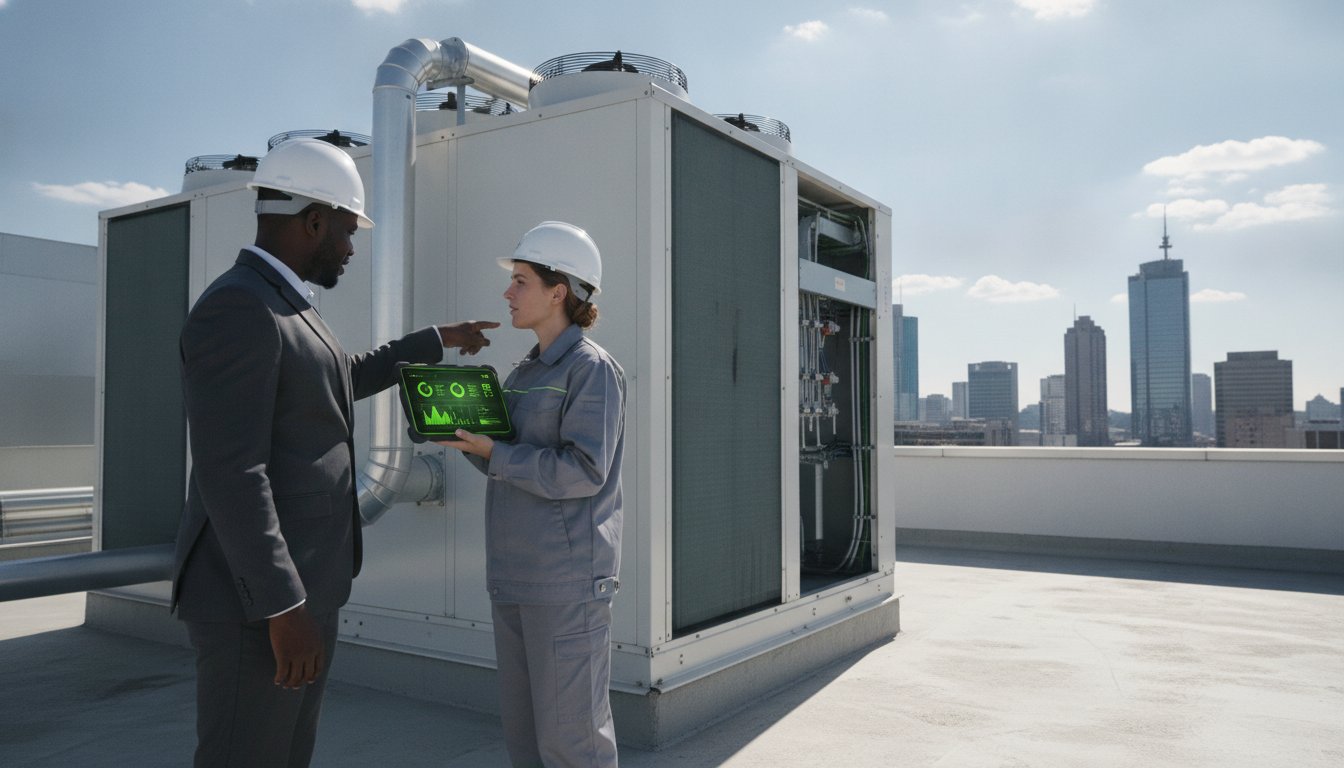
Could your commercial property maintain its margins if electricity costs continue their current upward trajectory? For many facility managers across Gauteng, the struggle to balance occupant comfort with soaring Eskom tariffs has reached a breaking point. Implementing a BMS for HVAC energy savings South Africa is no longer just a forward-thinking choice; it’s becoming a critical requirement for any business looking to stabilise its operational budget. You likely already know that manual adjustments to large-scale air handling units are inefficient, especially when fighting the intense ambient temperatures often found in Johannesburg and Pretoria.
In this article, you’ll discover how integrated building management systems are revolutionising efficiency for local commercial properties. We’ll explore the 2026 trends that are making automated control the standard for lower costs and GBCSA compliance. By understanding how these systems synchronise your air conditioning and ventilation, you can prepare for a more sustainable, high-performance future whilst significantly reducing your building’s carbon footprint.
Key Takeaways
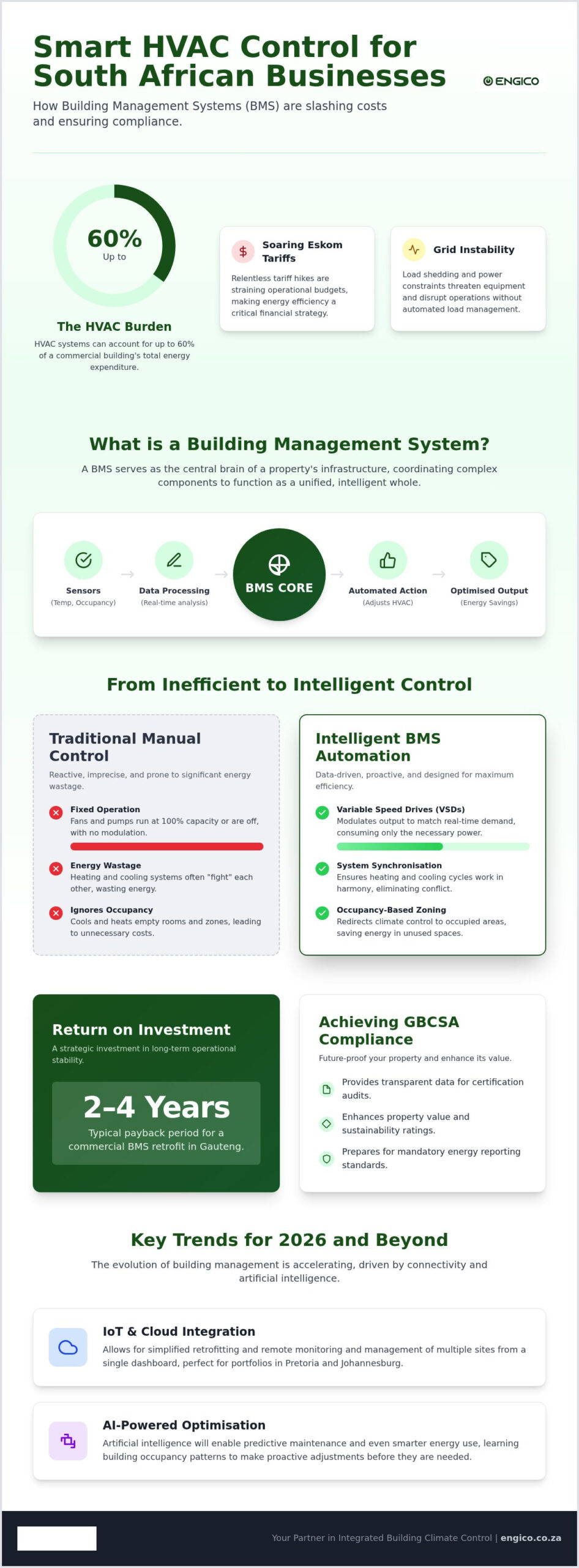
- Understand why HVAC systems account for up to 60% of commercial energy expenditure and how a central management system serves as an essential control hub for your infrastructure.
- Discover how a BMS for HVAC energy savings South Africa enables the transition from inefficient manual controls to precise, real-time monitoring of occupancy and ambient conditions.
- Explore the 2026 shift towards IoT and cloud-based integration, which allows for remote monitoring and simplified retrofitting across multiple sites in Pretoria and Johannesburg.
- Learn how to calculate the return on investment for building automation, including the typical two-to-four-year payback period for modern commercial retrofits.
- Identify the steps required to achieve GBCSA compliance and lower operational costs through a methodical approach to system integration and maintenance.
The Growing Necessity of BMS for HVAC Energy Savings in South Africa
A Building Management System (BMS) serves as the central brain of a property’s infrastructure, coordinating complex mechanical and electrical components to ensure they function as a unified whole. In the South African commercial sector, HVAC systems are typically the largest energy consumers, often accounting for 40% to 60% of total monthly electricity expenditure. As we approach 2026, the urgency to implement a BMS for HVAC energy savings South Africa has intensified. This shift is driven by relentless Eskom tariff hikes and a national push toward “Net Zero” carbon footprints. Automated demand-side management provides a level of energy security that manual operation simply cannot achieve, especially when managing large-scale air handling units in demanding climates.
Rising Electricity Costs and the Green Building Council SA (GBCSA)
Commercial property values in economic hubs like Johannesburg and Pretoria are increasingly tied to sustainability ratings. The Green Building Council South Africa (GBCSA) provides certifications that serve as a benchmark for premium office space and industrial facilities. BMS data provides the transparent, real-time evidence of energy performance that forms the backbone of GBCSA certification audits. By 2026, the transition from voluntary to mandatory energy reporting will likely make these automated systems a baseline requirement for large-scale landlords. A robust Building Management System ensures that every kilowatt is accounted for, allowing businesses to maintain their competitive edge whilst meeting environmental obligations.
Grid Instability: Managing HVAC Loads During Power Constraints
South Africa faces unique challenges regarding grid stability and the constant threat of load shedding. Reliable automation allows facility managers to shed non-essential HVAC loads during peak demand or periods of power constraint without compromising the entire building’s climate. Smart systems can automatically adjust setpoints for air conditioning or cycle industrial ventilation fans to stay within supply limits. It’s a methodical way to protect your infrastructure. This level of control also safeguards expensive equipment from the electrical surges associated with frequent power cycles. Modern systems now play a vital role in integrating HVAC consumption with on-site solar PV systems. By synchronising cooling cycles with peak renewable generation, properties can significantly reduce their reliance on the national grid.
The transition to smart climate control isn’t just about modernising equipment. It’s about creating a resilient environment that can withstand the economic and technical pressures of the current energy crisis. For Gauteng businesses, the move toward automated efficiency is a strategic investment in long-term operational stability.
How Building Management Systems Optimise HVAC Energy Consumption
The transition from manual thermostats to data-driven environmental control represents a fundamental shift in how Gauteng businesses manage their utility costs. Traditional systems often rely on human intervention, which is reactive and imprecise. In contrast, a BMS for HVAC energy savings South Africa utilises real-time monitoring of ambient temperature, humidity, and occupancy levels to make proactive adjustments. This is particularly vital on the Highveld, where the sharp contrast between chilly winter mornings and intense afternoon sun can cause manual systems to oscillate wildly. By processing data from multiple sensors, the system ensures that heating and cooling cycles don’t “fight” against each other, a common cause of energy wastage in large commercial buildings.
Central to this optimisation is the use of Variable Speed Drives (VSDs) on fans and pumps. Instead of operating at 100% capacity or being completely off, VSDs allow the system to modulate output based on actual demand. This methodical approach ensures that air handling units only consume the exact amount of power required to maintain the desired setpoint. It’s a precise way to manage the load that significantly reduces the strain on electrical infrastructure whilst providing a more stable indoor climate for occupants.
Occupancy-Based Climate Control and Zoning
Eliminating energy waste in unoccupied zones is one of the most effective ways to lower operational costs. Whether it’s an empty boardroom or a quiet warehouse wing, a BMS can automatically scale back climate control in these areas. Modern multi split air conditioning systems benefit immensely from this centralised logic, as it allows for granular control over individual indoor units from a single interface. Additionally, integrating CO2 sensors allows the system to adjust fresh air intake based on the number of people in a room, ensuring air quality without overworking ventilation fans during low-occupancy periods.
Predictive Maintenance and System Longevity
A well-integrated system does more than just save electricity; it acts as an early warning system for mechanical issues. By identifying subtle efficiency drops or unusual vibration patterns, the BMS can alert facility managers before a component fails completely. This is where commercial HVAC maintenance Sunninghill becomes truly effective, as technicians can arrive with data-backed insights to resolve specific problems. Extending the lifespan of air handling units through these proactive measures reduces long-term capital expenditure and ensures your property remains a “safe pair of hands” for tenants. If you’re looking to modernise your facility’s infrastructure, exploring BMS integration services is a logical first step toward sustainable building management.
Key 2026 Trends: IoT, Smart Valves, and AI Integration
Building management is entering a phase where connectivity and intelligence define operational success. By 2026, the shift towards cloud-based BMS has become a standard requirement for property portfolios across Johannesburg and Pretoria. These platforms allow facility managers to oversee multiple sites from a single dashboard, providing a comprehensive view of performance without the need for on-site server maintenance. This centralised visibility is a cornerstone of achieving a BMS for HVAC energy savings South Africa, as it enables the rapid identification of inefficiencies across a diverse range of properties.
The adoption of IoT wireless sensors has fundamentally changed the cost-benefit analysis for retrofitting older buildings. Instead of the prohibitive labour costs associated with traditional hard-wired installations, wireless protocols allow for rapid deployment of environmental sensors. In centralised cooling systems, we’re seeing the rise of Smart Energy Valves. These devices automatically balance water flow and maintain the correct temperature differential, preventing the wasted pumping energy that often plagues older chilled water plants. For more complex environments, AI-driven “self-healing” systems are now a reality. These algorithms constantly adjust operating parameters to maintain maximum efficiency, effectively correcting for wear and tear or changing building loads before they impact the bottom line.
The Role of IoT in Modern Building Automation
In the South African industrial context, wireless protocols like Zigbee and LoRaWAN offer the range and reliability needed for vast floorplates. These systems excel at connecting industrial ventilation fans and louvers to a central hub, ensuring that air movement is synchronised with the primary HVAC system. As these networks expand, cybersecurity has become a non-negotiable priority for 2026. Modern integrations must feature robust encryption to protect building data from external threats whilst maintaining seamless internal communication between sensors and controllers.
AI and Machine Learning for Highveld Climate Adaptation
Machine learning is uniquely suited to handle the Highveld’s volatile climate. AI models can now predict cooling requirements by analysing local weather patterns and anticipating Pretoria’s sudden summer temperature spikes. One effective application is the optimisation of night-purge ventilation. By using the BMS to flush buildings with cooler night air whilst the grid is stable, properties can reduce the mechanical cooling load required the following morning. By automating these complex calculations, AI significantly reduces the risk of human error and ensures that efficiency targets are met consistently. It’s a methodical way to ensure that climate control remains precise regardless of external fluctuations.
Calculating ROI and Navigating Implementation in Gauteng
Investing in a BMS for HVAC energy savings South Africa requires a clear understanding of the financial outcomes. The initial capital expenditure is typically divided between hardware acquisition, software licensing, and the technical commissioning process. Whilst the upfront cost can be significant, the return on investment is accelerated by the ongoing escalation of electricity prices. For most commercial offices in Gauteng, the payback period for a comprehensive retrofit settles between two and four years. This timeline makes building automation one of the most viable capital projects for property funds and owner-occupiers alike.
Beyond direct utility savings, property owners should account for “hidden” financial benefits. Precise climate control reduces the frequency of mechanical strain, leading to fewer emergency repair calls and lower annual maintenance costs. There is also a strong correlation between indoor air quality and tenant retention. Happy tenants are less likely to vacate, which stabilises rental income. Additionally, South African businesses can often leverage Section 12L tax incentives. These allowances provide a deduction for every kilowatt-hour of energy saved, provided the improvements are documented and verified by a SANAS-accredited professional.
A Step-by-Step Implementation Framework
Successful implementation begins with a professional energy audit of your existing HVAC equipment. This baseline data allows you to identify which units are underperforming and where the greatest savings can be achieved. When moving to the integration phase, following a professional installation checklist ensures that all sensors and controllers are placed correctly for accurate data collection. Finally, staff training is essential. A management system is only effective if your facility managers can confidently navigate the dashboard and interpret the alerts it generates.
Overcoming Retrofit Challenges in Older Buildings
Modernising an older office block in Johannesburg or Pretoria doesn’t always require a total system replacement. A phased integration approach allows you to start with the most energy-intensive air handling units (AHUs) first. This manages cash flow whilst delivering immediate results. The primary challenge often involves bridging the gap between legacy hardware and modern software protocols. Choosing experienced aircon installers Gauteng who understand the nuances of BMS logic is critical to avoiding compatibility issues. If you’re ready to improve your building’s performance, you can request a technical assessment to determine the most cost-effective path forward for your property.
Partnering with Engico Air Conditioning for Integrated Building Climate Control
Engico Air Conditioning occupies a unique position in the Gauteng market as a specialist that understands both the mechanical intricacies of hardware and the digital complexity of control logic. This dual expertise allows us to deliver a BMS for HVAC energy savings South Africa that is technically sound and operationally reliable. We focus on providing smart HVAC control for commercial buildings that addresses the specific environmental and economic pressures found in our local region. By acting as a single partner for supply, installation, and long-term maintenance, we eliminate the communication gaps that often lead to system inefficiency. You don’t have to manage multiple contractors; instead, you have one point of contact for the entire lifecycle of your building’s climate infrastructure.
Comprehensive HVAC and Ventilation Solutions
Our capabilities extend across the entire spectrum of modern climate control technology. Engico Air Conditioning supplies and installs wall-mounted split air conditioners, multi-split systems, and ceiling cassette units, alongside large-scale ducted systems and air handling units for industrial applications. Our team ensures that industrial ventilation fans and louvers are fully integrated into the building’s management logic to maximise energy efficiency. With a dedicated presence across Johannesburg, Pretoria, and Midrand, we offer the local support necessary for complex commercial projects. It’s a methodical approach that ensures every component, from a single ducted unit to a massive air handling system, contributes to the building’s overall performance targets.
The Engico Air Conditioning Advantage: Reliability and Expertise
Professional reliability is the cornerstone of our approach to every project. We don’t rely on hyperbolic language or aggressive sales tactics; instead, Engico Air Conditioning provides a grounded, solution-oriented service that builds trust through transparency. Positioning ourselves as a “safe pair of hands”, we manage the efficiency journey from the initial audit through to ongoing performance monitoring. This comprehensive service includes the regular maintenance of air conditioners, as well as the technical service and repairs required to keep systems running at peak performance. Our methodical process ensures that your building meets modern GBCSA standards whilst maintaining a disciplined focus on long-term value.
The synergy between our maintenance contracts and BMS monitoring provides a significant advantage for property managers. By having real-time data on system performance, our technicians can identify potential issues before they escalate into costly failures. This proactive stance is particularly valuable in the harsh Gauteng climate, where systems often work under high stress. We understand the technical requirements of various environments, from high-rise office blocks to industrial warehouses. Our goal is to provide a stable, efficient environment that supports your business objectives without unnecessary fuss. If you’re ready to discuss your facility’s requirements, we invite you to contact us for a professional consultation.
Securing Your Property’s Energy Future
Adopting a BMS for HVAC energy savings South Africa has transitioned from a luxury to a fundamental business requirement. By integrating intelligent controls with your existing air handling units and industrial ventilation fans, you can effectively mitigate the impact of rising electricity costs whilst ensuring GBCSA compliance. We’ve explored how IoT sensors and AI-driven logic provide the precision needed to manage complex Gauteng climates without the inefficiencies of manual intervention. It’s a methodical shift that protects both your operational budget and your mechanical infrastructure.
Engico Air Conditioning has been a specialist in Gauteng commercial HVAC since 2022, offering the expertise required for high-performance industrial ventilation and professional maintenance and repair services. Our team provides the quiet confidence and technical reliability needed to manage your transition to a smarter building. Whether you require a new installation or a complex retrofit, we’re here to act as your dependable partner in operational excellence. Optimise your building’s efficiency with Engico Air Conditioning’s BMS integration services today. You can look forward to a more resilient, cost-effective property that is well-prepared for the efficiency standards of 2026 and beyond.
Frequently Asked Questions
How much can a BMS realistically save on HVAC energy costs in South Africa?
Real-world applications typically see energy reductions between 15% and 30% depending on the age and condition of the existing equipment. These savings are achieved by eliminating the overlap between heating and cooling cycles and ensuring that high-capacity air handling units only operate when necessary. For Gauteng businesses, this reduction directly offsets the impact of annual electricity tariff increases and improves overall property margins.
Is it possible to install a BMS on an existing, older HVAC system?
Retrofitting a modern control layer onto legacy hardware is a standard practice for older commercial properties in Johannesburg and Pretoria. Whilst some older mechanical components may require the addition of new sensors or actuators, a BMS for HVAC energy savings South Africa can often be integrated without replacing the entire system. This phased approach allows landlords to improve performance whilst managing capital expenditure effectively.
What is the difference between building automation and a building management system?
Building automation refers to the specific technology and processes that allow mechanical systems to operate without human intervention. A building management system is the overarching platform that integrates these automated functions into a single, centralised interface. Whilst automation handles the individual tasks like fan speed adjustment, the BMS provides the data and visibility needed for facility managers to make informed decisions.
How does a BMS help with load shedding management for commercial buildings?
A BMS allows for the automated shedding of non-essential electrical loads during periods of grid instability or peak demand. By pre-programming specific sequences, the system can cycle ventilation fans or adjust temperature setpoints to stay within a limited power budget. This methodical approach also protects your primary HVAC equipment from the electrical surges often associated with frequent power cycles.
Do I need a full-time operator to manage a BMS dashboard?
Modern systems are designed to operate autonomously and don’t require a dedicated full-time operator to be present. Most platforms feature intuitive dashboards that send automated alerts to facility managers only when a system parameter falls outside of its optimal range. This allows your existing team to oversee the property’s efficiency whilst focusing on other operational priorities.
What are the most important sensors for HVAC energy savings?
Occupancy sensors and CO2 monitors are critical for reducing waste in zones that aren’t consistently in use. These sensors allow the system to scale back climate control in empty boardrooms or adjust fresh air intake based on the actual number of occupants. Precise temperature and humidity sensors provide the baseline data needed to maintain comfort whilst preventing the system from overworking during the Highveld’s temperature spikes.
Are there South African government incentives for installing a BMS?
The Section 12L energy efficiency allowance is the primary incentive available to South African businesses looking to modernise their infrastructure. This tax deduction is calculated based on verified energy savings achieved through efficiency projects, including building automation. To qualify, you must have your energy baseline and subsequent savings documented and verified by an accredited professional to ensure compliance with national standards.
How long does a typical BMS integration take for a Gauteng office block?
A standard integration for a medium-sized office block typically takes between three and six months from the initial audit to final commissioning. This timeline includes the installation of hardware, software configuration, and the necessary staff training. Choosing local specialists for a BMS for HVAC energy savings South Africa ensures that the project moves at a methodical pace without disrupting daily business operations.
Recent Comments