

The best commercial HVAC company in Sandton is the provider that can match its installation and service work to your building’s requirements, with clear work scopes, experienced technicians and a service contract suited to the system. A low quote alone won’t show whether the proposed work supports reliable, long-term climate control.
Choosing a commercial HVAC provider is an operational decision. System design, installation quality and ongoing maintenance all affect how well the equipment serves your premises. The right fit depends on your building, how it is used and the support you need.
This guide explains how to assess Sandton providers by their installation and maintenance services, technical experience, work scopes and service arrangements. You’ll also see what can affect project costs and how to take the next step for your commercial HVAC requirements.
Key Takeaways
- Match the air-conditioning system to the building’s layout, use and cooling requirements before comparing proposals.
- Assess reliability through clear communication, consistent maintenance planning and a defined approach to service requests.
- Look for technicians whose experience fits the equipment and the demands of the premises.
- Review work scopes and service contracts carefully so you understand what maintenance and repairs they cover.
- Compare Sandton providers by the systems and support they offer, then choose a solution aligned with your property’s needs.
Commercial and residential air-conditioning installation
Installation planning starts with the building, its occupants and the spaces that need temperature control. Equipment selection and a well-defined scope help shape the outcome.
Air-conditioning installation
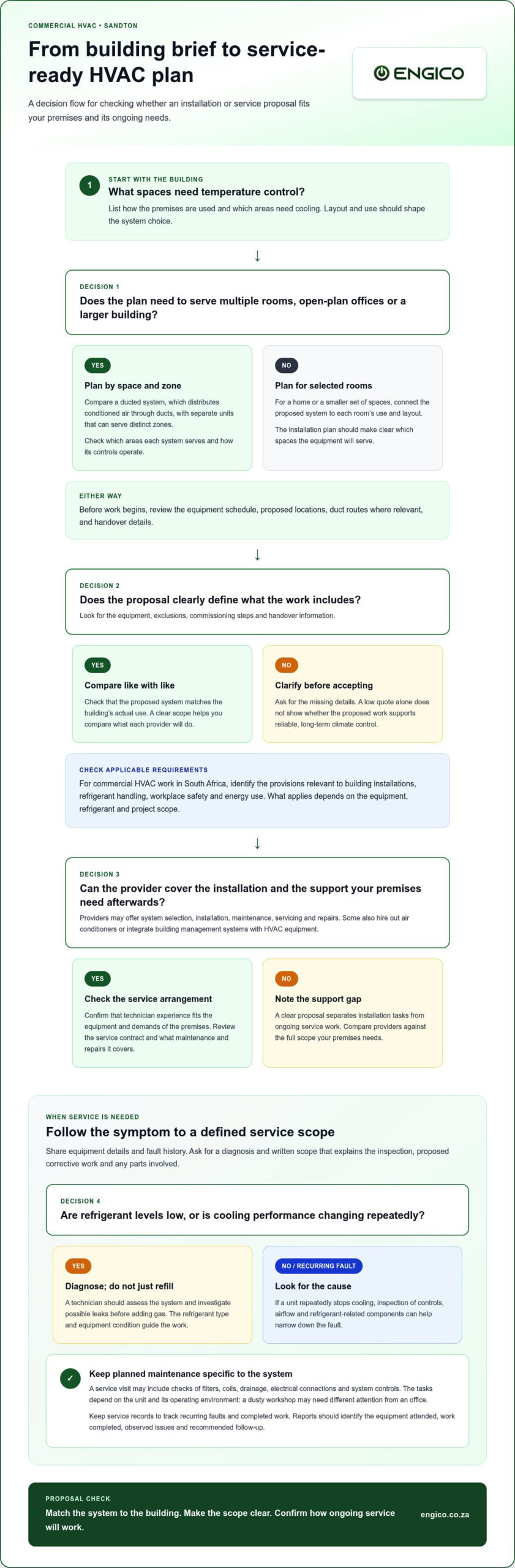
Commercial installations may need to serve multiple rooms, open-plan offices or a larger building, while a home may need cooling in selected rooms. The plan should connect each space’s use and layout to the proposed system. For example, a ducted system distributes conditioned air through ducts, while separate units can serve distinct zones. Before work begins, review the equipment schedule, proposed locations, duct routes and handover details.
For commercial HVAC work in South Africa, consider requirements that apply to building installations, refrigerant handling, workplace safety and energy use. The relevant provisions depend on the equipment, refrigerant and project scope, so identify applicable obligations during design and before installation begins.
Sandton HVAC service providers
Commercial HVAC companies serving Sandton may offer system selection, installation, maintenance, servicing and repairs. Some also hire out air conditioners or integrate building management systems with HVAC equipment. Compare providers by whether they can cover the work your premises needs, such as installing a ducted system and maintaining it after handover. A clear proposal separates installation tasks from ongoing service work.
Low refrigerant levels call for a diagnosis, not just a refill. A technician should assess the system and investigate possible leaks before adding gas. The refrigerant type and equipment condition guide the work. Describe symptoms such as weak cooling or recurring performance changes, then ask for a service scope that explains the inspection and corrective steps.
Planned maintenance can help identify issues before they disrupt normal operation. A service visit may include checking filters, coils, drainage, electrical connections and system controls. The tasks needed depend on the unit and its operating environment: a dusty workshop, for example, may need different attention from an office. Keep service records to track recurring faults and completed work.
Repairs should address the cause of a fault, not just its visible effect. If a unit repeatedly stops cooling, a technician can inspect the controls, airflow and refrigerant-related components to narrow down the cause. Share the equipment details and fault history when arranging service. A written repair scope clarifies the diagnosis, proposed work and any parts involved.
Before accepting an installation or service proposal, compare the equipment, exclusions, commissioning steps and handover information. For a Sandton office with several zones, check that the plan identifies which areas each system serves and how the controls operate. These details make proposals easier to compare and help align the work with the building’s actual use.
Customer service and reliability
Reliable HVAC support is evident in how a provider manages routine requests, planned work and changing site needs. Start by noting how clearly your requirements are recorded. For example, a Sandton office may have meeting rooms that need cooling before staff arrive. A useful response confirms the affected areas, access arrangements and next steps, rather than offering a vague assurance.
Communication should make the work clear to the person responsible for the building. Look for updates on job status, changes to the proposed scope and what happens after a technician’s visit. If a fault returns in the same area, records of earlier findings help the service team recognise the pattern. This avoids repeated explanations and supports informed decisions.
Reliability also depends on planning around the premises. A retail space, office and server room have different operating requirements, so service arrangements should reflect access, occupancy and sensitive equipment. Agree how the site contact will be notified before a visit and which areas need attention first. A practical process helps facilities teams coordinate access without disrupting normal operations.
Review how service requests are handled from the first report to close-out. An organised process records the reported symptom, assigns the next action and documents the outcome. When reporting a warm office, include the room, when the issue occurs and any recent changes in use. These details give the technician a more useful starting point than a general complaint about poor cooling.
Maintenance records are another useful measure. Check that each service report identifies the equipment attended, work completed, observed issues and recommended follow-up. For a building with several air-conditioning units, consistent records help a facilities manager distinguish a new fault from a recurring one. They also support clearer discussions about priorities and planned expenditure, without relying on memory or informal handovers.
Ask how the provider communicates when a repair requires additional work. A clear explanation describes the issue observed, the proposed action and any effect on the agreed scope. If an inspection reveals a component fault, for example, the site contact needs to understand what is affected and what decision is needed. This keeps approvals and building operations aligned.
Before selecting a provider, compare the quality of its communication as well as its technical proposal. Keep a simple record of response details, visit reports and follow-up actions for each site. If you’re planning ongoing support for a Sandton property, review the available air-conditioning service information as one practical next step.
Technician experience
Compare Sandton HVAC contractors by their relevant project experience, technician credentials and detailed customer feedback. A provider experienced with office systems may suit a multi-zone commercial site better than one whose examples focus on single-room installations.
Ask for examples involving buildings and equipment similar to yours. A hotel, retail centre and office have different operating patterns, access needs and priorities. Look for experience diagnosing similar faults, working in occupied spaces and documenting completed work. A useful project example describes the system, the work performed and how handover was managed.
Technician experience should be evident in the diagnostic process. For a unit that repeatedly loses cooling, an experienced technician records the symptoms, inspects relevant components and explains the findings. The repair proposal should link the diagnosis to the recommended action. Clear reasoning helps facilities staff distinguish a considered solution from a parts list without context.
Check whether credentials match the proposed work. For South African commercial projects, assess relevant trade qualifications, task-specific authorisations for refrigerant handling and documented site-safety procedures. Customer reviews can add context: focus on specific comments about communication, diagnosis and follow-up rather than treating star ratings alone as proof.
Look for recurring, detailed themes in feedback. Several accounts describing clear explanations and complete service records offer more context than brief praise without an example. Consider the review date and service type, too. A comment about a home installation may say little about a contractor’s experience with a commercial plant room.
Before work begins, ask who will lead the technical assessment and who will complete each task. A defined team clarifies responsibility when a project involves controls, multiple units or restricted site access. Request the technicians’ names or roles in the work plan, along with the sequence for inspection, installation or repair. This connects experience to the actual scope.
Safety practices are visible in preparation and conduct. A site visit should account for access routes, occupied areas, equipment isolation procedures and protection of nearby workspaces. For example, a technician working above a suspended ceiling needs a safe access plan and a way to protect office furnishings. Site-specific planning matters more than generic safety claims.
Use a simple comparison record for each proposal: relevant project examples, credentials, named technical responsibilities, review themes and safety documentation. Note unanswered technical questions separately. This makes it easier to compare equivalent proposals and assess whether the team’s experience fits your building’s HVAC equipment and operating conditions.
Compare contractors by how closely their documented projects match your building and equipment, whether their technicians’ credentials suit the proposed work, and whether detailed reviews consistently mention clear communication, sound diagnosis and follow-up. Commercial project examples and feedback about similar service work are more useful than general praise or reviews of home installations.
Check for relevant trade qualifications, task-specific authorisations for refrigerant handling and documented site-safety procedures suited to the work. Safety planning should address access routes, occupied areas, equipment isolation and protection of nearby workspaces.
Work scopes and service contracts
A detailed scope makes HVAC proposals easier to compare and helps align site work with operational needs. Review installation, maintenance and repair responsibilities separately.
Installation, maintenance and repair specialisms
In Sandton, look for providers whose documented work covers the specific tasks your premises need. Some focus on installation, while others also handle scheduled maintenance and fault repairs. For a building with existing equipment, prioritise relevant service and repair experience. For a new fit-out, compare installation planning, commissioning and handover details, as well as ongoing support.
Compare each proposal against the same equipment list and site requirements. Note whether the scope covers inspection, labour, parts, controls and reporting. A quote that groups several tasks under one broad label can obscure what the provider will actually do. Request separate descriptions for each work stage, including exclusions and the process for approving additional work.
Service contracts
A commercial HVAC service contract sets out planned visits, included maintenance tasks, reporting and how repair requests are handled. Its value depends on how well those terms match the equipment and building use. A busy retail site, for example, may need a different service plan from a small office. Read the contract for exclusions, parts treatment, response arrangements and renewal terms.
Check whether the agreement identifies covered equipment by location or asset reference. It should also explain how completed work and recommended follow-ups are recorded. These details help facilities teams track coverage across a building and avoid confusion when systems or site contacts change. Compare the included tasks with the maintenance schedule proposed for your equipment.
To get and compare commercial HVAC quotes in Sandton, give each provider the same equipment details, site access requirements and description of the work. Compare the scopes line by line, including exclusions, maintenance tasks and repair procedures. Costs depend on the equipment, work scope, site access and parts required, so request a quote based on your project.
Which Sandton HVAC providers specialise in installation, maintenance and repairs? Shortlist providers whose proposals explicitly cover the work you need, rather than relying on a general HVAC label. Compare their installation, planned-maintenance and repair scopes against your building’s requirements.
Before agreeing to a contract, identify who can approve extra work and how findings will be reported. For example, the site manager may need to approve in writing any repair work beyond a planned maintenance visit. Clear approval steps help control scope changes and preserve an auditable facilities-management record.
Keep a comparison sheet for each quote. Record covered systems, visit tasks, exclusions, reporting, renewal terms and repair arrangements. This gives decision-makers a consistent basis for reviewing proposals and shows whether a lower-priced scope omits work your building needs.
Which commercial HVAC companies serve Sandton, Johannesburg?
Choosing the best commercial HVAC company in Sandton starts with matching its services to your site requirements. Compare providers by the work they cover, experience with similar buildings and the clarity of their proposals. An office tower with several occupied floors, for example, needs a different service plan from a small retail unit.
Providers may focus on installation, planned maintenance, repairs or a combination. For a new fit-out, compare design coordination, installation scope and commissioning. For an occupied building with existing equipment, examine maintenance and fault-diagnosis capabilities. A provider’s suitability depends on the work required, not simply its general HVAC description.
Service coverage matters in practical terms. Ask each prospective provider to include your Sandton site address in its proposal and explain how access, equipment locations and operating hours affect the work plan. A property with a loading dock or restricted plant-room access may need specific arrangements. These details help distinguish a site-specific proposal from a generic quotation.
- Installation: Compare the proposed system, equipment locations, commissioning and handover documents.
- Maintenance: Review planned tasks, equipment covered and the records supplied after visits.
- Repairs: Check how diagnosis, recommended work, approvals and close-out reporting are described.
- Controls: For sites using building controls, identify how HVAC integration appears in the work scope.
Use the same brief when requesting proposals. Include the building type, areas requiring heating or cooling, known equipment details, access arrangements and work required. Keep a repair proposal separate from a maintenance agreement when comparing options. This makes omissions and differences easier to identify, without assuming similarly worded offers cover the same tasks.
Shortlist providers using evidence relevant to your property. Look for project examples involving comparable equipment or building use, clear descriptions of responsibilities and service records that explain completed work. Customer feedback adds context when it describes a specific installation or maintenance experience. Consider each comment’s detail and relevance, rather than relying on a rating alone.
For businesses deciding which is the best commercial HVAC company in Sandton, the written proposal should clearly state responsibilities and site requirements. Confirm that it names the Sandton site, identifies covered systems and explains how changes to the work are handled. Keep the proposal and service records together for future facilities reviews.
To discuss your commercial HVAC requirements, contact the HVAC team.
Engico Air Conditioning: Wall-mounted Split Air Conditioners
Engico Air Conditioning can help match an air-conditioning system to your building’s layout and cooling requirements. Wall-mounted split air conditioners can suit individual rooms, while multi-split systems serve multiple indoor spaces. Ceiling cassette units and ducted air-conditioning systems offer other options for commercial layouts.
For a Sandton office, consider how rooms are used, where equipment can be positioned and whether separate areas need independent control. Assessing these details helps guide system selection. Engico Air Conditioning also provides air-conditioner maintenance, servicing and repairs to support ongoing system care after installation.
Contact Engico Air Conditioning to discuss your requirements or visit engico.co.za.
Plan the next step for your Sandton premises
Choosing the best commercial HVAC company in Sandton means connecting your building’s needs with a practical system plan. Before starting a project, identify which areas need cooling, how the premises are used, and whether you’re planning a new installation or reviewing existing equipment. These details give the conversation a clear starting point.
Engico Air Conditioning offers wall-mounted split, multi-split and ceiling cassette air conditioners. The right configuration depends on the building layout and the spaces to be served. A focused discussion can help you consider suitable options for your premises while keeping operational requirements in view.
Prepare a brief with your site details, the areas involved and your project priorities. Then take the next step and contact Engico Air Conditioning to discuss your air-conditioning requirements. A clear starting brief makes it easier to move forward with confidence.
Frequently Asked Questions
Do Sandton commercial HVAC companies offer emergency call-outs and service-level agreements?
Some Sandton contractors offer emergency call-outs or service-level agreements, but the agreement should define its coverage. Check operating hours, qualifying faults, escalation steps, exclusions and whether parts are included. Engico Air Conditioning provides air-conditioner servicing and repairs, but not 24/7 emergency repair. For a Sandton site, record the agreed contact route and fault-reporting details in the contract so staff know how to raise a request.
What should businesses check before choosing a commercial HVAC contractor in Sandton?
Match the written proposal to your building’s equipment register and operational needs. Check who handles each task, which areas are included, how changes are approved and what records you’ll receive. For example, a Sandton office with tenant-controlled rooms needs clear responsibilities for access and reporting. Review relevant project examples, technician credentials and site-safety arrangements, then compare proposals using the same assumptions rather than headline price alone.
How do the top commercial HVAC companies in Sandton compare by experience, certifications, and customer reviews?
Compare providers’ examples of similar commercial buildings and equipment, and check that their trade qualifications, refrigerant-handling authorisations and site-safety procedures suit the proposed work. Look for recurring, detailed customer feedback about communication, diagnosis and follow-up. Star ratings alone are not proof.
Recent Comments