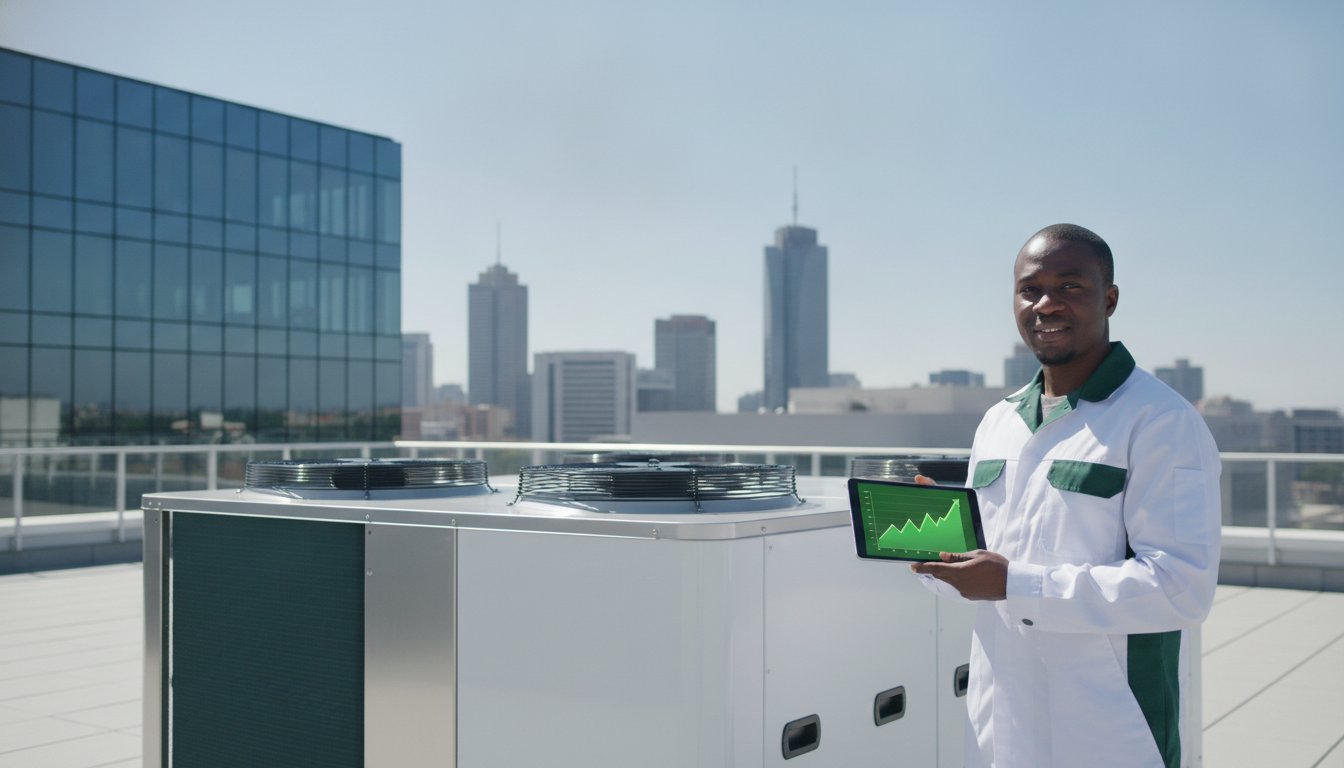
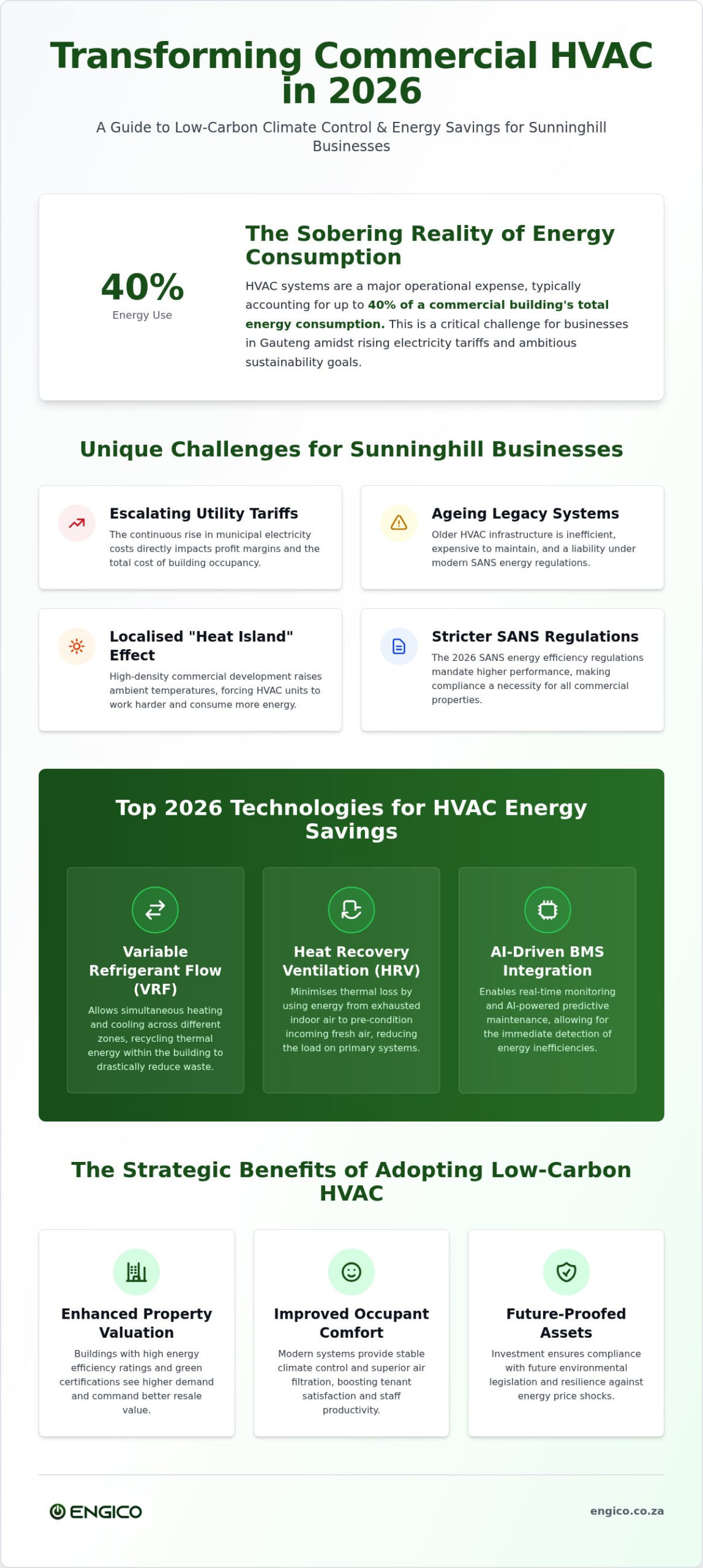
Did you know that HVAC systems typically account for up to 40% of a commercial building’s total energy consumption? For many property managers and owners in Gauteng, this statistic is particularly sobering whilst electricity tariffs continue their upward trajectory and legacy cooling systems become increasingly expensive to maintain. You are likely facing significant pressure to reduce monthly utility bills while simultaneously striving to meet ambitious corporate sustainability goals for your facilities.
This article demonstrates how prioritising commercial HVAC energy savings Sunninghill through modern low carbon climate control systems is transforming energy efficiency for local businesses in 2026. By moving beyond simple repairs and embracing intelligent system integration, you can secure a more reliable and cost-effective environment for your occupants. We will examine the critical shift towards heat pump technology, the role of AI-powered predictive maintenance, and how advanced Building Management System (BMS) integration creates a future-proofed asset with improved indoor air quality.
Key Takeaways
- Understand why low carbon climate control systems are becoming the standard for Sunninghill business parks to meet evolving sustainability goals.
- Explore how modern technologies like Variable Refrigerant Flow (VRF) systems provide precision cooling while significantly lowering operational costs.
- Learn to evaluate the true value of upgrades through a comprehensive analysis of commercial HVAC energy savings Sunninghill and total cost of ownership.
- Discover how AI-driven Building Management Systems (BMS) allow for real-time monitoring and the immediate detection of energy inefficiencies.
- Gain insights into the methodical process of upgrading legacy systems to future-proof your commercial property against rising utility tariffs.
The Shift to Low Carbon Climate Control Systems in Sunninghill
In 2026, the definition of a low carbon climate control system has evolved beyond simple electricity reduction. It now encompasses a holistic approach to Heating, ventilation, and air conditioning (HVAC) that prioritises minimal carbon output through heat recovery, electrification, and the use of sustainable refrigerants. For businesses in Sunninghill, this shift is driven by a combination of environmental responsibility and the urgent need for operational cost control. Achieving commercial HVAC energy savings Sunninghill is no longer just a sustainability goal; it’s a financial necessity in a volatile energy market.
Sunninghill business parks are currently at the forefront of this transition within Gauteng. This is largely due to the concentration of corporate headquarters and multi-tenant offices that must align with modern South African energy standards. The 2026 SANS energy efficiency regulations for commercial buildings now mandate stricter performance metrics, making legacy systems a liability. Compliance requires a methodical update of infrastructure to ensure that cooling and ventilation processes don’t waste precious resources. By integrating low carbon systems, property owners can significantly lower their carbon footprint whilst protecting their bottom line from rising municipal tariffs.
Why Sunninghill Businesses Face Unique Cooling Challenges
The high density of commercial developments in Sunninghill creates a localised heat island effect. This phenomenon keeps ambient temperatures higher than in surrounding areas, forcing HVAC units to work harder to maintain indoor comfort. Additionally, the specific climate patterns of the Sandton area, characterised by intense summer heat and significant daily temperature fluctuations, put immense pressure on older cooling infrastructure. For local SMEs, the primary pain point remains the escalating cost of municipal electricity. When systems aren’t optimised, these rising tariffs can quickly erode profit margins and increase the total cost of building occupancy.
The Core Benefits of Low Carbon Adoption
Adopting low carbon systems provides a clear path to reducing Scope 2 emissions, which is essential for transparent corporate reporting and meeting international ESG standards. It’s a strategic move that helps businesses meet their sustainability targets whilst securing long-term value. Key benefits include:
- Enhanced Property Valuation: Buildings with high energy efficiency ratings and green certifications often see higher demand and better resale value amongst institutional investors.
- Improved Occupant Comfort: Modern systems provide more stable climate control and better air filtration, which has a direct correlation with tenant satisfaction and staff productivity.
- Future-Proofed Assets: Investing in low carbon technology ensures that a building remains compliant with future environmental legislation and is less affected by energy price shocks.
By moving towards these advanced solutions, property managers can ensure their facilities remain reliable and cost-effective. It’s a transition that requires technical expertise but offers a significant return on investment through reduced maintenance needs and lower monthly utility spends.
Top 2026 Technologies for Commercial HVAC Energy Savings
Selecting the right hardware is a fundamental step in achieving long-term sustainability for your property. In 2026, the market for energy-efficient commercial HVAC equipment has shifted towards systems that offer granular control rather than just raw power. Variable Refrigerant Flow (VRF) systems have become the preferred choice for multi-tenant offices in Sunninghill because they allow for simultaneous heating and cooling across different zones. VRF systems reduce waste by redirecting heat from areas requiring cooling to those needing warmth, effectively recycling thermal energy within the building. This level of precision ensures that energy is only consumed where it is strictly necessary, significantly contributing to commercial HVAC energy savings Sunninghill.
Beyond VRF, Heat Recovery Ventilation (HRV) plays a critical role in minimising thermal loss. These systems capture the energy from exhausted indoor air to pre-condition incoming fresh air, reducing the load on the primary cooling coils. When paired with high-efficiency Air Handling Units (AHUs) that utilise smart sensors, the entire climate network becomes responsive to real-time occupancy levels. This transition is further supported by the 2026 HFC phase-down, which restricts high-GWP refrigerants and mandates the use of more sustainable alternatives in all new commercial installations.
Variable Speed Drives and Inverter Technology
Traditional HVAC systems often struggle with energy spikes during peak Sunninghill afternoons when the cooling demand is at its highest. Inverter technology addresses this by allowing compressors to modulate their speed based on the actual load rather than simply switching on and off. This constant, adjusted operation prevents the massive power draws associated with start-up cycles. Retrofitting older systems with modern Variable Speed Drives can reduce energy consumption by up to 30% in typical commercial applications, providing a stable and reliable cooling profile throughout the day.
Advanced Air Handling and Ventilation
Effective air movement is just as important as cooling. Modern industrial ventilation fans now work in tandem with smart control logic to adjust airflow based on CO2 levels and temperature gradients. In many Sunninghill buildings, the installation of high-performance louvres assists in passive temperature management by reducing solar gain before it impacts the interior. For those managing larger facilities, our centralised HVAC for industrial projects guide offers deeper insights into scaling these technologies. If you are considering a system audit, you can consult with our specialists to discuss a tailored efficiency plan for your building.
Cost vs. Value: The ROI of Energy-Efficient HVAC Upgrades
Property owners often hesitate at the initial capital expenditure required for a comprehensive system overhaul. However, evaluating commercial HVAC energy savings Sunninghill requires a shift in perspective from the purchase price to the Total Cost of Ownership (TCO). This metric provides a more accurate financial picture by accounting for installation, energy consumption, and maintenance expenses over the system’s entire service life. When viewed through this lens, the “high upfront cost” of low carbon technology often reveals itself as a strategic investment that pays for itself through reduced monthly outgoings.
Over a typical 10-year cycle, the operational costs of a legacy system can be staggering. Inefficient units consume more power to achieve the same cooling effect and require more frequent technical intervention. Modern low carbon systems are engineered with high-quality components that reduce the frequency of emergency repairs, which are often the most expensive part of property management. By choosing a system with a proven reliability record, you protect your building from the hidden costs of downtime and tenant dissatisfaction.
Analysing Payback Periods for Sunninghill Offices
The timeframe to recoup an investment in high-efficiency cooling is directly linked to local utility rates. As electricity tariffs in Gauteng continue to rise, the payback period for a full retrofit in Sunninghill has shortened significantly. Staying with an obsolete system is often more expensive than upgrading when you factor in the escalating costs of electricity and the scarcity of parts for older units. Legacy systems using R22 refrigerant are particularly problematic, as the phase-out of these substances makes regular servicing increasingly costly and difficult to manage. A well-considered energy efficient HVAC design that accounts for the building’s specific thermal envelope can dramatically accelerate this payback period by ensuring every component is optimised from the outset.
Lifespan Extension through Modern Technology
Low carbon systems generally experience less mechanical wear and tear because they don’t operate at maximum capacity 100% of the time. Modern commercial units utilise modular components, which allows for targeted repairs rather than the expensive replacement of entire assemblies. This design philosophy ensures that the system remains serviceable for a longer duration. By maintaining balanced loads and preventing short-cycling, modern inverter systems extend compressor life by several years compared to fixed-speed alternatives. This added longevity ensures that your building asset remains future-proofed and continues to deliver value long after the initial investment has been recovered.
Ultimately, the transition to energy-efficient infrastructure is about risk management. It’s about moving away from the unpredictability of failing legacy equipment and towards a stable, methodical approach to climate control. This strategy not only lowers your utility bills but also enhances the overall marketability of your commercial property in a competitive Sunninghill landscape.
Implementing Smart HVAC Control for Commercial Buildings
Modern climate control has moved past the era of manual adjustments and basic programmable thermostats. In 2026, the industry standard for achieving commercial HVAC energy savings Sunninghill centres on the deployment of AI-driven Building Management Systems (BMS). These platforms provide a centralised interface that integrates cooling and ventilation with other essential building services like lighting and security. By analysing vast amounts of operational data, a smart BMS can identify energy leaks in real time, such as a sticking damper or a sensor that has drifted out of calibration. This proactive approach ensures that minor technical issues don’t escalate into significant utility expenses.
Automation is another critical component of modern efficiency. Smart systems now use occupancy sensors and historical data to predict when specific office zones require cooling. Rather than maintaining a uniform temperature across an entire floor, the system focuses resources on occupied meeting rooms whilst reducing output in empty corridors or storage areas. This granular level of control significantly reduces unnecessary run-time and aligns energy consumption with actual business activity. By integrating these services, property managers can achieve a holistic view of building performance that was previously impossible with isolated units.
The Power of BMS Integration
Engico Air Conditioning specialises in the methodical integration of these systems to ensure that your building operates at its peak potential. We organise complex BMS data into actionable insights, allowing property managers to optimise daily cooling cycles based on real-time environmental conditions. Remote monitoring capabilities mean that our technicians can often identify and diagnose faults before they impact occupant comfort or waste energy. For a deeper look at these technologies, read our smart HVAC control for commercial buildings guide.
Preventive Maintenance as an Efficiency Strategy
Technology alone is not enough; a system must be physically well-maintained to remain efficient. Technical assessments often show that a clean, well-calibrated system consumes up to 15% less energy than one neglected by its owners. Regular duct inspections ensure that airflow is not restricted by debris, whilst routine refrigerant checks prevent the compressor from overworking due to low pressure. Maintaining a strict service schedule is a fundamental part of securing commercial HVAC energy savings Sunninghill over the long term. You can find more details in our commercial HVAC maintenance Sunninghill resource.
If you want to modernise your building’s infrastructure and reduce operational waste, contact Engico Air Conditioning for a professional BMS integration audit today.
Partnering with Engico Air Conditioning for Sustainable Climate Solutions
Engico Air Conditioning approaches every commercial project with the weight of experience and technical precision. We understand that upgrading a facility in Sunninghill is not merely about swapping units; it’s about a disciplined design process that aligns with the 2026 SANS energy efficiency regulations whilst ensuring that long-term value remains the primary objective. Our team acts as a dependable partner for property owners, managing the technical complexities of low carbon system integration whilst ensuring that every project is delivered with quiet confidence. By focusing on commercial HVAC energy savings Sunninghill, we help businesses move beyond the inefficiencies of legacy equipment toward a future-proofed building asset.
Our role as a “safe pair of hands” in the Gauteng commercial sector means we take full responsibility for the technical performance of your climate control. We don’t rely on aggressive sales tactics; instead, we build trust through transparency and a solution-oriented approach. Every consultation begins with a methodical assessment of your current infrastructure, identifying where energy is being lost and how modern standards can be applied to restore efficiency. This conscientious provider mindset ensures that the broader impact of our work—both environmental and financial—is always prioritised for our clients.
Turnkey Project Management in Sunninghill
Sunninghill’s corporate landscape requires a specialist who understands the nuances of high-density business parks and the specific thermal loads they generate. Engico Air Conditioning manages the entire lifecycle of a retrofit, from the initial consultation to the final commissioning of ducted air conditioning systems or industrial ventilation fans. This turnkey approach minimises disruption to your tenants and ensures that the transition to modern standards is conducted without fuss. Our experience with Sunninghill’s specific commercial infrastructure allows us to navigate complex installations with precision. For a comprehensive overview of our methodology, explore our guide on commercial HVAC system design Gauteng.
Secure Your Business’s Energy Future
Achieving commercial HVAC energy savings Sunninghill starts with professional installation and a commitment to meticulous maintenance standards. Whether you require a permanent upgrade to your building’s air handling units or seek a multi-split configuration for a smaller office block, our methodical process ensures that every component is optimised for the Gauteng climate. We provide ongoing support through custom maintenance programs that prevent the gradual decline in efficiency often seen in neglected systems. We encourage property managers to request a thorough energy efficiency audit to identify specific opportunities for carbon reduction. By partnering with a conscientious provider, you ensure that your climate control infrastructure is durable, compliant, and ready for the future. Contact Engico Air Conditioning for a professional HVAC consultation today to begin your building’s transition to sustainable efficiency.
Future-Proofing Your Commercial Infrastructure for 2026 and Beyond
The transition to low carbon systems represents a fundamental shift in how Gauteng businesses manage their operational environment. By moving away from legacy equipment and embracing the precision technologies discussed, property owners can achieve sustainable commercial HVAC energy savings Sunninghill whilst meeting modern regulatory standards. We’ve explored how intelligent automation and data-driven monitoring through Building Management System (BMS) integration transform climate control from a fixed overhead into an optimised, future-proofed asset.
Securing these benefits requires a partner with specific expertise in Gauteng’s commercial infrastructure. Engico Air Conditioning provides the technical reliability needed to manage complex retrofits and ongoing maintenance with methodical precision. As specialists in BMS integration, we focus on delivering long-term value through comprehensive maintenance plans that protect your equipment and your bottom line. Investing in high-efficiency infrastructure today ensures your facility remains competitive and cost-effective in an increasingly demanding energy landscape.
Optimise your building’s efficiency with Engico Air Conditioning’s commercial HVAC solutions to ensure your property is prepared for the future of sustainable climate control. Taking these steps now provides the stability your business needs to thrive.
Frequently Asked Questions
How much can a Sunninghill business save by upgrading to a low carbon HVAC system?
Upgrading to a low carbon system can reduce energy consumption by 30% to 50% compared to legacy infrastructure. These savings are primarily achieved through inverter technology and heat recovery, which significantly lower the cooling load. Actual reductions depend on building occupancy patterns and the specific efficiency of the existing unit being replaced.
What are the most energy-efficient HVAC systems for large offices in 2026?
Variable Refrigerant Flow (VRF) systems and high-efficiency Air Handling Units (AHUs) with smart sensors are the leading choices for large-scale offices. VRF technology allows for precise zone control, ensuring that energy is only used to cool occupied areas. Integrating these systems with Heat Recovery Ventilation (HRV) further minimises thermal loss during fresh air exchanges.
Is it better to repair an old commercial AC unit or replace it with a low-carbon model?
Replacing an old unit is typically the better long-term financial decision if the equipment is over 12 years old or uses obsolete refrigerants. Modern low-carbon models offer superior reliability and significantly lower operational costs. Whilst repairs might seem cheaper initially, they don’t address underlying inefficiency or the risk of frequent future breakdowns.
How does a Building Management System (BMS) improve HVAC energy savings?
A BMS improves commercial HVAC energy savings Sunninghill by providing real-time data monitoring and automated control over climate zones. It identifies inefficiencies, such as equipment running in empty rooms, and adjusts output based on actual occupancy. This centralised oversight prevents energy waste and ensures all building services work in a coordinated, efficient manner.
Are there specific South African regulations for commercial HVAC energy efficiency?
South African commercial properties must comply with the 2026 SANS energy efficiency regulations for building infrastructure. These standards mandate specific performance metrics for cooling and ventilation systems in new builds and major retrofits. Compliance ensures that buildings meet national sustainability targets and maintain a high standard of environmental responsibility.
How often should commercial HVAC systems in Sunninghill be serviced for maximum efficiency?
Commercial systems should be professionally serviced at least twice a year to maintain peak efficiency. Regular maintenance prevents the build-up of debris and identifies minor technical issues before they impact energy consumption. High-density areas like Sunninghill may require more frequent filter changes due to localised dust and ambient pollution levels.
What is the typical ROI timeframe for a commercial HVAC retrofit in Gauteng?
Most businesses in Gauteng see a return on investment within three to five years through utility bill reductions and lower maintenance costs. The rising cost of municipal electricity has shortened this period considerably. A well-executed retrofit contributes to commercial HVAC energy savings Sunninghill while increasing the overall valuation of the property as a green-certified asset.
Can low carbon climate control systems handle the extreme heat in Johannesburg?
Modern low carbon systems are specifically engineered to maintain stable indoor climates even during Johannesburg’s peak summer temperatures. Technologies like modulating compressors and advanced heat exchangers ensure consistent performance without the energy spikes seen in older equipment. These systems provide a reliable solution for intense heat while remaining energy-conscious.
Recent Comments