
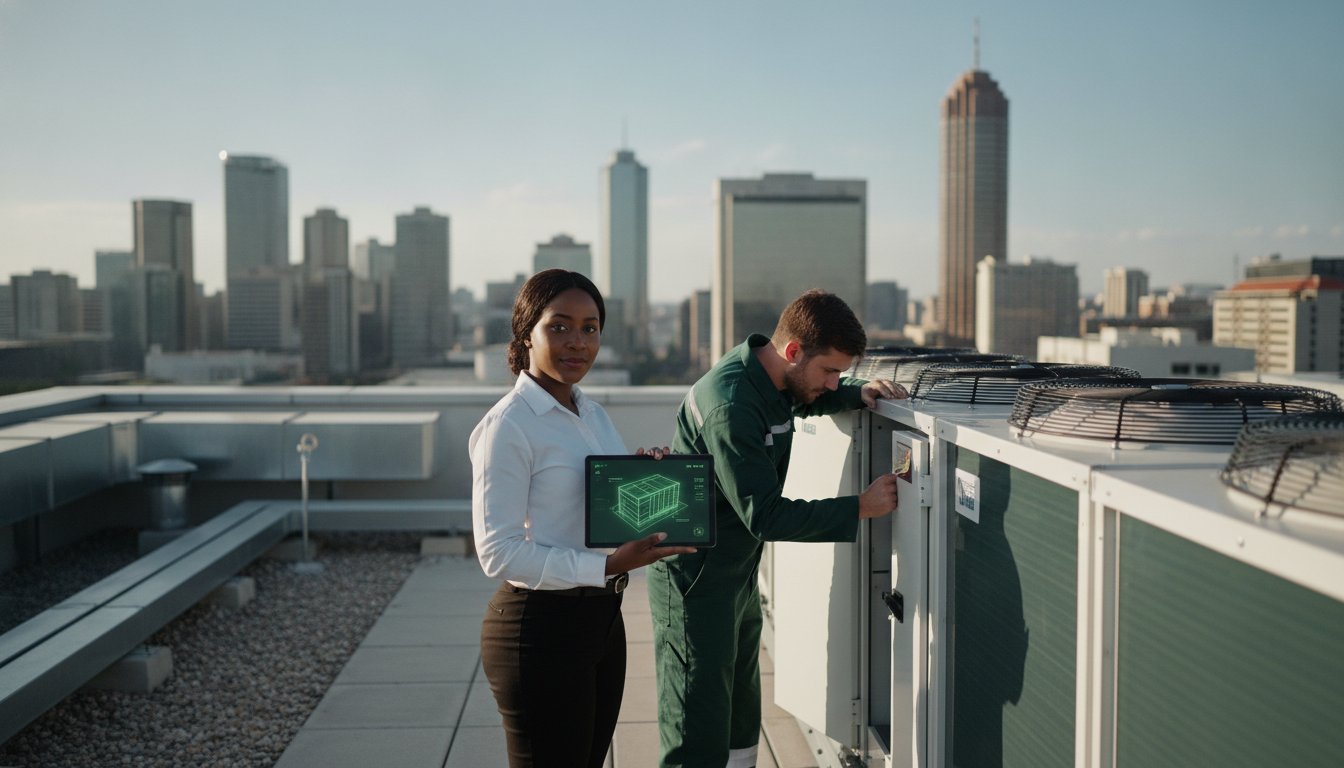
Did you know that your HVAC system likely accounts for up to 60% of your building’s total energy consumption? For many Gauteng businesses, this significant overhead is often inflated by fragmented project management and misaligned technical specifications. When commercial HVAC system design Gauteng is handled by separate entities for planning and installation, the result is frequently a series of expensive communication breakdowns and missed SANS 10400-XA compliance targets. These inefficiencies don’t just delay your project; they compromise your long-term operational costs and energy efficiency.
It’s frustrating to deal with unforeseen costs and technical delays simply because the designer and the installer aren’t on the same page. You deserve a methodical process that guarantees system performance without the stress of managing multiple contractors. This guide will show you how to implement a turnkey approach that ensures single-point accountability and full compliance with the updated 2026 energy standards. We’ll explore the entire lifecycle of a project, from initial load calculations to final commissioning, so you can achieve faster completion times and reliable air quality.
Key Takeaways
- Understand the transition from fragmented contracting to integrated turnkey models to ensure single-point accountability and reduced project risk.
- Discover the critical role of site-specific environmental assessments in commercial HVAC system design Gauteng to ensure compliance with SANS energy standards.
- Learn how to manage the procurement of high-performance air handling units and industrial ventilation whilst minimising disruption to your daily business operations.
- Explore the rigorous commissioning process and the value of integrating Building Management Systems (BMS) for long-term energy savings and system performance.
What is Turnkey HVAC Project Management?
Turnkey HVAC project management represents a significant shift away from the traditional, fragmented approach to building services. In a turnkey model, a single specialist provider assumes full responsibility for the entire project lifecycle. This includes everything from the initial engineering and Heating, ventilation, and air conditioning (HVAC) system design to procurement, installation, and final commissioning. For many property developers, this integrated method is the preferred choice for commercial HVAC system design Gauteng, as it aligns technical engineering with commercial accountability from day one.
Turnkey HVAC project management is the holistic delegation of design and execution to one specialist firm.
This approach replaces the outdated design-bid-build model, where a client must manage separate contracts for consultants and installers. By consolidating these roles, the turnkey provider ensures that the design intent is preserved throughout the installation process. It removes the common risk of “design gaps” where equipment specified on paper doesn’t fit the physical constraints of the site. This is particularly vital in Gauteng’s industrial and commercial sectors, where space optimisation and energy efficiency are non-negotiable requirements.
The Single-Point Responsibility Model
The primary benefit of a turnkey contract is the elimination of finger-pointing between different parties. In a traditional setup, if a system fails to meet performance targets, the designer might blame the installer, whilst the installer blames the equipment or the original design. A turnkey model places the burden of performance squarely on one firm. This creates a “safe pair of hands” environment where the client has a single point of contact for every technical detail.
For facility managers in busy commercial hubs like Sandton and Midrand, this model significantly reduces the administrative burden. Instead of juggling multiple communication channels, they deal with one dedicated project manager who oversees the entire lifecycle. This streamlined communication ensures that technical queries are resolved quickly. It prevents the delays that often plague large-scale developments when information gets lost between separate contracting companies.
Turnkey vs. Traditional HVAC Contracting
Traditional HVAC contracting is often a fragmented process that leads to bottlenecks, especially during the handover phase between design and construction. When the firm responsible for commercial HVAC system design Gauteng is the same firm handling the installation, these transitions are seamless. There’s no learning curve for the installation team because they’ve been involved since the conceptual phase.
- Accountability: Turnkey providers remain accountable during the critical warranty and maintenance periods, ensuring long-term system reliability.
- Timeline Efficiency: Integrated teams can begin procurement and site preparation whilst finalising design details, which shortens the overall project duration.
- Cost Control: Single-point responsibility reduces the likelihood of unforeseen variations and “claims for extras” that often arise from communication breakdowns in traditional models.
This methodical approach ensures that the final system isn’t just a collection of components. It’s a high-performance solution that meets modern SANS energy standards and specific operational requirements without the usual friction of multi-contractor management.
Step 1: The Design and Engineering Phase
Effective commercial HVAC system design Gauteng starts with a precise understanding of the physical environment. It’s not just about square metreage; it’s about the interaction between the building’s envelope and the local climate. A professional design phase identifies the specific thermal loads of a site before a single piece of equipment is ordered. This methodical approach ensures that the resulting system is neither underpowered nor unnecessarily expensive to operate.
In Gauteng, designers must account for high altitude and significant temperature fluctuations. The air is thinner at 1,600 metres above sea level, which directly impacts heat transfer efficiency and fan motor requirements. We conduct detailed load calculations that analyse solar gain on glass-heavy office parks in Sandton or the high-occupancy demands of retail centres in Pretoria. This level of technical scrutiny prevents the common mistake of over-engineering, which leads to short-cycling and premature equipment failure. Businesses seeking to reduce utility bills through modern low carbon technology should also explore commercial HVAC energy savings Sunninghill strategies that are reshaping how Gauteng properties approach climate control in 2026.
Site Assessment and Load Calculations
A comprehensive site assessment looks beyond the floor plan. It evaluates occupancy levels, internal heat gains from machinery or server rooms, and the building’s orientation. For industrial sectors, this might include specifying specialised ventilation fans and louvres to manage air quality. Determining the exact capacity required allows for the selection of the most efficient hardware, whether that involves ducted split systems for versatile office cooling or centralised HVAC for industrial projects that require massive scale.
Navigating South African Building Regulations (SANS)
Compliance is a critical component of the engineering phase. As of July 2026, all new commercial developments must adhere to the updated SANS 10400-XA (Edition 3) regulations, which mandate strict energy usage and thermal performance standards. Following HVAC system design best practices ensures that your mechanical ventilation also meets SANS 10400-O requirements for indoor air quality. This focus on IAQ is vital for preventing Sick Building Syndrome, a condition that often leads to increased absenteeism and reduced productivity in poorly ventilated office environments.
Modern commercial HVAC system design Gauteng also prioritises future scalability. A well-engineered system allows for modular expansion, ensuring that as your business grows, your cooling and ventilation infrastructure can grow with it. Adopting a strategic energy efficient HVAC design from the outset is the most effective way to ensure your building meets the March 2026 SANS 10400-XA regulations whilst lowering long-term utility costs. If you’re planning a new facility or upgrading an existing one, speaking with the technical team at Engico Air Conditioning during the early planning stages can help you align your project with the latest 2026 energy codes whilst keeping long-term operational costs low.
Step 2: Procurement and Implementation
The transition from a conceptual commercial HVAC system design Gauteng to a physical installation requires a disciplined approach to supply chain management and technical execution. This phase is where the theoretical efficiency of the engineering meets the practical realities of procurement and site logistics. In a turnkey model, the project manager synchronises the delivery of equipment with the construction schedule to prevent costly delays and ensure that the installation proceeds without friction.
Sourcing high-performance equipment isn’t simply a matter of ordering parts; it’s about ensuring every component, from Air Handling Units to industrial ventilation louvers, meets the specific technical standards defined during the engineering phase. For commercial spaces in Pretoria or Johannesburg, this might involve selecting durable wall-mounted split units or ceiling cassettes that offer both aesthetic appeal and operational efficiency. The goal is to procure hardware that balances immediate lead times with long-term durability and energy performance.
Sourcing High-Performance HVAC Equipment
Procuring specialised hardware for large-scale Gauteng projects requires deep local market knowledge. We manage the supply chain for various systems, including Ducted Air Conditioning Systems and industrial-grade fans designed for warehouse applications. By maintaining strong relationships with reputable manufacturers, a turnkey provider can navigate the fluctuations in equipment availability that often affect the Johannesburg market. This ensures that high-performance units are on-site exactly when they’re needed, avoiding the bottleneck of waiting for critical components whilst other trades are ready to proceed.
On-Site Project Management and Safety
Effective construction project management principles are applied to ensure that every technician follows the rigorous safety protocols required on commercial sites. Organising the installation sequence is vital to prevent trade interference, especially in complex environments where electrical and plumbing contractors are working simultaneously. Regular site inspections are conducted to verify that the workmanship aligns perfectly with the original commercial HVAC system design Gauteng specifications.
- Safety Standards: Implementing strict health and safety protocols amongst all on-site personnel to mitigate risks and ensure compliance with South African labour regulations.
- Milestone Reporting: Providing transparent updates on project progress and budget adherence to keep stakeholders informed and maintain trust.
- Logistics Coordination: Managing the movement of heavy equipment and materials to minimise disruption to the client’s daily business operations.
This methodical execution ensures that the system is installed correctly the first time. It eliminates the need for reactive troubleshooting during the final stages of the project. By maintaining a steady rhythm and high standards of workmanship, the implementation phase sets a solid foundation for the final commissioning and integration of smart controls.
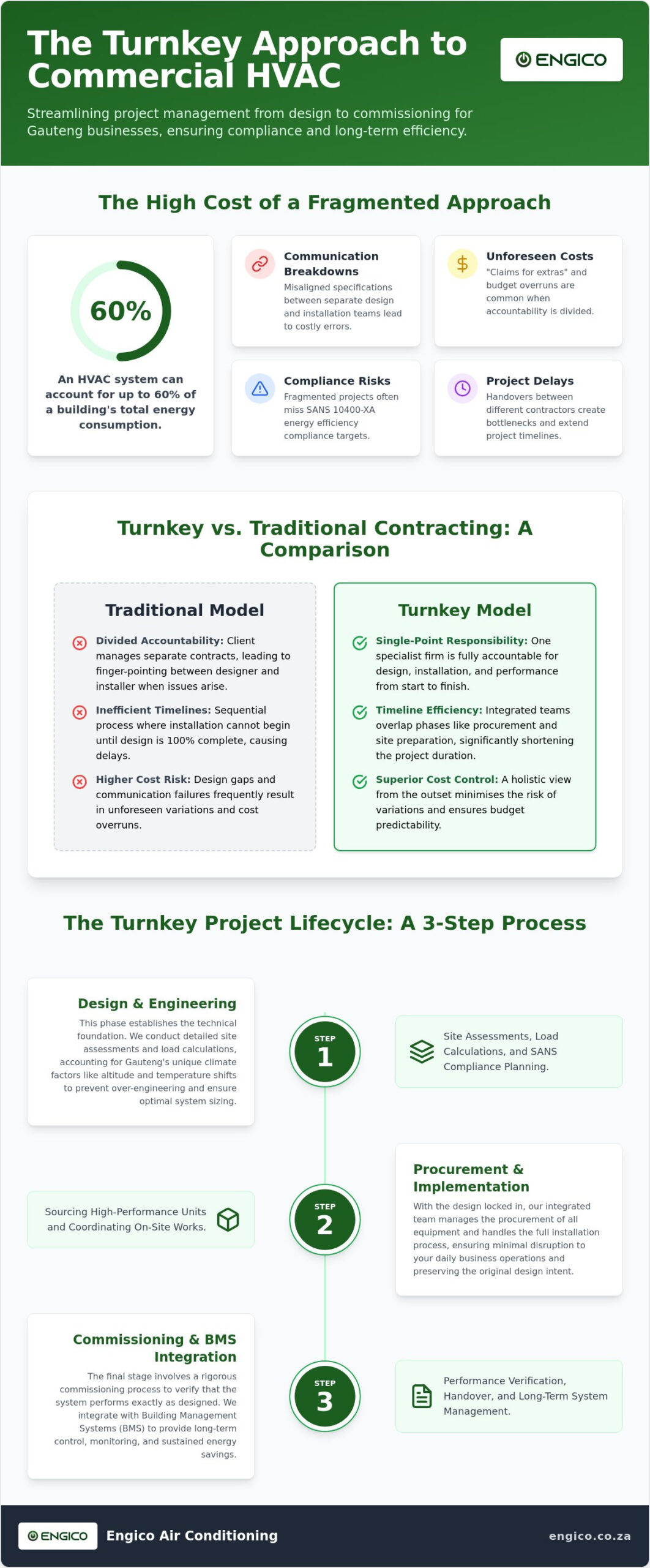
Step 3: Commissioning and BMS Integration
Commissioning is the critical final stage where the theoretical commercial HVAC system design Gauteng is validated through empirical testing. It’s not enough to simply power on the units; a methodical verification process ensures that every component performs exactly as the engineering specifications intended. This stage transforms a collection of installed hardware into a cohesive, high-performance system that meets the rigorous energy efficiency and air quality standards required in 2026.
A turnkey provider manages this transition by conducting exhaustive performance audits before the building is occupied. This includes verifying that the Air Handling Units (AHUs) deliver the correct volumes of fresh air and that the pressure differentials across different zones are maintained. It’s during this phase that any minor installation discrepancies are identified and corrected, ensuring that the final handover is seamless and that the system is ready for long-term operation.
System Testing and Air Balancing
Air balancing is essential for maintaining consistent comfort and operational efficiency. Technicians use calibrated instruments to measure flow rates at every terminal point, ensuring that the air distribution matches the commercial HVAC system design Gauteng requirements. In industrial environments, this process also involves testing ventilation fans and louvers to confirm they provide adequate extraction for heat or fumes. Safety protocols are equally prioritised, with rigorous testing of emergency shut-off systems and fire damper integration to ensure the building remains compliant with local safety codes.
Building Management System (BMS) Optimisation
Modern HVAC efficiency is increasingly dependent on sophisticated automation. Integrating your equipment into smart HVAC control for commercial buildings allows for precise, data-driven management of your indoor environment. A well-configured BMS uses sensors to monitor occupancy levels and CO2 concentrations, adjusting the cooling and ventilation in real-time to reduce energy waste. This is particularly valuable for Gauteng businesses facing rising electricity tariffs, as it enables demand-controlled ventilation that only uses power when and where it’s needed. Property owners looking to maximise returns on their BMS investment can also benefit from understanding the latest commercial HVAC energy savings Sunninghill trends, including AI-powered predictive maintenance and heat pump integration that are driving measurable reductions in energy costs across the region.
- Automated Scheduling: Setting up intelligent run-times that align with business hours to prevent unnecessary energy consumption during nights and weekends.
- Remote Monitoring: Configuring dashboards that allow facility managers to track performance and receive instant alerts for fault detection.
- Staff Training: Providing comprehensive walk-throughs for your internal team so they can operate the control interface with confidence.
The process concludes with the delivery of a comprehensive handover pack. This includes detailed Operation and Maintenance (O&M) manuals, as-built drawings, and all relevant warranty certificates. If you want to ensure your facility benefits from the latest automation standards, you can contact Engico for professional BMS integration and commissioning services that guarantee long-term system performance.
Partnering with Engico for Turnkey Excellence in Gauteng
Engico Air Conditioning approaches every project with a philosophy of quiet confidence and professional reliability. We understand that for Gauteng business owners, an HVAC system is a critical infrastructure investment that must perform without fail. By selecting us for your commercial HVAC system design Gauteng, you’re engaging a partner that manages the technical complexities of modern engineering whilst maintaining a focus on your specific commercial objectives. Our methodical approach ensures that every project, regardless of its scale, is delivered with precision and transparency.
Our role as a “safe pair of hands” means that we take full responsibility for the technical integrity of your installation. We move beyond the role of a traditional contractor by acting as a conscientious provider that cares about the broader impact of our work. This includes a commitment to energy efficiency and environmental responsibility, ensuring that your building remains compliant with South African standards whilst keeping operational costs manageable.
Local Expertise in Diverse Environments
Gauteng presents a unique set of challenges for climate control, from the thin air of the highveld to the erratic power supply that can affect sensitive electronic components. We have extensive experience managing projects across Johannesburg and Pretoria, tailoring our solutions to the specific needs of each district. Whether it’s designing sophisticated cooling for high-end Sandton office blocks or robust industrial ventilation for rugged Midrand warehouses, we provide a stable and dependable service for your most complex requirements.
Our team is well-versed in the practical application of Air Handling Units and ducted systems in various industrial settings. We don’t just install equipment; we engineer environments that support productivity and meet the latest 2026 building standards. This local insight allows us to anticipate potential bottlenecks and implement solutions that ensure your facility remains operational and efficient throughout the year, even during peak summer temperatures.
Comprehensive Post-Installation Support
A successful turnkey project doesn’t end at commissioning. To protect your investment and ensure long-term reliability, we offer structured HVAC maintenance services for Gauteng properties. These programmes are designed to identify potential issues before they lead to costly downtime, ensuring that your system continues to operate at peak efficiency long after the initial handover. Our focus on long-term value helps you avoid the pitfalls of short-term excitement and unreliable installations.
For businesses in specific commercial hubs, such as those requiring commercial HVAC maintenance in Sunninghill, we provide localised support that combines routine servicing with technical repairs. This integrated approach creates a clear path from the initial commercial HVAC system design Gauteng to a lifetime of dependable performance. By combining sustainable engineering with proactive care, Engico positions your business for long-term success in an increasingly demanding regulatory environment.
Securing Long-Term Value for Your Gauteng Facility
A turnkey approach to commercial HVAC system design Gauteng represents more than just a convenient contracting model; it’s a strategic investment in operational stability. By consolidating engineering, procurement, and commissioning under a single point of responsibility, you eliminate the communication gaps that frequently lead to budget overruns and technical delays. This methodical process ensures your system doesn’t just meet today’s comfort needs but also remains fully compliant with the latest SANS energy regulations. Integrating modern automation through a Building Management System further guarantees that your facility operates at peak efficiency whilst reducing long-term overheads.
Engico provides a safe pair of hands for businesses across Johannesburg and Pretoria. Our technical teams are specialists in industrial ventilation and BMS integration, offering a solution-oriented approach to even the most complex climate control challenges. We focus on delivering professional reliability and quiet confidence from the initial site assessment through to post-installation maintenance. You can discuss your next turnkey HVAC project with Engico to ensure your infrastructure is built for durability and performance. We look forward to helping you create a more efficient, compliant, and comfortable environment for your business.
Frequently Asked Questions
What does turnkey HVAC project management actually include?
Turnkey HVAC project management includes every stage of the project lifecycle, from the initial site assessment and engineering to the final commissioning and handover. This comprehensive service covers commercial HVAC system design Gauteng, the procurement of equipment like air handling units or ducted systems, and the management of on-site installation teams. It ensures that a single specialist firm remains responsible for the technical integrity and performance of the entire system.
Is a turnkey HVAC solution more expensive than a traditional bid?
Whilst a turnkey quote may appear higher initially because it encompasses all professional fees and equipment costs, it often results in a lower total cost of ownership. Traditional fragmented bids frequently lead to unforeseen variations and expensive redesigns when communication breakdowns occur between designers and installers. Turnkey management provides cost certainty and eliminates the administrative burden of managing multiple separate contracts.
How long does a typical turnkey industrial HVAC installation take in South Africa?
The duration of an installation depends on the project’s scale and complexity. A standard commercial office fit-out might be completed within four to eight weeks; however, large-scale industrial projects requiring custom ventilation louvers and centralised air handling can span several months. The turnkey model typically accelerates these timelines because procurement and site preparation can begin whilst the final design details are being refined.
Do turnkey providers handle the electrical and plumbing work too?
Turnkey HVAC specialists focus on the mechanical ventilation and climate control components of a building. Whilst they coordinate closely with other trades to ensure seamless integration, general electrical contracting and plumbing are typically handled by separate specialist contractors. A turnkey provider acts as a “safe pair of hands” for the HVAC scope, ensuring all mechanical equipment is correctly interfaced with the building’s existing utilities.
Can a turnkey project help my building meet SANS energy efficiency standards?
Yes, turnkey projects are highly effective for achieving compliance with SANS 10400-XA energy efficiency standards. Because the firm responsible for the commercial HVAC system design Gauteng also executes the installation, there is a direct line of accountability for the system’s performance. This integrated approach ensures that energy-saving features, such as demand-controlled ventilation or BMS integration, are implemented exactly as specified in the engineering phase.
What happens if there is a problem with the design after installation?
In a turnkey model, the provider assumes single-point responsibility for any design or performance issues. There is no opportunity for finger-pointing between different parties, as the same firm managed the project from inception to completion. If the system fails to meet the original design intent or performance targets, the turnkey provider is contractually obligated to rectify the issue without the client needing to mediate between separate consultants and contractors.
Is turnkey management suitable for small office renovations in Gauteng?
Turnkey management is an excellent solution for smaller office renovations where business owners want to minimise disruption. It allows for the efficient installation of wall-mounted split or ceiling cassette units without the need for the client to hire independent engineering consultants. This model provides small businesses with the same level of professional reliability and technical expertise usually reserved for large-scale industrial developments.
How much involvement is required from the client in a turnkey project?
Client involvement is primarily concentrated in the initial briefing and final approval phases. Once the technical requirements and budget are established, the project manager handles the daily logistics, supply chain coordination, and site safety protocols. This allows business owners to focus on their core operations whilst receiving regular, transparent updates on project milestones and performance targets.
Recent Comments