
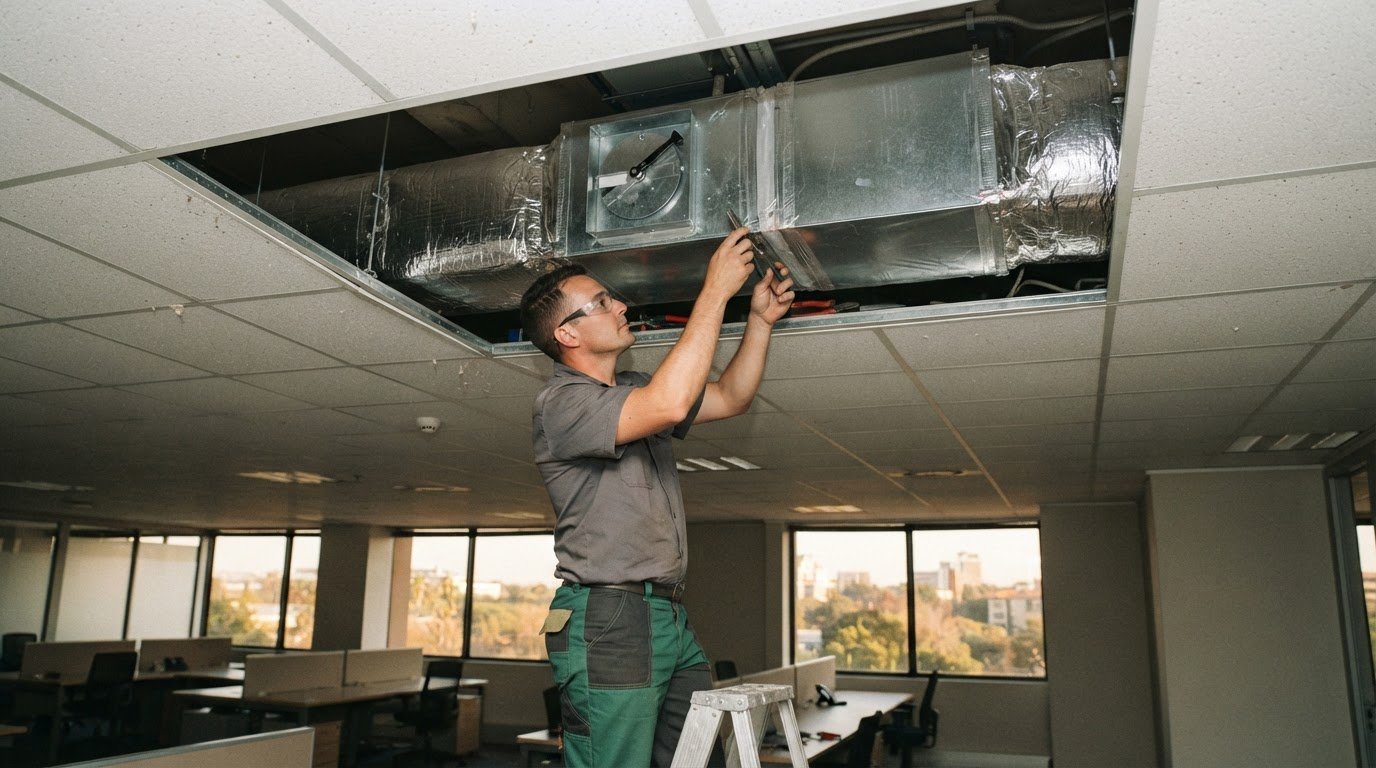
Heating and cooling can account for a substantial share of energy use in commercial buildings. To understand how to reduce HVAC energy consumption in office buildings, start by identifying what drives the system’s workload: operating hours, occupancy, ventilation needs and heat entering or escaping the building.
It’s easy to focus on the air-conditioning unit alone, but office energy demand is also shaped by ventilation, operating schedules and the building envelope. This article explains which systems use the most energy and how HVAC performance, insulation and occupancy patterns interact. You’ll learn where energy waste can occur and which practical changes can help reduce unnecessary demand while maintaining a suitable working environment.
Key Takeaways
- Use retro-commissioning to identify controls or operating settings that no longer match how the office is used.
- Align equipment schedules and ventilation with occupancy to avoid conditioning empty spaces unnecessarily.
- Improve insulation and seal air leaks to limit heat transfer and reduce the workload placed on HVAC systems.
- Building Management System Integration can help coordinate HVAC controls with building operations and support more informed energy management.
1. What consumes the most energy in a commercial building?
Heating and cooling often use a third to half of commercial building energy. The share varies with climate, building type and equipment age. In offices, lighting also uses around 17-20% of total energy. Monitoring both loads helps identify where energy is going.
Retro-commissioning reviews how existing equipment and controls perform against current occupancy and operating needs. It involves measuring schedules, setpoints and system response, then correcting settings that cause unnecessary heating or cooling. For example, a system may condition meeting rooms outside booked hours. Comparing control schedules with actual use can reveal the mismatch.
Preventive maintenance supports efficient operation through regular checks of filters, coils, ducts and thermostat calibration. Blocked filters restrict airflow, while dirty coils and leaking ducts can make equipment run longer to maintain indoor conditions. Ductwork can account for 25%-40% of HVAC energy loss. Poorly maintained air-conditioning systems can add 30% to the bill. Inspections should record faults, repairs and control adjustments, so recurring problems are easier to identify.
Performance monitoring makes inspections more useful. Establish an energy-use baseline, then measure consumption after repairs or control changes. An energy audit can assess HVAC, lighting, water heating and the building envelope, helping teams prioritise improvements. Compare operating schedules with actual occupancy and note changes in equipment performance. This helps show whether an adjustment reduced waste or merely shifted demand.
Upgrade costs depend on equipment, installation scope, control changes and building condition. The project price is given after a quote request. Payback depends on measured savings, operating hours, energy tariffs and capital cost. South African rebates, incentives or financing depend on programme rules, project scope and applicant eligibility. Savings evidence may also help determine whether an option fits the upgrade.
2. Why Energy-Efficient HVAC Systems Matter?
Heating, air conditioning and ventilation together accounted for 52% of energy use in typical office buildings in the cited survey. Ventilation alone accounted for 11%. These figures show why operational settings matter: fans and heating and cooling equipment use energy even when rooms are empty.
Match equipment schedules to actual building activity. Set start and stop times around working hours, then use wider overnight and weekend setbacks when the building is unoccupied. A meeting room used only for booked sessions does not need the same schedule as a busy open-plan office. Smart thermostats can adjust settings by time or occupancy, reducing unnecessary operation without changing the entire building schedule.
Occupancy sensors can support demand-controlled ventilation by adjusting system output to the number of people using a space. This can help in rooms with fluctuating attendance, such as training areas. Sensors can also switch off lighting in empty spaces, while daylight controls can reduce artificial lighting near windows. Coordinating these settings helps heating and cooling respond to actual demand.
There is no single savings figure for HVAC efficiency measures across commercial offices. Results depend on the starting schedule, occupancy patterns, system controls and how much equipment runs when spaces are empty. A practical first step is to compare operating schedules with actual use, then measure consumption after making changes.
Reducing ventilation too far can compromise indoor air quality, while overly aggressive temperature setbacks can affect comfort when staff arrive. Keep ventilation aligned with occupancy and adjust temperature settings gradually, observing how rooms perform during normal use. For coordinated HVAC and lighting settings, consider building control integration as part of an operational improvement plan.
3. Insulation quality and building energy demand
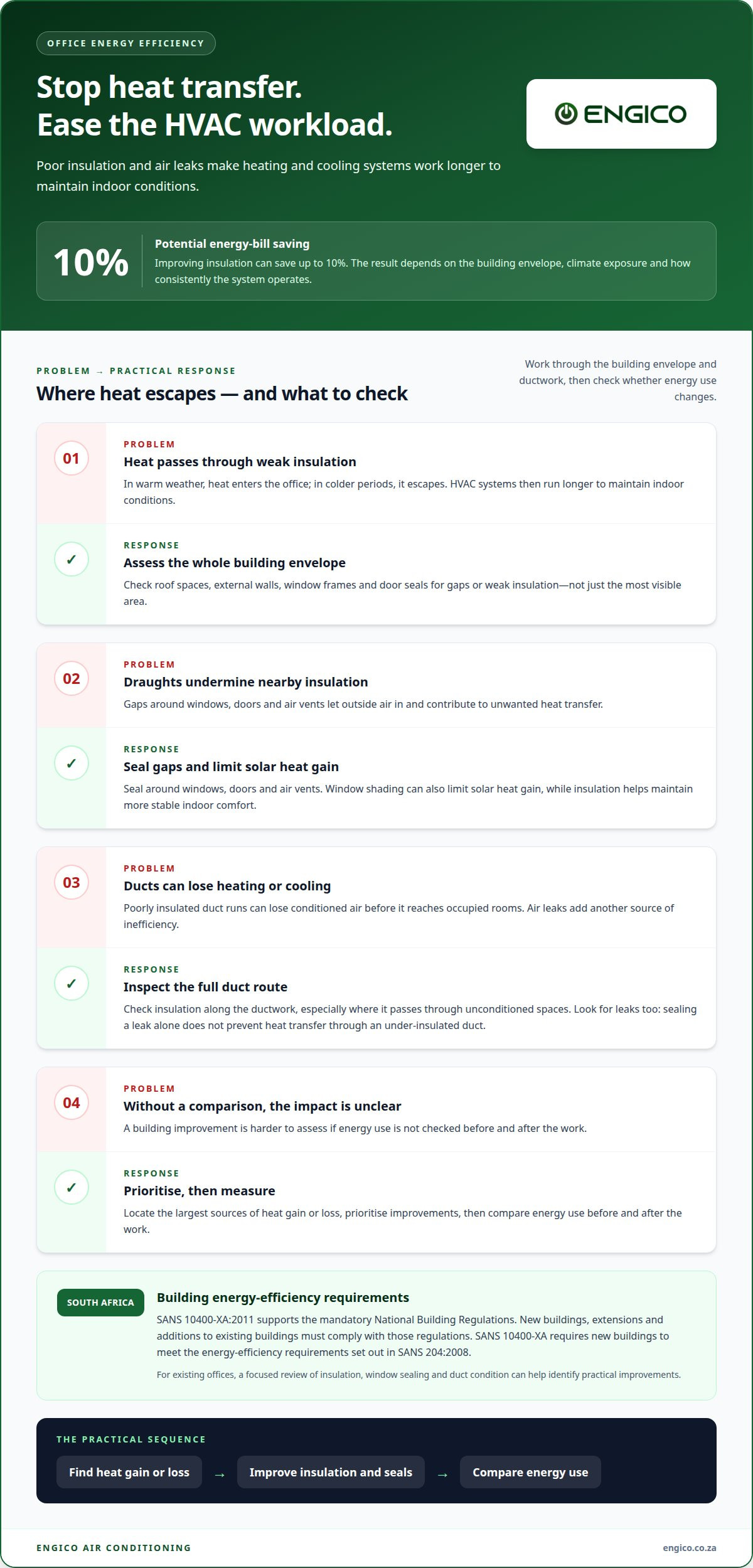
Poor insulation allows heat to enter offices during warm weather and escape during colder periods. HVAC systems then run longer to maintain indoor conditions, increasing energy demand. Improving insulation can save up to 10% on energy bills. The result depends on the building’s existing envelope, climate exposure and how consistently the system operates.
Assess the whole building envelope, not just one visible area. Check roof spaces, external walls, window frames and door seals for gaps or weak insulation. Draughts around a window, for example, can undermine nearby insulation by letting outside air in. Sealing gaps around windows, doors and air vents helps prevent draughts and unwanted heat transfer.
Duct insulation matters too. In a ducted system, poorly insulated runs can lose heating or cooling before conditioned air reaches occupied rooms. Inspect insulation along the duct route, especially where ducts pass through unconditioned spaces. Check for air leaks as well: sealing a leak alone cannot prevent heat transfer through an under-insulated duct.
Prioritise improvements by locating the largest sources of heat gain or loss, then compare energy use before and after the work. This makes insulation part of practical energy management rather than an isolated building project. Window shading and specialised films can significantly limit solar heat gain; services like sunnysideglasssolutions.com show how modern window films and glass replacements improve envelope efficiency. Together, these measures can reduce the ongoing demand on heating and cooling equipment.
In South Africa, SANS 10400-XA:2011 supports the mandatory National Building Regulations. New buildings, extensions and additions to existing buildings must comply with those regulations. SANS 10400-XA requires new buildings to comply with the energy-efficiency requirements set out in SANS 204:2008. For existing offices, a focused review of insulation, window sealing and duct condition can help identify practical improvements that support energy efficiency and sustainability.
4. HVAC energy use in office buildings
In fully air-conditioned buildings, HVAC accounts for 30 to 60% of overall energy use. The share depends on climate, occupancy, building design and equipment operation. Cooling, heat-rejection systems, ventilation and air handling are almost exclusively powered by electricity. In a cited survey of typical offices, heating accounted for 32% of energy use, while air conditioning accounted for 9%.
These figures show why office HVAC demand needs its own assessment. Heating and cooling loads change with outdoor conditions, sunlight, internal equipment and the number of people in each area. Establish an energy-use baseline before making changes. Compare consumption with operating hours and occupancy patterns, then identify when conditioning continues despite low demand.
Commercial cooling systems often operate at partial load. A system that runs efficiently only at full capacity may use more energy than necessary during ordinary office conditions. Zoning directs heating or cooling to occupied areas instead of empty rooms. Comparing zone schedules with actual use can reveal where controls or operating times need adjustment.
Temperature settings also influence demand. One guide recommends a summer indoor temperature of 26°C rather than 22°C to reduce cooling workload. In its example, raising indoor temperature from 22°C to 26°C, with an external design temperature of 30°C, reduces transmission and ventilation heat gain by 50%. Treat this as an illustration of how the temperature difference affects cooling demand.
In South Africa, SANS 10400-XA:2011 supports the mandatory National Building Regulations. New buildings, extensions and additions to existing buildings must comply; SANS 10400-XA requires new buildings to meet the energy-efficiency requirements set out in SANS 204:2008. For an existing office, combine the energy baseline with climate, occupancy and system performance. That makes it easier to target HVAC improvements where they can reduce unnecessary conditioning without overlooking how the building is used.
Engico Air Conditioning: Building Management System Integration
Engico Air Conditioning provides Building Management System integration to coordinate building controls with HVAC operations. It can help when separate systems, changing occupancy or inconsistent schedules make energy use difficult to monitor. Integration brings HVAC controls into a more coordinated management approach, supporting clearer oversight of operating settings.
For offices planning equipment changes, Engico Air Conditioning supplies wall-mounted split, multi-split and ceiling cassette air conditioners. The right system depends on the building layout, room use and existing installation. Building Management System integration is most relevant when the priority is coordinating controls rather than replacing equipment alone.
Contact Engico Air Conditioning to discuss Building Management System integration for your office.
Make your next HVAC decision a measured one
Turn energy observations into a clear sequence of decisions. Set a priority for the office, record the operational issue behind it, and decide how progress will be assessed. This keeps future changes focused on the building’s needs rather than assumptions about what should be replaced. A measured approach to how to reduce HVAC energy consumption in office buildings also helps teams balance energy performance with comfortable working conditions.
Engico Air Conditioning can discuss Building Management System integration and air-conditioning options for different office layouts. Share the building’s operating needs and the areas you want to address, then explore a practical way forward.
Contact Engico Air Conditioning to discuss your office HVAC requirements and take the next step with confidence.
Frequently Asked Questions
What consumes the most energy in a commercial building?
Heating, cooling and ventilation are often among a commercial building’s largest energy loads, although the main driver varies with building use and climate. Lighting, computers and other office equipment also contribute. Separate meter readings or system-level monitoring can distinguish HVAC demand from plug loads and show whether energy use is concentrated in occupied areas or continues after staff leave.
Why Energy-Efficient HVAC Systems Matter?
Energy-efficient HVAC systems can meet a building’s heating, cooling and ventilation needs with less unnecessary operation. This matters in offices where equipment may run beyond occupied hours or serve areas with different requirements. Better control can support consistent conditions across workspaces and help building teams make operational decisions using energy data, rather than relying on a single whole-building figure.
What are the most effective ways to reduce HVAC energy consumption in office buildings?
To understand how to reduce HVAC energy consumption in office buildings, first identify where and when HVAC energy is used. Compare system run times with occupancy, review temperature settings and check whether individual zones match their actual use. Keep maintenance current and assess insulation or control improvements that could reduce demand. Measure consumption after each change to understand its effect before adding further measures.
What HVAC temperature setpoints and schedules reduce energy use without compromising comfort?
Use settings that suit the season, building conditions and work taking place rather than applying one temperature across every area. Align start-up and shutdown times with office attendance, and use overnight or weekend setbacks when the building is unoccupied. Avoid frequent manual overrides, which can disrupt schedules. Review staff feedback alongside energy use so adjustments support comfort as well as lower demand.
How can building automation, occupancy sensors, and smart thermostats optimise office HVAC?
Automation can link operating schedules to occupancy, while smart thermostats adjust settings according to time or activity. When considering how to reduce HVAC energy consumption in office buildings, a sensor can indicate that a meeting room is empty, allowing HVAC operation to reduce until the room is used again. Place sensors carefully: if one misses an occupied area, it can trigger unsuitable settings.
How can office buildings improve ventilation and indoor air quality while reducing HVAC energy use?
Match ventilation operation to building activity without indiscriminately cutting airflow. Coordinate occupancy-based controls with each space’s ventilation needs, and keep air intakes clear and filters clean so the system can deliver air effectively. For offices in Pretoria, Johannesburg, Centurion, Menlyn, Farie Glen, Silverton, Waterkloof, Gezina, Doringkloof, Midrand, Waterfall, Sunninghill, Woodmead, Sandton, Randburg, Roodepoort, Fourways, Gauteng Province and Hyde Park, local climate and occupancy patterns also inform control settings.
Recent Comments