
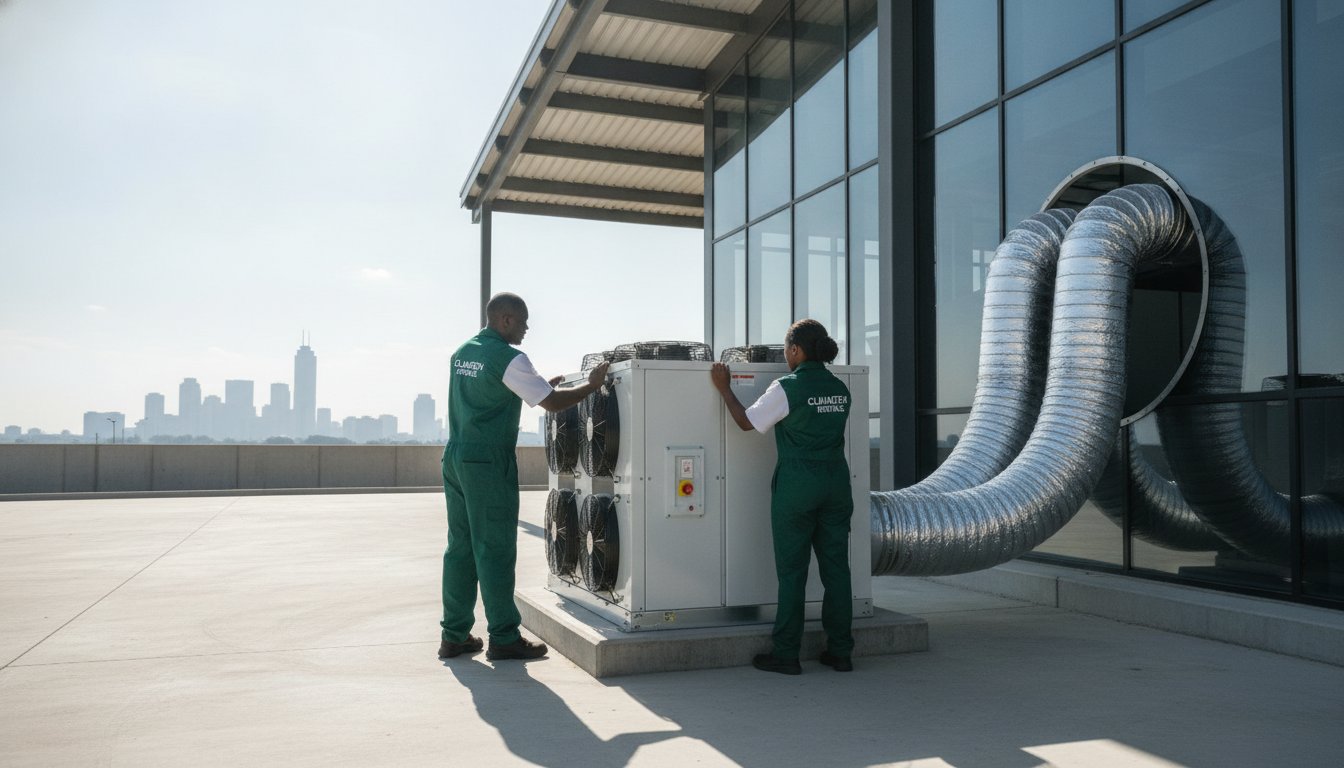
How much does a single hour of thermal downtime actually cost your facility when a server room overheats or a production line stalls? For many South African businesses, the answer is measured in lost revenue and damaged reputation rather than just degrees Celsius. In our demanding climate, maintaining stable temperatures isn’t just about comfort; it’s a critical requirement for protecting infrastructure and ensuring operational continuity, particularly whilst managing the challenges of power instability and ageing HVAC systems.
This comprehensive guide demonstrates how a strategic approach to industrial air conditioner rental South Africa allows you to maintain precise climate control and reduce operational risk without the immediate capital expenditure of new installations. You’ll discover how to navigate the 2026 R22 refrigerant phase-down and the updated SANS 10400-XA energy standards whilst keeping your assets protected during extreme heatwaves. We’ll provide a methodical overview of selecting the right temporary cooling solutions and finding a reliable local partner for rapid, professional deployment that aligns with modern efficiency requirements.
Key Takeaways
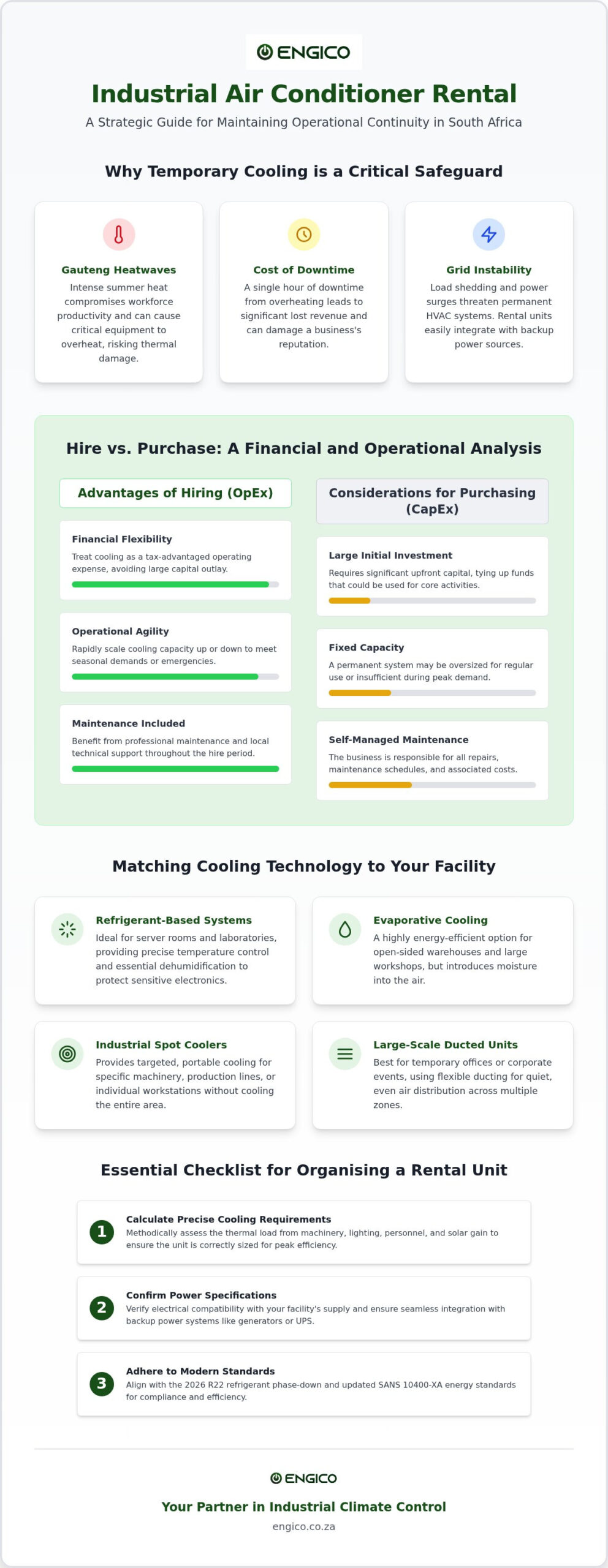
- Understand how temporary climate control serves as a strategic safeguard against Gauteng heatwaves and critical infrastructure overheating.
- Identify the most effective cooling technology for your facility, ranging from high-capacity air handling units to targeted industrial spot coolers.
- Evaluate the financial benefits of the hire model, focusing on the tax advantages of operating expenditure over traditional capital investment.
- Learn to calculate precise cooling requirements and power specifications to ensure your industrial air conditioner rental South Africa operates at peak efficiency.
- Discover the importance of professional maintenance and local technical support in maintaining operational continuity throughout the hire period.
Understanding the Role of Industrial Air Conditioner Rental in South Africa
Industrial air conditioner rental South Africa refers to the temporary provision of high-capacity climate control systems designed for heavy-duty environments. This approach differs significantly from residential cooling because it focuses on the precise management of high thermal loads found in factories, warehouses, and data centres. By utilising professional-grade Heating, ventilation, and air conditioning (HVAC) technology, businesses can maintain specific temperature and humidity levels that standard equipment cannot achieve.
Standard domestic units are often overwhelmed by the environmental demands of an industrial setting. In a server room, for instance, the heat generated by hardware is constant and intense. A domestic split-system lacks the static pressure and airflow capacity to penetrate dense equipment racks or handle the continuous operation required. Industrial rental units are built for durability; they feature robust components that resist the dust and vibration common in manufacturing hubs like Centurion and Midrand. This reliability is essential for protecting sensitive infrastructure from thermal damage.
The transition toward “Cooling as a Service” provides companies with necessary operational flexibility. Instead of committing to a permanent installation that may be oversized or underutilised, businesses can hire equipment tailored to their current needs. This model ensures that cooling is treated as a utility rather than a capital burden. It allows for rapid scaling during peak seasons or emergency outages, ensuring that financial resources remain available for other core business activities.
Why Businesses in Gauteng Prioritise Temporary Cooling
In Gauteng, the combination of high altitude and intense summer heatwaves creates a volatile environment for critical assets. Temperatures in Johannesburg and Pretoria frequently rise to levels that compromise workforce productivity and equipment safety. Many facilities use temporary units as an essential bridge whilst their primary systems undergo commercial HVAC maintenance. This ensures that operations don’t halt during scheduled repairs or unexpected breakdowns during the hottest months of the year. Protecting sensitive electronics amongst these peaks is a primary concern for IT managers and facility supervisors alike.
The Impact of Grid Instability on Climate Control
South Africa’s ongoing challenges with grid stability and load shedding have fundamentally changed how businesses view climate control. Permanent HVAC systems are often vulnerable to power surges or prolonged outages that can damage sensitive electronics. Rental units are frequently chosen for their ability to integrate seamlessly with backup power sources like industrial generators or UPS systems. Implementing smart HVAC control for commercial buildings allows facility managers to monitor these hired systems in real-time. This ensures that cooling remains consistent even when the primary power source fluctuates. This methodical approach to redundancy minimises the risk of infrastructure failure during unstable periods.
Types of Industrial Cooling Units Available for Hire
Selecting the correct technology for a facility requires a methodical understanding of how different systems interact with the environment. Most industrial applications rely on either refrigerant-based systems or evaporative cooling. Refrigerant-based units provide precise temperature control and dehumidification, making them the preferred choice for server rooms and sensitive laboratories. Evaporative cooling, whilst more energy-efficient in open-sided warehouses, introduces moisture into the air, which can be detrimental to electronic components or specific chemical processes.
A successful industrial air conditioner rental South Africa strategy often hinges on matching the unit’s capacity to the specific thermal load of the space. Large-scale ducted systems are frequently deployed for temporary office partitions or high-profile corporate events where aesthetics and even air distribution are paramount. These systems use flexible ducting to deliver conditioned air quietly and efficiently amongst various zones, avoiding the disruptive noise levels often associated with multiple smaller fans. For facilities in the Sunninghill area considering a more permanent solution alongside their rental strategy, a professional ducted air conditioning installation Sunninghill offers a seamless transition from temporary to long-term climate control.
Portable Industrial Spot Coolers
Portable spot coolers are designed for rapid deployment and targeted relief. These units operate on a “plug-and-play” basis, allowing technicians to provide immediate cooling to specific machinery or high-traffic workstations without modifying the building’s existing infrastructure. In a commercial context, these units typically offer capacities ranging from 4.5 kW to over 10 kW. They are particularly effective in Gauteng’s industrial hubs where sudden equipment overheating can threaten production timelines. Their mobility ensures that cooling follows the workflow, providing a versatile solution for varying operational demands.
Large-Scale Air Handling and Ventilation
For expansive volumes like distribution centres or manufacturing floors, a single Air Handling Unit (AHU) is often superior to a fleet of portable coolers. These high-capacity systems are frequently integrated with professional warehouse ventilation design to ensure consistent air changes and optimal pressure. By utilising high-performance fans and louvers, an AHU can manage the climate of an entire floor plate from a single external point. This approach saves valuable internal floor space and reduces the risk of electrical overloads on internal circuits. If you need to assess the specific requirements for your facility, you can view the full range of rental options to compare technical specifications and airflow capacities.
Ducted rental solutions further enhance this capability by allowing conditioned air to be piped into areas with restricted access. This is essential for maintenance projects where primary systems are offline. By using temporary louvers and specialised ducting, businesses can maintain a stable environment whilst avoiding the long-term costs of permanent upgrades. This methodical approach ensures that every cubic metre of space receives the necessary cooling to protect both personnel and assets.
Hire vs. Purchase: The Strategic Financial Analysis
Deciding between purchasing and renting high-capacity HVAC equipment is a strategic choice that affects a company’s balance sheet for years. For many South African firms, the upfront capital expenditure (CAPEX) required for a permanent installation can be prohibitive, especially when liquidity is needed for core operations. Opting for industrial air conditioner rental South Africa shifts this cost to operating expenditure (OPEX). This transition is financially advantageous in the local corporate tax environment, as rental payments are typically fully deductible in the year they occur, providing more immediate relief than multi-year depreciation schedules.
Ownership brings several “hidden costs” that are often overlooked during the initial procurement phase. These include insurance premiums, the cost of storing bulky equipment during the winter, and the inevitable risk of technical obsolescence. As South African energy standards like SANS 10400-XA become more stringent, older owned units may fail to meet compliance, leading to costly retrofits. A hire model removes these risks by providing access to modern, energy-efficient technology that meets current regulatory requirements without the long-term burden of asset management. Recognising the signs you need aircon repair on ageing owned equipment is often the catalyst that prompts businesses to reconsider the financial logic of continued ownership versus a flexible rental arrangement.
Operational Flexibility and Scalability
Gauteng’s climate is known for intense seasonal heatwaves that place immense pressure on cooling systems. Scaling your capacity up or down based on these peaks is far more efficient through a hire model. It allows a business to test a specific system type in their unique environment before committing to a permanent installation. This methodical approach prevents the common error of “over-speccing” a permanent system that only runs at full capacity for three months of the year. By renting, you ensure that you only pay for the cooling you actually use, optimising your budget throughout the varying seasons.
Maintenance-Free Reliability
Ownership places the full responsibility for technical upkeep, part sourcing, and emergency repairs on your facility management team. In contrast, a rental agreement with a specialist like Engico Air Conditioning includes professional maintenance and guaranteed uptime. This is particularly vital in demanding environments, such as temporary cooling solutions for construction sites, where dust and heavy usage can quickly compromise equipment integrity. By transferring the technical risk to the provider, you ensure that your facility remains cooled by a “safe pair of hands” whilst your team focuses on primary business goals. This managed approach guarantees that any technical issue is resolved swiftly without additional repair costs or administrative delays.
Technical Considerations for Organising a Rental Unit
Organising an industrial air conditioner rental South Africa requires a methodical assessment of your facility’s physical and electrical constraints. Unlike domestic setups, industrial cooling involves significant air volumes and power draws that must be managed to ensure safety and efficiency. Site access is a primary consideration; large-scale equipment like Air Handling Units often requires specific loading bay clearances or even crane access for rooftop placements. You should also consider the path for exhaust ventilation. Portable refrigerant units must vent hot air outside the cooled space, typically through a ceiling void or a window kit, to prevent the unit from fighting its own heat output.
Electrical compatibility is equally critical. Whilst smaller spot coolers may run on standard single-phase power, high-capacity industrial units almost always require three-phase power. It’s essential to verify your facility’s available amperage before the equipment arrives to avoid tripped breakers or damaged circuits. If you are unsure about your building’s electrical capacity, you should request a technical site survey to confirm your requirements before signing a hire agreement.
Sizing Your Cooling Requirements
Calculating the required cooling capacity is the most important step in the planning process. In South African conditions, where ambient temperatures in Gauteng can exceed 35°C, a general rule of thumb is to allow for approximately 0.15 kW to 0.20 kW of cooling per square metre for standard commercial spaces. However, this calculation changes drastically when heat-generating equipment is present. A server room with high-density racks may require double or triple the cooling capacity of an empty warehouse of the same size. Professional site surveys in hubs like Sandton or Midrand are highly recommended to account for solar gain through large glass facades and the specific thermal load of your machinery.
Power and Logistics in Gauteng
Logistical planning is vital for a seamless deployment, particularly in the congested business districts of Johannesburg and Pretoria. In the Johannesburg CBD, older buildings often have limited electrical infrastructure, making it necessary to check for available amperage at the distribution board. Noise levels also play a role in equipment positioning; whilst industrial units are built for performance, their decibel ratings may be disruptive in an open-plan office. Strategic placement behind partitions or in dedicated plant areas can mitigate this. Finally, always organise delivery schedules to avoid peak traffic hours in Centurion and Pretoria. Scheduling a 06:00 arrival ensures that the equipment is on-site and ready for installation before the business day begins, minimising operational disruption.
Partnering with Engico Air Conditioning for Industrial Climate Control
Engico Air Conditioning provides a structured approach to industrial air conditioner rental South Africa, ensuring that every project is managed with technical precision. Our service model encompasses the full lifecycle of the rental, from initial equipment selection to professional installation and proactive maintenance. By focusing on technical accuracy and high-quality descriptors, we position ourselves as a dependable partner for businesses requiring stable climate control. We manage the entire process centrally, allowing your team to focus on their primary responsibilities whilst we handle the logistics of climate management.
A significant advantage of our service is the integration of Building Management Systems (BMS) with hired units. This capability allows for real-time monitoring and energy optimisation, ensuring that temporary cooling doesn’t lead to excessive utility costs or electrical strain. This methodical progression ensures that your facility remains efficient throughout the hire period. We don’t simply drop off equipment; we ensure it is tuned to the specific thermal requirements of your environment, whether it’s a high-density server room or a large-scale manufacturing floor.
Comprehensive Support from Pretoria to Johannesburg
Our local presence in key commercial hubs like Sandton, Randburg, Midrand, and Centurion allows for rapid deployment and consistent technical support. Engico Air Conditioning acts as a “safe pair of hands,” managing complex HVAC projects from inception to completion without unnecessary fuss. Industrial clients benefit from our technical backup capabilities, which provide the reassurance needed when managing critical assets. This regional focus ensures that we understand the unique environmental challenges of the Gauteng Province, from the intense summer heat to the specific power constraints found in different industrial zones.
How to Get Started with Your Rental
Securing a rental unit begins with a professional consultation to match our equipment to your specific environment. Whilst portable spot coolers provide immediate relief for machinery, we also offer wall-mounted split systems and ducted air conditioning for longer-term requirements or semi-permanent office partitions. This consultative approach ensures that you don’t just receive a machine, but a complete cooling solution tailored to your operational needs. Whether you require an emergency backup or a planned maintenance bridge, our team is prepared to conduct a professional site assessment. This assessment determines the most effective configuration for your assets and ensures that all safety and efficiency standards are met before deployment begins.
Securing Your Operational Future with Strategic Cooling
Navigating the complexities of the 2026 climate and energy landscape requires a shift from reactive repairs to proactive resilience. As established throughout this guide, the decision to utilise industrial air conditioner rental South Africa is a strategic move that addresses both immediate thermal risks and long-term financial objectives. By prioritising high-capacity, energy-efficient systems, businesses can maintain operational continuity amongst the most challenging Gauteng heatwaves and power fluctuations.
Engico Air Conditioning offers the technical expertise and local infrastructure to manage these requirements with precision, ensuring that your facility meets the latest SANS 10400-XA standards without the burden of permanent capital investment. This partnership provides the technical redundancy and professional maintenance necessary to protect your workforce and your critical assets. Contact Engico Air Conditioning for a professional industrial cooling rental quote to begin your site assessment. Choosing a reliable climate partner today ensures your facility remains productive and compliant regardless of the environmental pressures ahead.
Frequently Asked Questions
How much does it cost to rent an industrial air conditioner in South Africa?
Rental costs for industrial units are calculated based on specific technical requirements, such as the required kW capacity and the duration of the hire period. Because industrial environments vary significantly, we provide customised quotes that account for site logistics and power needs. This ensures you only pay for the exact cooling volume your facility requires without the burden of capital expenditure.
Can I rent a portable air conditioner for my server room in Johannesburg?
Yes, you can hire portable industrial units specifically designed for server room applications in Johannesburg. These units provide targeted spot cooling to prevent hardware overheating during primary system failures or scheduled maintenance. Their robust design allows for rapid deployment in high-density IT environments where maintaining a precise temperature is critical for asset protection.
What is the difference between an evaporative cooler and an industrial aircon hire?
The primary difference lies in how these systems manage heat and humidity. Evaporative coolers use water evaporation to lower temperatures, which is effective in dry, open spaces but increases moisture levels. In contrast, an industrial air conditioner rental South Africa uses refrigerant-based technology to provide precise temperature control and dehumidification, making it the superior choice for sensitive electronics and enclosed offices.
Do rental units require professional installation by an HVAC specialist?
High-capacity industrial rental units require professional installation to ensure electrical safety and proper exhaust ventilation. Specialist technicians must verify that three-phase power connections are secure and that hot air is correctly vented outside the building envelope. This methodical approach prevents equipment failure and maintains a safe, compliant working environment for your staff.
How quickly can Engico deliver a rental unit to Midrand or Sandton?
Delivery times to Midrand and Sandton depend on the current availability of specific units and the complexity of the installation. Our local presence in these key Gauteng hubs allows us to organise logistics efficiently and minimise transport delays. We recommend scheduling a site assessment early to ensure the equipment is ready for deployment exactly when your facility needs it.
Are industrial rental units energy efficient for long-term use?
Modern industrial rental units are designed with energy efficiency in mind and often meet the latest SANS 10400-XA standards. Many units feature inverter technology and advanced controls that adjust cooling output based on the current thermal load. This makes them a cost-effective solution for long-term hire periods whilst managing operational electricity costs in a volatile energy market.
What happens if the hired air conditioner breaks down during the rental period?
If a hired unit experiences a technical issue, professional maintenance and repairs are included as part of the rental agreement. Our technicians provide reliable backup support to resolve malfunctions swiftly and restore operational continuity. This managed service removes the burden of repair costs and technical troubleshooting from your facility management team, providing a “safe pair of hands” for your climate needs.
Can I integrate a rental cooling system with my existing Building Management System?
You can integrate our rental cooling systems with your existing Building Management System (BMS) for enhanced monitoring and control. This integration allows for precise tracking of energy usage and temperature fluctuations across your facility. It provides a comprehensive overview of the temporary system’s performance, ensuring it operates in harmony with your permanent infrastructure for maximum efficiency.
Recent Comments