
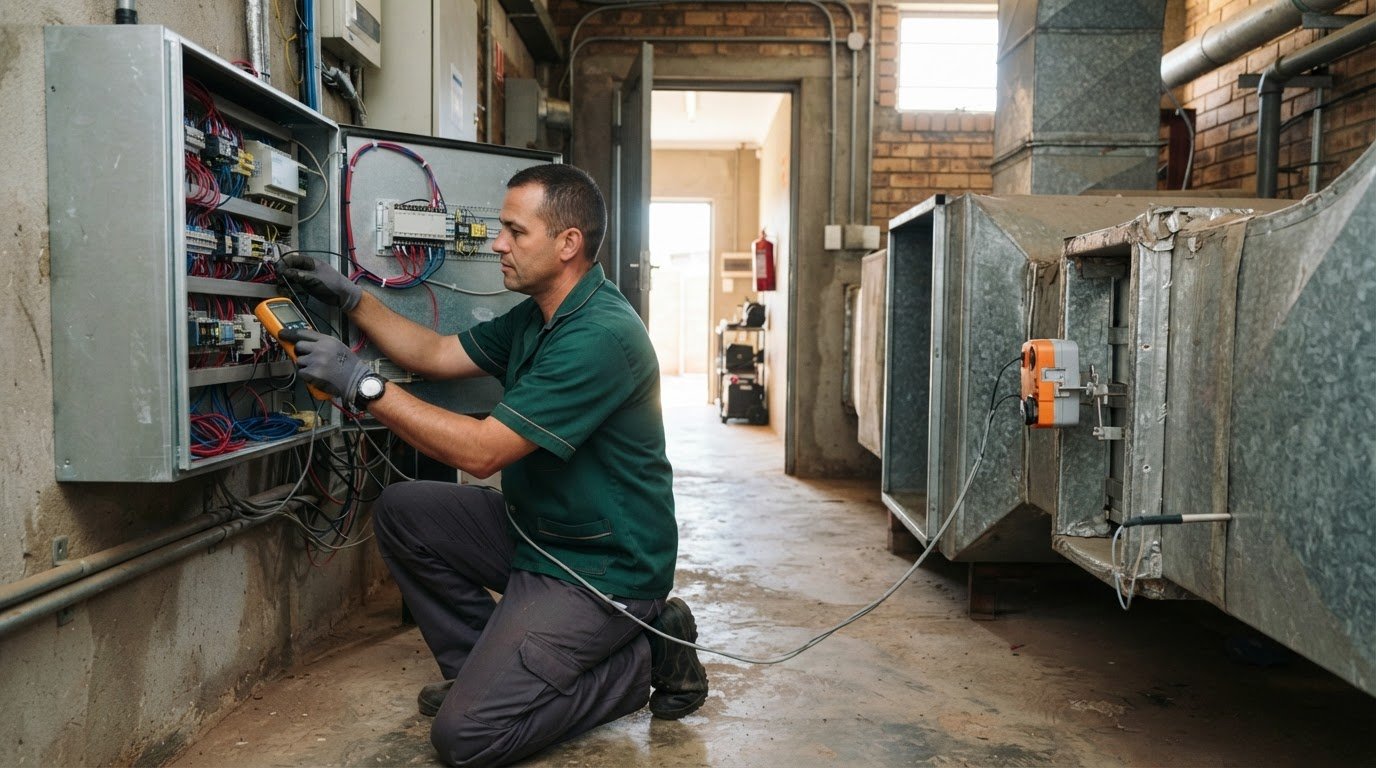
A building’s control system can help teams spot issues early instead of discovering them through discomfort or disruption. A building management system upgrade in Gezina can modernise how a building’s mechanical and electrical services are monitored and controlled. A BMS brings information from systems such as heating, ventilation, air conditioning, lighting and alarms into a more manageable view.
Building systems should work reliably without constant manual adjustment. An upgrade can improve monitoring, support more responsive alarms and scheduling, and help coordinate climate, ventilation and lighting controls. The results depend on the existing equipment and system configuration, so understanding what a BMS does is a useful starting point.
This article explains how a BMS works, when an upgrade may be worthwhile, and how better integration and control can support building operations. It also covers the practical role of HVAC and ventilation systems in creating a comfortable, efficiently managed indoor environment.
Key Takeaways
- Understand how a BMS connects building systems and why integration matters when updating older equipment.
- Learn how better scheduling and energy monitoring can help identify avoidable energy use and improve operational control.
- See how centralised dashboards, alarms and sensor data can help facilities teams spot issues and respond more effectively.
- Explore how Engico Air Conditioning’s ducted systems and BMS integration can support coordinated climate control in a building.
Alarms, integration, scheduling and remote access
A BMS monitors and manages a building’s mechanical, electrical and electromechanical services. Its software can collect alarms, identify affected equipment and support a timely response. For example, an air-conditioning fault alert can help facilities staff locate the system that needs attention. Remote access can also let authorised users view system information away from the control panel.
Integration depends partly on whether equipment can communicate with the BMS. Common protocols include BACnet, LonWorks and Modbus, which support interoperability between devices from different manufacturers. Older buildings may need retrofitting to connect legacy controls with a modern platform. A structured upgrade maps existing controllers and communication links, then identifies which equipment can connect directly and which needs adaptation.
Business systems add another layer. Computer-aided facilities management (CAFM) software manages maintenance, space and resources, while integrated workplace management systems (IWMS) bring together real estate, facilities and sustainability management. Connecting these systems with BMS data can link equipment status to maintenance workflows, helping teams turn an alarm into a recorded task. Building information modelling (BIM) is a 3D imaging process for planning, designing, constructing and managing buildings. Its model can give teams spatial context for locating building assets alongside operational readings.
Scheduling can align operating times with building use. For example, a weekday schedule can set HVAC operation around occupied periods, while alarms flag equipment that does not respond as expected. Integrating security and access control can help coordinate system operation with authorised building use. These connections require clear permissions: remote users need appropriate access, and alarm settings should specify who receives each notification. In Gezina, compatibility, access design and maintenance workflows are central to practical BMS integration.
Energy efficiency and operational cost reduction
A BMS can connect energy use with building operations, helping teams identify where controls may need adjustment. Its value comes from matching equipment schedules and settings to how the building is actually used.
Efficient HVAC and lighting control
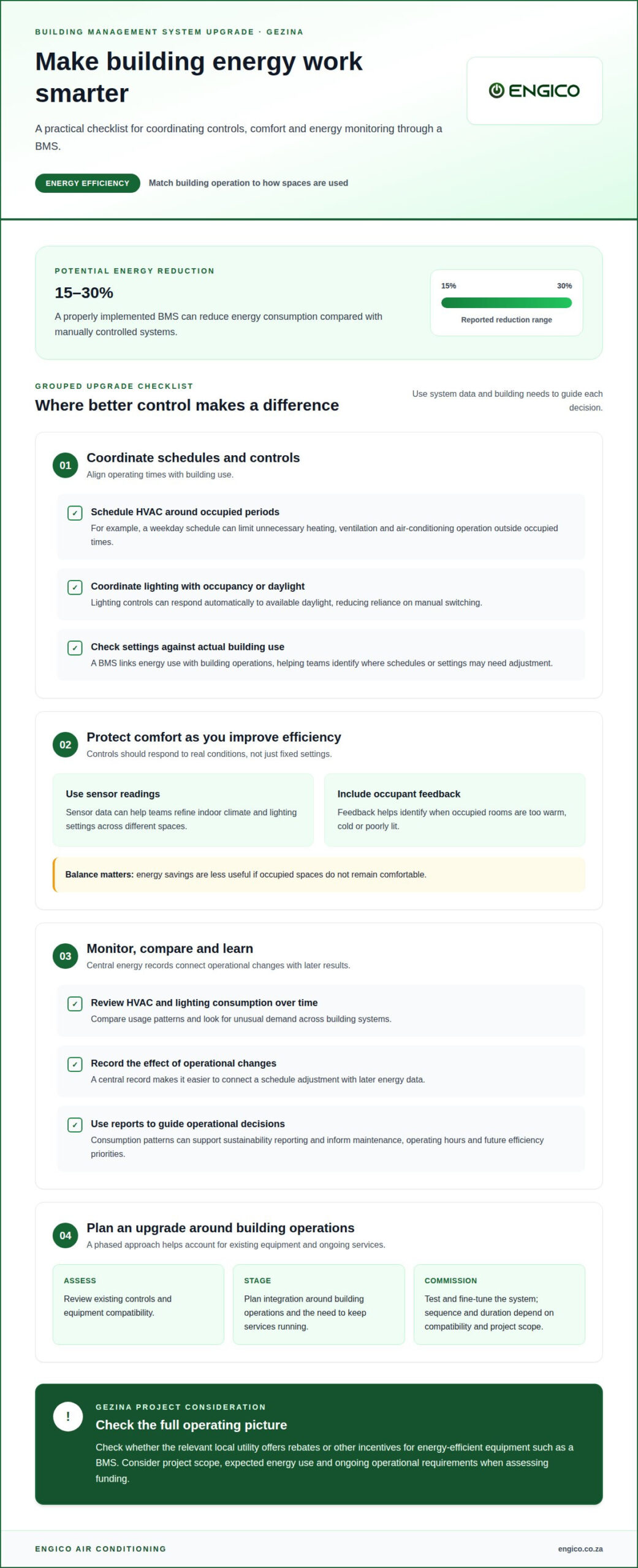
Energy-efficient control uses BMS schedules and system data to coordinate HVAC operation and lighting with occupancy or available daylight. A properly implemented BMS can reduce energy consumption by 15-30% compared with manually controlled systems. For example, a schedule can limit unnecessary HVAC operation outside occupied periods, while lighting controls can respond automatically to daylight. Reviewing those settings helps facilities teams target energy use without relying on manual switching.
Comfort and energy efficiency
Energy efficiency and occupant comfort work together when controls respond to real conditions rather than applying fixed settings everywhere. For example, a BMS can adjust indoor climate and lighting to support comfortable spaces while limiting unnecessary operation in unoccupied areas. Sensor readings and occupant feedback help teams refine settings. Energy savings are less useful if occupied rooms are too warm, cold or poorly lit.
Energy monitoring can also support sustainability reporting by showing consumption patterns across building systems. Facilities teams can compare HVAC and lighting use over time, identify unusual demand and document the effects of operational changes. A central record makes it easier to connect a schedule adjustment with later energy data. These reports support informed decisions about maintenance, operating hours and future efficiency priorities.
In an occupied building, an upgrade is typically planned in phases: assess existing controls, stage integration around building operations, then commission and fine-tune the system. The sequence and duration depend on equipment compatibility, project scope and the need to keep services running during the work.
For a Gezina project, check whether the relevant local utility offers rebates or other incentives for energy-efficient equipment such as a BMS. Funding decisions should account for project scope, expected energy use and ongoing operational requirements.
Energy-management integration can help align control capabilities with the building’s operating needs.
Centralised monitoring and real-time dashboards
A central interface brings building-system readings together so teams can monitor performance and identify issues. The most useful dashboard depends on the building’s equipment and operational needs.
Building systems monitored by the BMS
A BMS monitors and controls technical systems such as HVAC, lighting, energy, security and fire safety. Bringing these components into one interface helps facilities teams see how systems perform together. For example, a dashboard can show an air-conditioning fault alongside relevant operating data, helping staff identify the affected equipment. Offices, retail buildings and apartments in Gezina can prioritise systems according to their use and installed equipment.
IoT connectivity and sensor data
IoT connectivity links devices and sensors so their readings can be collected and viewed through a BMS. Sensors detect environmental changes, while controllers and actuators carry out system commands. A dashboard can present readings from different areas, helping staff investigate changes in temperature, lighting or equipment status. Sensor data is most useful when teams understand what each reading measures and how it relates to building operations.
Security and fire-safety monitoring can bring relevant system status into the central interface. This gives facilities staff a shared view of alerts alongside HVAC or lighting information, supporting a coordinated response. The BMS can also log and analyse data, helping teams distinguish recurring faults from isolated events.
A site assessment should map installed systems, equipment condition, sensor coverage, communications and the building’s operating needs. For an office, retail space or apartment building, this identifies which devices can connect directly and where legacy components may need retrofitting. It also clarifies which data and alerts belong on the dashboard.
Upgrade risks include incompatible components, inaccurate readings and disruption while controls are changed. To limit downtime, plan work around building operations, stage integration by system and test each group of components before transferring control. Maintaining existing operating arrangements during staged testing can help keep services running.
Indoor climate, ventilation and lighting control
A BMS uses sensor readings and control settings to coordinate indoor conditions with building use. In an occupied office, it can help align HVAC, ventilation and lighting operation with changing conditions.
For HVAC optimisation, sensors detect environmental changes and the BMS can adjust equipment through connected controls. For example, actuators can adjust HVAC dampers in response to system commands. This lets facilities teams coordinate climate settings rather than rely solely on fixed manual adjustments. Sensor accuracy matters: readings can develop an error of up to one degree over time, which must be offset to keep control decisions aligned with actual conditions.
Ventilation control can help maintain airflow and reduce indoor carbon dioxide. A BMS can use environmental readings to inform ventilation adjustments, while industrial ventilation fans and louvers form part of the wider system. The practical control strategy depends on building use, occupied areas and how the ventilation equipment responds. Coordinating these factors helps balance indoor conditions with energy management.
Lighting control can respond automatically to occupancy or available daylight. In a room with strong daylight, the BMS can adjust lighting circuits; in an unoccupied area, settings can limit unnecessary operation. Predictive control uses operating patterns and sensor information to anticipate changing demand, allowing HVAC and lighting schedules to be adjusted before conditions shift. This supports coordinated control without treating every space identically.
Coordination between contractors and suppliers matters because BMS controls connect equipment from different disciplines. HVAC, ventilation, sensors, actuators and electrical lighting controls need compatible settings and clear commissioning responsibilities. Documenting each component’s role during an upgrade helps teams test whether a sensor reading produces the intended response, such as a damper adjustment or lighting change.
For coordinated building controls, discuss BMS integration for your building’s HVAC and ventilation requirements.
Engico Air Conditioning: Ducted Air Conditioning Systems
Engico Air Conditioning can help buildings bring ducted air conditioning and building controls together. Ducted systems can suit spaces that need air distributed through connected ductwork, while Building Management System Integration can link HVAC controls with wider building operations.
This is a relevant next step when a BMS upgrade also involves reviewing how air conditioning is controlled across the building. The appropriate system depends on the building layout, current equipment and climate-control requirements. Wall-mounted split and multi-split air conditioners are options for other installation needs.
For a Gezina project, discuss how ducted air conditioning and BMS integration can support your building’s operating requirements. Contact Engico Air Conditioning to talk through your project.
Plan your building’s next control upgrade
As you plan the next stage, define what the building’s controls need to achieve as operations change. Consider which areas need independent climate control, how equipment should fit existing spaces, and what information facilities teams need to manage daily performance. These priorities can shape a practical scope for a building management system upgrade in Gezina, guided by the building’s layout and current systems.
Air-conditioning equipment is part of this planning. Engico Air Conditioning offers wall-mounted split, multi-split and ceiling cassette air conditioners, as well as ducted systems and Building Management System Integration. The right combination depends on the building’s requirements and how its systems need to operate together.
A clear discussion of the building’s needs can help establish a suitable direction for the work. Contact Engico Air Conditioning to discuss your project and its climate-control requirements.
Frequently Asked Questions
What is BMS and why is it Necessary?
A BMS, or building management system, is a computer-based system that supervises a building’s technical services. It is useful when owners need a coordinated view of equipment operation rather than managing each control separately. For example, facilities staff can use recorded data to investigate recurring faults, plan maintenance priorities and make operational decisions based on building performance.
What building management system (BMS) upgrade services are available in Gezina, Pretoria?
Engico Air Conditioning provides Building Management System Integration for HVAC control, alongside ducted, wall-mounted split, multi-split and ceiling cassette air-conditioning systems. A building management system upgrade in Gezina may suit a property needing its climate-control equipment integrated with building operations. Local coverage includes Pretoria, Johannesburg, Centurion, Menlyn, Silverton, Waterkloof, Gezina, Doringkloof, Midrand, Waterfall, Sunninghill, Woodmead, Sandton, Randburg, Roodepoort, Fourways, Gauteng Province and Hyde Park.
How much does a BMS upgrade cost in Pretoria, South Africa?
The cost depends on project scope and is provided after a quote request. For a Pretoria commercial building, the estimate is shaped by existing controllers and sensors, system compatibility, equipment requiring replacement, areas covered, integration with HVAC or other building systems, and commissioning needs. A site review helps define the work, so a software change and a broader controls upgrade can be assessed according to their different requirements.
What factors affect the cost of upgrading a commercial building management system?
Commercial upgrade costs are affected by project scope and the resources needed to support the system after installation. Allow for software updates, possible annual software licensing fees, trained technicians, system testing and inspection. Commissioning and staff training also affect planning. A proposal should distinguish implementation work from ongoing system costs, helping owners assess operational commitments alongside the initial upgrade.
How do modern BMS platforms compare for HVAC, lighting, access control, and energy monitoring?
Compare platforms by how they handle the functions your building prioritises, such as HVAC controls, lighting schedules, access-control connections and energy monitoring. A unified interface may suit teams that need a shared operational view, while a specialist platform may focus more narrowly on one system. Also consider supported equipment, user permissions, data exports and reporting tools, as these affect everyday usefulness.
Which South African building, electrical, and energy-efficiency regulations apply to BMS upgrades?
Applicable South African requirements depend on the work involved, such as building changes, electrical alterations or energy-efficiency measures. A software configuration change differs from replacing controllers or modifying electrical circuits, so the project scope determines which requirements apply. Define software and physical work separately, then assess each against the relevant South African building, electrical and energy-efficiency rules before implementation.
Recent Comments