
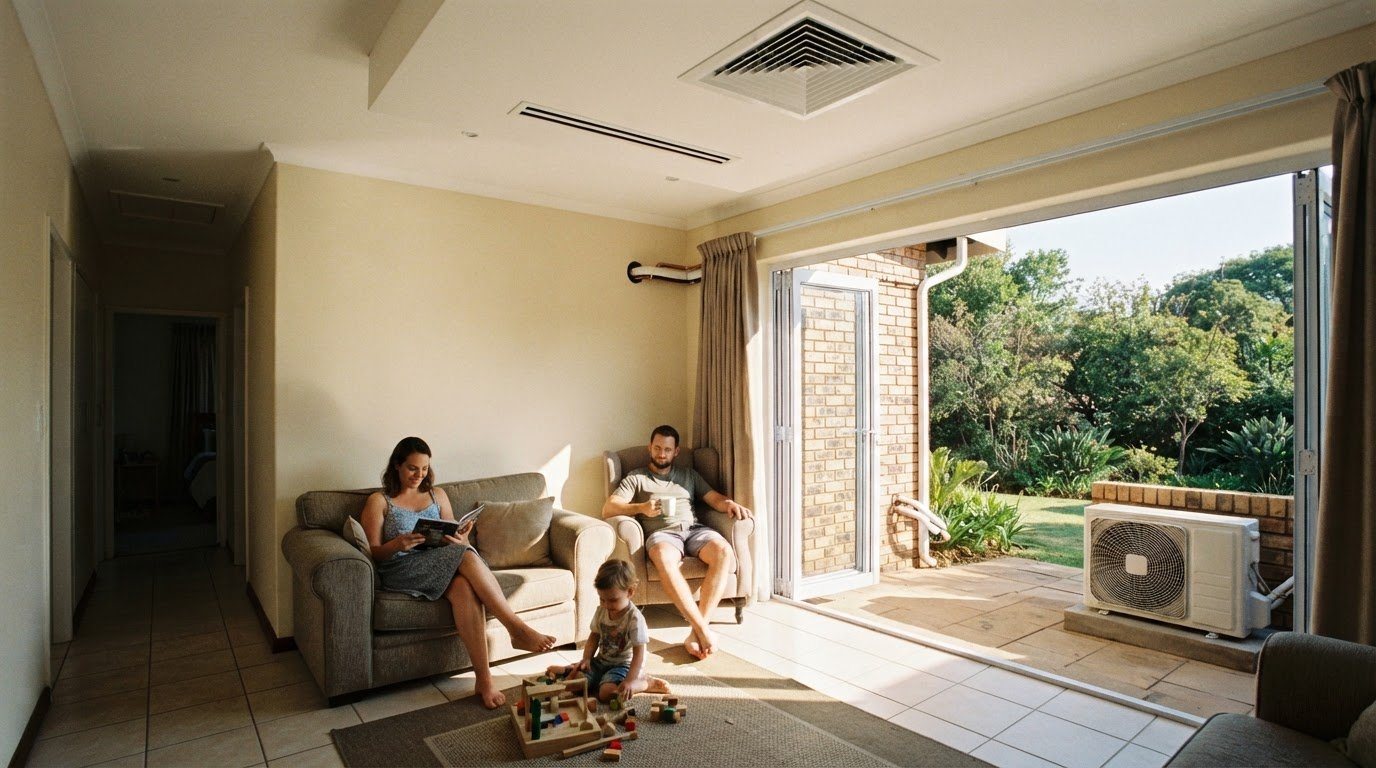
A large Pretoria home’s cooling capacity doesn’t tell you what its ducted air conditioning will cost to run. The cost of running ducted air conditioning in a large house Pretoria depends more on the system’s electrical input, how many hours it operates and which areas you cool than on floor area alone.
It’s reasonable to want a clear monthly estimate before committing to whole-home cooling. But cooling capacity and electricity consumption are different measures, and a generic figure can overlook your household’s routines, system settings and electricity tariff. Your bill can help identify the rate to use, while the equipment’s details and expected operating pattern make the calculation more relevant to your home.
This guide explains the main factors behind running costs and shows how to estimate energy use from your system and electricity bill. It also covers practical ways to manage consumption, including zoning and sensible temperature settings, and how project-specific planning can help you understand expected use in a large Pretoria home.
Key Takeaways
- Separate cooling capacity from electrical input: running cost depends on the electricity the system uses and your applicable tariff.
- Estimate the cost of running ducted air conditioning in a large house Pretoria by multiplying electrical input in kW by operating hours to calculate kWh, then applying your tariff.
- Match cooling hours to your household’s routines and keep thermostat settings consistent to help manage use.
- A site visit and design discussion can connect the system plan to your home’s layout. Engico’s installation process includes design and quotation, installation, project management and training.
Why ducted air conditioning costs vary in a large Pretoria home
Homeowners need a usable estimate, not a universal promise based on house size. The cost of running ducted air conditioning in a large house Pretoria depends on the electricity the system consumes while operating and the tariff charged for that electricity. In simple terms, running cost is estimated kWh multiplied by the applicable rate in R/kWh.
The home itself affects how much cooling is needed. A layout with open living areas may behave differently from one with separate rooms and closed doors. Occupancy patterns matter too: cooling empty rooms for much of the day can add demand without improving comfort where people are gathered. Insulation, window glazing and the amount of direct sun entering rooms also influence how quickly heat builds up and how long cooling is needed.
Your address alone doesn’t identify the rate on your bill. Pretoria households may have different electricity suppliers or tariff arrangements, so use the tariff and billing details shown on your household account. If your tariff uses consumption bands, check which rate applies to the energy you’re estimating rather than assuming one rate applies to every unit used.
Cooling capacity is not the same as electricity use
Cooling capacity describes how much heat a system can remove, commonly expressed in kW. Electrical input is the power the equipment draws to operate, also expressed in kW. These figures describe different things: capacity alone doesn’t show how much electricity the system will use over a day or month.
Actual consumption depends on operating hours, demand and how the system serves the home. A duct layout can also affect how air is delivered between rooms. Ducted air distribution and ductwork design provides technical background on this relationship. A project-specific assessment can therefore give a more useful basis for estimating energy use than floor area or cooling capacity alone.
How to estimate ducted air conditioning electricity costs for your Pretoria home
A practical estimate starts with the equipment’s electrical input and your household’s pattern of use, not its cooling capacity. The calculation won’t predict every change in demand, but it gives you a consistent way to compare expected energy use with the tariff on your bill.
Which figures should homeowners gather before estimating?
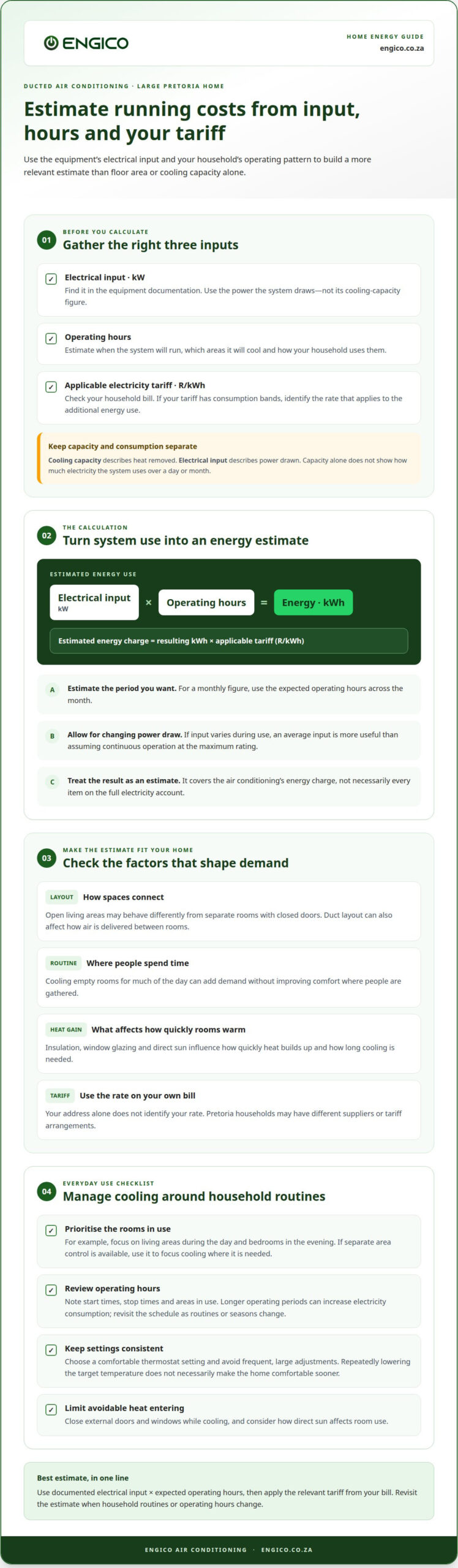
Look in the system documentation for its electrical input, expressed in kilowatts (kW). Don’t substitute the cooling-capacity figure: it measures heat removed, not electricity drawn. You’ll also need to estimate the hours the system operates and find the applicable electricity tariff on your household bill. If the system’s power draw varies during use, an average input will make the estimate more useful than assuming it runs continuously at its maximum rating.
- Find the electrical input. Use the equipment documentation to identify the input in kW.
- Estimate operating hours. Record likely use, taking account of which areas are cooled and when the system runs.
- Calculate energy use. Multiply electrical input by operating hours to estimate consumption in kilowatt-hours (kWh).
Estimated energy use (kWh) = electrical input (kW) × operating hours. To estimate the energy charge, multiply the resulting kWh by the applicable tariff in R/kWh from your bill. This estimates the air conditioning’s energy charge, not necessarily every item on the full electricity account.
For a simple example, use the average electrical input shown in the equipment documentation and multiply it by the expected hours of operation for the period you’re estimating. Then multiply the resulting kWh by the applicable tariff to estimate the energy charge. This is an estimate, not a Pretoria average or a prediction for every home. For a monthly figure, use the expected operating hours across the month and revisit the calculation as routines change. If your tariff has different consumption bands, account for the rate that applies to the additional energy use.
Air distribution also matters to system performance. ENERGY STAR offers duct sealing and insulation guidance that can help homeowners understand the role of ductwork. For a home-specific system plan, Engico’s ducted air conditioning design and installation process can relate the proposed system to the property’s needs.
Practical ways to manage ducted air conditioning use in a large house
In a large home, comfort doesn’t require every room to be cooled all day. Plan use around where people spend time: for example, prioritise living areas during the day and bedrooms in the evening. If the system supports separate area control, use it to focus cooling where it’s needed. This makes household routines, rather than the home’s total floor area, the basis for daily operation.
Match operating hours to the household’s routine
Note when rooms are occupied and when cooling is genuinely useful. A simple record of start times, stop times and areas in use can reveal where the schedule could be adjusted. Longer operating periods can increase electricity consumption, although actual use varies with outdoor conditions, indoor heat gains and how the system is operated. Review the schedule as routines or seasons change.
Choose a comfortable thermostat setting and avoid making frequent, large adjustments. A steady setting can support more consistent operation; repeatedly lowering the target temperature doesn’t necessarily make the home comfortable sooner. Close external doors and windows while cooling, and consider how direct sun affects room use. For instance, a sunlit room may need cooling earlier than a shaded space, so plan its use accordingly rather than automatically cooling every area for the same length of time.
Good upkeep matters too. Scheduled maintenance keeps the system serviced, while inspection and cleaning can help identify issues that affect operation. Engico provides preventive maintenance and duct cleaning as part of its HVAC services. For further background on duct placement, airflow and maintenance, see University of Florida extension research on minimising duct energy losses.
These habits give homeowners practical ways to manage the cost of running ducted air conditioning in a large house Pretoria, without assuming that one schedule suits every household. Arrange ducted air conditioning maintenance with Engico to support ongoing system care.
Planning ducted air conditioning for a large Pretoria home with Engico
A useful running-cost estimate starts with a system plan that reflects the home, not a generic figure based on floor area. A site visit and design discussion help relate the proposed ducted air conditioning system to the property’s layout, household routines and cooling needs. That gives homeowners a clearer basis for considering expected electricity use before installation.
What a project-specific plan helps clarify
Room arrangement, areas used at different times and the household’s preferred operating schedule all inform the design. The estimate can then use the proposed system’s actual electrical input and realistic operating hours, alongside the applicable electricity tariff shown on the household bill. These inputs make the calculation relevant to the planned system and household, while recognising that actual use can vary with conditions and behaviour.
Engico’s installation process is structured around the project: it begins with an initial discussion, followed by a site visit, design and quotation, installation, project management and training. Each stage helps connect the system plan with the home and gives the homeowner a clearer understanding of how the installation will be managed and operated.
Engico focuses on energy-efficient HVAC solutions, with system planning tailored to the property. Efficiency is an important consideration, but it isn’t a promise of a particular saving or electricity bill. A realistic estimate depends on the chosen equipment, how the household uses it and the tariff that applies.
Engico serves homes and businesses across Gauteng, including Pretoria, Johannesburg, Centurion, Menlyn, Silverton, Waterkloof, Gezina, Doringkloof, Midrand, Waterfall, Sunninghill, Woodmead, Sandton, Randburg, Roodepoort, Fourways and Hyde Park.
If you’re planning a ducted system for a large Pretoria home, you can discuss a ducted air conditioning solution with Engico and explore a plan suited to your property.
Make your next step a home-specific plan
A useful next step is to turn your household’s cooling priorities into a system plan that can be assessed against real equipment data and your electricity tariff. That gives you a more grounded way to consider the cost of running ducted air conditioning in a large house Pretoria before deciding how the system should serve your home.
Engico supplies and installs ducted air conditioning systems, with fully licensed, factory-trained and insured technicians. A tailored discussion can help connect the project requirements with a suitable approach, without relying on a generic running-cost promise or assuming a particular bill outcome.
There’s no need to settle for an estimate that doesn’t reflect your home. Discuss a ducted air conditioning solution for your Pretoria home and take a considered next step towards comfortable, well-planned cooling.
Frequently Asked Questions
Does ducted air conditioning use more electricity than a split system?
Not automatically. To compare the cost of running ducted air conditioning in a large house Pretoria with a split system, look at equipment input and use under similar conditions. For example, compare systems serving the same rooms for the same hours, rather than comparing a whole-home ducted system with a split unit cooling one bedroom. Actual household consumption depends on the system and how it’s used.
Can ducted air conditioning cool only selected rooms?
It depends on the installation’s design and controls. A system planned around your household’s routines may address different areas according to when they’re used, but separate room control shouldn’t be assumed. For example, note whether bedrooms, living spaces or a home office need cooling at different times. Sharing these preferences during design discussions helps shape a system plan around the areas where comfort matters most.
Does ducted air conditioning use electricity when switched off?
Some systems may draw a small amount of standby power, depending on their controls and configuration. The amount varies, so don’t add an assumed figure to your estimate. Check the equipment documentation for standby consumption if you want to include it. Also distinguish standby use from active cooling: your estimate of operation should reflect the hours the system is actually running, not simply the time it remains connected.
Can maintenance affect the running cost of ducted air conditioning?
Maintenance can help keep a system serviced and address issues such as dirty filters or restricted airflow, but it can’t guarantee a particular reduction in electricity use. If airflow seems weaker than usual or the system’s operation changes, arrange servicing rather than assuming the cause. Engico provides scheduled preventive maintenance and duct cleaning as part of its HVAC services, supporting ongoing care of ducted systems.
Recent Comments