
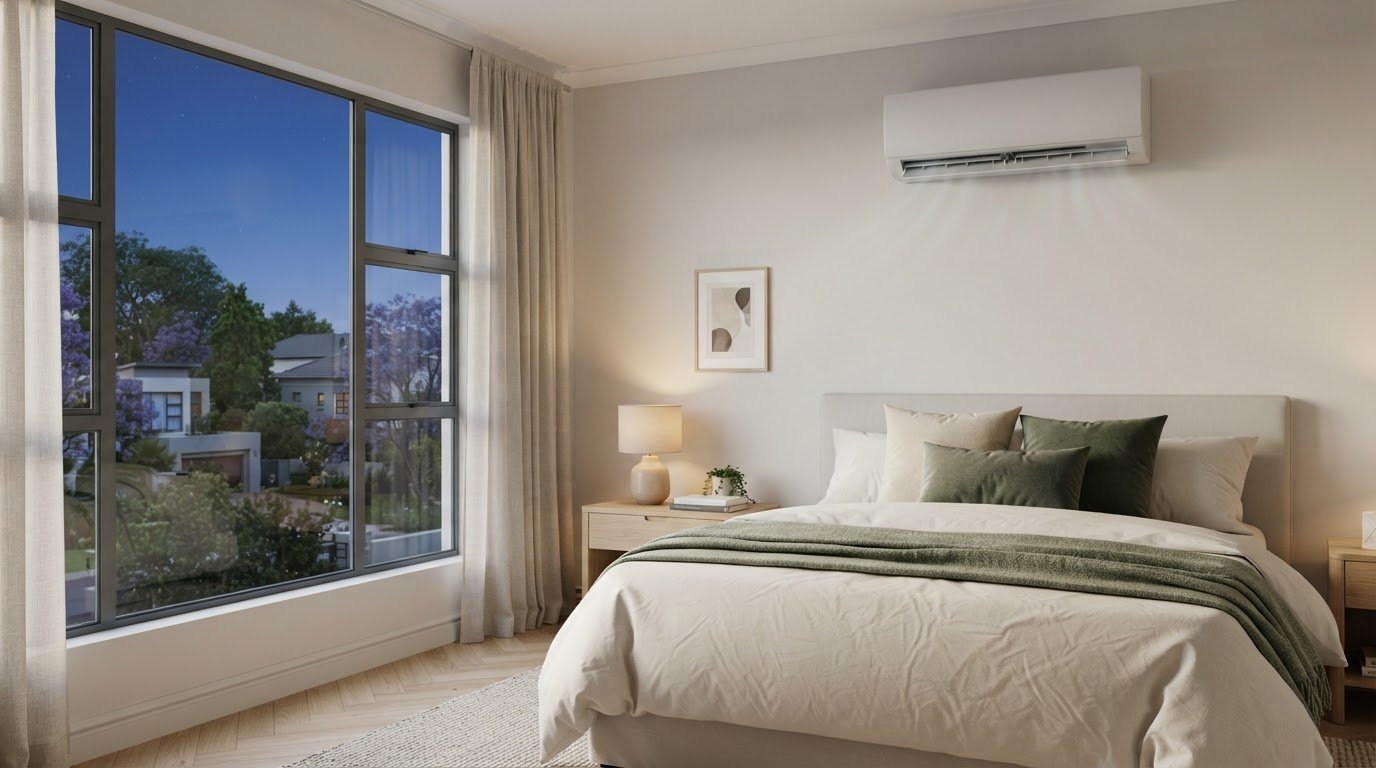
What if the quietest number on an air conditioner’s label isn’t what determines whether you sleep well? Choosing a quiet air conditioner for bedroom South Africa homes depends on more than comparing decibels. Room size, airflow and installation can all affect what you hear at night.
Noise ratings are useful, but only when you know which operating mode and measurement conditions they describe. This guide covers what to compare, how to assess a bedroom’s cooling needs and placement, and what to consider for installation and maintenance. It also explains why the positions of both indoor and outdoor units matter to comfort.
Engico supplies and installs residential wall-mounted split and multi-split air conditioners. The turnkey process includes an on-site visit, design and quotation, installation, project management and training. Considering the room and installation alongside the unit’s noise rating helps you make a more informed choice.
Key Takeaways
- Compare indoor-unit noise ratings only when the operating mode and manufacturer’s measurement conditions are equivalent.
- Consider windows, sun exposure, ceiling height and how the bedroom is used when discussing cooling capacity.
- Include indoor and outdoor unit positions in the installation plan, since placement can affect bedroom comfort.
- When choosing a quiet air conditioner for bedroom South Africa homes, bring room details and manufacturer noise specifications to a discussion about Engico’s wall-mounted or multi-split options.
What makes a quiet air conditioner suitable for a South African bedroom?
A suitable bedroom air conditioner should cool the room effectively without creating disruptive noise or airflow. The right fit depends on both the equipment and the space: a low noise figure alone can’t tell you whether a system will feel comfortable in your bedroom. For a quiet air conditioner for bedroom South Africa homes, consider the model’s sound information alongside the room’s cooling needs and how you use the space.
A low-noise specification describes sound measured under stated conditions; it doesn’t guarantee a silent experience in every bedroom. Ratings are specific to a model and operating mode. A figure for a low-fan setting shouldn’t be treated as the sound level in every mode. Sound pressure ratings, often expressed in dBA, help describe sound levels, but how noticeable a sound feels also depends on the surrounding environment and the listener.
Why bedroom comfort is more than a low noise figure
Sound is only one part of sleep comfort. Airflow directed towards a bed may feel intrusive, while a unit that can’t meet the room’s cooling needs may leave the space uncomfortable. People also differ in their sensitivity to sound: a steady hum that one person barely notices may bother a light sleeper, particularly when the rest of the room is quiet. Consider sound, air direction and cooling together instead of treating one rating as a universal comfort threshold.
South African room conditions that affect the choice
Start by noting the bedroom’s dimensions, window size and position, sun exposure, ceiling height and typical use. Include whether the door is usually open or closed. These details help inform a suitable system instead of relying on floor area alone. Conditions vary across South Africa; even within Gauteng, a shaded bedroom and one exposed to direct sun may have different cooling demands.
Bring these details into the assessment before comparing equipment. They provide useful context for weighing the manufacturer’s noise information against the level of cooling the bedroom needs.
How to compare bedroom air conditioner noise in South Africa
Start by comparing the indoor unit’s sound rating, then check the conditions behind the number. A noise rating only makes sense alongside the operating mode and test conditions stated by the manufacturer. A quiet-mode figure for one model isn’t directly comparable with a standard-operation figure for another.
| What to compare | What to record | Why it matters |
|---|---|---|
| Indoor-unit rating | Published sound level and whether it is expressed in dBA | Identifies the sound attributed to the indoor unit under stated conditions. |
| Operating mode | The exact mode or fan setting used for the rating | Shows whether the figures describe equivalent operation. |
| Measurement context | Manufacturer’s notes on how and where the sound was measured | Helps explain differences between published figures. |
| Other sound sources | Airflow noise and any separate outdoor-unit rating | Keeps these sounds distinct from the indoor-unit figure. |
What a decibel rating can and cannot tell you
Decibels describe sound level, not how every sleeper will experience it. A rating is useful for comparing like with like, but it can’t guarantee that a particular bedroom will feel silent. Check the manufacturer’s current documentation for the specific model and note its test conditions. If the measurement methods differ, don’t treat the figures as directly comparable.
Which operating details matter at night?
Compare low-fan, sleep or other operating modes only if the manufacturer lists them for that model, and use the rating supplied for the exact mode. A mode name alone doesn’t tell you its sound level. Also consider the indoor unit’s position and whether its airflow would reach the bed. The ENERGY STAR room air conditioner sizing guidelines offer additional context on room suitability, which you can consider alongside sound specifications.
For a bedroom installation, Engico’s residential air conditioner assessment and installation brings equipment choice and placement into the same discussion.
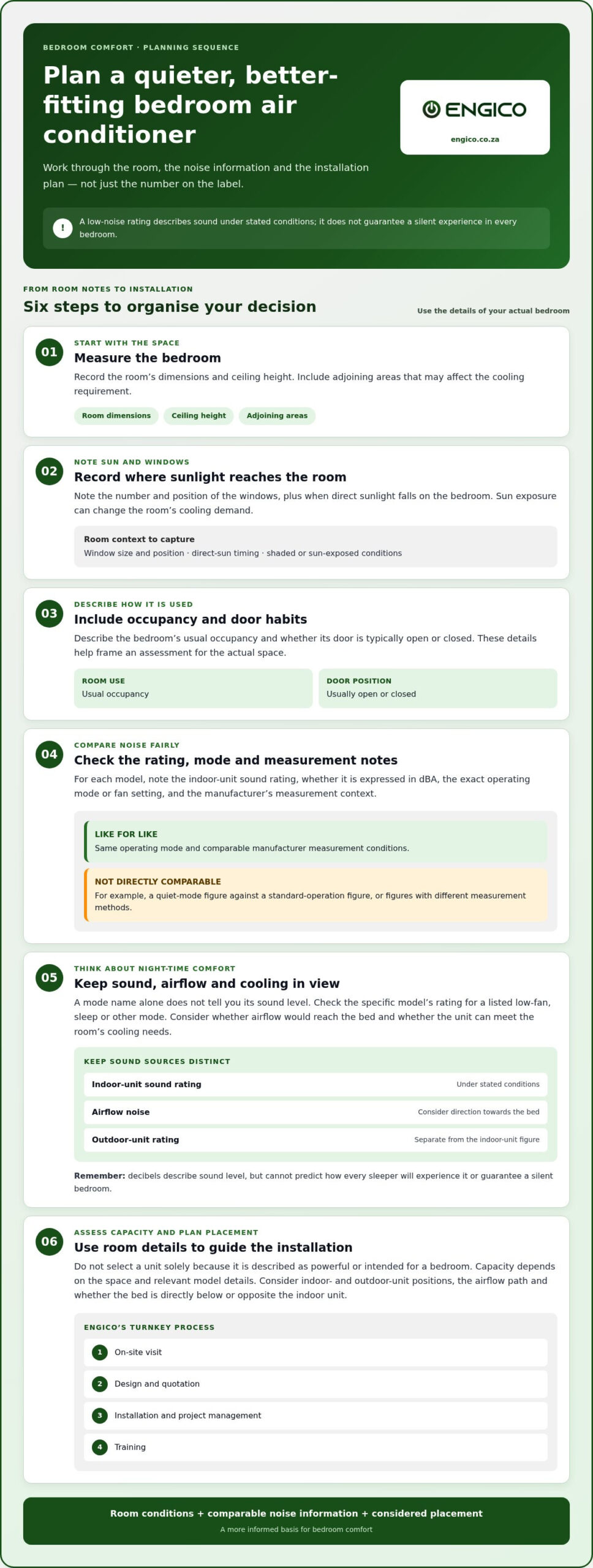
Bedroom air conditioner sizing, placement and installation: a practical checklist
Choose a quiet air conditioner for bedroom South Africa homes by considering the room and installation, not just the equipment label. Use this checklist to organise the decision before selecting a system.
Assess the bedroom before selecting a unit
A room assessment is a better starting point than choosing by room type alone. Two bedrooms described as “standard” may differ in size, sunlight, ceiling height and use. Record the details below so the cooling capacity and placement can be considered for the actual space.
- Measure the room. Note its dimensions and ceiling height, and include any adjoining areas that may affect the cooling requirement.
- Record windows and sun exposure. Note the number and position of windows, and when direct sunlight reaches the room.
- Describe room use. Include usual occupancy and whether doors are typically open or closed. These details help frame the assessment.
- Discuss capacity. Use the room information to guide a professional assessment. Don’t choose a unit solely because it is described as powerful or intended for a bedroom; capacity depends on the space and the relevant model details.
Plan placement and professional installation
Unit position affects where cooled air travels and how noticeable the sound may be near the bed. Consider the airflow path before deciding where to place the indoor unit, especially if the bed is directly below or opposite a possible installation point. Give the outdoor unit’s position the same consideration.
- Plan the layout. Review the bed position, airflow direction and practical options for locating the indoor and outdoor units.
- Review the installation plan. Engico’s turnkey process includes an on-site visit, design and quotation, installation and project management, followed by training.
For a bedroom-specific assessment and installation, discuss a bedroom installation with Engico.
Choose a quiet bedroom air conditioner with Engico in Gauteng
For a useful discussion about a quiet air conditioner for bedroom South Africa homes, bring together the details that shape equipment choice and installation. Have the room dimensions, window and sun exposure notes, ceiling height and usual occupancy ready. Add your preferred indoor-unit position, any concerns about airflow near the bed, and the manufacturer’s noise specifications, including the operating mode and measurement conditions for each rating.
Engico supplies and installs residential wall-mounted split and multi-split air conditioners. The right option depends on the home and installation requirements, so consider the room, unit positions and manufacturer information as a whole.
What to expect from Engico’s installation process
The process begins with initial contact and an on-site visit. Engico then carries out design and quotation, followed by installation and project management, with training included as part of the turnkey service. This gives the room assessment and installation plan a clear place in the decision, rather than leaving them until after equipment selection.
Keep bedroom performance in view after installation
Engico’s maintenance and repairs include filter and coil cleaning, refrigerant checks, leak detection, airflow measurement and thermostat accuracy checks. When you buy a new air conditioner from Engico, free one-year maintenance and repairs apply to that purchase.
These checks help review airflow and system operation over time. Engico’s local service covers Pretoria, Johannesburg, Centurion, Menlyn, Farie Glen, Silverton, Waterkloof, Gezina, Doringkloof, Midrand, Waterfall, Sunninghill, Woodmead, Sandton, Randburg, Roodepoort, Fourways, Gauteng Province and Hyde Park. Explore residential air conditioning with Engico to discuss a room-specific installation.
Make your bedroom cooling decision with confidence
The right choice fits how your household uses the bedroom, not simply the unit with the most appealing headline specification. Before deciding, consider what matters most during rest: steady comfort, limited noticeable airflow or keeping sound unobtrusive for a light sleeper. Agreeing on these priorities can make equipment discussions more focused and help set realistic expectations.
For a quiet air conditioner for bedroom South Africa homes, take a considered approach rather than choosing a model based on one figure. Keep the manufacturer’s information alongside your household’s priorities, then use both to guide a tailored decision. The aim is a system suited to the space and the people who sleep in it.
Explore residential air conditioning with Engico and take the next step towards a bedroom solution that feels right for your home.
Frequently Asked Questions
Is a quiet air conditioner completely silent?
No. “Quiet” describes sound that may be less noticeable, not an absence of sound. You may still hear air moving or the unit operating, and the sound can seem more apparent in a bedroom with little background noise. If you’re particularly sensitive to sound, consider how you respond to steady airflow as well as mechanical noise before making your choice.
Can an air conditioner’s sound change during the night?
Yes. The sound you notice can vary as the unit operates under changing conditions or you select a different fan setting. A room that becomes quieter after other household activity stops may also make the air conditioner seem more prominent, even if its operation hasn’t changed. Keep the settings and room conditions in mind when assessing what you hear overnight.
How do I compare noise ratings between air conditioners?
Compare the same type of rating for the same operating mode, and read the manufacturer’s measurement notes. For example, a low-fan figure shouldn’t be compared directly with a rating for standard operation. Also check whether the number describes the indoor or outdoor unit. For a bedroom decision, focus on indoor-unit information, while considering airflow and the outdoor unit’s position separately.
What size air conditioner do I need for a bedroom?
There isn’t one size that suits every bedroom. As a broad Gauteng highveld benchmark, standard ceiling heights and typical insulation may call for around 500 to 600 BTU per square metre, but this isn’t a substitute for a room assessment. Choose a quiet air conditioner for bedroom South Africa homes with room dimensions, sun exposure, windows and ceiling height in view.
How often should a bedroom air conditioner be maintained?
Follow the maintenance schedule in the manufacturer’s instructions, as the appropriate timing depends on the unit and its use. Regular checks can include cleaning filters and coils, checking refrigerant levels, leak detection and measuring airflow. If cooling or airflow changes, or unusual sounds develop, note what has changed and arrange an assessment rather than assuming the issue is simply routine filter cleaning.
Recent Comments