
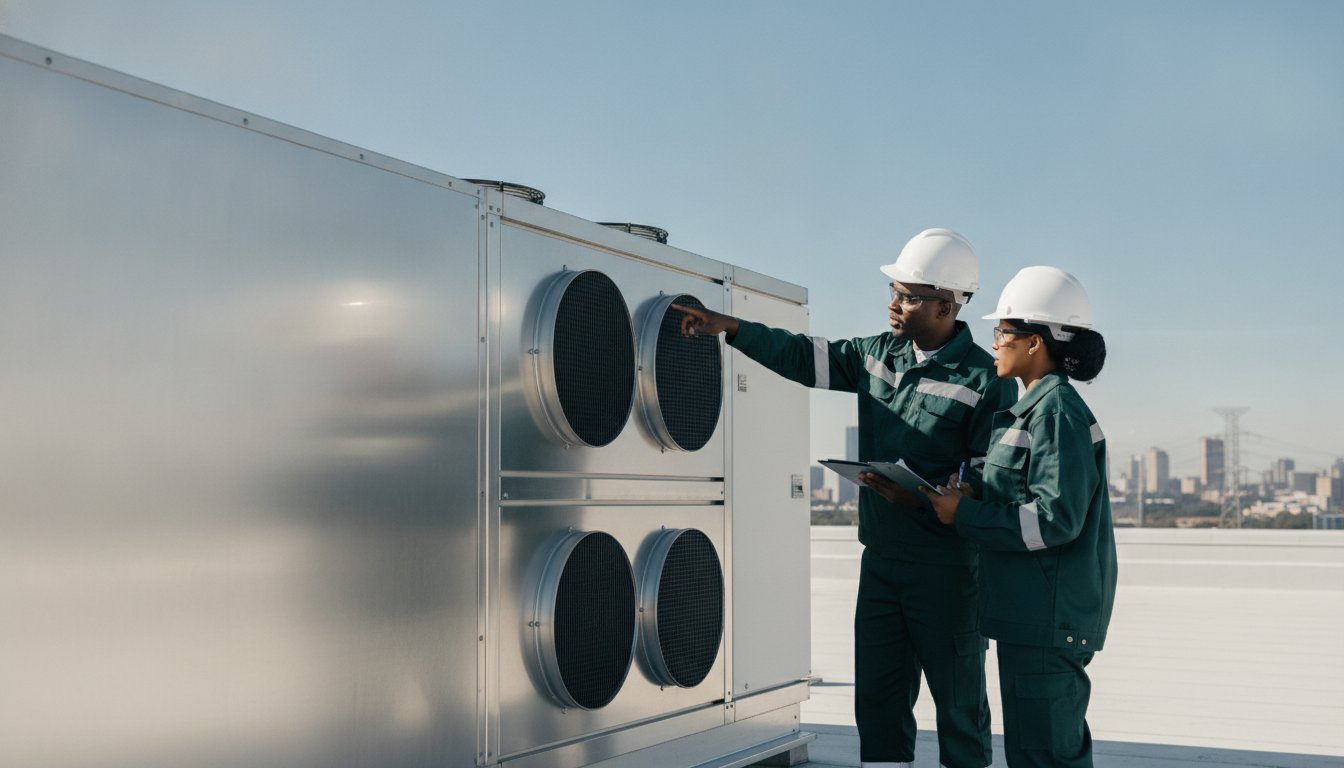
With Eskom’s standard tariffs rising by an average of 8.76% in April 2026, the cost of simply moving air has become a primary concern for facility managers across Gauteng. Effective industrial ventilation system design South Africa requires more than just installing fans; it demands a precise balance between regulatory compliance and operational economy. You likely understand that maintaining air quality is vital for worker health, yet the pressure to reduce overheads whilst meeting the latest SANS 10400-XA:2021 energy standards has never been higher.
We agree that managing extreme heat loads in Johannesburg or Pretoria warehouses shouldn’t compromise your bottom line or your safety record. This guide provides the technical expertise needed to master the 2026 regulatory landscape, including the Physical Agents Regulations and the Highveld Priority Area requirements. We’ll examine how smart technology integration and high-performance air handling units can help you recover costs through the Section 12L tax incentive. You’ll gain a clear roadmap for designing a system that ensures long-term reliability and professional excellence in any industrial environment.
Key Takeaways
- Identify the critical technical specifications for industrial fans and louvers to maintain precise airflow control in large-scale environments.
- Master the complexities of industrial ventilation system design South Africa by accounting for the unique air density and heat load challenges found in Gauteng.
- Navigate the latest regulatory frameworks, including SANS 10400-O and the OHS Act, to ensure your facility meets mandatory health and safety standards.
- Learn how integrating Building Management Systems and energy-efficient components can significantly lower your facility’s monthly operational costs.
- Understand the importance of a methodical, turnkey approach to installation and maintenance for ensuring long-term system reliability.
Fundamentals of Industrial Ventilation System Design in South Africa
Industrial ventilation is the purposeful control of air quality and temperature amongst large-scale environments. It involves a systematic approach to air exchange that goes far beyond simple cooling. In the context of industrial ventilation system design South Africa, this process ensures that facilities remain compliant with health standards whilst managing the heavy thermal loads typical of the Highveld. Relying solely on insulation is a common mistake; without active air exchange, heat and pollutants remain trapped regardless of how well a building is wrapped.
Effective industrial ventilation system design South Africa starts with a rigorous assessment of the specific site conditions in areas like Pretoria or Johannesburg. A professional design phase prevents the need for costly retrofitting later. It’s much simpler to integrate air handling units or ducting during the initial build than to modify a finished structure. This methodical approach ensures that every component, from the placement of louvers to the capacity of the fans, is optimised for the local climate. Understanding the Fundamentals of ventilation ensures that these spaces remain productive and safe for all occupants.
The Primary Objectives of Ventilation Design
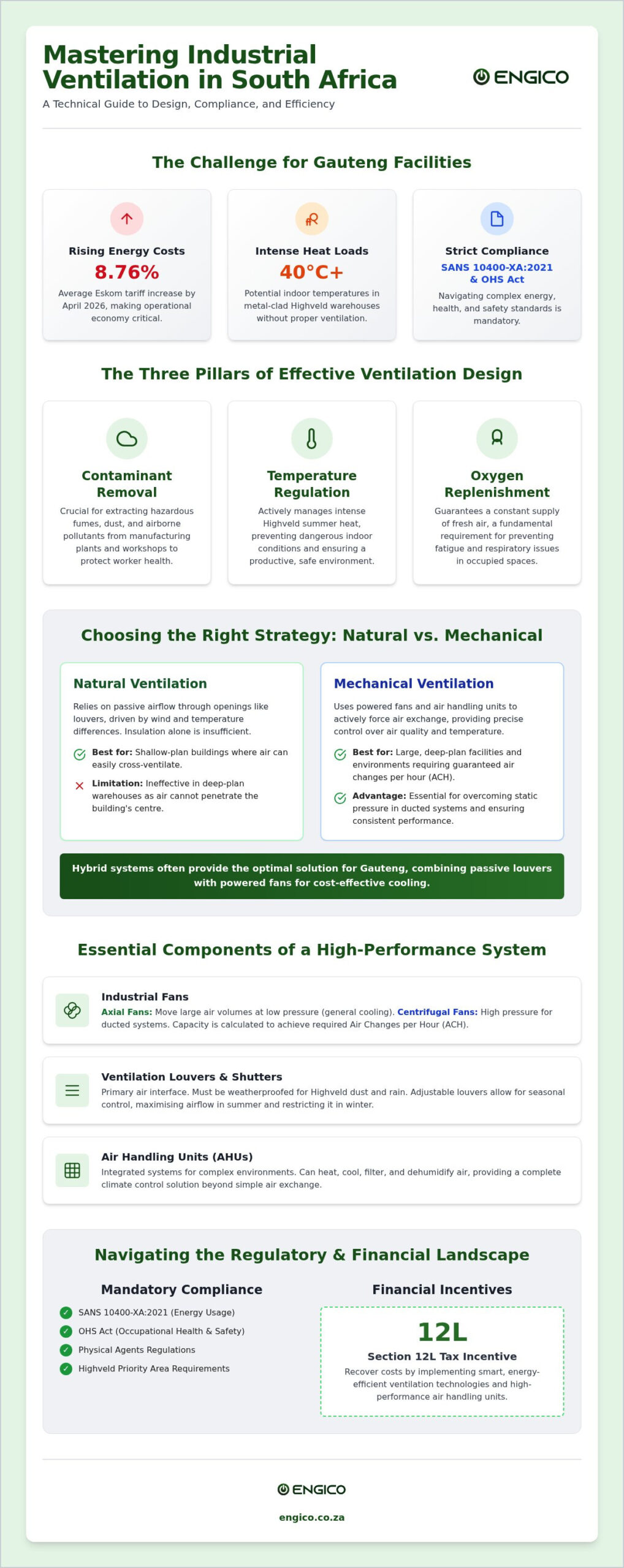
A robust system must achieve three goals simultaneously. First, it facilitates the removal of airborne contaminants and hazardous fumes, which is critical in manufacturing plants using chemicals or heavy machinery. Second, it provides temperature regulation to combat intense Highveld summer heat. Without this, indoor temperatures in metal-clad warehouses can exceed 40 degrees Celsius. Finally, the system ensures constant oxygen replenishment. This is a fundamental requirement for personnel health and safety, preventing the fatigue and respiratory issues associated with stagnant air.
Natural vs Mechanical Ventilation: Which Suits Your Facility?
Choosing between natural and mechanical strategies depends heavily on the building’s footprint. Natural airflow often fails in deep-plan warehouses because fresh air cannot penetrate the centre of the floor space. In these instances, mechanical fans are required to drive the exchange. Many Gauteng facilities benefit from hybrid systems. These combine passive ventilation louvers with powered industrial fans to provide cost-effective cooling during peak heat. Building orientation also plays a role; a facility’s alignment with prevailing winds can enhance passive performance, but it’s rarely a substitute for a precision-engineered mechanical solution in high-density industrial zones.
Essential Components of a High-Performance Ventilation System
A robust ventilation solution is more than a collection of hardware. It is an integrated network designed for precision and durability. In industrial ventilation system design South Africa, every component must be selected to withstand specific environmental stresses, such as high UV radiation and seasonal dust storms. High-quality materials are non-negotiable for external fixtures to prevent the premature degradation often caused by the harsh South African sun.
Industrial Fans and Air Circulation
Selecting the correct fan requires an understanding of the relationship between air volume and static pressure. Axial fans move large quantities of air at low pressure, making them ideal for general warehouse cooling. In contrast, centrifugal fans are better suited for ducted systems where higher pressure is needed to overcome resistance. We calculate fan capacity to ensure the facility achieves the necessary Air Changes per Hour (ACH), which prevents air from becoming stagnant. Modern designs also prioritise sound attenuation, using noise-control technology to ensure a safer working environment for staff.
Ventilation Louvers and Shutters
Louvers act as the primary interface between the internal and external environments. Intake louvers are positioned to draw in fresh air, whilst exhaust shutters facilitate the removal of heat and contaminants. In the dusty conditions of the Highveld, weather-proofing is essential to prevent moisture ingress during summer thunderstorms. Adjustable louvers offer an added layer of control, allowing managers to restrict airflow during cold winter mornings and maximise it during peak heat. This seasonal flexibility is a hallmark of a well-considered design.
Air Handling Units (AHUs) for Complex Environments
Facilities that require sterile conditions or exact temperature ranges rely on Air Handling Units (AHUs). These systems provide precise climate and humidity control by integrating cooling coils and multi-stage filtration. This level of control is particularly vital for warehouse ventilation design South Africa where sensitive inventory is stored. AHUs ensure that incoming air is scrubbed of particulates, maintaining the high air quality standards required for modern manufacturing. To keep these complex systems operating at peak efficiency, we recommend consistent service of air conditioners and ventilation components to avoid unplanned downtime.
Designing for the South African Climate and Energy Constraints
The unique geography of the Highveld introduces specific variables into industrial ventilation system design South Africa. At altitudes exceeding 1,600 metres in Johannesburg and Pretoria, air density is significantly lower than at sea level. This physics-based reality means that standard fan performance curves must be adjusted to ensure the required mass flow of air is achieved. If these calculations are ignored, systems often underperform during the peak dry heat of a Gauteng summer, leading to overheating in machinery-heavy environments. Precision in the design phase ensures that equipment isn’t just sized for volume, but for the actual density of the air it must move.
Energy management is equally critical in the current economic climate. With Eskom’s standard tariffs increasing by an average of 8.76% in April 2026, the cost of running inefficient ventilation is no longer a minor overhead. Since HVAC systems typically account for 20% of energy consumption in the South African industrial sector, every efficiency gain translates directly to improved margins. A well-designed system doesn’t just move air; it does so with the lowest possible electrical footprint.
Managing Heat Loads in Johannesburg and Pretoria
Calculating internal heat gains requires a detailed audit of industrial equipment and lighting layouts. In manufacturing hubs like Midrand or Germiston, heavy machinery generates significant thermal energy that must be exhausted immediately to prevent heat soak. We often implement night-time cooling strategies to flush the building with cooler evening air. This reduces the thermal mass of the structure, making it easier to maintain indoor air quality when temperatures spike the following afternoon. It’s a methodical way to use the natural diurnal temperature swing of the Highveld to your advantage.
Energy Efficiency and BMS Integration
Variable Speed Drives (VSDs) are essential for modern efficiency. They allow fan speeds to modulate based on actual demand rather than running at full capacity constantly. This is where smart HVAC control for commercial buildings becomes a vital asset. By integrating these components into a Building Management System (BMS), facility managers can monitor energy usage through real-time dashboards. Automated industrial ventilation system design South Africa ensures that air handling units and fans respond dynamically to environmental changes. This level of automation keeps operational costs within predictable limits whilst ensuring your organisation remains eligible for the Section 12L tax incentive, which remains available until 2030.
Regulatory Compliance and Health Standards (SANS & OHS)
Compliance isn’t a mere box-ticking exercise. It’s a legal safeguard for your business. In industrial ventilation system design South Africa, you must navigate the National Building Regulations alongside the Occupational Health and Safety (OHS) Act. The Physical Agents Regulations, gazetted in 2025, have introduced updated requirements that facility managers must address during the current 18-month transition period. Professional certification and sign-off are essential to verify that your system meets these evolving standards and provides a defensible audit trail during inspections.
Ensuring a system is legally compliant begins in the design phase. It’s far more efficient to engineer for compliance than to attempt to rectify a failing system after an OHS audit. A methodical approach involves identifying the specific pollutants present in your environment and designing the air exchange rates to mitigate those risks. This technical precision protects your organisation from the legal liabilities associated with non-compliant workplaces.
Meeting SANS 10400-O Requirements
SANS 10400-O:2011 remains the primary “deemed-to-satisfy” standard for ventilation in South African buildings. It dictates the minimum fresh air rates based on the specific occupancy and activity levels within your facility. For example, a high-density manufacturing plant requires a significantly higher air exchange rate than a low-traffic storage warehouse. We also prioritise fire safety integration within the ventilation layout. This includes the strategic placement of smoke extraction fans and fire-rated louvers that activate during emergencies. Calculating the effective louver area is a critical technical requirement to ensure that natural ventilation components meet these mandatory airflow thresholds.
OHS Act and Worker Productivity
The OHS Act 85 of 1993 mandates that employers provide a healthy working environment. Poor air quality is a leading cause of “Sick Building Syndrome,” which manifests as chronic fatigue and respiratory issues amongst staff. By controlling dust and hazardous fumes to remain below Permissible Exposure Limits (PELs), you protect both your workforce and your productivity levels. The 2025 Highveld Priority Area Air Quality Management Plan has also introduced stricter emission targets for businesses in Gauteng. Maintaining detailed documentation of your system’s performance is no longer optional; it’s a requirement for modern health and safety compliance. To ensure your facility meets these rigorous legal standards, we recommend a professional review of your industrial ventilation compliance and maintenance schedules.
Optimising Performance with Engico’s Turnkey Ventilation Solutions
Engico provides a comprehensive approach to industrial ventilation system design South Africa, ensuring that every project is backed by technical precision and local expertise. We operate as a methodical partner for complex facilities across Johannesburg and Pretoria, offering a disciplined path from the initial concept to final commissioning. Our focus remains on long-term value and environmental responsibility, positioning us as a safe pair of hands for businesses that cannot afford the risks of non-compliance or system failure. By managing the entire lifecycle of a project, we eliminate the friction often found when coordinating multiple contractors.
A Turnkey Solution from Design to Commissioning
The process begins with a rigorous site assessment and airflow modelling. We analyse the specific requirements of your floor plan and machinery layout to predict how air will move through the space. This data-driven foundation allows us to source high-performance equipment, including industrial fans and air handling units, from leading global brands. Our multi-discipline technical teams then handle the professional installation. We ensure that every component is integrated correctly with your existing infrastructure, including Building Management Systems, to deliver a seamless and efficient climate control solution from day one.
Maintenance and Long-Term Reliability
System reliability is not a one-time achievement but a continuous requirement. Scheduled servicing is the most effective way to prevent mechanical failure and avoid the high costs of unplanned downtime. This is why we emphasise the necessity of commercial HVAC maintenance in Sunninghill and throughout the wider Gauteng region. Regular inspections allow our technicians to identify wear in fan motors or blockages in louvers before they impact your facility’s air quality or energy efficiency. We provide a stable support structure that includes emergency repair services for critical industrial infrastructure, ensuring your operations remain productive year-round.
To support our clients in maintaining these high standards, Engico includes a one-year free maintenance offer for all new installations. This initiative ensures that your system is fine-tuned during its first year of operation, providing you with peace of mind and a clear understanding of your long-term maintenance requirements. Whether you are upgrading an existing facility or starting a new build, our industrial ventilation system design South Africa ensures your environment is safe, compliant, and cost-effective. We combine nationwide supply capabilities with deep local knowledge to deliver results that meet the professional excellence your business demands.
Securing Future-Ready Industrial Environments in Gauteng
Precision in industrial ventilation system design South Africa is the foundation of a safe and profitable facility. We’ve explored how technical accuracy in fan selection and louver placement ensures compliance with the latest SANS 10400-O standards and the 2025 Physical Agents Regulations. By addressing the unique air density challenges of the Highveld and integrating smart BMS controls, you can mitigate rising energy costs whilst protecting worker health. A methodical approach to design doesn’t just meet legal requirements; it establishes a sustainable environment for long-term growth.
Engico stands as your dependable partner for these complex technical requirements. As specialists in BMS integration, we provide Gauteng-wide HVAC support that balances operational efficiency with regulatory rigour. Every new installation includes a free one-year maintenance plan to ensure your system continues to perform at its peak long after the initial commissioning. This proactive service model is designed to prevent mechanical failure and maintain the high standards your business demands.
Don’t leave your air quality and compliance to chance. You can Request a Professional Ventilation Design Quote from Engico to start your project with a safe pair of hands. We look forward to helping you build a more sustainable and productive industrial space.
Frequently Asked Questions
What are the legal requirements for industrial ventilation in South Africa?
The primary legal requirements are dictated by the Occupational Health and Safety Act 85 of 1993 and the National Building Regulations, specifically SANS 10400-O. These standards mandate that employers provide a workplace free of hazardous fumes and stagnant air. New Physical Agents Regulations gazetted in March 2025 also introduce stricter controls for thermal stress. Compliance requires a certified design that meets these mandatory safety benchmarks to protect both workers and the organisation.
How often should industrial ventilation fans be serviced?
Industrial ventilation fans should typically be serviced every three to six months, depending on the dust levels and operational intensity of your Gauteng facility. High-dust environments in areas like Silverton or Germiston require more frequent inspections to prevent particulate build-up on fan blades. Routine maintenance ensures mechanical reliability and prevents the motor strain that leads to increased energy consumption. Engico offers scheduled maintenance programmes to keep your air circulation systems running at peak efficiency.
Can a BMS really save money on industrial ventilation costs?
A Building Management System (BMS) generates significant savings by automating ventilation based on real-time demand rather than constant operation. By integrating sensors and Variable Speed Drives, the system reduces fan speeds during off-peak hours or cooler Johannesburg mornings. This precision control can lower HVAC-related electricity usage by up to 26% in commercial sectors. It also provides the data necessary to claim the Section 12L tax incentive for energy efficiency, which remains available until 2030.
What is the difference between axial and centrifugal fans for warehouses?
Axial fans are designed to move large volumes of air at low pressure, making them suitable for wall-mounted general ventilation in large warehouses. Centrifugal fans generate higher static pressure, which is necessary for pushing air through complex ducting or filtration systems. Choosing the right type is a critical step in industrial ventilation system design South Africa to ensure your equipment overcomes the resistance of your building layout without wasting power or increasing noise levels.
How do I calculate the number of air changes required for my factory?
To calculate the required air changes, multiply the total volume of your factory by the Air Changes per Hour (ACH) rate specified in SANS 10400-O for your occupancy type. A heavy manufacturing zone might require 10 to 15 air changes per hour to manage fumes effectively. Accurate calculations must also account for internal heat gains from machinery. This ensures the temperature remains stable during peak summer months in Pretoria or Johannesburg without over-sizing the equipment.
Does Engico provide ventilation design for data centres in South Africa?
Yes, Engico provides specialised ventilation and climate control design for data centres across South Africa. These sensitive environments require precise temperature and humidity management, which we achieve through high-performance air handling units and redundant cooling systems. Our team focuses on the high-density cooling needs of server rooms in Midrand and Sandton. We ensure that your critical infrastructure is protected by reliable, energy-efficient HVAC technology and consistent professional maintenance to prevent any operational downtime.
What is the role of ventilation louvers in an industrial system?
Ventilation louvers serve as the primary interface for air intake and exhaust whilst protecting the building from moisture and debris. In industrial ventilation system design South Africa, they’re positioned to facilitate cross-ventilation and prevent the ingress of rain during Gauteng’s heavy summer thunderstorms. High-quality louvers also include bird screens and adjustable slats. These allow facility managers to control airflow manually or through automated actuators linked to a central management system for improved climate control.
How does Gauteng’s altitude affect industrial ventilation design?
Gauteng’s altitude, which averages 1,600 metres, results in lower air density compared to coastal regions. This means that fans must move a greater volume of air to achieve the same cooling effect or oxygen replenishment. Our design process includes altitude correction factors to ensure that equipment is sized correctly for Johannesburg and Pretoria. Ignoring this factor often leads to underperforming systems that fail to maintain safe air quality levels or adequate temperature control during intense heatwaves.
Recent Comments