
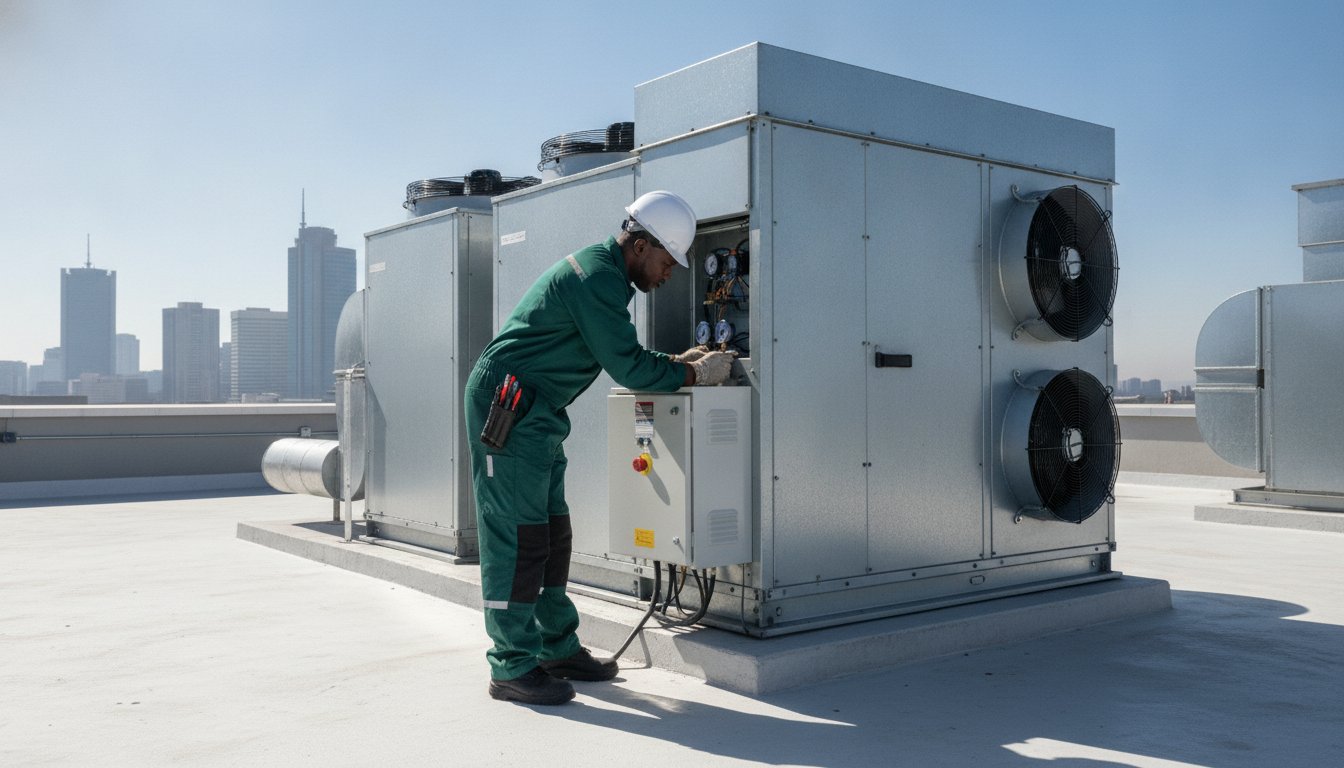
With Eskom’s standard tariffs increasing by an average of 8.76% in April 2026, the financial burden on Gauteng’s industrial sectors has reached a critical threshold. Selecting the right industrial air handling units South Africa requires more than just cooling capacity; it demands a precise strategy to offset these rising operational costs through technical efficiency. You’re likely feeling the pressure of balancing strict health and safety ventilation standards against a volatile energy grid and the abrasive dust of the Highveld. It’s a difficult middle ground where equipment reliability often suffers under the weight of maintenance neglect or outdated design.
This comprehensive guide provides the technical clarity you need to select, optimise, and maintain systems tailored for our unique environment. You’ll discover how to leverage the Section 12L tax incentive, which remains available until 2030, to recover costs whilst ensuring your facility meets SANS 10400-XA:2021 standards. We’ll preview the essential role of Building Management System (BMS) integration and professional maintenance contracts in securing long-term reliability for your operations.
Key Takeaways
- Distinguish between standard split systems and large-scale industrial air handling units South Africa to ensure your facility has the appropriate ventilation capacity.
- Learn how to optimise system performance for the specific climate of Johannesburg and Pretoria whilst navigating the challenges of the current energy grid.
- Utilise a strategic framework for heat load calculations and Total Cost of Ownership (TCO) to make informed, high-value procurement decisions.
- Identify how Building Management System (BMS) integration and professional maintenance contracts reduce operational costs and ensure compliance with SANS 10400-XA:2021.
- Understand the risks associated with unqualified installation and the methodical approach required to secure long-term equipment reliability in Gauteng.
Understanding Industrial Air Handling Units (AHUs) in the South African Context
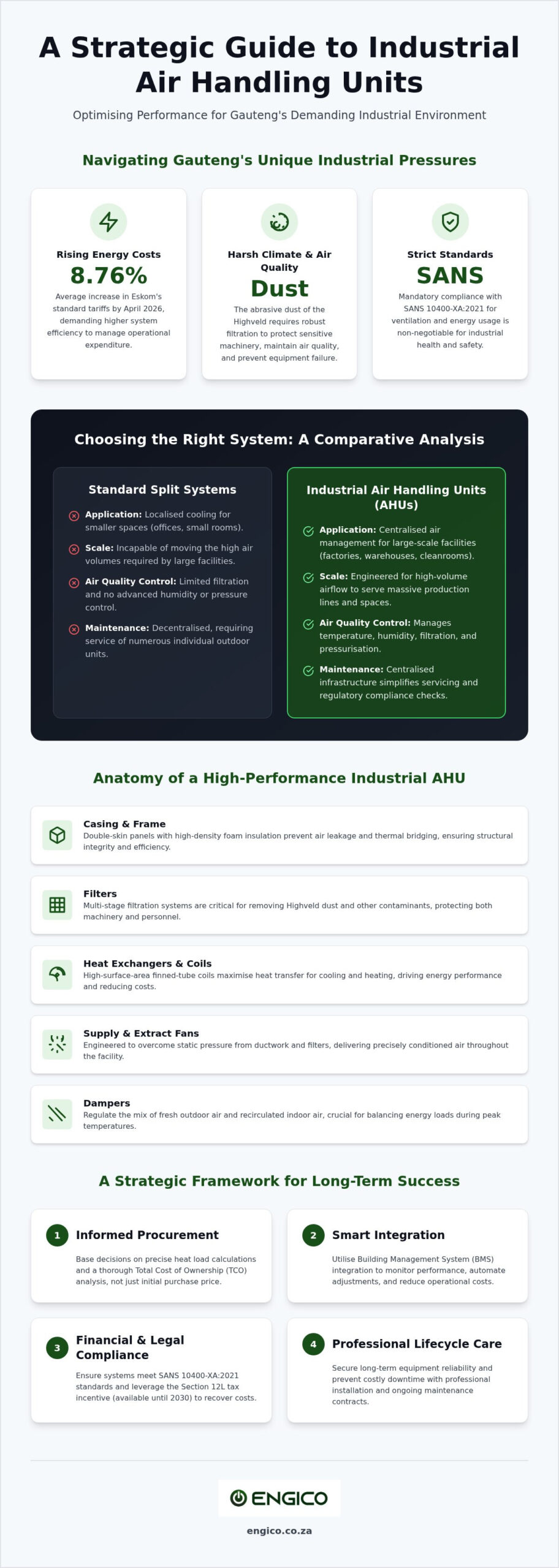
An air handling unit (AHU) serves as the “lungs” of a building. It’s a centralised system that regulates and circulates air as part of a comprehensive HVAC infrastructure. Unlike standard split units or rooftop packaged systems, which provide localised cooling for smaller spaces, industrial air handling units South Africa are engineered for the high-volume demands of large-scale facilities. They don’t just cool a room; they manage the complex transition between harsh outdoor ambient conditions and the precise indoor climate requirements of an industrial floor.
In South Africa’s manufacturing, mining, and pharmaceutical sectors, air quality isn’t just about comfort. It’s a critical operational requirement. These units pull in fresh air, filter out Highveld dust, and adjust temperature and humidity levels before distributing the air through ductwork. This process is vital for protecting sensitive machinery from overheating and ensuring that pharmaceutical production remains within strict sterile parameters. A well-designed system acts as a barrier against external contaminants whilst maintaining the internal pressure needed for specialised cleanrooms.
Why Industrial AHUs are Non-Negotiable for Large Facilities
Large facilities in Gauteng require air volumes that standard split systems simply cannot move. AHUs offer the scalability needed for massive warehouses or production lines. By centralising the air processing components, facility managers can consolidate maintenance into a single, accessible infrastructure rather than managing dozens of individual outdoor units. This centralisation also simplifies regulatory compliance. Meeting SANS ventilation standards for industrial safety is much more manageable when you’re monitoring a single, high-performance system designed for heavy-duty service.
The Distinction Between Standard and Custom AHU Configurations
Not every facility requires the same technical specifications. Modular AHUs are often suitable for commercial office blocks in Sandton, where the primary goal is occupant comfort. However, heavy industrial environments in areas like Midrand or Pretoria often demand bespoke configurations for their industrial air handling units South Africa. These custom units are built to withstand high-humidity or corrosive atmospheres found in chemical processing or deep-level mining.
A professional installation might include integrated ventilation components like specialised fans and louvers, or it may involve standalone modules that work in tandem with existing Building Management Systems. Choosing the right configuration is about balancing long-term durability with the specific environmental challenges of the site. It’s the difference between a system that merely functions and one that provides a reliable, energy-efficient solution for decades.
Core Components and Engineering of Large-Scale Air Handling Units
The structural integrity of industrial air handling units South Africa begins with the casing. These are typically constructed from double-skin panels filled with high-density polyurethane foam to prevent thermal bridging and air leakage. Within this frame, dampers play a vital role in balancing the intake of fresh outdoor air with recirculated indoor air, which is a key factor in managing the energy load during Gauteng’s peak summer temperatures. If you are reviewing your current system’s efficiency, a professional service of air conditioners and AHUs can identify which of these components need upgrading to modern standards.
Heat exchangers and coils act as the primary drivers of energy performance. By utilising high-surface-area finned-tube coils, the system achieves maximum heat transfer with minimal pressure drop. This engineering precision ensures that the cooling and heating processes don’t overwork the central plant, directly addressing the financial burden of high electricity tariffs. Because large-scale fans generate significant kinetic energy, vibration isolation mounts and sound attenuators are essential to prevent structural fatigue and ensure the facility remains within noise regulation limits.
A supply fan functions to overcome the static pressure resistance of the ductwork and filtration stages to deliver treated air to the designated industrial zones.
Filtration Systems: Combatting Gauteng’s Industrial Dust
Gauteng’s Highveld air carries high particulate loads that can quickly degrade internal components. Multi-stage filtration is essential for protecting both the machinery and the indoor environment. G4 pre-filters catch larger debris, whilst HEPA-grade filters are used for specialised cleanroom environments. Without these, dust settles on sensitive machinery in Johannesburg and Pretoria, leading to premature wear and overheating. Maintenance-friendly filter designs allow for quick swaps, which significantly reduces operational downtime during routine servicing.
Fan Technology and Air Circulation Efficiency
Modern industrial air handling units South Africa utilise either plug fans or centrifugal fans depending on the specific facility requirements. Plug fans are often preferred for their compact footprint and ease of cleaning, which is a major advantage in pharmaceutical or food-grade environments. Integrating Variable Speed Drives (VSDs) allows the system to match airflow to real-time demand, significantly cutting energy waste. High-efficiency fans reduce the thermal load on cooling coils by moving air more effectively, ensuring that the entire HVAC infrastructure operates within its most efficient parameters.
Optimising AHU Performance for the Gauteng Climate and Energy Grid
Managing summer peaks in Midrand and Pretoria requires a proactive approach to thermal load. High ambient temperatures often coincide with peak electricity demand, placing immense strain on the local energy grid. For industrial air handling units South Africa, energy resilience is no longer optional. Modern systems must be configured to transition seamlessly between grid power, backup generators, and solar arrays. This ensures that critical industrial processes, such as those in pharmaceutical manufacturing or food storage, aren’t compromised during power fluctuations or load shedding events.
Integrated building climate control is essential for preventing “over-cooling” during off-peak hours or cooler nights. By adjusting the cooling output based on real-time external conditions, the AHU reduces its mechanical load and extends the lifespan of its components. This methodical management of energy consumption is the most effective way to combat the 8.76% Eskom tariff increase implemented in April 2026. It’s a strategy that prioritises long-term reliability over short-term fixes.
BMS Integration: The Brain of the Industrial HVAC System
Automation is the most reliable method for maintaining efficiency. A Building Management System (BMS) acts as the brain, regulating damper positions based on CO2 levels and occupancy sensors. This ensures that the system only processes the volume of air required at any given moment. For facility managers across Gauteng, remote monitoring provides a “safe pair of hands” to prevent catastrophic equipment failure. Linking your AHU performance to smart HVAC control for commercial buildings allows for granular data analysis, identifying areas where energy is being wasted before it impacts the bottom line.
Passive Cooling and Ventilation Louvers
Mechanical cooling systems don’t work in isolation. Incorporating warehouse ventilation design South Africa helps to alleviate the load on your AHUs. By using industrial-grade ventilation fans and louvers, facilities can facilitate natural air intake during cooler periods. This passive approach reduces the reliance on mechanical cooling, particularly during the dry winter months in Johannesburg when humidity levels drop to around 41%. The synergy between mechanical industrial air handling units South Africa and passive louvers creates a balanced, energy-efficient environment that handles climate extremes without excessive operational costs.
Selecting the Right AHU: A Strategic Framework for South African Facilities
Selecting industrial air handling units South Africa requires a shift from simple procurement to strategic engineering. A thorough heat load calculation is the first essential step. This process must account for the specific thermal output of heavy machinery and the peak occupancy levels of the facility. In Gauteng’s industrial hubs, failing to account for these internal heat gains leads to systems that struggle to maintain setpoints during the sweltering October and November months. If you require a detailed heat load analysis to determine your facility’s exact requirements, you can request a consultation for the installation of air handling units from our technical team.
Evaluating the Total Cost of Ownership (TCO) is more critical than the initial capital expenditure. Whilst a lower-priced unit may seem attractive, it often lacks the energy-efficient components needed to survive the 2026 energy landscape. Choosing refrigerants that align with modern sustainability goals is also a priority for forward-thinking businesses. Space constraints in urban centres like Johannesburg and Pretoria often dictate whether an indoor or rooftop placement is most viable. Rooftop units save valuable floor space but require additional weatherproofing and structural support to handle Highveld storms.
Matching AHU Capacity to Facility Requirements
Oversizing an AHU is as detrimental to efficiency as undersizing. An oversized unit leads to frequent short-cycling, which increases wear on the motor and fails to provide adequate humidity control. This precision is especially vital for sensitive environments, such as HVAC for data centres in South Africa, where constant temperature stability is non-negotiable. Planning for future facility expansions during the initial design phase allows you to select a modular system that can grow with your business without requiring a complete overhaul of the existing infrastructure.
Material Selection for Durability
The longevity of industrial air handling units South Africa depends heavily on material choice. Corrosion protection is a necessity for units located in harsh industrial zones or near chemical processing plants. Double-skin panels are the industry standard for providing both thermal insulation and noise reduction, ensuring that the unit remains efficient whilst keeping the facility within occupational noise limits. Selecting specialised industrial-grade ventilation fans and louvers that can withstand high-velocity air and abrasive debris is a proven way to reduce long-term maintenance costs and prevent premature component failure.
Professional Installation and Maintenance: Ensuring HVAC Longevity with Engico
Large-scale HVAC systems are far too complex for unqualified contractors or DIY attempts. An error in fan alignment, duct sealing, or sensor calibration can lead to immediate inefficiencies or even catastrophic mechanical failure. Engico employs a methodical installation process across Johannesburg and Pretoria, ensuring that every industrial air handling units South Africa project adheres to strict technical specifications from the outset. This precision protects your initial capital expenditure and ensures the system operates at peak performance from day one.
Routine servicing is the only reliable way to preserve manufacturer warranties and extend equipment lifespan. Neglecting these systems often leads to increased energy consumption and unpredictable downtime, which can halt production lines. For businesses operating in high-demand zones, engaging in commercial HVAC maintenance in Sunninghill or surrounding areas provides a structured approach to system health. Regular inspections identify minor issues, such as worn belts or clogged drains, before they escalate into expensive repairs that disrupt your bottom line.
The Preventative Maintenance Checklist for AHUs
A disciplined maintenance schedule is essential for the “lungs” of your facility. We recommend a tiered approach to servicing to ensure no component is overlooked:
- Monthly: Conduct inspections of belt tension and alignment; check filter cleanliness and clear any obstructions in the condensate drains to prevent moisture build-up.
- Quarterly: Perform a detailed calibration of all sensors and verify that BMS integration points are reporting accurate data for energy monitoring.
- Annual: Schedule a deep cleaning of heating and cooling coils to maintain heat transfer efficiency; test all emergency shutdown protocols to ensure safety compliance.
Partnering with Engico for Industrial Climate Control
Our “safe pair of hands” philosophy means we manage your industrial infrastructure with meticulous care. We don’t believe in one-size-fits-all solutions. Instead, we provide HVAC maintenance services for Gauteng properties that are tailored to the specific operational hours and environmental loads of your facility. This proactive management style ensures that your industrial air handling units South Africa remain a reliable asset rather than a liability. Contact Engico today for a professional consultation to secure the long-term reliability of your industrial air handling needs.
Securing Your Facility’s Operational Future
Operating large-scale facilities in the 2026 industrial environment demands a methodical approach to climate control. Success requires balancing high-capacity cooling with energy resilience to offset rising operational costs. Integrating industrial air handling units South Africa into a robust Building Management System ensures that your infrastructure remains resilient against rising electricity tariffs and grid instability. Professional oversight isn’t just about compliance. It’s about building a stable foundation for your industrial operations.
Engico has been a specialist in Gauteng industrial HVAC since 2022, providing the technical expertise required for complex BMS integration. With dedicated maintenance teams based in Johannesburg and Pretoria, we offer a “safe pair of hands” to manage your systems from initial installation through to long-term servicing. Consult Engico for your Industrial Air Handling Requirements today to ensure your facility remains efficient and reliable. We look forward to partnering with you to optimise your industrial environment.
Frequently Asked Questions
What is the average lifespan of an industrial air handling unit in South Africa?
An industrial air handling unit typically lasts between 15 and 25 years when supported by a professional maintenance programme. In Gauteng, the actual lifespan depends heavily on protecting internal components from abrasive Highveld dust and extreme thermal cycles. Units in Johannesburg or Pretoria that receive quarterly technical inspections often reach the upper end of this range, whereas neglected systems may require expensive repairs or full replacement much sooner.
How often should AHU filters be replaced in a dusty Gauteng environment?
In the dusty industrial zones of Johannesburg and Pretoria, you should inspect filters monthly and replace them every one to three months. High particulate loads in the Highveld air can quickly clog G4 pre-filters, which increases the pressure drop and forces fans to work harder. Maintaining clean filters is a cost-effective way to protect your industrial air handling units South Africa from internal debris and ensure consistent airflow.
Can an existing AHU be retrofitted with a Building Management System (BMS)?
Most existing industrial systems can be retrofitted with a Building Management System (BMS) to improve operational efficiency. This process involves installing modern sensors, actuators, and a centralised controller to automate damper positions and fan speeds. For facilities in Midrand or Sandton, retrofitting is a strategic way to gain real-time visibility into energy consumption without the capital expense of replacing the entire air handling infrastructure from scratch.
What is the difference between an AHU and a Rooftop Packaged Unit?
An AHU is a component of a larger centralised HVAC system that requires an external chiller or boiler to provide cooling or heating. In contrast, a Rooftop Packaged Unit is a self-contained system that includes all necessary refrigeration components in one cabinet. AHUs offer greater customisation and are better suited for large-scale industrial applications in Gauteng where precise control over air quality and pressure is required for production.
How much energy can be saved by using Variable Speed Drives in an AHU?
Integrating Variable Speed Drives (VSDs) into your fan motors can reduce energy consumption by 20% to 50% depending on your facility’s load profile. By allowing the system to match fan speed to actual demand rather than running at constant full capacity, you significantly lower your electricity bill. This is particularly effective for managing the 8.76% Eskom tariff increase seen in 2026, as it prevents energy waste during off-peak hours.
Are there specific South African regulations for industrial air quality?
Industrial air quality is governed by the National Building Regulations, specifically SANS 10400-XA:2021, which sets mandatory standards for energy efficiency and ventilation. Additionally, the second-generation Highveld Priority Area Air Quality Management Plan gazetted in 2025 introduces stricter emission reduction targets for businesses in Gauteng. Compliance requires a methodical approach to air filtration and circulation to ensure a safe environment for your workforce whilst meeting all legal obligations.
What happens if an industrial AHU is not maintained regularly?
Neglecting regular maintenance leads to a rapid decline in efficiency and an increased risk of catastrophic mechanical failure. Dust accumulation on coils reduces heat transfer, whilst worn belts can cause fan motors to burn out unexpectedly. In addition to higher energy costs, poor maintenance often voids manufacturer warranties. For facilities in Roodepoort or Centurion, the resulting equipment downtime can cause significant production losses that far exceed the cost of a service contract.
How do I determine the correct size of an AHU for my warehouse?
Determining the correct size requires a comprehensive heat load calculation that factors in the warehouse volume, insulation levels, and machinery heat output. You must also account for the number of occupants and the frequency of loading bay door operations. Choosing the right industrial air handling units South Africa involves balancing these variables to avoid the efficiency losses associated with oversizing or the inadequate cooling performance of an undersized system.
Recent Comments