
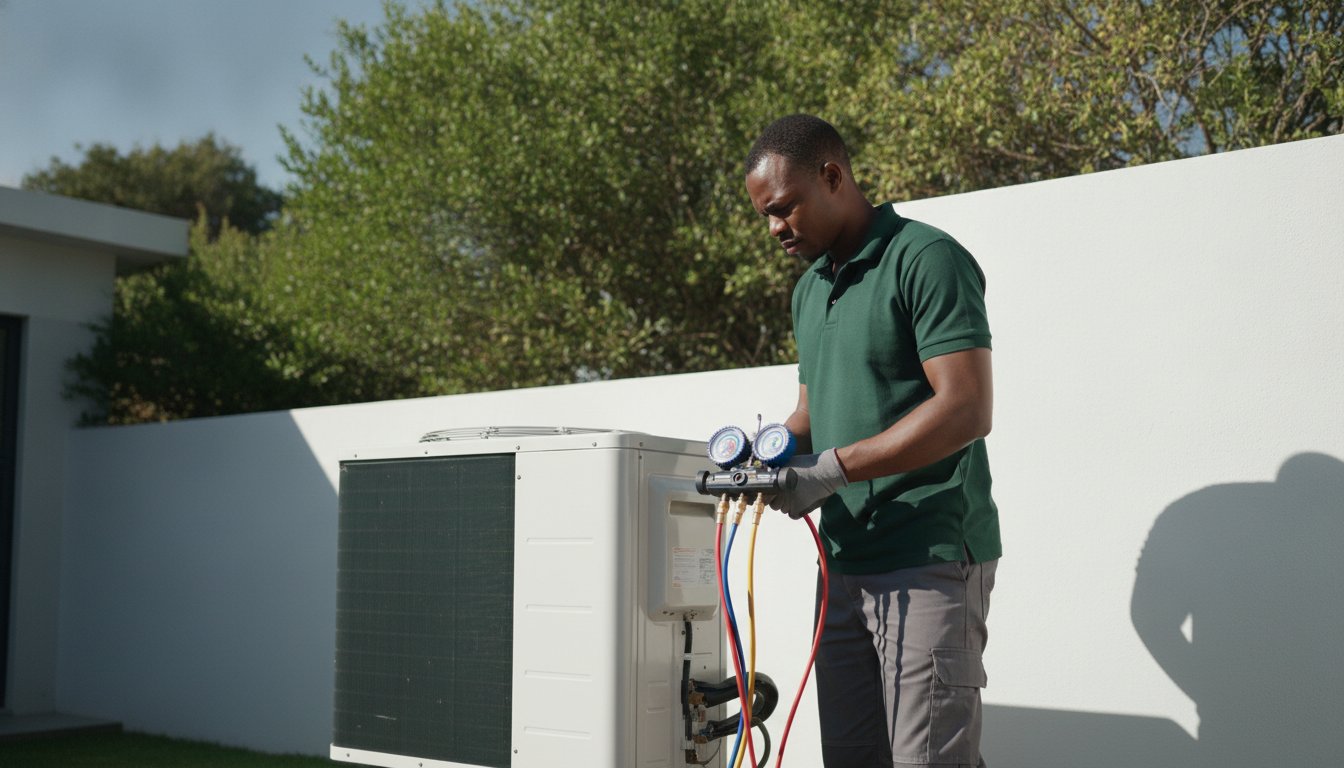
Most homeowners and facility managers assume that an air conditioner consumes gas like a vehicle uses petrol, but your cooling unit is actually a sealed system that shouldn’t require a top-up under normal operating conditions. If you’ve noticed your unit blowing warm air or freezing up during a Gauteng heatwave, you’re likely facing a leak rather than routine depletion. It’s frustrating to deal with climbing electricity bills and a stifling indoor environment when you expect reliable performance. Engaging professional aircon gas refill services South Africa is the first step toward restoring comfort, but it’s vital to understand that a refill without a leak repair is only a temporary fix.
This professional guide explores the technical reasons behind refrigerant loss and how expert services in Gauteng ensure your system operates at peak efficiency. You’ll discover the critical differences between car regassing and building HVAC maintenance, alongside the implications of the 2026 R22 phase-out. We’ll outline how to identify permanent leaks and the steps required to protect your equipment’s longevity while reducing power consumption. By the end of this article, you’ll have a clear roadmap for maintaining a stable, cost-effective climate in your home or office.
Key Takeaways
- Understand why stationary air conditioning units are sealed systems and how their maintenance requirements differ fundamentally from automotive cooling.
- Identify the technical causes of refrigerant loss, including micro-leaks and joint failures caused by thermal expansion, to prevent recurring issues.
- Learn to spot early warning signs like ice formation or constant cycling to avoid the high electricity costs associated with inefficient cooling.
- Discover how professional aircon gas refill services South Africa utilise precise pressure testing and leak detection to ensure a permanent solution rather than a temporary top-up.
- Explore the benefits of structured maintenance programmes for wall-mounted and ducted systems to maintain long-term reliability in the Gauteng climate.
Understanding Aircon Gas Refill Services for Stationary Units
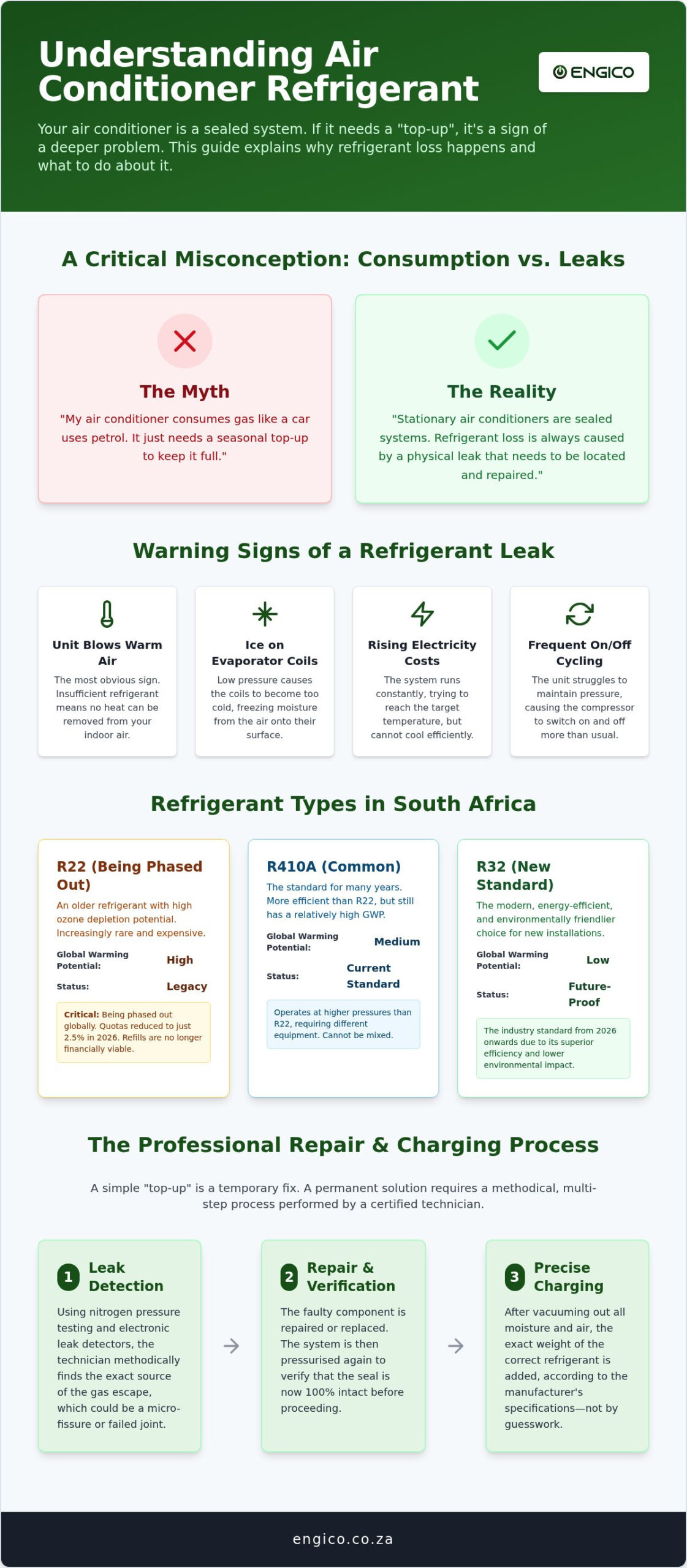
Stationary air conditioning units in South African homes and offices operate on a closed-loop principle. This means the gas, or refrigerant, isn’t a fuel that the machine consumes during operation. Instead, it’s a medium for heat transfer. When you seek aircon gas refill services South Africa, you’re essentially addressing a symptom of a failure in that sealed loop. Unlike automotive systems, which often experience minor seepage through rubber hoses and constant road vibrations, building HVAC systems use rigid copper piping. A healthy stationary unit shouldn’t lose any gas over its entire lifespan. The idea that gas simply evaporates or needs a seasonal top-up is a misconception. If a technician suggests a refill without first performing a leak test, they’re providing a temporary band-aid for a permanent mechanical fault.
The process of regassing is actually the act of restoring the correct pressure to this loop. To understand the necessity of this service, one must first grasp what is refrigerant and its role in your comfort. It’s a chemical compound that shifts from a liquid to a gas at specific temperatures, absorbing heat from your indoor air and releasing it outside. If the gas level drops, the heat exchange cycle fails. This leads to the common pains of warm air blowing from the vents and ice formation on the evaporator coils. It’s a technical issue that requires a methodical approach to resolve permanently.
Refrigerant Types in South Africa: R410A vs R32
Most modern South African installations use either R410A or the newer R32 gas. R32 has become the industry standard in 2026 due to its lower Global Warming Potential and superior energy efficiency. With the 2026 reduction in R22 quotas to just 2.5% of previous levels, identifying your current gas type is more critical than ever. Owners of older systems may find that a regas is no longer a viable financial option compared to a full system replacement. You cannot mix these refrigerants. They operate at different pressures and require specific lubricants for the compressor. Using the wrong gas or a cocktail of types will cause catastrophic hardware failure and void your warranty.
Refill vs. Regas: What Terminology Should You Use?
In Gauteng, people often use the terms refill or regas interchangeably. However, Engico Air Conditioning technicians refer to this process as refrigerant charging. This technical distinction is important. It implies that a measured, precise weight of gas is added according to the manufacturer’s specific requirements. It isn’t a top-up based on guesswork. Legally, any person handling these substances must be a SARACCA-registered technician. This ensures they follow environmental protocols for recovering old gas rather than venting it into the atmosphere. It’s the only way to ensure your unit operates efficiently whilst remaining compliant with South African environmental regulations.
Why Your Air Conditioning System Requires a Refrigerant Top-Up
Micro-leaks are the primary reason residential and commercial clients require aircon gas refill services South Africa. Because stationary air conditioners are hermetically sealed systems, any drop in pressure indicates a physical breach in the circuit. These breaches often occur in the evaporator coil or at the connection points of the copper piping. When copper piping expands and contracts during the extreme temperature shifts common in Johannesburg and Pretoria, the physical stress on flare joints can eventually create microscopic fissures. This thermal expansion is a natural byproduct of the heating and cooling cycle, but it remains the leading cause of gradual gas depletion over several years.
Poor initial installation also plays a significant role in long-term gas retention. If a system wasn’t correctly vacuumed or if the flares weren’t tightened to specific torque settings, the integrity of the seal is compromised from day one. Adhering to industry best practices during the installation of wall-mounted split or ducted systems is the only way to prevent these early failures. In Gauteng, environmental factors such as high dust levels and industrial pollutants can also accelerate the corrosion of aluminium fins on the outdoor condenser, eventually weakening the underlying copper tubes and leading to refrigerant escape.
The Problem with “Top-Ups” Without Leak Detection
Simply adding more gas to a leaking unit is a wasteful and irresponsible practice. Refrigerants are potent greenhouse gases; releasing them into the atmosphere through an unrepaired leak contributes to environmental degradation. Beyond the ecological impact, low gas levels force the compressor to work significantly harder to achieve the desired temperature. This leads to overheating and, eventually, a total mechanical failure of the compressor unit. It’s far more cost-effective to invest in professional air conditioner repairs that identify and seal the leak before recharging the system.
Industrial vs. Residential Gas Loss Factors
Industrial systems face unique challenges compared to residential wall-mounted units. Large-scale air handling units and industrial ventilation fans generate significant vibration, which can rattle pipework and loosen mechanical fittings over time. This is particularly prevalent in facilities with complex Warehouse Ventilation Design South Africa where long pipe runs are common. Whilst coastal units suffer from salt-spray corrosion, Gauteng systems are more susceptible to chemical corrosion in industrial zones, which requires a methodical maintenance approach to detect thinning pipe walls before a catastrophic blowout occurs.
Warning Signs Your Office or Home Aircon Needs a Gas Refill
Identifying the early symptoms of refrigerant loss can save you from costly compressor replacements. When a system lacks the necessary gas to facilitate heat exchange, it doesn’t simply stop working; it attempts to compensate by running for longer periods. You might notice that your wall-mounted split or ducted system is operating constantly, yet the room temperature remains stubbornly high during a Gauteng afternoon. This persistent operation is a primary indicator that the unit can no longer reach the set point on your thermostat. Consequently, you will likely see a sudden, unexplained spike in your monthly electricity bill. With South African electricity tariffs having increased by nearly 1,000% since 2007, an inefficient air conditioner is a significant financial burden.
Audible cues are another reliable way to detect a breach in the system. If you hear a distinct hissing or bubbling sound coming from the indoor unit or the external copper pipes, it’s a strong sign that refrigerant is escaping in gas or liquid form. Unlike the normal hum of a healthy compressor, these sounds indicate a physical leak that requires immediate attention. Ignoring these signs often leads to the unit blowing warm air, as the remaining gas is insufficient to absorb indoor heat. Seeking professional aircon gas refill services South Africa ensures that these mechanical failures are diagnosed before they result in a total system breakdown.
Diagnostic Checks Before Assuming It Is Gas
Before concluding that your unit requires a regas, it’s essential to rule out simpler maintenance issues. A dirty evaporator or condenser coil can increase energy consumption by up to 30%, mimicking the symptoms of gas loss. Always check that your filters are clean and that the outdoor unit isn’t obstructed by debris. In South Africa, the frequent power cycles caused by load shedding can also trigger electronic glitches in the control board. Sometimes, simply resetting the isolator switch can resolve a thermostat inaccuracy that looks like a cooling failure. However, if the hardware is clean and the settings are correct, the issue is almost certainly a pressure fault.
The “Frozen Pipe” Indicator
One of the most visible signs of low refrigerant is the formation of ice on the evaporator coils or the brass valves of the outdoor unit. This happens because low pressure causes the refrigerant temperature to drop well below freezing, turning ambient moisture into ice. Whilst it might seem counterintuitive that a unit that isn’t cooling is freezing up, this is a classic symptom of a leak. Running a frozen unit is dangerous; it puts immense strain on the fan motor and can cause significant water damage to your walls when the ice eventually melts. Regular HVAC Maintenance Services for Gauteng Properties can help identify these pressure drops before they lead to such extreme symptoms, ensuring your system remains efficient and your interior remains dry.
The Professional Process: How a Correct Refrigerant Charge is Performed
A professional refrigerant charge begins with a methodical diagnosis rather than an immediate refill. Technicians first perform pressure testing and measure the temperature differential across the evaporator coil to confirm the extent of the loss. When using aircon gas refill services South Africa, the specialist should employ electronic leak detection or nitrogen pressure testing to locate the precise point of failure. Simply adding gas to a system without identifying the breach is a violation of industry standards. Once the leak is sealed, any remaining contaminated gas is recovered into specialised cylinders. The system is then vacuumed using a high-grade pump to remove moisture and non-condensable gases, which is a critical step in preventing internal corrosion.
After the vacuum holds, indicating a tight seal, the technician introduces the new refrigerant. This isn’t done by sight or sound; it’s a calculated procedure. For commercial clients with large-scale ducted systems or air handling units, this precision ensures that the hardware operates within its designed safety margins. If your system requires expert intervention, you can schedule a professional air conditioner service to ensure your equipment is handled by qualified specialists.
Why Weight Matters More Than Pressure
Charging an air conditioner by pressure alone is an outdated and inaccurate practice. Pressure readings fluctuate significantly based on the ambient outdoor temperature, making it impossible to achieve a perfect charge through gauges alone. Instead, professional technicians use digital scales to charge the system with the exact weight of refrigerant specified by the manufacturer. This factory-spec approach prevents the risks of overcharging, such as liquid slugging. Liquid slugging occurs when unevaporated refrigerant enters the compressor, leading to immediate and permanent mechanical destruction. Using scales ensures the unit achieves maximum efficiency whilst protecting the long-term health of the motor.
Post-Refill Performance Testing
The process concludes with rigorous performance verification. Technicians measure superheat and subcooling levels to ensure the system is perfectly balanced. These technical metrics confirm that the refrigerant is changing state at the correct points within the coils, providing optimal cooling without wasting energy. For industrial and commercial sites, it’s also vital to ensure that the Smart HVAC Control for Commercial Buildings correctly reflects the repair and monitors future pressure trends. This methodical progression from detection to verification is what separates a professional repair from a temporary fix.
Expert HVAC Maintenance and Repair Solutions in Gauteng
Engico Air Conditioning provides a disciplined and methodical approach to air conditioner repairs across Johannesburg and Pretoria. We prioritise long-term reliability over the “quick fix” culture that often leads to recurring mechanical failures. For commercial and industrial clients, a scheduled maintenance programme is a strategic necessity rather than an optional expense. These programmes prevent the micro-leaks and joint failures discussed earlier, ensuring that wall-mounted split, multi-split, and ducted systems operate at peak performance. Our commitment to professional excellence involves strict adherence to SARACCA regulations, ensuring all refrigerants are handled with the highest level of environmental responsibility and technical precision.
By focusing on the root causes of system inefficiency, we help property managers and homeowners extend the operational lifespan of their cooling infrastructure. This methodical progression from initial diagnostic to final verification ensures that every component, from the compressor to the building management system integration, functions as a cohesive unit. Our role as a “safe pair of hands” in the Gauteng HVAC sector is built on transparency and the delivery of sustainable value rather than short-term excitement.
Serving Residential and Industrial Clients Across Gauteng
The Gauteng climate presents specific challenges that require local expertise to navigate successfully. From the high dust concentrations affecting factories in Midrand to the heat-island effects prevalent in Sandton office parks, environmental variables significantly impact HVAC longevity. These factors, coupled with the erratic power cycles of the national grid, place immense strain on electronic components and refrigerant circuits. Engico Air Conditioning manages these complexities by providing tailored solutions for everything from residential units to large-scale air handling units and industrial ventilation fans. Our deep understanding of these local conditions allows us to identify potential issues before they necessitate aircon gas refill services South Africa, keeping your operational costs predictable.
Booking Your System Health Check
During a professional Engico Air Conditioning service visit, you can expect a comprehensive assessment that goes far beyond a simple pressure check. We examine the integrity of the entire refrigerant loop, clean the evaporator and condenser coils to restore heat exchange efficiency, and verify the accuracy of all thermostat settings. This thoroughness ensures that we identify permanent leaks rather than merely “topping up” a failing system. Our technicians focus on providing a stable indoor environment that supports both occupant comfort and equipment durability. Secure your system’s efficiency by booking a comprehensive diagnostic check with our Gauteng specialists. By choosing a partner who values precision and reliability, you ensure your climate control systems remain a dependable asset for years to come.
Securing Long-Term Performance for Your HVAC System
Maintaining a comfortable indoor environment in Gauteng requires more than just a reactive approach to cooling failures. As we’ve explored, needing aircon gas refill services South Africa is always a symptom of an underlying mechanical issue rather than a routine requirement. By identifying micro-leaks early and ensuring your system is charged with the precise weight of refrigerant, you can avoid the high electricity costs and premature compressor failures that plague poorly maintained units. Transitioning to modern, eco-friendly refrigerants also ensures your property remains compliant with evolving environmental standards.
Engico Air Conditioning provides a stable and dependable partnership for all your cooling needs. Our SARACCA-compliant technicians are specialists in Gauteng commercial and residential HVAC, employing a methodical leak detection and repair process that delivers lasting results. We focus on transparency and technical excellence to ensure your wall-mounted or ducted systems operate at peak efficiency throughout the year. Contact Engico Air Conditioning for Professional Aircon Repairs and Maintenance to secure your system’s health today. We look forward to helping you maintain a perfectly balanced climate in your home or office.
Frequently Asked Questions
How much does an aircon gas refill cost in South Africa?
Industry averages for aircon gas refill services South Africa depend heavily on the refrigerant type and the complexity of the required leak detection. Older R22 units are becoming increasingly expensive to service due to the 2026 quota restrictions, whilst modern R32 systems are generally more cost-effective. Call-out fees and leak detection charges are typically separate from the cost of the gas itself. Engaging a professional ensures you receive a precise weight-based charge rather than an estimated volume.
How often should a home air conditioner need a gas refill?
A healthy home air conditioner should never require a gas refill because it’s a hermetically sealed system. Unlike vehicle air conditioning that uses flexible rubber hoses, building units use rigid copper piping designed to contain the refrigerant for the equipment’s entire lifespan. If your unit requires a top-up, it’s a definitive sign of a physical leak. Routine maintenance focuses on cleaning and electrical checks rather than adding gas, as refrigerant isn’t a fuel that the system consumes.
Can I refill my own air conditioner gas at home?
No, it’s illegal for an unqualified individual to handle refrigerants in South Africa. The Department of Labour mandates that only SAQCA-certified and SARACCA-registered technicians may perform aircon gas refill services South Africa. These regulations exist because refrigerants are high-pressure chemicals that can cause severe frostbite or respiratory issues if handled incorrectly. Professional tools like vacuum pumps and digital scales are essential for a factory-spec charge that won’t damage your compressor or void your warranty.
Is it dangerous if my air conditioner is leaking gas?
Whilst a minor leak isn’t typically an immediate health threat in a well-ventilated room, it’s harmful to the environment and the machine’s longevity. Refrigerant gases have a high Global Warming Potential and contribute to ozone depletion if they’re older types like R22. Mechanically, a leak causes the compressor to overheat as it struggles to cool the space with insufficient pressure. This eventually leads to a total motor burnout, which is far more expensive to repair than a simple leak.
What is the difference between R22 and R410A gas?
R22 is an older generation hydrochlorofluorocarbon that’s being phased out globally due to its ozone-depleting properties. By 2026, South African import quotas for R22 have dropped to just 2.5% of previous consumption levels. R410A is a newer hydrofluorocarbon that doesn’t deplete the ozone layer and operates at much higher pressures. These gases are not interchangeable; putting R410A into an R22 system will cause the pipes to burst and the compressor to fail immediately.
How long does a professional aircon regas take to complete?
A professional regassing process typically takes between 90 minutes and three hours to complete properly. This duration includes time for a methodical leak test, recovering any old gas, and pulling a deep vacuum to remove moisture from the circuit. The final step of charging the system by weight only takes a few minutes, but the preparation is vital for success. Rushing this process often leads to moisture being trapped in the pipes, which causes internal corrosion and eventual failure.
Why is my air conditioner freezing up after a gas refill?
If your unit freezes up shortly after a refill, it’s usually because the underlying leak wasn’t repaired or the system was incorrectly charged. Low refrigerant pressure causes the evaporator coil temperature to drop below freezing, turning ambient humidity into a block of ice. However, it can also be caused by restricted airflow. Before assuming the gas level is wrong, ensure your filters are clean and the fan motor is operating at the correct speed to pull air.
Does load shedding affect the gas levels in my aircon?
Load shedding doesn’t cause your aircon to lose gas, but it can damage the components that manage the gas flow. Frequent power surges can weaken the electronic expansion valves or cause the compressor to stall, which might mimic the symptoms of a gas leak. In Gauteng, the sudden restoration of power is a common cause of capacitor failure. Whilst the gas remains inside the sealed loop, the electrical system may no longer be able to circulate it effectively.
Recent Comments