
Could an inefficient extraction fan be the primary reason your facility is failing to meet SANS air quality standards while simultaneously driving up your monthly overheads? In the demanding climate of Gauteng, managing excessive heat buildup via industrial ventilation systems South Africa is often a losing battle against rising electricity tariffs and aging equipment. It’s a common challenge for facility managers who must balance worker safety with the need for strict cost control in an increasingly competitive market.
This comprehensive 2026 guide explores how modern airflow solutions have evolved into intelligent, automated systems that do more than just move air. You will discover how to optimise your facility’s environment, ensure total regulatory compliance, and significantly reduce energy consumption through smart Building Management System integration. We provide a methodical overview of high-performance fans and louvers, alongside the practical benefits of scheduled maintenance, giving you a clear roadmap to a cooler, safer, and more reliable workspace.
Key Takeaways
- Align your facility with South African Occupational Health and Safety (OHS) standards by implementing controlled air movement strategies.
- Identify the optimal hardware for your site by comparing axial and centrifugal applications within modern industrial ventilation systems South Africa.
- Evaluate the performance benefits of mechanical precision versus natural stack effects to maintain stable internal temperatures in large-scale warehouses.
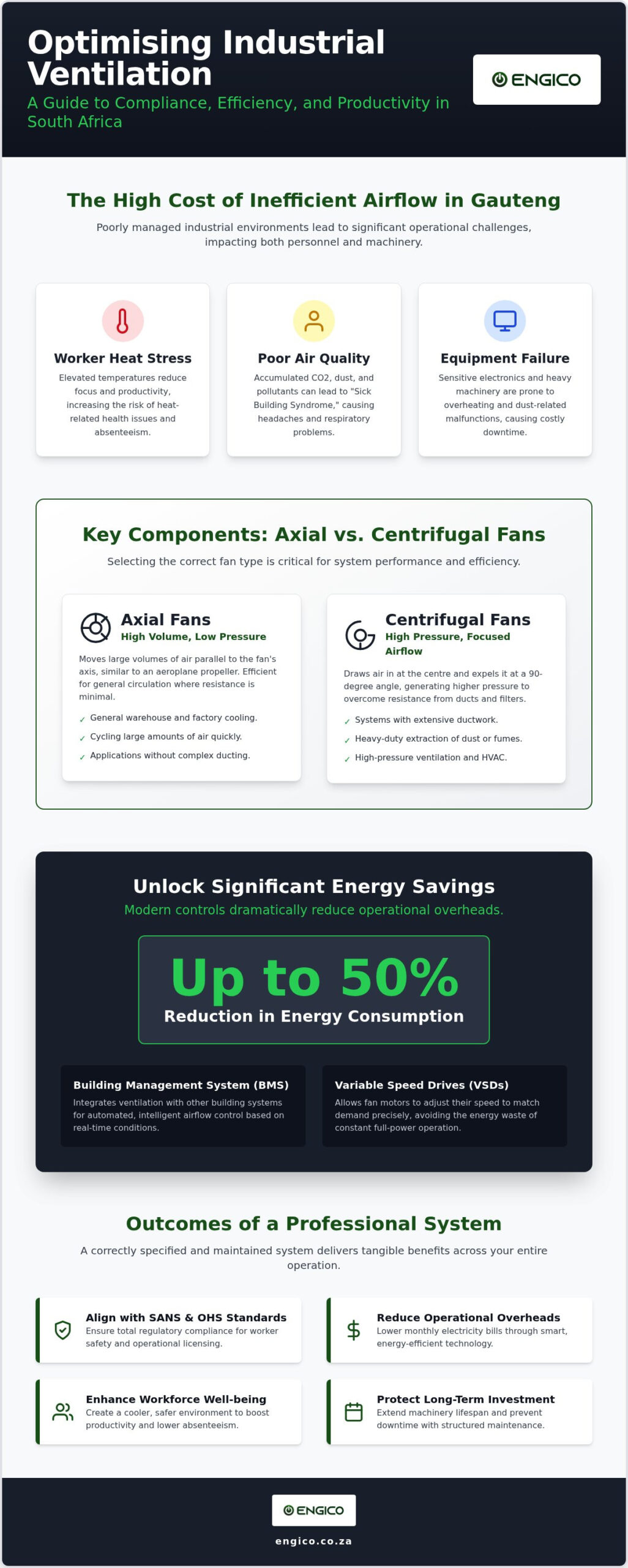
- Reduce operational overheads by integrating Building Management Systems (BMS) and Variable Speed Drives to lower energy consumption by up to 50%.
- Protect your long-term investment through professional installation and structured maintenance protocols designed to prevent equipment failure and downtime.
Understanding Industrial Ventilation Requirements in South Africa
Industrial ventilation is the methodical regulation of airflow within expansive commercial or manufacturing environments. In South Africa, this process involves more than just temperature control; it’s about removing contaminants, managing humidity, and ensuring a constant supply of fresh oxygen. Implementing robust industrial ventilation systems South Africa is a technical necessity for any facility manager overseeing operations in the high-heat, high-dust regions common to our provinces.
Operating in Gauteng presents unique challenges. The high altitude means air is less dense, which affects the cooling efficiency of standard fans. Combined with intense summer heat and seasonal dust, “off-the-shelf” ventilation units often struggle to perform. These mass-produced solutions usually lack the durability required for heavy-duty industrial settings, leading to premature motor failure and inadequate air exchange. A tailored approach is required to handle the specific atmospheric conditions found in hubs like Sandton, Midrand, and Pretoria.
Regulatory Compliance and SANS Standards
South African law is clear regarding air quality in the workplace. SANS 10400-O provides the framework for natural and mechanical ventilation, stipulating specific air change rates based on the nature of the work being performed. Meeting these legal minimums isn’t optional. It’s a fundamental requirement for worker safety and operational licensing. Compliance also involves specialised fire and smoke ventilation systems. These are designed to extract toxic fumes during emergencies, protecting both the structural integrity of the building and the lives of those inside.
The Impact of Poor Ventilation on Industrial Productivity
A stagnant environment directly harms your bottom line. When temperatures rise in Gauteng factories, worker focus declines, and the risk of heat stress increases. Poorly ventilated spaces often lead to “Sick Building Syndrome,” where employees suffer from headaches and respiratory issues due to accumulated CO2 and pollutants. Beyond human health, consistent air circulation protects your assets. Consider the following benefits of a well-designed system:
- Reduced Heat Stress: Maintaining a cooler floor temperature keeps staff alert and productive during peak summer months.
- Machinery Longevity: Protecting sensitive electronics and heavy machinery from overheating and dust-related malfunctions.
- Lower Absenteeism: Reducing the spread of airborne illnesses and respiratory irritants amongst the workforce.
Professional industrial ventilation systems South Africa ensure these environments remain within their optimal operating parameters. This extends equipment lifespan and reduces the likelihood of unplanned downtime in critical production lines.
Key Components of a High-Performance Ventilation System
A high-performance ventilation system is more than just a collection of fans. It’s an integrated network designed to move specific volumes of air while resisting the environmental pressures of a facility. When specifying industrial ventilation systems South Africa, engineers must look at the synergy between extraction points, intake louvers, and the distribution network to ensure no dead zones remain in the warehouse. Each component must be selected based on the specific cubic metres of air movement required to maintain a safe and productive environment.
Industrial Fans: Axial, Centrifugal, and Inline
Fans are the primary drivers of airflow. Axial fans are best suited for high-volume air movement at low pressures. They’re typically used for general warehouse cooling where the goal is to cycle large amounts of air quickly without the resistance of complex ducting. Centrifugal fans, however, are designed for high-pressure applications. If your system requires air to travel through extensive ductwork or requires heavy-duty extraction of particulate matter, centrifugal units provide the necessary force to overcome static pressure.
Selecting the right fan impeller is just as critical. In South African industrial environments, impellers must often resist abrasive dust or corrosive fumes. Choosing a material that matches the specific chemical or physical load of your facility ensures the unit won’t degrade prematurely. If you’re unsure which combination of hardware suits your site’s layout, consulting with experts in industrial ventilation fans and louvers can prevent costly specification errors.
Ventilation Louvers and Air Handling Units
Louvers act as the system’s first line of defence against the elements. Fixed louvers provide constant ventilation while blocking rain and debris. Adjustable louvers offer greater control, allowing facility managers to restrict airflow during cold winter nights or open them fully during the Gauteng summer heat. These components are essential for balancing the intake of fresh air with the exhaust of stale, heated air.
For environments requiring sterile conditions or precise temperature control, Air Handling Units (AHUs) are indispensable. These units manage filtration, humidity, and cooling in a single enclosure. In many local industrial zones, high-grade filtration is necessary to prevent external pollutants from entering the production floor. Proper distribution then depends on well-designed ducting. Without a structured distribution network, air won’t reach the centre of large floorplates, leaving pockets of heat and stagnant air that compromise worker safety and equipment reliability.
Mechanical vs Natural Ventilation: Selecting the Right Approach
Choosing between mechanical and natural airflow strategies is a pivotal decision for any facility manager. Natural ventilation relies on the stack effect, where thermal buoyancy allows warm air to rise and exit through roof vents whilst cooler air enters through low-level louvers. Ensuring these roof structures remain sound is a universal maintenance priority; for detailed advice, Acute Roofing provides a comprehensive guide that illustrates the importance of structural integrity for optimal building performance. While this method is energy-efficient, it’s often insufficient for the high-intensity environments found in modern industrial parks. Relying solely on wind and temperature differentials can leave a facility vulnerable during the stagnant, high-heat days common in the interior provinces.
Mechanical systems provide the precision required for complex manufacturing processes. By using powered fans and blowers, these industrial ventilation systems South Africa maintain a consistent air exchange rate regardless of the external weather conditions. This reliability is vital for meeting the air quality standards previously discussed. The ability to force air through specific zones ensures that every corner of a large floorplate receives adequate circulation, preventing the buildup of heat or pollutants in stagnant areas.
When to Choose Mechanical Ventilation
Mechanical solutions are essential when managing high heat loads or extracting toxic fumes produced during industrial processes. In windowless industrial units or basement levels, natural airflow simply cannot reach the required volumes to ensure worker safety. These systems offer total control over the environment, allowing for filtered air intake and high-pressure extraction that natural systems cannot replicate. They are the preferred choice for facilities where compliance with OHS regulations is a non-negotiable priority and where process-generated heat must be removed instantly to protect machinery.
For industrial sites with hazardous zones, ensuring that all electrical and ventilation equipment is Ex-certified is paramount. Specialist providers like exsafe.shop offer hardware designed to meet these stringent safety requirements for explosive environments.
The Benefits of Hybrid Systems in Gauteng
Many businesses now opt for hybrid or mixed-mode systems to balance efficiency with performance. These systems use natural louvers during the milder winter months and engage mechanical fans only when temperatures reach a specific threshold during peak summer. This approach significantly reduces the carbon footprint of a facility without compromising air quality. It allows for a flexible response to South Africa’s variable climate, using “free” natural cooling whenever possible whilst having the mechanical capacity to handle extreme conditions.
Implementing a hybrid strategy requires careful planning during the design phase to ensure both systems work in harmony. For a deeper look at how these elements are integrated into modern facilities, you can read our Warehouse Ventilation Design South Africa: The 2026 Industrial Guide. This methodical approach ensures that the initial investment delivers long-term operational value through lower electricity bills and improved equipment reliability.
The cost-benefit analysis often favours a hybrid or mechanical approach when considering the long-term impact on productivity. While the initial capital expenditure for powered systems is higher than natural vents, the reduction in heat-related downtime and the assurance of regulatory compliance provide a more stable return on investment for South African industrial clients. Investing in the right strategy today prevents the need for expensive retrofitting in the future.
Improving Energy Efficiency through BMS Integration
A Building Management System (BMS) acts as the central nervous system for modern industrial facilities. It coordinates diverse hardware components into a single, cohesive unit that responds dynamically to the environment. For industrial ventilation systems South Africa, this means moving away from static, manual controls toward intelligent automation. By centralising the management of fans, louvers, and air handling units, operators in Johannesburg can oversee multi-site performance from a single interface, ensuring every facility operates at peak efficiency.
The implementation of Variable Speed Drives (VSDs) is perhaps the most effective way to lower overheads. Traditional fans often operate at a fixed speed, regardless of the actual demand. VSDs allow motors to modulate their output based on real-time requirements. This adjustment can reduce fan energy consumption by 30% to 50%, providing a significant buffer against rising electricity tariffs. When combined with CO2 and temperature sensors, the system only activates high-intensity airflow when specific thresholds are met, preventing the waste of power on empty or already-cooled zones.
Automation and Smart HVAC Control
Smart integration provides a level of visibility that traditional setups lack. Real-time monitoring allows facility managers to track fan performance and air quality metrics as they happen. This data isn’t just for observation; it’s a tool for predictive maintenance. By analysing vibration or power draw patterns via the BMS, the system can flag potential motor failures before they cause a production halt. To explore these technologies further, you can consult our guide on Smart HVAC Control for Commercial Buildings.
Optimising Energy Usage in High-Demand Facilities
In the South African energy market, demand charges can be just as costly as actual usage. Automated ventilation allows for peak-shaving strategies, where non-essential cooling is throttled during high-tariff periods or when the building’s total load approaches its limit. This integration ensures that ventilation doesn’t compete with critical production machinery for power. The return on investment for these systems is often realised quickly through reduced utility bills and extended equipment life. If you’re looking to modernise your facility, we specialise in Building Management System integration for complex industrial environments.
Expert Installation and Maintenance Services for Industrial Air Systems
The longevity of industrial ventilation systems South Africa depends heavily on the precision of their initial setup. Even the most advanced hardware will fail prematurely if it’s incorrectly balanced or mounted on an unstable surface. Professional installation ensures that every fan impeller is aligned and every louver is positioned to handle the specific wind pressures of the site. This methodical approach prevents the mechanical strain that leads to costly downtime and ensures the system operates at its designed efficiency from day one.
The Installation Process for Large-Scale Systems
A successful project begins with a comprehensive site assessment. In Gauteng, this often includes airflow modelling to predict how air will move through complex warehouse layouts. This stage identifies potential dead zones before any equipment is bolted down. During system upgrades, we prioritise minimising operational disruption, often scheduling work to align with your facility’s low-activity periods. The process concludes with rigorous testing and commissioning to verify that the air change rates meet SANS compliance, providing a “safe pair of hands” for your regulatory requirements.
Preventive Maintenance and Repair
Consistent servicing is the only way to protect your long-term investment. In high-dust environments, particulate matter quickly accumulates on fan blades and louvers. This buildup increases the weight of the impeller, leading to vibration that can destroy bearings. Our routine protocols include detailed vibration analysis and bearing checks to catch these issues early. For comprehensive care, you can explore our HVAC Maintenance Services for Gauteng Properties, which are designed to keep systems running at peak performance.
Deciding between a repair and a full equipment replacement requires a technical evaluation of the unit’s remaining lifecycle. If a fan motor requires frequent rewinding or the casing shows significant structural corrosion, replacement is often the more cost-effective choice for long-term reliability. We provide end-to-end support across major hubs, including Sandton, Midrand, and Pretoria, managing everything from the initial design to scheduled servicing. The lifecycle management of industrial ventilation systems South Africa ensures your installation remains a functional asset rather than a maintenance burden.
Modernising Your Industrial Air Strategy for 2026 and Beyond
Industrial ventilation is a critical investment in your facility’s operational health. By moving toward intelligent climate management, you can transform a necessary utility into a strategic advantage. The transition to automated industrial ventilation systems South Africa allows for precise control over energy consumption whilst ensuring your site remains fully compliant with SANS air quality regulations. Whether you’re managing heat loads in a Gauteng warehouse or extracting fumes from a manufacturing floor, the focus remains on long-term reliability and cost reduction.
Engico Air Conditioning acts as a safe pair of hands for these complex technical projects. We provide professional installation by Gauteng HVAC specialists, expertise in high-efficiency BMS integration, and comprehensive maintenance contracts to prevent unplanned downtime. Our methodical approach ensures that your system remains a durable asset rather than a growing liability. It’s about getting the job done right the first time to protect your workforce and your bottom line.
Enquire about a custom industrial ventilation solution from Engico Air Conditioning to secure a cooler, more efficient future for your business operations.
Frequently Asked Questions
What are the legal requirements for industrial ventilation in South Africa?
Industrial ventilation must comply with the National Building Regulations, specifically SANS 10400-O, and the Occupational Health and Safety (OHS) Act. These regulations mandate specific air change rates to ensure worker safety and the removal of hazardous pollutants. Failing to meet these standards can result in legal penalties and operational shutdowns. Professional assessments are necessary to verify that your system provides the required cubic metres of fresh air per person per hour.
How often should industrial ventilation fans be serviced?
Most industrial ventilation fans require professional servicing every six to twelve months. In high-dust environments or heavy manufacturing settings common in Gauteng, quarterly inspections are often recommended to prevent particulate buildup on impellers. Regular maintenance includes bearing lubrication, vibration analysis, and belt tension adjustments. This proactive schedule prevents mechanical failure and ensures that your industrial ventilation systems South Africa continue to operate at their designed efficiency levels.
Can a BMS really reduce my factory ventilation costs?
A Building Management System (BMS) reduces costs by automating airflow based on real-time demand rather than running fans at constant speeds. By integrating Variable Speed Drives (VSDs), the system modulates power usage according to temperature or CO2 levels. This targeted approach can lower electricity bills by up to 50% in large facilities. Additionally, centralised monitoring allows for predictive maintenance, which reduces the expense of emergency repairs and unplanned production downtime.
What is the difference between a ventilation fan and an air handling unit?
The primary difference lies in the treatment of the air being moved. A ventilation fan is a mechanical device designed solely to move air from one point to another, either for intake or extraction. An Air Handling Unit (AHU) is a more complex enclosure that treats the air by filtering out pollutants, adjusting humidity, and controlling temperature. While fans are essential for general circulation, AHUs are required for environments needing precise climate management.
How do I choose between natural and mechanical ventilation for my warehouse?
Natural ventilation is suitable for smaller facilities with low heat loads, leveraging the stack effect through roof vents and louvers. However, mechanical ventilation is necessary for large floorplates or manufacturing plants where heat and fumes must be extracted forcefully. If your warehouse exceeds a specific depth or contains windowless zones, a mechanical or hybrid system is required to maintain consistent air change rates regardless of external wind conditions.
Does Engico provide ventilation services in Pretoria and Johannesburg?
Yes, Engico provides comprehensive ventilation and HVAC services across all major Gauteng hubs, including Sandton, Midrand, Pretoria, and Johannesburg. Our team specialises in the design, installation, and long-term maintenance of large-scale industrial systems. We understand the specific atmospheric challenges of the Highveld, such as high altitude and seasonal dust, allowing us to provide tailored solutions that ensure equipment longevity and regulatory compliance for local businesses.
What happens if my industrial ventilation system fails?
A failure in your ventilation system leads to immediate heat accumulation, stagnant air, and potential exposure to toxic fumes. This creates a dangerous working environment that violates South African OHS standards and can lead to equipment overheating. Beyond safety risks, a breakdown often results in lost productivity and expensive emergency repair costs. Implementing a structured maintenance contract is the most effective way to identify wear before it leads to a total system shutdown.
Are there energy-efficient ventilation options for high-heat environments?
High-efficiency options include the installation of Variable Speed Drives (VSDs) and aerodynamically optimised fan impellers. These components allow the system to provide the required airflow using significantly less wattage. Integrating your hardware with a BMS ensures that fans only operate when sensors detect a need for cooling or air exchange. These modern industrial ventilation systems South Africa are designed to handle extreme heat whilst keeping your facility’s carbon footprint and utility costs as low as possible.
Recent Comments