
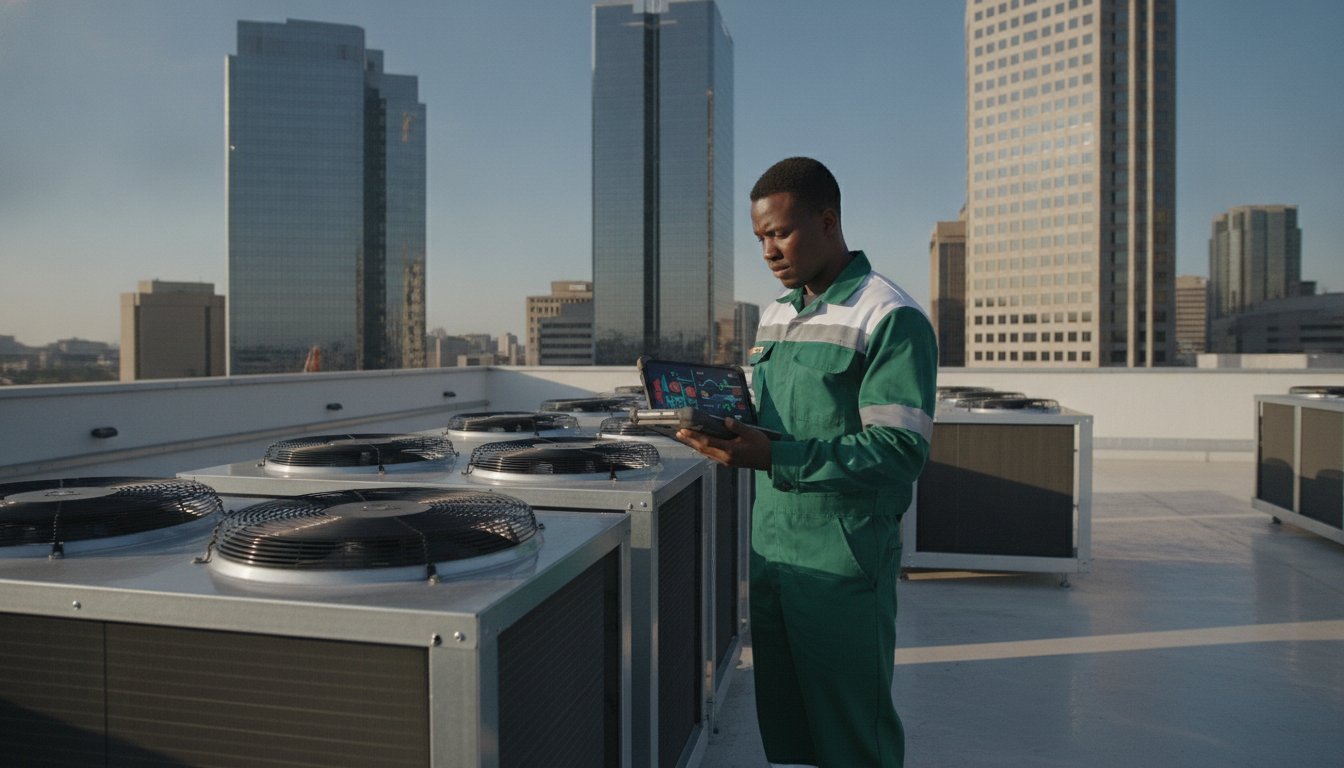
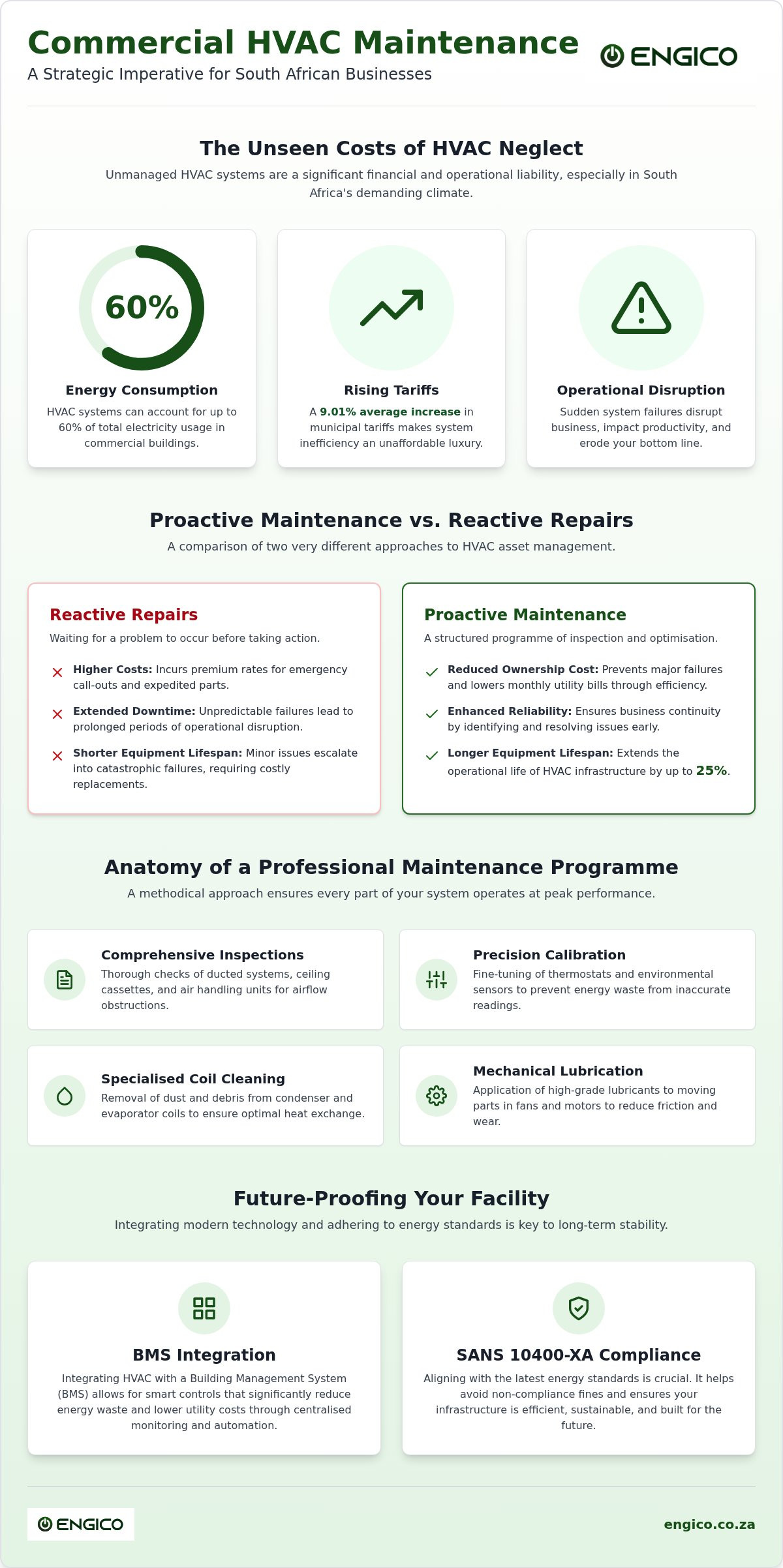
Did you know that HVAC systems account for up to 60% of the total electricity usage in South African commercial buildings? In Gauteng’s demanding climate, where summer peaks test even the most robust infrastructure, managing these costs whilst maintaining operational reliability is a constant challenge. You’re likely aware that rising municipal tariffs, which increased by an average of 9.01% in July 2026, make inefficiency a luxury your business cannot afford. Frequent system downtime doesn’t just cause discomfort; it disrupts your entire operation and erodes your bottom line.
This guide demonstrates how professional commercial HVAC maintenance across Gauteng protects your valuable assets and ensures your facility remains compliant with the latest SANS 10400-XA energy standards. At Engico Air Conditioning, we’ve positioned ourselves as a methodical partner to help you navigate these technical requirements without the fuss of unreliable contractors. We will explore the critical transition away from HCFC refrigerants, the practical benefits of Building Management System integration, and how a structured maintenance programme provides the long-term stability your business requires to thrive in 2026.
Key Takeaways
- Understand why systematic commercial HVAC maintenance Polokwane is essential for protecting equipment against extreme Limpopo heat and ensuring business continuity.
- Learn the technical requirements of a professional programme, from the thorough inspection of ducted systems to the precise calibration of environmental sensors.
- Discover how Building Management System (BMS) integration and smart controls can significantly reduce energy waste and lower monthly utility costs.
- Gain a clear framework for auditing your existing climate control assets and establishing a service schedule based on usage intensity and environmental exposure.
- Recognise the importance of aligning with 2026 energy standards to avoid non-compliance fines whilst extending the operational lifespan of your HVAC infrastructure.
Why Commercial HVAC Maintenance in Polokwane is Critical for Business Continuity
Commercial HVAC maintenance is the systematic inspection and optimisation of Heating, ventilation, and air conditioning (HVAC) systems to prevent mechanical failure. In Polokwane, where summer temperatures frequently soar, this process is a strategic necessity rather than a luxury. High-heat environments place immense strain on compressors. When ambient temperatures rise, refrigerant stability is compromised, forcing the system to work harder to achieve the same cooling effect. Without professional oversight, these units often fail when they are needed most.
Limpopo’s unique environment adds another layer of technical complexity. The region is known for high dust levels, which quickly accumulate on condenser and evaporator coils. This buildup acts as an insulator, trapping heat and leading to premature coil degradation. If these environmental factors are ignored, the resulting efficiency decay accelerates wear and tear. This often leads to expensive component replacements long before the end of the system’s expected lifecycle. Businesses that prioritise commercial HVAC maintenance Polokwane avoid these pitfalls through methodical cleaning and calibration.
Protecting Your Operational Infrastructure
For retail centres and office blocks in Polokwane, a cooling failure is a critical operational risk. Employees cannot maintain peak productivity in a stifling environment, and customers are unlikely to linger in a store that lacks climate control. Reliability is the cornerstone of a professional workspace. Preventive maintenance acts as a vital tool for extending equipment life by up to 25%. By identifying worn belts or leaking valves early, businesses avoid the chaos of sudden downtime and keep their operations running smoothly.
Reducing the Total Cost of Ownership
The financial disparity between proactive servicing and reactive emergency repairs is substantial. A reactive approach often involves paying premium rates for urgent call-outs and expedited parts delivery. Regular servicing prevents these minor issues from escalating into catastrophic mechanical failures that require total system replacement. Clean filters and optimised motors also have a direct impact on your monthly utility bills. Systems that operate without obstruction consume significantly less electricity. This focus on efficiency aligns with broader regional standards, similar to the practices outlined in our guide for commercial HVAC maintenance Sunninghill, where professional oversight is used to mitigate rising energy costs.
Essential Components of a Professional HVAC Maintenance Programme
A professional maintenance programme is defined by its attention to technical detail. It follows established minimum HVAC inspection and maintenance requirements to ensure that every component operates within its design parameters. For businesses seeking reliable commercial HVAC maintenance Polokwane, this involves more than a cursory glance at the equipment. It requires a deep dive into the mechanical and electronic health of the entire system to ensure long-term durability.
The process begins with a comprehensive inspection of ducted systems and ceiling cassette units. Technicians look for airflow obstructions that force fans to work harder, consuming excess power. Precision is also applied to the technical calibration of thermostats and sensors. Even a slight deviation in temperature readings can lead to significant energy spikes. Condenser coils are treated with specialised cleaning agents to maintain optimal heat exchange efficiency, whilst moving parts in industrial ventilation fans receive high-grade lubrication to reduce mechanical friction. If you require a methodical assessment of your facility’s infrastructure, you can explore our full range of maintenance and repair services.
Industrial Ventilation and Air Handling Units
Large-scale commercial buildings in Limpopo often rely on complex air handling units (AHUs). These systems require specialised care to manage the high volumes of air they circulate. Maintenance includes inspecting louvers and industrial fans for structural integrity and ensuring that dampers operate smoothly. For warehouses, these components are vital for maintaining air quality and temperature consistency. You can find more detailed technical standards in our guide on Warehouse Ventilation Design South Africa, which outlines the requirements for industrial-grade circulation.
Refrigerant Management and Leak Detection
Maintaining gas pressure is essential for cooling capacity, especially during a Polokwane heatwave. From 2026, South Africa’s import quota for HCFCs like R22 has been reduced to just 2.5%, making refrigerant management an environmental and financial priority. Technicians use advanced leak detection tools to identify signs of depletion before the system shuts down. This proactive approach ensures compliance with modern standards and prevents the efficiency decay that occurs when gas levels drop. Regular testing confirms that your system remains a safe pair of hands for your business climate needs.
Energy Efficiency and BMS Integration: Modernising Polokwane’s Climate Control
Modernising climate control in Limpopo requires a shift from reactive repairs to data-driven management. As electricity prices continue to rise, businesses must look beyond simple filter changes to maintain profitability. Integrating a Building Management System (BMS) provides a centralised platform for monitoring every component of your infrastructure. This technology allows for real-time tracking of energy spikes and performance metrics, ensuring your system operates at peak efficiency. It’s a methodical approach that replaces guesswork with precise technical insights.
A key advantage of this integration is the implementation of smart HVAC control for commercial buildings. These systems eliminate the waste associated with manual adjustments, which are often imprecise or forgotten by staff. By using data analytics, facility managers can identify “ghost loads”, which are instances where cooling or ventilation systems run at high capacity in unoccupied zones or after business hours. Transitioning to automated, sensor-driven management ensures that your commercial HVAC maintenance Polokwane strategy is both modern and fiscally responsible.
Optimising Energy Consumption for 2026
In 2026, the focus has shifted toward precision hardware that responds to environmental conditions. Implementing variable speed drives (VSDs) allows motors to match their output to the actual cooling demand rather than running at 100% capacity constantly. Modern maintenance audits now identify these specific opportunities for energy-saving hardware upgrades during routine checks. Building Management Systems can reduce commercial energy costs by up to 30% through intelligent scheduling and demand-side management. This level of control is essential for staying compliant with stricter thermal calculation requirements introduced in the latest SANS 10400-XA standards.
Remote Monitoring and Predictive Alerts
Predictive maintenance is the next logical step for businesses that value reliability. Remote monitoring tools provide alerts the moment a system deviates from its baseline performance, often weeks before a physical failure occurs. This allows for scheduled interventions that don’t disrupt your daily operations or customer experience. Remote diagnostics also reduce the need for multiple on-site technical call-outs, as technicians arrive with a clear understanding of the fault and the necessary parts. Integrating this HVAC data into broader facility management reporting ensures your infrastructure remains a transparent and manageable asset.
How to Organise an Effective HVAC Servicing Schedule
Implementing a structured schedule is the most effective way to manage your facility’s climate control assets. It moves your business away from the “fix-on-failure” cycle that often results in high repair bills and unexpected downtime. To begin, you must conduct a full audit of all existing HVAC assets, including wall-mounted split units, ducted systems, and air handling units. This inventory should record the age, condition, and service history of every component to create a clear baseline for performance.
Once you’ve mapped your infrastructure, the next step is determining the service frequency. This isn’t a one-size-fits-all calculation. It depends on usage intensity and environmental exposure. Businesses that invest in structured commercial HVAC maintenance Polokwane ensure their systems are calibrated for the city’s specific environmental stressors. After establishing these intervals, create a clear logbook for all maintenance activities. This logbook serves as a technical record of every filter change, gas pressure test, and sensor calibration, providing accountability for every technician visit.
Partnering with a specialist contractor is vital for long-term success. You need a partner capable of managing both air conditioning and industrial ventilation to ensure all parts of the building work in harmony. Finally, make it a habit to review your performance data annually. This allows you to adjust your plan based on actual energy savings and equipment performance, ensuring maximum return on investment, especially given the 9.01% municipal tariff hike in July 2026. If you’re ready to secure your facility’s operational future, you can contact our team to schedule a technical audit of your HVAC systems.
Determining Your Service Frequency
High-traffic retail spaces often require more frequent filter changes than low-density offices. The constant movement of people introduces more particulates into the air, which can quickly clog ceiling cassette units and reduce airflow. We recommend a balance between seasonal deep cleans and monthly routine inspections. In industrial environments with high dust or particulate levels, monthly checks on ventilation fans and louvers are essential to prevent mechanical friction from causing a total system shutdown during a heatwave.
Documenting for Compliance and Warranty
Professional maintenance records are not just for internal use. They are critical for protecting manufacturer warranties, which often become void if regular servicing by qualified technicians is neglected. Detailed service history is also a prerequisite for insurance claims and building safety audits. In 2026, with the deadline for Energy Performance Certificates (EPCs) having passed, digital logbooks are now essential for demonstrating building compliance. They allow for instant retrieval of data during inspections, proving that your business meets the latest South African National Standards for energy usage.
Engico Air Conditioning: Your Partner for Reliable HVAC Solutions in Limpopo
Engico Air Conditioning operates with a tone of professional reliability and quiet confidence. We position ourselves as a methodical specialist that manages climate control projects from inception to completion without fuss. Our focus is on providing long-term value for businesses in Limpopo, ensuring that your infrastructure remains an asset rather than a liability. By choosing Engico for your commercial HVAC maintenance Polokwane, you’re partnering with a team that understands the technical requirements of high-demand environments. We provide a safe pair of hands to manage everything from initial installation to complex Building Management System (BMS) integration.
Our process is disciplined and detail-oriented. We recognise that industrial clients require a partner who values precision over self-promotion. We don’t rely on aggressive sales tactics; instead, we build trust through transparency and a commitment to modern standards. This solution-oriented approach ensures that every maintenance contract we manage is tailored to the specific mechanical needs of the facility, protecting your bottom line against the rising costs of energy and equipment failure.
Comprehensive HVAC and Ventilation Capabilities
We bring extensive expertise in a wide array of systems, including ducted air conditioning, air handling units (AHUs), and industrial ventilation fans and louvers. This breadth of capability allows us to provide a holistic service that covers both cooling and air circulation. We integrate modern efficiency standards into every maintenance contract, ensuring your equipment meets the 2026 requirements for thermal performance. Our presence across both Gauteng and Limpopo serves as a testament to our regional reliability. It demonstrates our ability to manage large-scale infrastructure projects with the same level of care and professional excellence regardless of the location.
Get Started with a Professional HVAC Audit
Transitioning from reactive repairs to a structured maintenance programme is the most effective way to eliminate operational uncertainty. We invite facility managers in Polokwane to assess their current system performance alongside an Engico expert. This audit identifies immediate efficiency gaps and provides a roadmap for long-term reliability. By moving away from quick fixes and embracing a methodical servicing strategy, you ensure your business remains resilient in the face of extreme weather and rising utility costs. It’s time to secure a worry-free environment for your staff and customers. Contact Engico for a professional HVAC maintenance consultation to begin your journey towards optimised performance.
Future-Proofing Your Commercial Climate Infrastructure
Adopting a proactive approach to your facility management ensures that your cooling and ventilation systems remain a strategic asset rather than a source of operational stress. We’ve explored how technical precision in commercial HVAC maintenance Polokwane protects your equipment from environmental degradation whilst ensuring your building meets the latest 2026 energy standards. By moving away from the cycle of reactive repairs, you gain control over your utility costs and provide a consistent environment for your staff and clients.
Engico Air Conditioning provides a safe pair of hands for businesses across Limpopo. Our team specialises in expert BMS integration for maximum energy efficiency and remains a leader in managing industrial-grade ventilation and AHUs. We focus on a methodical, professional approach that prioritises long-term reliability and technical excellence. It’s time to transition to a maintenance strategy that supports your business growth and operational stability.
Secure your commercial HVAC infrastructure with an Engico maintenance programme and enjoy the confidence that comes with professional oversight. We look forward to helping you optimise your facility for the challenges of the years ahead.
Frequently Asked Questions
How often should commercial HVAC systems in Polokwane be serviced?
Commercial systems in Polokwane should generally be serviced at least twice a year, though quarterly visits are recommended for high-traffic retail spaces or industrial sites. Polokwane’s high dust levels and extreme summer peaks place significant stress on condenser coils and compressors. Regular inspections allow for the methodical cleaning of filters and the monitoring of refrigerant levels, ensuring your system remains reliable during the hottest months of the year.
What are the most common signs that my commercial AC needs urgent maintenance?
The most frequent indicators include unusual mechanical noises, a noticeable drop in airflow, and inconsistent temperatures across different zones. You might also observe a sudden increase in your monthly electricity consumption or rising humidity levels within the building. These symptoms often point to blocked coils or failing sensors that require immediate technical attention to prevent a total system shutdown and avoid costly emergency repairs.
Can regular maintenance actually reduce my business’s monthly electricity bill?
Professional commercial HVAC maintenance Polokwane significantly reduces utility costs by preventing efficiency decay. Since HVAC systems can account for up to 60% of a commercial building’s electricity usage, even minor optimisations lead to substantial savings. Well-maintained units don’t have to work as hard to reach target temperatures, which protects your budget from the 9.01% municipal tariff increase implemented in July 2026.
What is the benefit of integrating a BMS with my existing HVAC system?
Integrating a Building Management System (BMS) allows for centralised, real-time monitoring of your entire climate control infrastructure. This technology enables automated scheduling and sensor-driven adjustments that eliminate human error. By identifying “ghost loads” where equipment runs unnecessarily after hours, a BMS can help reduce your total energy expenditure by up to 30% through intelligent, data-driven demand management.
Do you maintain industrial ventilation fans and louvers as part of a contract?
Yes, we specialise in the maintenance of industrial ventilation fans and louvers as part of our comprehensive service contracts. These components are essential for maintaining air circulation and quality in large-scale warehouses and manufacturing plants. Our methodical approach includes lubricating moving parts to reduce friction and inspecting louver structural integrity to ensure your facility remains compliant with modern South African ventilation standards.
What happens if a major HVAC component fails between scheduled service visits?
If a component fails between visits, a technical diagnostic is required to identify the root cause and provide a professional repair solution. Our service programmes are designed to minimise these risks through predictive alerts and thorough inspections. Whilst scheduled maintenance is the best defence against failure, we provide expert repair services to restore your system to its design parameters as efficiently as possible.
Is it better to repair an old commercial unit or replace it with a modern ducted system?
Replacing an older unit with a modern ducted system is often more cost-effective if the equipment is over 12 years old or requires expensive R22 refrigerant. From 2026, HCFC import quotas have been reduced to 2.5%, making repairs on legacy systems increasingly difficult and costly. Modern inverter-driven systems offer superior efficiency and better alignment with the latest South African National Standards for energy usage.
Does professional maintenance help with indoor air quality in an office environment?
Professional commercial HVAC maintenance Polokwane is vital for maintaining high indoor air quality in professional environments. Regular filter replacements and the cleaning of evaporator coils remove dust, pollen, and other particulates from the air stream. This process prevents the buildup of mould and bacteria within the ductwork, ensuring a healthier environment for your employees whilst supporting overall building safety and hygiene.
Recent Comments