

If you’re looking at the sticker price of a new cooling unit, you’re only seeing half the story. The true wall mounted split air conditioners price is measured over five years of operation, not just at the checkout counter. It’s understandable to feel overwhelmed by technical BTU ratings or the fear of how a new installation might impact your monthly Eskom bill. Most homeowners in Gauteng worry about choosing a brand that can handle our specific climate whilst remaining energy efficient.
This guide provides a comprehensive breakdown of hardware, professional installation, and long-term running costs to ensure you receive the best possible value for your investment. We’ll examine the difference between upfront hardware costs and professional labour; this helps you select a unit that balances initial affordability with modern efficiency standards. By the end, you’ll have the clarity needed to choose a reliable system and a qualified local installer who understands the unique demands of the South African environment.
Key Takeaways
- Understand why the retail “box price” is only a fraction of the total investment and how to budget for a complete professional installation.
- Learn how to calculate the correct BTU capacity for your space to ensure the wall mounted split air conditioners price you pay aligns with your actual cooling requirements.
- Discover why modern inverter technology offers superior long-term value by significantly reducing energy consumption compared to traditional fixed-speed units.
- Identify the specific installation variables in Gauteng that influence labour costs, including pipe run distances and necessary electrical upgrades.
- Recognise how professional maintenance and warranty compliance safeguard your equipment against the unique demands of the South African climate.
Understanding Wall-Mounted Split System Costs: Hardware vs Installation
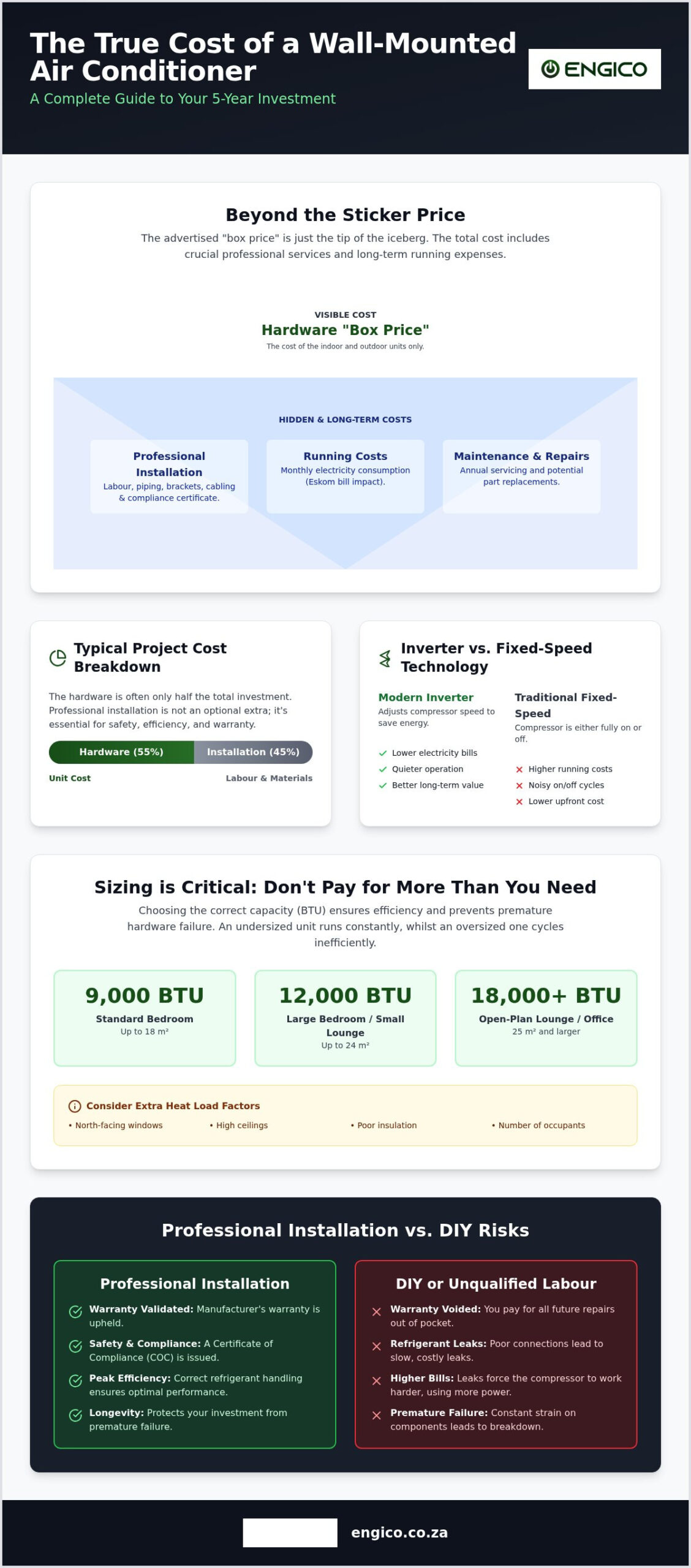
When browsing retail catalogues, it’s easy to assume the advertised figure represents the total investment. However, the wall mounted split air conditioners price you see in a store typically covers only the physical hardware. For the average consumer, this “box price” is misleading because it excludes the technical expertise and materials required for a safe, functional setup. In many cases, the hardware represents only a portion of the total project cost, with professional labour and specialised materials making up the remainder.
A standard system consists of two primary parts: the indoor evaporator unit and the outdoor condenser. These are connected by refrigerant piping, which allows the system to transfer heat away from your living space. The base hardware price is largely determined by the unit’s capacity, measured in British Thermal Units (BTU). Higher BTU ratings are necessary for larger rooms; as the cooling capacity increases, so does the cost of the internal components and the compressor.
What is a Midwall Split Unit?
These systems are often referred to as split-system air conditioners because they divide the cooling process into two distinct locations. By placing the noisy compressor and condenser fan outside, the indoor environment remains quiet and comfortable. This design is the most popular choice for Gauteng homes and offices because it offers a sleek profile that mounts high on a wall, saving floor space whilst providing efficient airflow. Each unit includes an indoor evaporator and an outdoor condenser, managed by a remote control for precise climate regulation.
The Hidden Costs of DIY or Unqualified Installation
Attempting a DIY installation or hiring an unqualified technician can lead to significant financial setbacks. Most major manufacturers stipulate that their warranties are only valid if the system is installed by a registered professional who can issue a Certificate of Compliance (COC). Without this document, you’ll likely find yourself footing the bill for expensive repairs if a fault occurs.
A professional installation package includes the supply of specialised mounting brackets, copper piping, and electrical cabling. Qualified technicians ensure that the refrigerant lines are vacuumed and sealed correctly. Poor connections often lead to slow refrigerant leaks; these leaks force the compressor to work harder, which increases your electricity bills and leads to premature equipment failure. Professional commissioning is vital for unit longevity and ensures the system operates at its peak efficiency from the moment it’s switched on.
Key Factors Influencing the Price of Your Split Unit
Several variables dictate the final wall mounted split air conditioners price, ranging from the unit’s raw cooling power to the sophistication of its internal filtration systems. It’s a mistake to view these units as identical appliances; the technology inside a premium model differs significantly from a budget-friendly alternative. Understanding these drivers helps you avoid paying for unnecessary features whilst ensuring you don’t compromise on essential performance for the Gauteng climate.
Brand tiers play a significant role in the initial investment. Premium manufacturers like Samsung and Daikin often command a higher price because they invest heavily in research and development, resulting in quieter operation and advanced compressor durability. In contrast, value-driven brands such as Alliance or TCL offer a more accessible entry point. Whilst these brands provide reliable cooling, they may lack the high-end finishes or the ultra-low decibel ratings found in top-tier models. Additionally, units with high Energy Efficiency Ratings (EER) typically cost more upfront but recoup that value through reduced monthly electricity consumption.
BTU Sizing: Don’t Pay for More Than You Need
Capacity is the most fundamental factor in hardware pricing. A 9,000 BTU unit is generally sufficient for a standard bedroom, whereas an 18,000 or 24,000 BTU model is required for large, open-plan lounges. If you install a unit that’s too small for the space, it will run at maximum capacity indefinitely. This constant strain leads to higher long-term maintenance costs and premature hardware failure. When calculating your needs, you must consider more than just square meterage; north-facing windows, high ceilings, and the number of occupants all increase the heat load of a room.
The “South African Factor”: Surge Protection and Load Shedding
In Gauteng, the stability of the electrical grid is a primary concern for any HVAC installation. Voltage surges that occur when power returns after a load shedding cycle can destroy the sensitive printed circuit boards (PCBs) inside modern air conditioners. Because of this, high-quality voltage protection is a mandatory additional cost to safeguard your equipment. You should also consider how the unit behaves during power transitions. Many modern systems include an “auto-restart” function that restores your previous settings once the grid is live. If you’re running a home on solar or backup batteries, it’s vital to select an inverter-compatible model that won’t trip your system during the initial start-up phase.
Modern features like Wi-Fi connectivity allow you to pre-cool your home via a smartphone app, whilst advanced air purification filters remove allergens and dust from the environment. For a tailored assessment of which features best suit your lifestyle, you can consult with our specialists to ensure your hardware choice matches your specific environment.
Inverter vs Fixed Speed: Which Offers Better Long-Term Value?
Choosing between an inverter and a fixed-speed model is the most significant decision affecting the total wall mounted split air conditioners price. The technical distinction lies in how the compressor operates. Traditional fixed-speed units work on an “all or nothing” basis; the compressor runs at full power until the target temperature is reached and then shuts off completely. When the room warms up, it restarts at full capacity. This constant cycling creates temperature swings and places a heavy load on your electrical circuit.
Inverter technology uses a variable-speed compressor that never truly turns off. Instead, it slows down once the desired temperature is achieved, maintaining a consistent climate with minimal energy. Whilst this advanced engineering means inverters typically cost 20% to 30% more at the point of purchase, they offer a far more refined experience. You won’t deal with the uncomfortable “cold blasts” or the noisy start-up sounds of older systems. Instead, you enjoy a stable environment and significantly lower monthly cooling bills, often reduced by up to 40%.
The Economics of Inverter Technology
In the current South African energy climate, the break-even point for an inverter unit has moved closer to the initial purchase date. Most residential users find that the electricity savings cover the higher upfront cost within 18 to 24 months. As we move through 2026, fixed-speed units are becoming increasingly obsolete for primary living areas. They simply cannot match the operational efficiency required for modern homes. This is especially true for properties equipped with solar power. Inverters have a much lower start-up current, which prevents the sudden power spikes that can overwhelm home battery systems or trip backup inverters during load shedding transitions.
Maintenance Requirements for Each Type
A common misconception suggests that inverter units are too delicate or expensive to fix. Whilst it’s true that the internal electronics are more sophisticated, they aren’t inherently less reliable. Most electronic faults are caused by external factors like dust or power surges rather than internal failure. Investing in professional HVAC maintenance services for Gauteng properties is the most effective way to protect these sensitive components. Expert technicians can identify worn capacitors or loose connections before they lead to a total system shutdown.
You can also take proactive steps to safeguard your hardware. Cleaning the indoor unit’s filters every month ensures the system doesn’t have to work harder than necessary to circulate air. When airflow is restricted, the compressor runs for longer periods, which increases wear and tear. By combining simple owner maintenance with scheduled professional servicing, you ensure your unit remains efficient for its entire 12 to 15-year lifecycle.
The physical unit is only one component of the total wall mounted split air conditioners price. Professional installation ensures the system operates safely and meets manufacturer specifications. A standard “back-to-back” installation is the most common arrangement, where the indoor unit and outdoor condenser are mounted on opposite sides of the same wall. This typically includes up to 3 metres of refrigerant piping and a basic electrical connection to an existing nearby point.
Several factors can increase labour and material costs. High-rise apartments in Sandton or offices in Pretoria often require specialised mounting brackets or long-reach ladders. If the outdoor unit must be placed on a roof or a distant wall, the cost of additional copper piping and trunking will rise. For larger units, specifically those rated at 18,000 BTU or higher, a dedicated electrical circuit from the main distribution board is often necessary to handle the power draw; this is a technical requirement that a general handyman might overlook.
Effective climate control also depends on location-specific needs. For instance, commercial HVAC maintenance in Sunninghill and surrounding business hubs often involves managing systems that run for extended hours, requiring more robust installation standards to prevent downtime.
What to Expect During a Professional Installation
A methodical installation begins with mounting the indoor unit on a level bracket to ensure proper drainage. The technician then performs core drilling to pass the refrigerant lines and communication cables through the wall. One of the most critical steps is vacuuming the system with a specialised pump to remove all air and moisture from the lines before releasing the refrigerant. This process prevents internal corrosion and ensures the compressor runs efficiently. A single-room split system installation usually takes between three and five hours to complete, depending on the complexity of the site.
Budgeting for Annual Servicing
Regular maintenance is a conscientious way to protect your long-term investment. Whilst a basic yearly service carries a modest fee, it can prevent the need for a total unit replacement that costs significantly more. During a service call, a technician will check refrigerant gas levels, clear the drainage lines to prevent indoor leaks, and chemically clean the external coils. This is not just about performance; most manufacturers require proof of annual professional servicing to uphold their warranty. If you neglect these checks, a minor component failure could lead to an expensive, out-of-warranty repair.
To ensure your system is installed correctly the first time, you can book a professional assessment with our expert team today.
Why Engico is Your Reliable Partner for Climate Control
Selecting a new climate control system involves more than just comparing the initial wall mounted split air conditioners price. It requires a partner who understands the technical nuances of the Gauteng environment and can manage the entire project lifecycle. Engico provides a comprehensive supply and fit service, which removes the burden of coordinating between hardware retailers and independent contractors. This end-to-end approach ensures that the unit you purchase is the same unit our technicians are trained to install and maintain, creating a seamless transition from sales to operation.
Our capabilities encompass everything from single-room residential units to smart HVAC control for commercial buildings. This broad expertise allows us to apply industrial-grade precision to every project, regardless of its scale. With a strong local presence across Gauteng, including Pretoria, Sandton, and Hyde Park, our teams are positioned to provide responsive support. We prioritise energy-efficient solutions that lower the total cost of ownership, ensuring your investment remains sustainable as electricity tariffs continue to rise.
Tailored Solutions for Gauteng Homes and Offices
We believe that a successful installation begins with an accurate assessment. Our specialists conduct personalised site visits to calculate the exact heat load of your space, ensuring the BTU sizing is neither under-specified nor unnecessarily large. This methodical approach protects the longevity of the hardware and prevents the high running costs associated with incorrectly sized units. We focus on equipment that offers proven durability in South African weather conditions, from intense summer heatwaves to sudden winter cold fronts. Our quoting process is transparent, providing a clear breakdown of hardware and labour with no hidden installation fees.
Get a Professional Quote Today
Choosing a seasoned professional who values precision is the most effective way to safeguard your property and your comfort. An incorrectly installed air conditioner can lead to structural damp, electrical faults, or voided manufacturer warranties. By partnering with a specialist team, you ensure that every mounting bracket, refrigerant line, and electrical connection meets the highest professional standards. We handle the technical complexities so that you can enjoy a stable, reliable climate in your home or office. We invite you to Request a comprehensive quote from Engico Air Conditioning to begin your journey toward a more comfortable and efficient environment.
Securing Your Climate Control Investment
Balancing the initial wall mounted split air conditioners price with long-term operational efficiency is the most effective way to ensure lasting value. You now understand that a successful installation requires more than just high-quality hardware. It demands precise BTU sizing and professional commissioning to guarantee warranty compliance. By prioritising energy-efficient inverter technology and committed maintenance, you safeguard your property against rising energy costs and the unique challenges of the South African grid.
Engico stands as a dependable partner for homeowners and businesses across Gauteng. Our specialists provide professional installation and comprehensive maintenance programmes designed to protect your equipment for years to come. Whether you’re upgrading a single room or managing a commercial facility, our methodical approach ensures your environment remains stable and comfortable. We provide the technical expertise and the quiet confidence needed to manage your project from inception to completion without fuss.
Get a Professional Quote for Wall-Mounted Split Air Conditioning
We’re ready to help you achieve the perfect balance of performance and efficiency for your specific environment.
Frequently Asked Questions
How much does a 12,000 BTU split air conditioner cost with installation in 2026?
The total cost for a 12,000 BTU unit depends on the brand tier you select and the complexity of the installation site. Whilst retail stores display a hardware figure, your final investment includes professional labour and specialised materials like copper piping and trunking. A standard installation is typically the most cost-effective option for a single-room setup.
Is an inverter air conditioner worth the extra price?
Inverter technology offers superior long-term value despite a higher initial wall mounted split air conditioners price. Because these units adjust their compressor speed rather than switching off completely, they use significantly less electricity. Most users find that the savings on their monthly utility bills allow them to recoup the price difference within a few years of operation.
What is included in a “standard back-to-back” installation?
A standard back-to-back installation covers the mounting of the indoor unit and the outdoor condenser on opposite sides of the same wall. This service typically includes up to three metres of refrigerant piping, basic electrical cabling, and the necessary drainage components. If your units are further apart or require high-rise mounting, additional labour and material costs will apply.
How often should I service my wall-mounted split unit to keep the warranty?
You must schedule a professional service at least once a year to ensure your manufacturer’s warranty remains valid. Most brands require a documented service history from a registered HVAC technician to process any future repair claims. Regular servicing also ensures the system operates at peak efficiency, which helps keep your running costs low.
Can I install a split system air conditioner myself to save money?
Attempting to install a split system yourself is not recommended and will invalidate your manufacturer’s warranty. Professional installation is essential because it requires specialised tools to vacuum the refrigerant lines and ensure there are no leaks. Additionally, a registered professional must provide a Certificate of Compliance, which is a legal requirement for insurance purposes.
Do split air conditioners use a lot of electricity?
Modern split systems are highly efficient, particularly those equipped with inverter technology. These units are designed to maintain a consistent temperature with minimal power draw once the room is cool. Your actual consumption will depend on the unit’s energy rating, the BTU sizing relative to the room, and how well you maintain the filters.
What is the lifespan of a wall-mounted split air conditioner in South Africa?
A high-quality unit typically lasts between 10 and 15 years when it receives regular professional maintenance. Factors such as Gauteng’s dust levels and frequent power fluctuations can impact longevity. Investing in surge protection and annual servicing is the most effective way to ensure your system reaches its maximum operational lifespan.
Does the price of an air conditioner include a VAT invoice?
Professional HVAC providers always provide a formal VAT invoice for both the hardware and the installation services. This document is vital for your business accounting and serves as your primary proof of purchase for warranty and insurance claims. You should be cautious of any provider who cannot offer a transparent, VAT-compliant breakdown of costs.
Recent Comments