
What if the true ducted air conditioning cost for commercial building projects isn’t found on a hardware price list, but rather within the architectural integration of your premises? It’s natural to feel a sense of anxiety regarding the substantial capital expenditure required for a new system, especially when you’re also concerned about potential disruptions to your daily operations. You’ve likely noticed that energy efficiency ratings have become more complex recently, leaving many Gauteng business owners unsure how to balance modern standards with their bottom line.
We’re here to provide the clarity you need to move forward with confidence. By the end of this guide, you’ll have a clear framework for budgeting that accounts for both the initial installation and the long-term return on investment offered by energy-efficient technologies. We’ll explore the critical factors that influence pricing in 2026, including system capacity and Building Management System integration, whilst ensuring your Gauteng-based facility remains a productive and climate-controlled environment.
Key Takeaways
- Identify how floor area and ceiling height dictate air volume requirements and final system sizing for your business premises.
- Learn how to accurately evaluate the ducted air conditioning cost for commercial building projects by accounting for ductwork complexity and material specifications.
- Discover the impact of Building Management System (BMS) integration on reducing monthly operational expenditure through smart sensor technology.
- Understand why professional heat load calculations during the design phase are vital for preventing performance issues in buildings with limited ceiling void space.
- Recognise the importance of a structured maintenance schedule to protect your capital investment and ensure long-term energy efficiency.
What is Ducted Air Conditioning and Why Does it Suit Commercial Spaces?
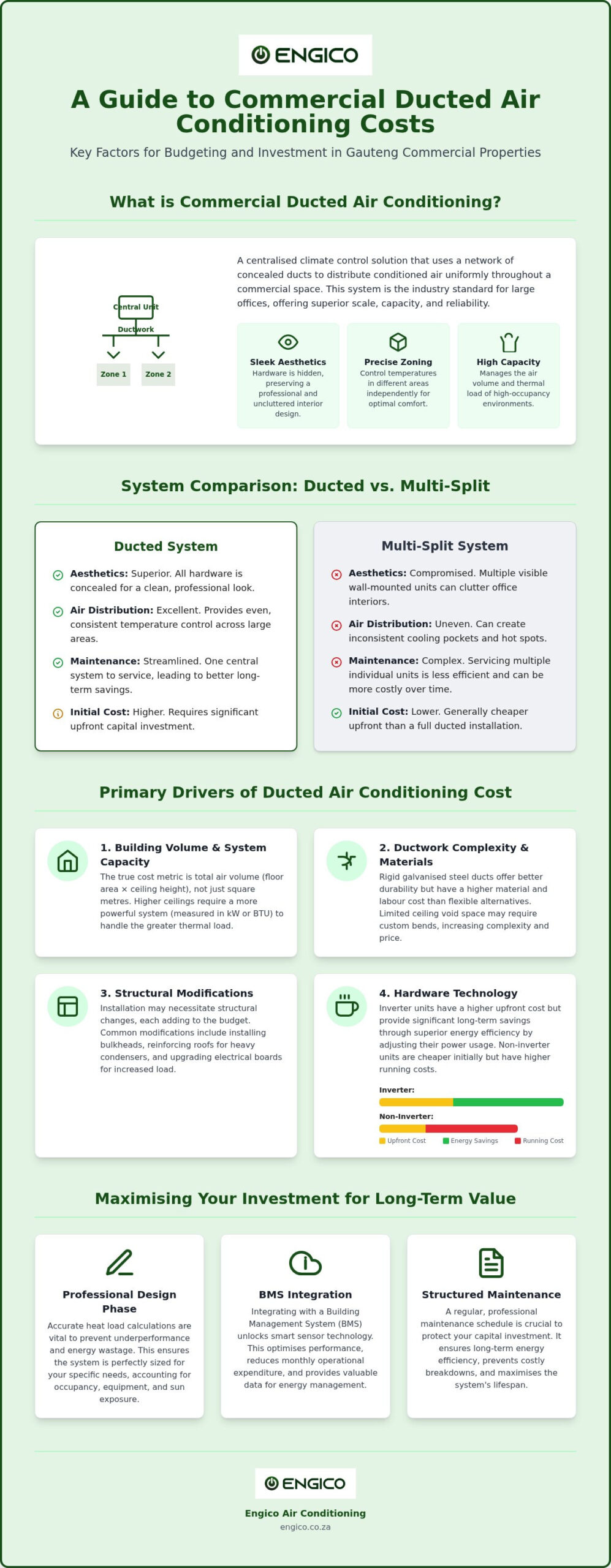
A ducted air conditioning system is a centralised climate control solution that employs a network of concealed ducts to distribute air through vents. This technology is a cornerstone of modern Heating, ventilation, and air conditioning (HVAC) design. For large Gauteng office blocks, these systems are the industry standard because they manage the scale and capacity required for high-occupancy environments. They offer a level of reliability and air volume control that smaller, residential-grade units simply cannot match in a professional setting.
The aesthetic advantage is a major draw for commercial clients who value a polished corporate image. All major hardware is tucked away in the ceiling void, which preserves the professional interior design of your premises without the clutter of wall-mounted units. Beyond looks, the zoning capabilities are indispensable for modern businesses. You can maintain a cool environment in a high-traffic boardroom whilst allowing a lower cooling output for less-occupied zones. When calculating the ducted air conditioning cost for commercial building installations, these operational benefits contribute significantly to the overall value proposition of the system.
The Components of a Commercial Ducted System
Internal Air Handling Units (AHUs) play a pivotal role by pulling air in, filtering it, and pushing it through the ductwork. These units must be sized correctly to handle the building’s specific volume and are often equipped with high-grade filtration to manage the dust levels common in urban Gauteng. External condenser units serve as the heat exchangers; they’re typically positioned on rooftops or in ventilated plant areas to keep noise away from workspaces. In our local climate, the placement of these condensers requires careful planning to ensure they don’t overheat during peak summer. The network of insulated ductwork and diffusers then ensures that the conditioned air reaches every corner of the office without losing its temperature along the way.
Ducted vs. Multi-Split Systems: A Commercial Perspective
Choosing between these systems often comes down to visual impact and long-term maintenance requirements. A multi-split setup requires several wall-mounted units, which can disrupt a clean office aesthetic and create uneven cooling pockets. In contrast, a ducted system offers a single, discreet interface that blends into the architecture. Whilst the initial ducted air conditioning cost for commercial building projects might seem higher than split units, the streamlined maintenance often leads to better long-term savings. It’s generally more cost-effective to service one central system than to manage ten individual units scattered across different rooms.
Thermal load is the specific amount of heat energy that must be removed from a room to maintain a stable temperature, a figure that fluctuates based on the number of people occupying the office at any given time. Accurate calculations of this load are essential during the design phase to ensure the system doesn’t underperform during busy periods.
Primary Drivers of Ducted Air Conditioning Cost for Commercial Buildings
Calculating the ducted air conditioning cost for commercial building projects requires more than a simple square-metre measurement. Total volume is the true metric; a warehouse with six-metre ceilings requires significantly more cooling capacity than a standard office floor with the same footprint. This volume directly dictates the system capacity, measured in kilowatts (kW) or British Thermal Units (BTU), ensuring the hardware can handle the building’s thermal requirements during a Gauteng summer.
Ductwork complexity also plays a major role in the final budget. Rigid galvanised steel ducts are more durable and provide better airflow than flexible alternatives, but they require a higher initial investment and more labour for installation. If your building has limited ceiling void space, custom bends and transitions will be necessary, adding to the project complexity. Structural modifications often include:
- Installation of bulkheads to conceal the ductwork in open-plan areas.
- Reinforcement of roof structures to support heavy external condensers.
- Upgrades to the main electrical distribution board to handle the increased load.
Hardware Costs: AHUs and Condensers
Choosing between inverter and non-inverter technology is a critical decision for any business owner. Whilst inverter units have a higher upfront price, they vary their motor speed to match demand, which significantly reduces long-term energy consumption compared to older, fixed-speed systems. Brand selection also matters; industrial-grade units are built for continuous operation and offer better durability than residential counterparts. High-quality filtration is another factor to consider. Modern offices often require specialised filters to improve indoor air quality, which adds a slight premium to the hardware cost but protects employee health and productivity.
Labour and Installation Complexity
The logistical challenges of the Gauteng CBDs impact the final bill. Projects in the Sandton or Pretoria central business districts often require specialised rigging or even crane hire to lift heavy condensers onto high-rise rooftops. Working within an existing building presents more constraints than a new build, as technicians must navigate around established plumbing, electrical, and structural elements. This often extends the timeline and increases the labour hours required for a successful handover.
Ensuring electrical compliance is non-negotiable for commercial premises. Every installation must be signed off by a professional HVAC technician to guarantee it meets safety standards and protects your insurance standing. If you are planning a complex upgrade, it’s wise to consult with a methodical specialist who can manage these technical requirements from inception to completion without fuss.
Evaluating Long-Term ROI and Energy Efficiency
Whilst the initial ducted air conditioning cost for commercial building installations represents a substantial capital investment, the long-term return on investment is primarily driven by operational efficiency. Monthly utility bills vary significantly based on the system’s energy rating, and in the South African context, businesses can often leverage tax incentives related to energy-efficiency savings to offset a portion of their hardware costs. This makes the selection of high-efficiency components a pragmatic financial decision rather than just an environmental one.
Smart sensor technology has revolutionised how we manage unoccupied office zones. By integrating occupancy sensors, a ducted system can automatically reduce airflow to empty boardrooms or storage areas, preventing the waste of cooled air. When evaluating the total ducted air conditioning cost for commercial building ownership, the integration of these smart controls often pays for itself within the first few years of operation. This granular control ensures that every kilowatt of power consumed is directly contributing to the comfort of your staff.
Maximising Efficiency in the Gauteng Climate
Gauteng’s summer temperatures in Johannesburg and Pretoria demand a system that can operate reliably under sustained heat. A critical factor in this performance is the proper insulation of all ductwork. Without high-quality thermal lining, cooled air can lose its temperature before it reaches the diffuser, forcing the AHU to work harder and increasing your monthly spend. For a deeper look at these strategies, consider our guide on maximising office cooling energy efficiency to see how regional factors impact your system’s performance.
The Impact of Professional Maintenance
A well-maintained ducted system can easily exceed a fifteen-year lifespan, whereas a neglected unit may begin to fail after just seven or eight years. Professional maintenance isn’t merely about reactive repairs; it’s a preventative strategy that protects your capital investment. Routine tasks like refrigerant level checks and coil cleaning ensure the system operates at its peak efficiency ratings, keeping energy consumption predictable. If your business is based in the north of Johannesburg, following a structured commercial HVAC maintenance Sunninghill plan will help identify minor issues before they escalate into expensive emergency failures. This disciplined approach to service is what separates a reliable facility from one plagued by unexpected downtime.
Budgeting for Your Commercial HVAC Project in 2026
Successful budgeting for a ducted air conditioning cost for commercial building project begins long before any equipment arrives on site. The design phase, specifically the professional heat load calculation, is the most critical step in ensuring your capital is spent wisely. Skipping this phase often leads to systems that are either too large, wasting energy, or too small, failing to cool the premises during peak Gauteng heat. For older buildings in Johannesburg or Pretoria CBD, budget contingencies are essential. These structures often have limited ceiling void space or outdated electrical infrastructure, requiring custom ducting solutions or power upgrades that aren’t apparent from a basic floor plan.
Generic online estimates are rarely accurate because they cannot account for these site-specific variables. A professional site assessment identifies structural obstacles and occupancy patterns that dictate the final price. Whether your business chooses to purchase the system outright or explore leasing options for better cash flow management, the foundation of your budget must be a detailed, technical survey. When evaluating the ducted air conditioning cost for commercial building upgrades, the design phase determines the long-term viability of the entire installation.
What to Include in Your HVAC Tender
When preparing a tender, clarity is your best protection against cost overruns. Your documentation should require a clear separation between hardware costs and labour hours. It’s also vital to specify that all associated electrical and plumbing work is included in the quote. We recommend integrating a long-term maintenance contract into the initial agreement; this ensures the system is serviced by the original installers who understand its specific configuration from the start.
Avoiding “Cheap” Installation Traps
Choosing the lowest quote often introduces hidden costs that emerge shortly after handover. Poorly designed ductwork leads to excessive noise and thermal leaks, whilst uncertified installers can inadvertently void your manufacturer’s equipment warranty. An undersized system in a high-occupancy office is a false economy that trades a lower purchase price for permanent thermal discomfort and accelerated equipment wear. To ensure your investment is protected by expert planning, you should request a comprehensive site-specific quote from a seasoned professional who understands the technical demands of commercial environments.
Integrating Ducted Systems with Building Management Systems (BMS)
Building Management System (BMS) integration represents the logical evolution of commercial climate control. It serves as a centralised digital platform that monitors and manages various mechanical and electrical systems within a building. For large-scale facilities in Gauteng, this integration is no longer a luxury but a standard requirement for maintaining operational efficiency. By connecting your HVAC hardware to a BMS, you gain a single interface to oversee multiple floors or zones, ensuring that the ducted air conditioning cost for commercial building projects delivers the highest possible value through data-driven management.
This centralised oversight allows facility managers to adjust parameters across an entire office block from a remote terminal. Instead of manually inspecting individual thermostats, you can monitor real-time performance and receive alerts regarding predictive maintenance. Modern systems can identify a drop in pressure or a rise in energy consumption before a total system failure occurs, allowing for methodical repairs that prevent business disruption. Engico takes a disciplined approach to these integrations, positioning ourselves as a reliable partner capable of managing the technical complexity of modern building automation in Johannesburg and Pretoria.
Automation for Cost Control
Automating your cooling cycles is one of the most effective ways to manage overheads. By scheduling the system to align strictly with office hours, you eliminate the risk of cooling empty spaces overnight. When calculating the total ducted air conditioning cost for commercial building operations, the reduction in energy waste provided by a BMS often justifies the initial integration expense. For a deeper understanding of these technologies, our resource on smart HVAC control for commercial buildings offers a practical look at total building efficiency. Integrating your HVAC with lighting and security systems creates a cohesive environment where energy is only consumed when it’s truly needed.
Specialised Cooling for Server Rooms
Server rooms present a unique challenge within a ducted network because they require consistent, 24-hour cooling regardless of the main office schedule. These areas must be integrated into the BMS with dedicated sensors and fail-safes to protect critical IT infrastructure. Maintaining these sensitive environments requires a specialist’s eye, which is why we’ve developed a HVAC maintenance for server rooms Gauteng guide. This integration ensures that your high-value equipment remains within safe thermal limits whilst the rest of the building’s climate control follows a standard occupancy schedule. If you’re ready to discuss a tailored integration for your premises, you can enquire about Engico’s commercial ducted solutions to secure a methodical assessment of your needs.
Securing Your Long-Term Climate Strategy
Investing in a centralised cooling system is a significant step towards modernising your Gauteng business premises. You’ve seen that the true ducted air conditioning cost for commercial building projects is determined by early design precision, architectural integration, and the choice of high-efficiency inverter technology. Whilst the initial capital expenditure is a primary concern, the long-term value lies in a system that operates reliably under the unique thermal loads of South African summers.
By integrating smart controls and committing to a structured maintenance plan, you protect your hardware from premature failure and keep operational costs predictable. As specialists in Gauteng commercial and industrial HVAC, Engico provides the technical expertise needed to manage these complex installations from inception through to long-term servicing. Our team excels in expert BMS integration, ensuring your facility achieves maximum energy efficiency without compromising on staff comfort. If you’re ready to move forward with a partner who values precision and reliability, get a professional commercial HVAC quote from Engico today. We look forward to helping you build a more efficient workspace.
Frequently Asked Questions
Is ducted air conditioning more expensive to run than split systems?
Ducted systems are often more efficient for large commercial spaces when they utilise zoning and modern inverter technology. Whilst a single split unit might consume less power than a large central system, cooling an entire floor with multiple individual units is typically less efficient than one centralised ducted setup. Proper zoning allows you to cool only the areas currently in use, which helps manage the overall ducted air conditioning cost for commercial building operations effectively.
How long does it typically take to install ducted AC in a commercial building?
Most commercial installations take between one and four weeks to complete, depending on the floor area and the complexity of the ductwork. New builds are generally faster because technicians don’t have to navigate around existing occupants or structural obstacles. For retrofitting projects in occupied offices, we often schedule the work in phases to minimise business disruption and ensure a methodical installation process.
What is the average lifespan of a commercial ducted HVAC system?
A professionally maintained commercial ducted system typically has a lifespan of 15 to 20 years. The longevity of the hardware depends heavily on regular servicing and the specific environmental conditions of the site. Systems in dusty industrial areas or those subjected to constant, high thermal loads may require more frequent maintenance to reach the 20-year mark without experiencing significant hardware failures.
Do ducted systems require a lot of ceiling space in an office?
Ducted systems generally require a ceiling void of between 300mm and 500mm to accommodate the insulated ductwork and indoor air handling units. If your building has limited ceiling height, we can design custom bulkhead solutions to conceal the components without compromising the professional aesthetic of the room. A thorough site assessment is necessary to determine the most space-efficient layout for your specific premises.
Can I add ducted air conditioning to an existing commercial building?
Yes, retrofitting ducted systems into existing buildings is a common procedure, although it requires careful planning to navigate established structural and electrical elements. We assess the current ceiling voids and power capacity to ensure the new system integrates seamlessly with the building’s architecture. This assessment is essential for accurately determining the ducted air conditioning cost for commercial building upgrades in older Gauteng structures.
How often should commercial ductwork be professionally cleaned?
Commercial ductwork should be professionally inspected and cleaned every three to five years to maintain indoor air quality and system efficiency. However, the air filters within the air handling units require more frequent attention, typically every three to six months depending on the office environment. Regular cleaning prevents the buildup of dust and allergens, ensuring a healthy and productive workspace for your employees.
Does Engico provide maintenance contracts for ducted systems in Pretoria?
Yes, Engico offers comprehensive maintenance contracts for commercial ducted systems across Pretoria, Sandton, and the wider Gauteng region. Our service agreements are designed to provide professional reliability by scheduling routine inspections and preventative repairs. These contracts help protect your capital investment and ensure that your system continues to operate at peak energy efficiency throughout its entire service life.
What happens if one zone in the ducted system fails?
If a single zone fails to cool correctly, it is usually due to a fault with a motorised damper or a specific zone sensor rather than a failure of the entire central plant. Because ducted systems are designed with independent zones, the rest of the building typically remains unaffected whilst the specific area is repaired. Our technicians can quickly diagnose these localised issues through the Building Management System to restore full climate control without fuss.
Recent Comments