
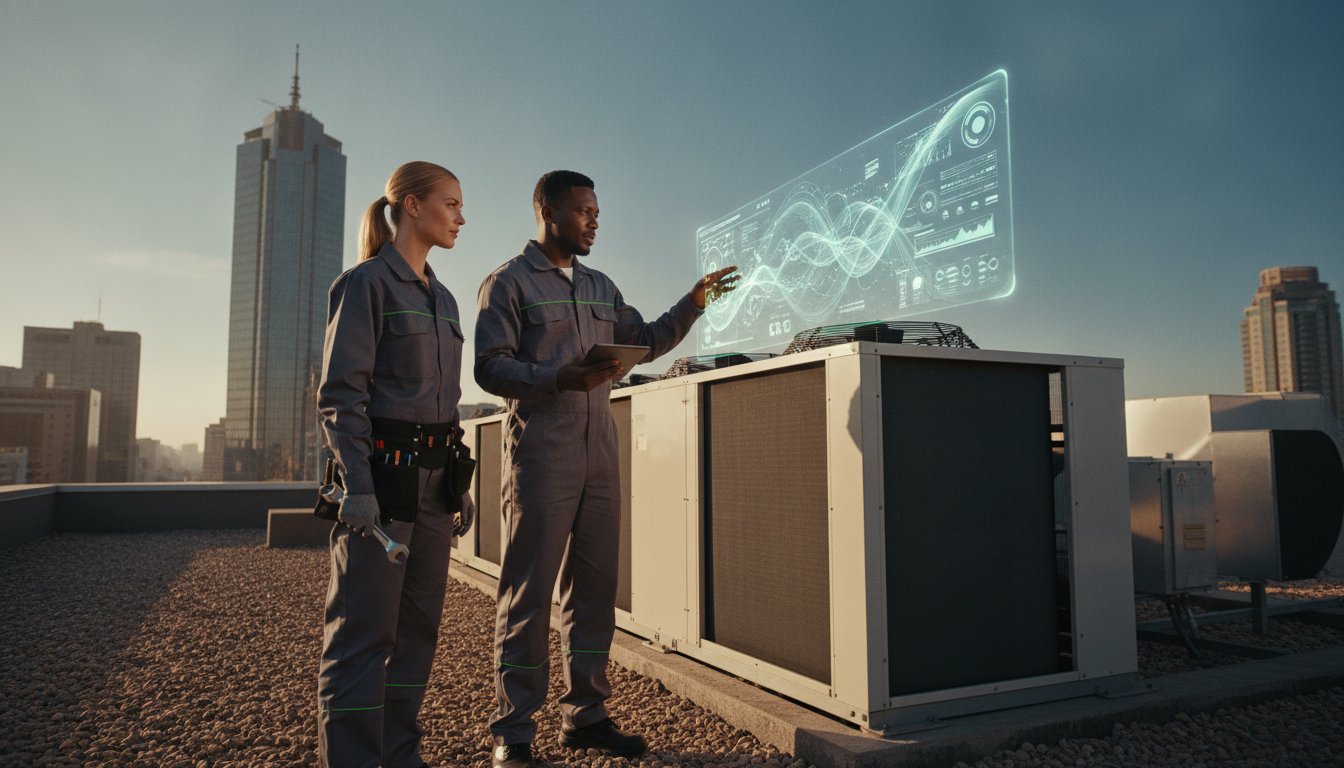
Did you know that 70% of medium-sized commercial buildings still operate without a unified energy management platform? In a climate where utility tariffs continue to rise, relying on manual monitoring for dozens of split or ducted units is no longer a sustainable strategy for South African businesses. Achieving true efficiency requires a shift from reactive maintenance to building management system integration HVAC, which brings every mechanical component into a single, visible framework.
You’ve likely experienced the frustration of unpredictable monthly energy bills and the constant worry that a critical air handling unit might fail without warning. It’s difficult to maintain consistent tenant comfort when your performance data is scattered across multiple interfaces. This guide demonstrates how a centralised BMS reduces monthly expenditure whilst automating climate control to improve indoor air quality. We’ll examine the technical pathways to a unified dashboard, the long-term benefits for asset durability, and why smart integration is the most reliable way to future-proof your commercial property for 2026 and beyond.
Key Takeaways
- Learn how building management system integration HVAC shifts your facility from reactive repairs to a proactive, data-driven climate management strategy.
- Understand the essential communication protocols, such as BACnet and Modbus, that allow diverse hardware components to communicate within a unified framework.
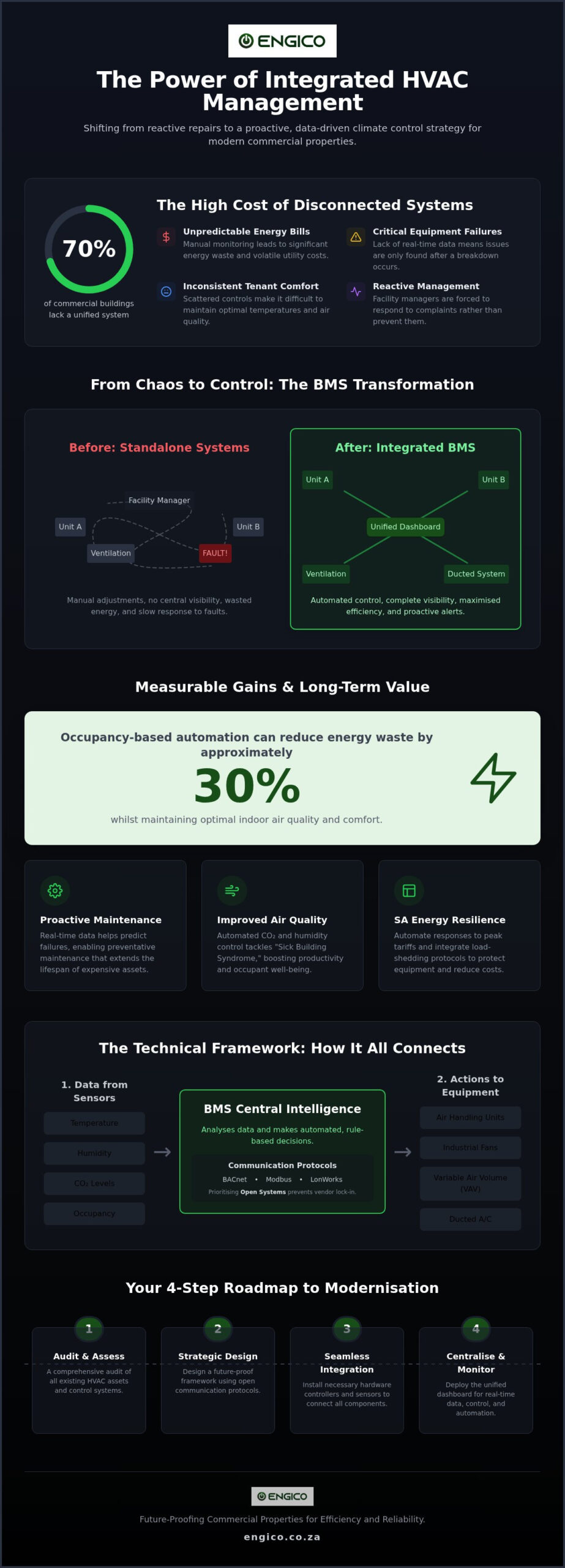
- Discover the financial impact of occupancy-based automation, which can reduce energy waste by approximately 30% whilst maintaining optimal indoor air quality.
- Identify the critical steps for modernising your facility, starting with a comprehensive audit of existing air handling units and industrial ventilation systems.
- Explore how real-time performance data helps prevent unexpected equipment failures and extends the lifespan of expensive cooling and ventilation assets.
The Strategic Value of Building Management System Integration for HVAC
A Building Automation System serves as the central intelligence of a modern commercial property. It coordinates the complex interactions between air handling units, industrial ventilation fans, and ducted air conditioning. Historically, facility management relied on reactive adjustments, often responding only when a tenant complained or a unit failed. In 2026, the industry has shifted toward proactive climate management. This transition ensures that building management system integration HVAC isn’t just a technical upgrade but a strategic asset that manages the environment before issues arise.
For businesses operating in Gauteng, operational costs are a primary concern. Centralised control allows for precise air quality monitoring, which directly addresses “Sick Building Syndrome” amongst office workers. By ensuring adequate CO2 extraction and humidity control, a unified system maintains a healthy workspace. This methodical approach to air quality reduces absenteeism and improves general productivity. It’s a shift from merely cooling a room to managing a comprehensive indoor ecosystem.
Centralised Control vs. Standalone Systems
Managing dozens of standalone wall-mounted split units manually is inefficient. It leads to inconsistent temperatures and significant energy waste when units are left running in empty boardrooms. A unified interface simplifies a facility manager’s duties by providing real-time visibility across the entire site. Whether you’re tracking performance across multiple floors in Johannesburg or different sites in Midrand, a centralised dashboard identifies faults immediately. You don’t have to wait for a technician to arrive to understand why a specific zone is overheating. This level of transparency allows for disciplined maintenance and ensures that expensive HVAC assets reach their full expected lifespan.
Addressing the South African Energy Crisis
South African commercial properties face unique challenges regarding energy stability and rising utility costs. Building management system integration HVAC allows for automated responses to peak tariff periods. You can programme systems to reduce load during expensive windows without compromising tenant comfort. Furthermore, integrating load-shedding protocols protects sensitive compressors from power surge damage during grid transitions. This proactive behaviour is essential for attaining green building certifications. These certifications are no longer just a badge of honour; they’re a requirement for high-value commercial leases in the current market. By automating HVAC behaviour, property owners can decouple their operational success from the volatility of the national energy grid.
The Technical Framework: How Integration Works
Building management system integration HVAC relies on a layered architecture that bridges the gap between digital instructions and mechanical action. At the foundation of this framework are communication protocols such as BACnet, Modbus, and LonWorks. These standardised languages allow equipment from different manufacturers to interact seamlessly. It’s essential to prioritise “open” systems during the design phase. This approach prevents vendor lock-in, ensuring you aren’t restricted to a single provider for future maintenance or hardware upgrades. When hardware can’t communicate across brands, the building’s efficiency suffers.
Hardware controllers serve as the primary translators in this ecosystem. They receive data from sensors monitoring CO2 levels, humidity, and temperature, then adjust the mechanical components accordingly. Adhering to the ASHRAE Standard 90.1 provides a technical benchmark for these integrations, ensuring the building meets international energy efficiency requirements. When these systems work in harmony, the building becomes a responsive environment rather than a static structure. If you’re planning a new installation, consulting with a specialist can ensure your technical framework is future-proof.
Interfacing with Air Handling Units and Ventilation
A sophisticated BMS does more than just toggle power. By connecting industrial ventilation fans and louvers to the central network, managers can implement Variable Air Volume (VAV) strategies. This allows for precise zone control, where airflow is adjusted based on real-time occupancy. You can also automate louver positions based on external weather conditions, pulling in cool evening air to reduce the load on your compressors the following morning. This level of coordination ensures that every kilowatt of energy is used purposefully. It’s a methodical way to manage large-scale air handling units without manual intervention.
Smart Remote Management and Cloud Connectivity
Modern building management system integration HVAC extends beyond the physical boundaries of the property. Secure mobile applications allow facility managers to monitor performance and adjust settings whilst off-site. Predictive alerts are a key feature of this connectivity; they identify anomalies, such as a failing motor or a refrigerant leak, before a catastrophic shutdown occurs. Cloud APIs allow for smart HVAC control for commercial buildings by enabling the system to ingest external data, such as local weather forecasts or utility pricing, to optimise its daily schedule.
Energy Efficiency and ROI: The Financial Case for Automation
Investing in building management system integration HVAC is a decision driven by long-term fiscal discipline. Whilst the initial capital expenditure is a consideration, the payback period is typically shortened by the immediate reduction in operational waste. Industry benchmarks suggest that occupancy-based cooling can reduce energy consumption by approximately 30% in commercial environments. This is achieved by ensuring that energy is only expended where and when it’s needed, rather than maintaining a static climate in empty boardrooms or corridors. By establishing a robust technical framework for integration, property owners can transform their HVAC setup from a sunk cost into a controllable variable.
Beyond simple consumption, automated scheduling directly impacts electricity demand charges. In South Africa, peak demand tariffs can significantly inflate monthly utility bills. A centralised system manages these peaks by staggered start-ups and load-shedding protocols, ensuring the building doesn’t exceed its allocated capacity. This level of control also provides a critical layer of protection against power fluctuations. By automatically isolating sensitive equipment or adjusting behaviour during grid instability, the system prevents the costly repairs often associated with surge damage. Data logs from these events provide the necessary evidence to justify future capital expenditure for equipment upgrades, moving away from guesswork toward evidence-based asset management.
Occupancy-Based Cooling and Lighting
The use of Passive Infrared (PIR) sensors allows the BMS to deactivate HVAC units in zones that aren’t in use. This isn’t just a simple on-off switch; modern systems utilise dynamic set-point adjustments. If a meeting room in a Sandton-based office block is occupied by two people instead of twenty, the system adjusts the cooling output to match the actual heat load. For a typical multi-storey facility, this precise management of split and ducted units results in a significant reduction in monthly expenditure. It ensures that comfort is maintained for tenants whilst eliminating the financial drain of cooling unoccupied square footage.
Optimising HVAC for Data Centres and Server Rooms
For facilities housing sensitive digital infrastructure, the financial stakes are even higher. The requirements for HVAC for data centres in South Africa involve maintaining strict temperature and humidity tolerances 24 hours a day. Building management system integration HVAC allows for sophisticated redundancy management. If a primary air handling unit shows signs of performance degradation, the BMS can trigger an automated failover sequence to a secondary system. This proactive response prevents hardware overheating and potentially catastrophic data loss. It allows managers to maintain the necessary cooling capacity whilst minimising the total energy draw through intelligent fan speed modulation and real-time monitoring.
Implementation Roadmap: Steps to Modernising Your Facility
Modernising a facility begins with a methodical audit of your current infrastructure. You must catalogue every wall-mounted split, ducted unit, and air handling unit to determine their communication capabilities. This inventory allows you to identify ‘quick wins’, such as correcting overlapping schedules or adjusting set-points in unoccupied zones, which offer immediate savings whilst the larger integration proceeds. Selecting BMS software requires a balanced approach; a system designed for a small boutique office in Pretoria will differ significantly from one required for a sprawling industrial site in Johannesburg. Once the technology is in place, the final step is ensuring your facility management team is fully trained to interpret the centralised dashboard. Without this human element, even the most advanced building management system integration HVAC remains an underutilised tool.
Retrofitting vs. Full Replacement
A common concern for South African property owners is whether older equipment can be salvaged. In many cases, legacy units can be integrated using gateway devices that translate proprietary signals into standard protocols like BACnet. However, if a unit is nearing the end of its lifecycle, the cost-benefit analysis often favours a full replacement during the integration phase. This ensures that your commercial HVAC maintenance schedule is streamlined and supported by modern, energy-efficient hardware that meets 2026 standards. Upgrading during integration avoids the double-handling of labour and ensures all assets are visible on the new network from day one.
Working with a Specialist Integrator
Successful implementation requires a specialist who understands HVAC logic rather than a general electrical contractor. The core of a functional BMS is the Sequence of Operations (SOO). This document defines exactly how the system responds to variables like outdoor temperature, CO2 levels, and peak tariff periods. A specialist integrator ensures that the software commands translate correctly to mechanical actions. Testing and commissioning are the final hurdles; this involves rigorous verification to ensure every sensor and actuator performs as designed under various load conditions. For a professional assessment of your site’s readiness, book a comprehensive facility audit with our technical team.
Engico: Your Partner for Integrated Climate Control in Gauteng
Engico Air Conditioning provides a disciplined, methodical approach to building management system integration HVAC across the Gauteng province. Our presence in Pretoria, Johannesburg, and Midrand ensures that commercial property owners have access to a reliable partner that understands the specific environmental and infrastructure challenges of the region. We position ourselves as a “safe pair of hands,” capable of managing the entire lifecycle of your climate control assets. By acting as a single provider for both mechanical hardware and digital control systems, we eliminate the communication gaps that often occur when multiple contractors are involved in a single project.
A significant advantage of our integrated approach is the synergy between smart control and our professional maintenance contracts. Traditional maintenance relies on fixed intervals, which can lead to unnecessary service calls or missed faults between visits. When your HVAC is integrated into a BMS, our technicians gain access to real-time performance data for every ducted system and air handling unit. This data-driven insight allows our maintenance contracts to evolve; we move from reactive repairs to predictive care based on actual run-hours and performance metrics. This ensures that your system remains optimised for efficiency throughout its lifespan, rather than just in the weeks following a service.
Bespoke Solutions for Commercial and Industrial Sectors
Every facility has unique requirements that a generic automation setup cannot address. We tailor our systems to meet the specific needs of diverse sectors, from high-traffic shopping centres to expansive industrial warehouses. For industrial clients, we focus on integrating industrial ventilation fans and louvers into the central logic to ensure proper air changes and heat extraction. Corporate offices benefit from software optimisations that balance tenant comfort with strict energy-saving targets. Our technical team remains available for ongoing repairs and adjustments, ensuring that your building management system integration HVAC continues to perform as your occupancy levels or operational needs change.
Get Started with a Professional HVAC Audit
The first step toward a more efficient facility is understanding the potential within your existing infrastructure. We invite property managers and owners in Gauteng to book a comprehensive site visit to assess your integration potential. Our technical team conducts a thorough audit of your current split units, AHUs, and ventilation hardware to identify the most effective path toward automation. Following the audit, we provide transparent reporting on expected energy savings and performance gains, allowing you to make an informed investment decision based on concrete data rather than estimates. Contact Engico Air Conditioning today for a professional consultation and take the first step toward a centralised, future-proof climate control strategy.
Future-Proofing Your Facility for 2026
Transitioning to a unified climate control framework is a decisive step toward long-term operational stability. By moving away from manual monitoring and fragmented control, you can effectively decouple your operational costs from rising energy tariffs whilst ensuring consistent tenant comfort. We’ve explored how technical protocols and occupancy-based cooling strategies transform building management system integration HVAC from a complex technical hurdle into a high-yield investment that protects your most expensive mechanical assets.
Engico serves as a methodical partner for businesses across Johannesburg and Pretoria, offering expertise in both mechanical installation and digital automation. Our team provides the “safe pair of hands” needed to navigate these technical transitions without disrupting your daily operations. If you’re ready to secure the long-term value of your property, request a professional HVAC integration audit from Engico. Taking a proactive approach today ensures your facility remains efficient, compliant, and comfortable for years to come.
Frequently Asked Questions
What exactly is BMS integration for HVAC systems?
BMS integration for HVAC systems is the process of connecting heating, cooling, and ventilation hardware into a centralised digital control network. It allows air handling units, ducted systems, and industrial fans to communicate through a unified interface. By establishing this link, building management system integration HVAC enables facility managers to automate climate control based on real-time data from occupancy sensors and external weather conditions, rather than relying on manual adjustments.
Can I integrate my existing, older air conditioning units into a new BMS?
Most existing air conditioning units can be integrated into a modern BMS using specialised gateway devices or interface cards. These components translate proprietary manufacturer signals into open-source protocols like BACnet or Modbus. Whilst some legacy units may have limited data visibility compared to 2026 models, basic functions like scheduling and temperature set-points are typically achievable. This retrofitting approach is a cost-effective way to modernise facilities in Johannesburg or Pretoria without a full hardware replacement.
How much energy can a business in Gauteng save through HVAC automation?
Commercial properties in Gauteng can achieve significant energy savings, with research indicating that occupancy-based automation can reduce HVAC energy consumption by approximately 30%. By ensuring that air conditioning units and ventilation fans only operate when rooms are in use, businesses can drastically lower their monthly utility expenditure. These savings are particularly impactful for large-scale facilities in Sandton or Midrand, where demand charges and peak utility tariffs often inflate operational costs.
What are the most common protocols used for building management systems?
The most common communication protocols for building management system integration HVAC include BACnet, Modbus, and LonWorks. BACnet is widely regarded as the industry standard for commercial buildings due to its interoperability across different hardware brands. Modbus is frequently utilised for industrial applications and power monitoring. Choosing an open protocol is essential for Gauteng property owners, as it prevents vendor lock-in and ensures that future equipment additions can be integrated without requiring proprietary software.
Is BMS integration only suitable for large industrial buildings?
BMS integration isn’t exclusive to large industrial sites; it’s increasingly viable for medium-sized office blocks and retail centres. Any facility in Pretoria or Johannesburg with multiple split units or a ducted system can benefit from centralised control. Whilst large warehouses use it for industrial ventilation, smaller commercial buildings use it to manage energy waste in boardrooms and server rooms. The scalability of modern software allows for tailored solutions regardless of the building’s total square footage.
How does a BMS help during South African load shedding?
A BMS provides a critical layer of protection during South African load shedding by implementing automated load-shedding protocols. The system can be programmed to shut down non-essential units before power is cut or to stagger the restart of air handling units to prevent a massive power surge when the grid returns. This methodical management protects sensitive compressors from damage and helps facilities in Gauteng manage their peak demand charges more effectively during grid instability.
Do I still need regular HVAC maintenance if I have a BMS?
Regular physical maintenance remains essential even with a sophisticated BMS in place. Whilst the software monitors performance and identifies faults, it can’t replace manual tasks like cleaning filters, checking refrigerant levels, or inspecting mechanical fan bearings. However, building management system integration HVAC makes maintenance more efficient by providing technicians with real-time performance data. This allows for a shift toward predictive care, where service visits are prioritised based on actual equipment health and run-hours.
How long does a typical integration project take to complete?
The duration of an integration project depends on the complexity of the facility and the number of individual units involved. A typical retrofit for a medium-sized office in Centurion or Sandton might take between four and twelve weeks from the initial audit to final commissioning. This timeline includes the installation of gateway devices, software programming, and rigorous testing of the sequence of operations to ensure the system performs as designed under various load conditions.
Recent Comments