What if the high-capacity fan you’ve just installed is actually struggling to move air because your facility lacks the correct intake points? It’s a common oversight in large-scale environments, where the focus often remains solely on the power of the motor rather than the balance of the entire system. Most facility managers recognise that excessive heat build-up and dust accumulation aren’t just uncomfortable; they’re significant risks to worker health and operational productivity. You likely already know that an inefficient system doesn’t just compromise air quality, it also leads to unnecessarily high energy bills that impact your bottom line.
This guide will show you how to optimise your facility’s airflow by correctly pairing industrial extraction fans and louvers for maximum efficiency. By understanding the dual-force nature of ventilation, you can achieve better temperature control and ensure full compliance with health and safety regulations. We’ll explore the technical requirements of precision-engineered louvres and how a methodical approach to installation creates a more sustainable, energy-efficient workspace for your team.
Key Takeaways
- Learn why the synergy between industrial extraction fans and louvers is essential for maintaining balanced air pressure and preventing motor strain in large facilities.
- Discover how to calculate the required Air Changes per Hour (ACH) and select materials like galvanised steel or aluminium to suit your environment’s specific demands.
- Understand the role of Building Management System (BMS) integration in automating ventilation for improved energy efficiency and consistent temperature control.
- Explore the importance of professional, vibration-free installation and structured maintenance programmes to extend the lifespan of your high-capacity ventilation hardware.
- Gain insights into how precision-engineered louvres provide both weather protection and controlled intake to ensure compliance with health and safety regulations.
What are Industrial Extraction Fans and Louvers?
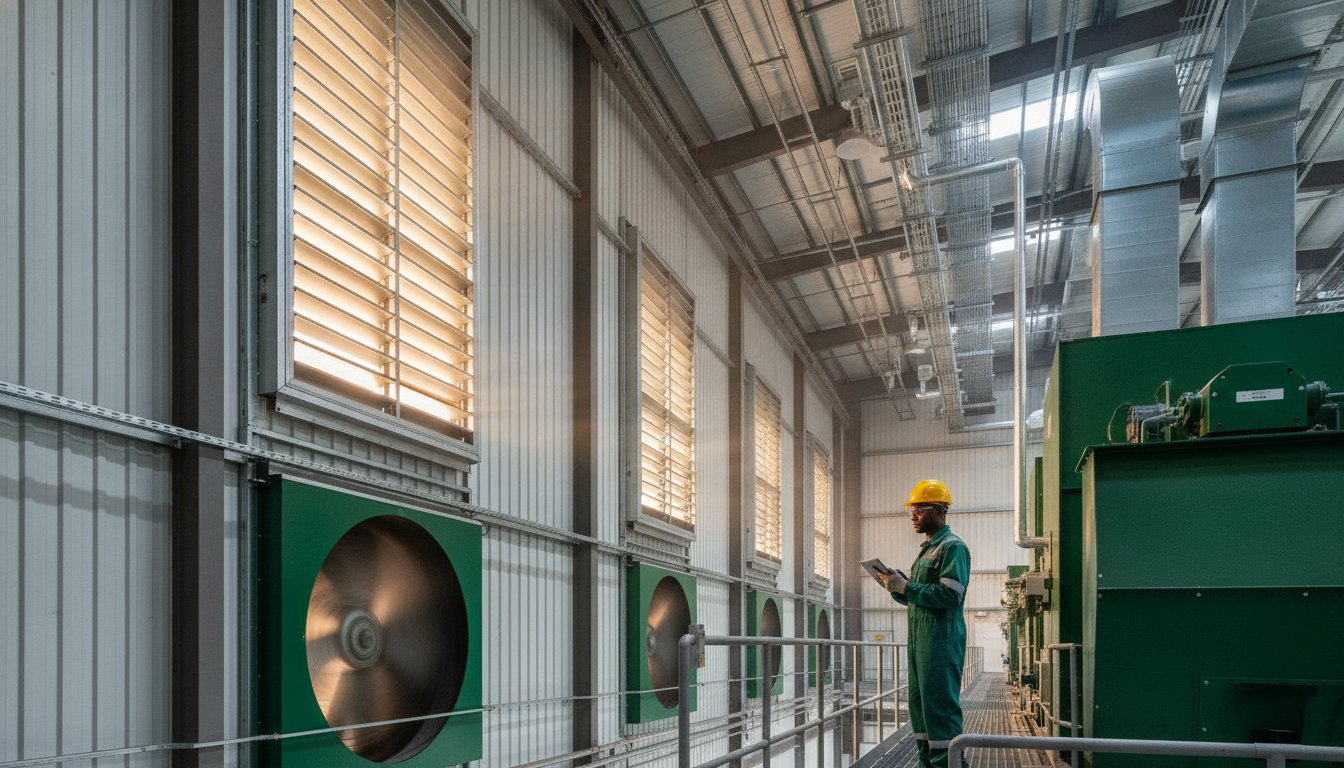
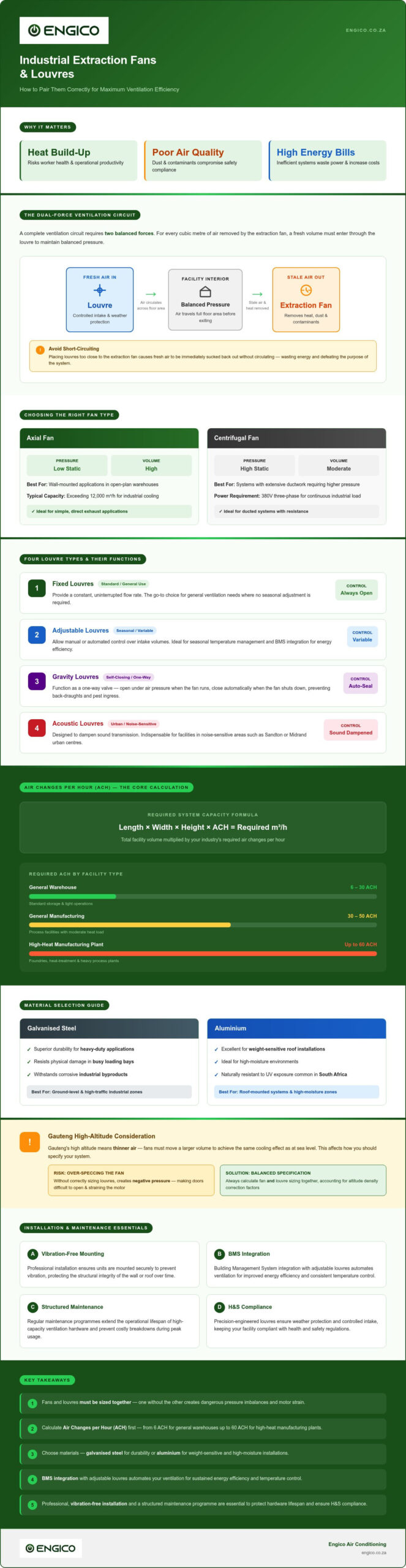
Industrial extraction involves the mechanical removal of stale air, thermal energy, and airborne contaminants from a building’s interior. This process is essential for maintaining a safe working environment, particularly in heavy-duty manufacturing or storage facilities. Whilst the fan provides the motive force, ventilation louvres act as the gateway for air movement. These precision-engineered components provide controlled air intake and vital weather protection, ensuring that fresh air enters the building whilst rain and debris remain outside. In the context of South African industrial sites, using high-quality materials like galvanised steel or aluminium is critical for durability against intense UV exposure and corrosive industrial byproducts. Industrial extraction fans and louvers work in tandem to create a complete ventilation circuit, ensuring that for every cubic metre of air removed, a fresh volume is introduced to maintain balanced pressure.
The Mechanics of High-Volume Air Extraction
Choosing between axial and centrifugal fans depends on your facility’s layout and the resistance air faces as it moves. Axial fans are typically used for high-volume air movement at low static pressure, making them ideal for wall-mounted applications in open-plan warehouses. Centrifugal fans are better suited for systems involving extensive ductwork where higher static pressure is present. Most Gauteng factories require equipment rated for 380V three-phase power to handle the massive air volumes, often exceeding 12,000 m3/h, required for industrial cooling. This ensures the system operates reliably under continuous load without overheating the motor. Professional installation ensures that these units are mounted securely to prevent vibration, which protects the structural integrity of your wall or roof.
The Function of Ventilation Louvres
Louvres serve as more than just aesthetic covers; they’re functional regulators of a building’s breath. Depending on your operational needs, you might select one of the following configurations:
- Fixed Louvres: These provide a constant flow rate and are the standard for general ventilation needs.
- Adjustable Louvres: These allow for manual or automated control over intake volumes, which is useful for seasonal temperature management.
- Gravity Louvres: These function as a one-way valve, opening under air pressure and closing automatically when the fan shuts down to prevent back-draughts and pest ingress.
- Acoustic Louvres: Specifically designed to dampen sound, these are indispensable for facilities located in noise-sensitive urban centres like Sandton or Midrand.
By selecting the correct louvre type, you don’t just manage air; you protect the internal environment from external elements whilst maintaining the efficiency of the extraction motor.
Selecting the Right Ventilation Hardware for Your Facility
Selecting the correct hardware requires more than a cursory glance at a catalogue. You must first determine the Air Changes per Hour (ACH) required for your specific industry. A general warehouse might only need 6 to 30 air changes, whilst a high-heat manufacturing plant could require up to 60. To calculate your needs, multiply the facility volume (length x width x height) by the required ACH. This gives you the total cubic metres per hour (m3/h) your industrial extraction fans and louvers must handle to maintain a safe environment.
Material selection is equally vital. Galvanised steel offers superior durability for heavy-duty applications, resisting physical damage in busy loading bays. Aluminium is an excellent alternative for weight-sensitive roof installs or environments where moisture levels are high. Beyond materials, consider the physical layout. Placing louvres too close to the extraction fan causes “short-circuiting,” where fresh air is immediately sucked back out without circulating through the building. Strategic placement ensures air travels across the entire floor area before exiting.
Matching Fan Capacity to Building Volume
Gauteng’s high altitude significantly affects air density, which in turn impacts fan performance. Because the air is “thinner” in Pretoria and Johannesburg, a fan might need to move a larger volume of air to achieve the same cooling effect as it would at sea level. Over-speccing a fan to compensate without correctly sizing the louvres can create negative pressure, making doors difficult to open and straining the motor. Our team can help you calculate these variables during a professional ventilation consultation to ensure your system is balanced from day one.
Environmental Considerations: Dust, Fumes, and Heat
If your facility handles volatile chemicals or generates high heat, standard hardware won’t suffice. You’ll need specialised fans with spark-resistant components or high-temperature motor insulation. In Johannesburg, dust accumulation is a constant challenge for sensitive machinery. Installing louvres with integrated mesh filters prevents particulate matter from entering the workspace whilst maintaining airflow. These considerations are a key part of effective warehouse ventilation design South Africa, where local environmental factors dictate the longevity of your equipment. Correct fan diameter and motor power must be matched to the floor area to ensure no “dead zones” are left where heat can stagnate.
The Synergy Between Extraction and Intake
Effective ventilation is never a one-sided operation. For every cubic metre of air removed by your extraction units, an equal volume must be allowed to enter the facility. This principle of balanced ventilation ensures that your industrial extraction fans and louvers operate as a unified circuit rather than competing components. If the intake area is insufficient, the extraction fan must work significantly harder to pull air through restricted gaps. This creates excessive static pressure, which increases energy consumption and leads to premature motor failure. A system that cannot “breathe” simply cannot perform to its rated capacity.
Strategic positioning is just as critical as capacity. By placing louvres at a low level and extraction fans near the roof apex, you exploit natural thermal buoyancy. Hot, stale air naturally rises, making it easier for the fans to expel it whilst cooler, fresh air is drawn in from below. This configuration also serves a practical purpose during Gauteng’s intense Highveld thunderstorms. Precision-engineered louvres are designed to deflect heavy rain ingress, ensuring that your facility remains dry whilst the ventilation system continues to function at peak capacity without risk of water damage to internal stock or machinery.
Avoiding Negative Pressure Issues
When a building lacks adequate air intake, it often develops negative pressure. You might notice whistling around window seals or find that fire doors become unexpectedly heavy and difficult to open. These aren’t just minor annoyances; they’re symptoms of a system under stress. Correctly sized louvres equalise this pressure, protecting the building’s structural integrity and ensuring the fans achieve their rated airflow. Using multiple smaller louvres distributed around the perimeter often provides better air distribution than a single large intake point, as it prevents the formation of stagnant air pockets in corners or behind racking.
Natural vs Forced Ventilation Circuits
Whilst passive louvres are suitable for many warehouses, some large-scale industrial plants require a “Push-Pull” system. This involves using powered intake fans alongside extraction units to force air along a specific path. This is particularly useful in facilities with complex internal layouts or heavy contaminant loads where natural airflow might be obstructed. By carefully mapping the airflow path, you ensure there are no “dead zones” where hazardous fumes or excessive heat can gather. This methodical approach to circuit design guarantees that air moves efficiently from the intake point to the exhaust, maintaining a consistent and safe environment throughout the shift.
Installation and Maintenance for Industrial Longevity
Industrial extraction fans and louvers represent a significant investment in your facility’s infrastructure. To ensure this investment provides long-term value, the installation process must be handled with technical precision. Professional mounting is essential to achieve vibration-free operation; without it, the torque from high-capacity motors can cause structural fatigue and excessive noise. Proper wiring for 3-phase industrial motors is equally critical, particularly when integrating these units with a Building Management System (BMS) for automated control. A well-installed system doesn’t just work better; it lasts longer and operates with greater electrical safety.
The Critical Nature of Professional Installation
DIY approaches or general contracting often overlook the nuances of industrial ventilation. In Gauteng’s industrial zones, ensuring weather-tight seals around louvre frames is a priority to prevent water ingress during heavy Highveld downpours. Once mounted, the system requires testing and balancing to verify it meets the calculated Air Changes per Hour (ACH). This post-installation verification ensures the airflow paths are functioning as intended and that no motor is under undue strain. It’s a methodical process that guarantees the hardware performs to its rated capacity from the first day of operation.
Preventative Maintenance Checklist
Maintenance is the most effective way to prevent costly production downtime. Dust build-up on fan blades creates imbalance, whilst debris on louvre slats restricts intake and reduces overall efficiency. For comprehensive long-term care strategies, you can refer to our resource on commercial HVAC maintenance Sunninghill. A reliable preventative maintenance programme should include the following tasks:
- Bearing Lubrication: Regular greasing of fan bearings to prevent friction-related heat and wear.
- Belt Inspection: Checking drive belts for signs of perishing, cracking, or tension loss.
- Actuator Testing: Verifying that louvre actuators and gravity flaps open and close fully without sticking.
- Blade and Slat Cleaning: Removing particulate matter to maintain aerodynamic performance and prevent motor strain.
Regular inspections allow you to identify minor issues before they escalate into mechanical failures. If your facility requires expert oversight to ensure operational continuity, Engico provides professional ventilation installation and maintenance services tailored to the specific environmental challenges of the Gauteng region.
Optimising Efficiency with Engico’s Industrial Solutions
Engico understands that no two industrial environments are identical. A manufacturing plant in Johannesburg faces different thermal loads compared to a storage warehouse in Pretoria. We provide bespoke configurations of industrial extraction fans and louvers that account for these variables, ensuring your facility remains compliant with safety standards whilst minimising energy expenditure. By utilising energy-efficient motors and Variable Speed Drives (VSDs), we allow your ventilation hardware to adapt to real-time conditions. Instead of running at full capacity throughout the shift, fans can ramp down during periods of lower activity, which significantly reduces mechanical wear and electricity costs.
Our process begins with a thorough audit of your facility’s layout and existing airflow patterns. We don’t just supply hardware; we design a system that addresses the specific pain points of your workspace, such as heat pockets or contaminant zones. This methodical progression ensures that every fan and louvre we install contributes to a balanced, high-performance ventilation circuit. From the initial site assessment to professional installation, we focus on precision to ensure the longevity of your equipment.
BMS Integration for Smart Ventilation
Modern industrial sites require more than manual switches. Integrating your ventilation with smart HVAC control for commercial buildings allows for a fully automated response to environmental changes. Sensors detect shifts in temperature or CO2 levels, triggering the extraction system to increase airflow precisely when needed. This demand-based approach ensures air quality is maintained without wasting power. Remote monitoring capabilities also allow our technicians to track performance data. This helps us predict maintenance needs before they lead to hardware failure, keeping your operations running smoothly.
Why Partner with Engico Air Conditioning?
Engico presents itself as a methodical specialist, managing the entire lifecycle of your ventilation project. From the initial site assessment and ACH calculations to professional installation and scheduled maintenance programmes, we act as a reliable partner for Gauteng businesses. Our team focuses on precision and long-term value, avoiding short-term fixes in favour of durable, high-standard solutions. We offer comprehensive support across Pretoria, Johannesburg, and the wider Gauteng region. Whether you operate a small workshop or a large-scale industrial plant, we provide the technical expertise required to manage air quality and temperature control effectively. Contact us for a tailored assessment of your industrial ventilation requirements.
Securing Operational Efficiency through Balanced Ventilation
Achieving a high-performance environment requires more than just high-capacity hardware; it demands a methodical approach to system design. By ensuring a technical balance between industrial extraction fans and louvers, you protect your facility from the hidden costs of negative pressure and motor strain. We’ve explored how correctly sized intake points and precision-engineered extraction units work together to maintain air quality whilst reducing energy consumption.
Engico stands as a dependable partner for businesses across Pretoria and Johannesburg, offering expert installation and specialised BMS integration to automate your facility’s climate. Our comprehensive maintenance programmes are designed to extend the lifespan of your equipment, ensuring operational continuity in even the most demanding industrial settings. Taking the time to optimise your ventilation today prevents costly downtime and health risks in the future.
Contact Engico for a Professional Industrial Ventilation Assessment to begin improving your facility’s airflow efficiency. We’re ready to help you create a safer, more productive workspace.
Frequently Asked Questions
What is the difference between an extraction fan and a supply fan?
Extraction fans are designed to pull stale, heated, or contaminated air out of a building, creating a void that must be filled. Supply fans do the opposite by forcing fresh outdoor air into the space. In a balanced system, these two work together to maintain neutral pressure. Without this coordination, you might experience door-whistling or poor air quality. Engico ensures both components are correctly matched for your specific Pretoria or Johannesburg facility.
Do I really need louvres if I have large warehouse doors?
Whilst large doors provide significant openings, they aren’t a substitute for controlled intake. Louvres allow for continuous ventilation even when the facility is secured at night or during inclement weather. They’re specifically designed to prevent rain ingress and pest entry, which open doors cannot do. Using industrial extraction fans and louvers together ensures a consistent airflow path that doesn’t rely on manual door management to function correctly for your staff.
How many air changes per hour does a typical factory require?
Air changes per hour (ACH) vary based on the intensity of your operations. A light assembly plant in Centurion might require 10 to 20 air changes, whereas a facility involving welding or chemical processing could need up to 60. Calculating the exact volume of your building is the first step. Our team performs these technical assessments to ensure your extraction system meets the specific health and safety requirements of your Gauteng industry.
Can industrial extraction fans be integrated into my existing BMS?
Yes, modern ventilation systems are highly compatible with Building Management Systems. Engico specialises in integrating industrial extraction fans and louvers into your existing infrastructure to allow for automated control. This means your fans can adjust their speed based on real-time data from temperature or air quality sensors. It’s a methodical way to reduce energy consumption whilst ensuring your factory in Midrand or Sandton maintains optimal conditions for all workers.
What maintenance do industrial louvres require?
Routine maintenance focuses on ensuring unobstructed airflow and mechanical integrity. You should regularly clean the slats to remove Johannesburg dust and industrial particulates that can restrict air intake. If your louvres are motorised, the actuators require periodic testing to ensure they open and close fully. We also recommend inspecting the weather seals around the frames to prevent leaks during heavy rainfall, which is a core part of our professional maintenance programmes.
Are there noise-reducing options for extraction fans in residential-adjacent areas?
Facilities located near residential areas in Hyde Park or Woodmead often require acoustic treatment. We provide acoustic louvres and silencers that significantly dampen the sound of high-capacity fans without compromising airflow. These units use sound-absorbent materials to trap noise within the ventilation path. This ensures your operations remain compliant with local noise ordinances whilst providing the high-volume extraction necessary for your industrial processes to continue without any complaints from neighbours.
How does altitude in Johannesburg affect industrial fan performance?
The high altitude in Johannesburg and Pretoria means the air is less dense than at the coast. Consequently, a fan must move a larger volume of air to achieve the same cooling effect or contaminant removal. We account for this “thin” air during the design phase by selecting fans with appropriate blade pitches and motor power. Ignoring altitude often leads to under-performing systems that fail to meet the required safety standards for South African factories.
What is the lifespan of a galvanised industrial extraction fan?
A high-quality galvanised extraction fan typically has an operational lifespan of 10 to 15 years, provided it’s part of a regular maintenance programme. The galvanised coating provides essential protection against corrosion, which is vital in busy industrial environments. Factors such as the chemical composition of the extracted air and the frequency of cleaning will influence this duration. Our service teams help extend this lifespan by identifying early signs of bearing wear or belt fatigue.
Recent Comments