
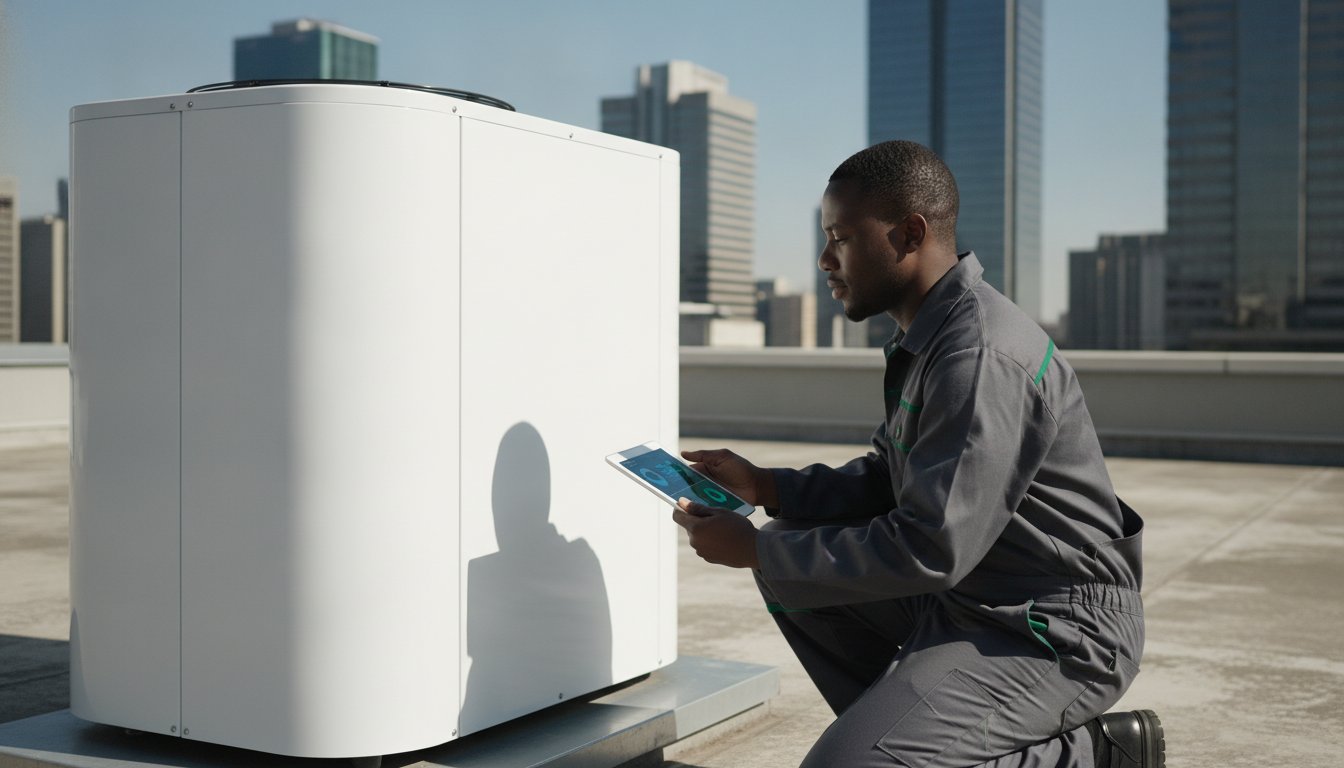
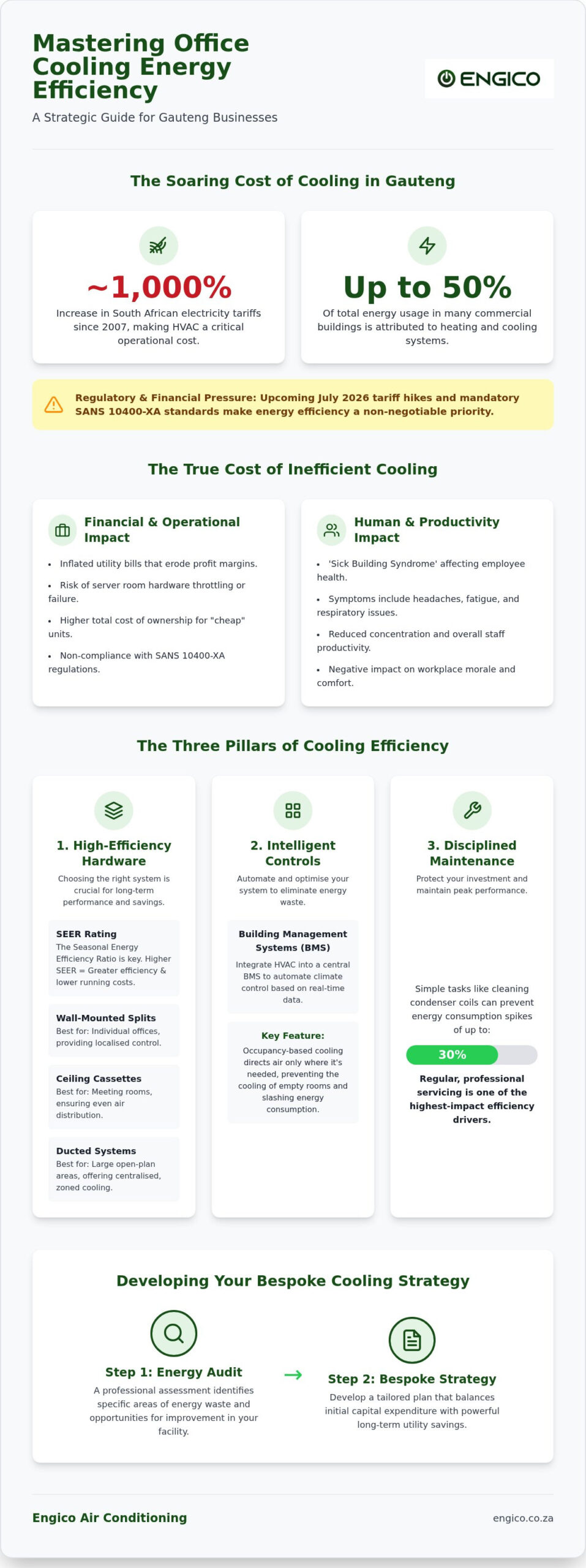
With electricity tariffs in South Africa having increased by nearly 1,000% since 2007, your HVAC system is likely the single largest contributor to your rising operational costs. In many Gauteng commercial buildings, heating and cooling account for up to 50% of total energy usage. It’s a significant burden for any business trying to maintain a productive environment during intense heatwaves whilst managing the impact of the July 2026 tariff hikes. You probably feel the pressure of balancing employee comfort against a mounting utility bill that seems increasingly difficult to predict.
This guide demonstrates how to master office cooling energy efficiency through strategic hardware upgrades, intelligent controls, and disciplined maintenance programmes. We’ll examine the technical requirements of the 2026 SANS 10400-XA regulations and show you how Building Management System (BMS) integration can provide the stability your facility requires. From wall-mounted splits to comprehensive ducted systems, we provide the methodical insights needed to ensure your workspace remains a reliable, high-performance environment regardless of the external climate or grid instability.
Key Takeaways
- Understand how 2026 tariff hikes and SANS 10400-XA regulations make office cooling energy efficiency a critical operational priority for Gauteng businesses.
- Learn how to select between wall-mounted split units, multi-split systems, and ducted air conditioning to match your specific office layout and zoning requirements.
- Discover the role of Building Management System (BMS) integration in automating climate control and reducing waste through occupancy-based cooling.
- Recognise the impact of professional maintenance, where simple tasks like cleaning condenser coils can prevent energy consumption spikes of up to 30%.
- Identify how a professional energy audit and a bespoke cooling strategy can balance initial capital expenditure with long-term utility savings.
The Foundations of Energy-Efficient Office Cooling in South Africa
Energy efficiency in modern HVAC engineering isn’t just about setting a thermostat to a specific number. It’s a precise calculation of how much thermal energy a system removes relative to the electrical power it consumes. Achieving optimal office cooling energy efficiency requires a holistic approach that integrates high-performance hardware with passive cooling strategies to reduce the baseline load on mechanical systems. When these elements work together, the result is a workspace that remains comfortable without excessive power draw.
The Seasonal Energy Efficiency Ratio (SEER) is the most reliable metric for predicting your monthly operational costs. A higher SEER rating indicates that the unit operates with greater precision across varying temperatures. This is vital in Gauteng, where morning chills often transition into intense afternoon heatwaves. Systems with low ratings might seem cost-effective during procurement, but they typically draw significantly more power to maintain set-points, leading to inflated utility bills that erode your bottom line.
Beyond the balance sheet, inefficient cooling directly impacts human capital. Poorly regulated temperatures and stagnant air contribute to ‘Sick Building Syndrome’, a condition where employees experience headaches, respiratory issues, or fatigue due to inadequate ventilation. Maintaining a stable, filtered climate isn’t a luxury; it’s a fundamental requirement for sustained staff productivity and long-term health. A reliable system ensures that the air is both cool and clean, fostering a better working environment.
The True Cost of Inefficiency
Electricity tariffs for municipal customers in Gauteng rose by an average of 9.01% in July 2026. These increases make inefficient HVAC systems a significant financial liability. Hidden costs often manifest in server rooms, where inadequate cooling leads to hardware throttling or total component failure. Whilst “cheap” budget units might lower initial capital expenditure, their lack of durability and high energy draw usually results in a much higher total cost of ownership over the system’s lifespan.
Environmental and Regulatory Pressures
The publication of the 3rd Edition of SANS 10400-XA in March 2026 established mandatory energy performance standards that Gauteng businesses must now meet. Compliance is essential for insurance validity and achieving Green Star ratings through the GBCSA. Modern HVAC solutions are also central to meeting corporate ESG targets. A carbon footprint in the context of office climate control is the total volume of greenhouse gases emitted as a result of the energy consumed and refrigerants used by the cooling system.
High-Efficiency HVAC Technologies: Selecting the Right System
Selecting the correct hardware is a technical decision that determines your facility’s long-term operational viability. Whilst the previous section established the financial and regulatory stakes, this section focuses on the specific engineering solutions that deliver results. Modern office layouts require a nuanced approach to hardware, moving away from a “one size fits all” mentality to ensure that cooling capacity is precisely matched to the thermal load of each room.
Ceiling cassette air conditioners are frequently utilised in corporate environments because they balance aesthetic design with high-volume air distribution. These units are recessed into the ceiling, providing four-way airflow that prevents “hot spots” in meeting rooms or communal areas. For smaller, individual offices, wall-mounted split air conditioners offer a cost-effective and flexible alternative, allowing for independent temperature control without the need for complex installations.
Ducted vs. Split Systems for Energy Savings
Ducted air conditioning systems remain the gold standard for large, open-plan office floors. These systems provide a centralised cooling source that distributes air through a network of concealed ducts, maintaining a uniform climate across vast areas. Their primary efficiency benefit lies in high-level zoning capabilities. By integrating smart dampers, you can direct cooling only to occupied zones, which significantly reduces the workload on the main air handling units. Maintenance accessibility is also a key factor; centralised systems often allow for servicing at a single point, reducing the disruption to your daily operations. For businesses looking to refine their approach, consulting an Office Energy Checklist can provide a structured framework for identifying where cooling is being wasted in your current layout.
The Inverter Advantage
The transition to inverter technology is perhaps the most significant advancement in office cooling energy efficiency. Traditional compressors operate on a binary on-off cycle, which creates massive energy spikes every time the system restarts. Inverter units use variable speed motors that adjust their output in real-time to maintain a steady temperature. This precision doesn’t just save electricity; it also improves office acoustics by eliminating the loud clatter of compressors cycling on and off. Because the motor doesn’t constantly stop and start, the system experiences less mechanical wear, which extends the lifespan of the equipment. As a “safe pair of hands” for commercial HVAC transitions in Gauteng, Engico Air Conditioning ensures that these high-efficiency systems are professionally installed to meet their rated performance levels.
Smart Integration: Using BMS to Organise Office Climate Control
A Building Management System (BMS) acts as the centralised intelligence for a facility, coordinating various mechanical and electrical components to ensure they function as a unified system. It interfaces directly with HVAC hardware to adjust performance based on actual building requirements rather than static schedules. By integrating sensors that detect occupancy and ambient light, a BMS can automate temperature set-points, ensuring that cooling is only provided when and where it’s needed. This level of control is fundamental to achieving high-level office cooling energy efficiency in modern Gauteng developments.
Beyond standard air conditioning, a smart system can also manage industrial ventilation fans and louvers. This allows the building to utilise natural airflow during cooler morning hours, reducing the initial load on mechanical systems. Real-time data logging provides facilities managers with the visibility needed to identify efficiency leaks, such as units running in empty boardrooms or systems fighting against open windows. This methodical approach ensures that every kilowatt of power is used purposefully.
Resilience During Grid Instability
In the South African context, a primary benefit of smart integration is the ability to manage grid instability. When power returns after a period of load shedding, a BMS ensures that HVAC systems restart in a staggered sequence. This prevents massive power surges that could damage sensitive electronic components or trip main circuit breakers. These controls also facilitate seamless transitions between the municipal grid and backup power sources like generators or UPS systems. By monitoring tariff structures, a BMS can pre-cool a building during off-peak periods, effectively using the building’s thermal mass to maintain comfort whilst avoiding the highest electricity costs.
Data-Driven Decision Making
Remote monitoring allows for the immediate identification of ‘rogue’ units that are consuming significantly more power than their peers. This often indicates a mechanical fault, such as a failing compressor or a refrigerant leak, before the issue causes a total system failure. For property owners, these systems generate detailed efficiency reports essential for commercial lease compliance and ESG auditing. To explore these technical implementations further, refer to our guide on Smart HVAC Control for Commercial Buildings. This disciplined approach to data ensures your cooling strategy remains transparent and cost-effective over the long term.
Maintenance as an Efficiency Driver: Protecting Your HVAC Investment
Professional hardware and smart controls provide the framework for a high-performance workspace, but their long-term success depends on a disciplined maintenance regime. Without regular attention, even the most advanced systems succumb to “efficiency drift,” where performance gradually declines whilst power consumption climbs. In the high-dust environments of Johannesburg and Pretoria, this degradation happens faster than standard manufacturer guidelines often suggest. Maintaining your equipment isn’t just about avoiding breakdowns; it’s about preserving the original engineering standards of the unit.
Dirty condenser coils are a primary culprit in reduced office cooling energy efficiency. When dust and debris coat the coils, the system cannot effectively dissipate heat, forcing it to run for longer cycles to reach the desired temperature. Research indicates that neglected coils can increase energy consumption by up to 30%. Similarly, incorrect refrigerant levels place an immense strain on the compressor. If levels are too low, the compressor works harder and hotter, which significantly shortens its operational lifespan and increases the risk of a total system failure.
The High Cost of Neglect
Neglecting your HVAC infrastructure often leads to premature system replacement, turning a manageable service cost into a massive capital expenditure. There is also a direct link between system hygiene and indoor air quality. Clogged filters and damp coils become breeding grounds for bacteria, which exacerbates the health issues previously discussed. To ensure your facility remains compliant and cost-effective, it’s vital to implement structured HVAC Maintenance Services for Gauteng Properties.
Service Checklist for Office Managers
A robust maintenance schedule should distinguish between routine tasks and technical interventions. This ensures that the system is always operating at its peak potential without unnecessary disruption to the office.
- Filter cleaning: Should be performed monthly to maintain airflow and reduce strain on fans.
- Chemical coil cleaning: A specialised process that removes deep-seated grime that standard brushing cannot reach.
- Louver alignment: Ensuring internal and external louvers are correctly positioned reduces air drag and optimises distribution.
Professional calibration is superior to DIY checks because it involves precise pressure testing and electrical diagnostics that identify hidden faults before they manifest as failures.
To protect your equipment and lower your monthly utility bills, contact Engico Air Conditioning to arrange a comprehensive service of your office cooling systems.
Developing a Bespoke Cooling Strategy for Your Gauteng Office
Creating a sustainable climate control plan requires moving beyond reactive repairs towards a structured, long-term strategy. A well-designed roadmap ensures that every technical intervention contributes to the overall office cooling energy efficiency of the facility. Whilst some industry models suggest “Energy as a Service” as a universal fix, many Gauteng businesses find that owning their infrastructure offers superior tax benefits and greater control over their assets. The objective is to balance initial capital expenditure with the significant operational savings provided by modern, high-efficiency hardware.
Phasing upgrades is often the most practical approach for established offices. You don’t always need to replace every unit simultaneously to see a reduction in power draw. By prioritising high-traffic boardrooms or areas with the highest thermal gain, you can implement high-efficiency inverter systems where they will have the most immediate impact. This methodical progression allows for better budget management whilst steadily lowering the building’s total carbon footprint.
The Audit Process
A professional energy audit is the foundation of any successful HVAC transition. This process involves more than just counting air conditioning units; it requires a detailed analysis of the building envelope. We evaluate insulation levels and solar gain through windows to determine if the current system is oversized or struggling against preventable heat infiltration. Accurate resizing is essential, as an incorrectly specified system will cycle inefficiently and consume excess power regardless of its SEER rating.
Specialised environments require dedicated attention during the audit. Boardrooms with high occupancy loads and server rooms with constant heat output have vastly different cooling profiles than general open-plan floors. For facilities managing critical IT infrastructure, our HVAC for Data Centres in South Africa guide provides specific insights into maintaining the strict temperature tolerances required for hardware longevity.
Partnering for Success
Selecting a local partner with specific expertise in the Pretoria and Johannesburg climates is vital for commercial reliability. Gauteng’s unique combination of high altitude, intense summer heat, and winter dust requires systems that are configured for local conditions. A “safe pair of hands” doesn’t just install equipment; they provide the technical support needed to keep systems running at their rated efficiency for years. Evaluating long-term service contracts often proves more cost-effective than ad-hoc repairs, as regular professional intervention prevents the efficiency drift that leads to inflated utility bills.
Establishing a partnership based on transparency and technical precision ensures your office remains a productive, comfortable environment. To begin refining your facility’s performance, Contact Engico Air Conditioning for a professional cooling audit and discover how a bespoke strategy can protect your HVAC investment.
Future-Proofing Your Office Climate Strategy
Achieving long-term office cooling energy efficiency in Gauteng requires a disciplined combination of advanced hardware and intelligent management. By transitioning to high-performance inverter systems and integrating Building Management Systems, facilities can navigate the complexities of rising tariffs and grid instability with far greater resilience. As we’ve explored, regular professional maintenance remains the most effective way to protect your infrastructure investment and prevent the efficiency drift that leads to unnecessary operational costs.
Engico Air Conditioning provides the technical expertise needed to implement these solutions across Johannesburg, Pretoria, and Sandton. We specialise in expert BMS integration for commercial efficiency and full-service maintenance for industrial and office HVAC, acting as a dependable partner for your facility. Our methodical approach ensures that your cooling infrastructure meets modern standards whilst delivering consistent long-term value for your business.
Optimise your office cooling with Engico Air Conditioning and ensure your workspace remains productive and cost-effective throughout 2026 and beyond. Taking proactive steps today will secure your operational budget against future energy price volatility.
Frequently Asked Questions
What is the most energy-efficient temperature for an office in South Africa?
Setting your thermostat to 23°C or 24°C provides the best balance between comfort and energy conservation. Every degree lower than 23°C can increase your power consumption by approximately 10%. In the Gauteng climate, aiming for a stable 24°C reduces the workload on your compressor whilst keeping staff productive. It’s essential to avoid setting the temperature to 16°C in the morning, as this doesn’t cool the room faster and simply wastes electricity.
How often should office air conditioning units be serviced to maintain efficiency?
Professional servicing should occur at least every six months to maintain peak performance. Gauteng’s high dust levels and seasonal pollen quickly clog filters and coat condenser coils, which forces the system to work harder. Regular maintenance prevents the gradual decline in office cooling energy efficiency that leads to higher bills. These biannual checks should include chemical coil cleaning and refrigerant pressure testing to ensure the system meets its original engineering specifications.
Can a Building Management System (BMS) really lower my cooling costs?
A Building Management System (BMS) can lower cooling costs by providing precise, automated control over your HVAC hardware. By integrating occupancy sensors and time-of-day schedules, the system ensures that air conditioning only operates in active workspaces. It eliminates the common problem of cooling empty boardrooms or running systems overnight. Real-time data logging also allows you to identify hardware faults early, preventing minor efficiency leaks from becoming expensive mechanical failures.
Is it worth replacing an old office HVAC system with a new inverter model?
Replacing an aged HVAC system with a modern inverter model is a sound financial decision for most commercial properties. Traditional on-off units create massive power surges every time the compressor starts, whereas inverter technology uses variable speed motors to maintain steady temperatures. This transition can reduce your cooling-related electricity usage by a significant margin. Whilst the initial investment is higher, the reduction in monthly utility bills and mechanical wear usually provides a rapid return on investment.
How does load shedding affect the energy efficiency of my air conditioner?
Load shedding negatively impacts efficiency by forcing systems to “catch up” after prolonged power outages. During an outage, the building’s internal temperature rises, requiring the air conditioner to run at maximum capacity for several hours once the grid returns. This creates an energy spike that wouldn’t occur with continuous operation. Additionally, frequent hard restarts can damage sensitive electronic components, leading to a long-term decline in the overall performance and reliability of your cooling infrastructure.
What is the difference between a split system and a ducted system for office cooling?
Split systems utilise individual indoor units for specific rooms, whilst ducted systems provide a centralised cooling source via concealed ceiling vents. Split systems are often easier to install in partitioned offices because they allow for independent temperature control in every room. Ducted systems are better suited for large, open-plan floors where uniform air distribution is required. Both options can be highly efficient if they are correctly sized and integrated with modern zoning controls.
Does industrial ventilation help with office energy efficiency?
Industrial ventilation fans and louvers significantly improve efficiency by reducing the initial heat load on your air conditioning. By circulating cooler outdoor air during the early morning or evening, you can lower the building’s baseline temperature before staff arrive. This process, known as “night purging,” means your mechanical HVAC system doesn’t have to work as hard to reach comfortable levels. It’s a cost-effective way to supplement refrigerated cooling and reduce total energy draw.
Can I use smart sensors to turn off cooling in empty meeting rooms?
Smart sensors are highly effective at eliminating energy waste in intermittently used spaces like meeting rooms. These sensors detect motion or CO2 levels to determine if a room is occupied and signal the HVAC system to power down or adjust the set-point accordingly. This targeted approach is a cornerstone of modern office cooling energy efficiency. It ensures that you aren’t paying to cool empty rooms, which can account for a substantial portion of a building’s wasted energy.
Recent Comments