
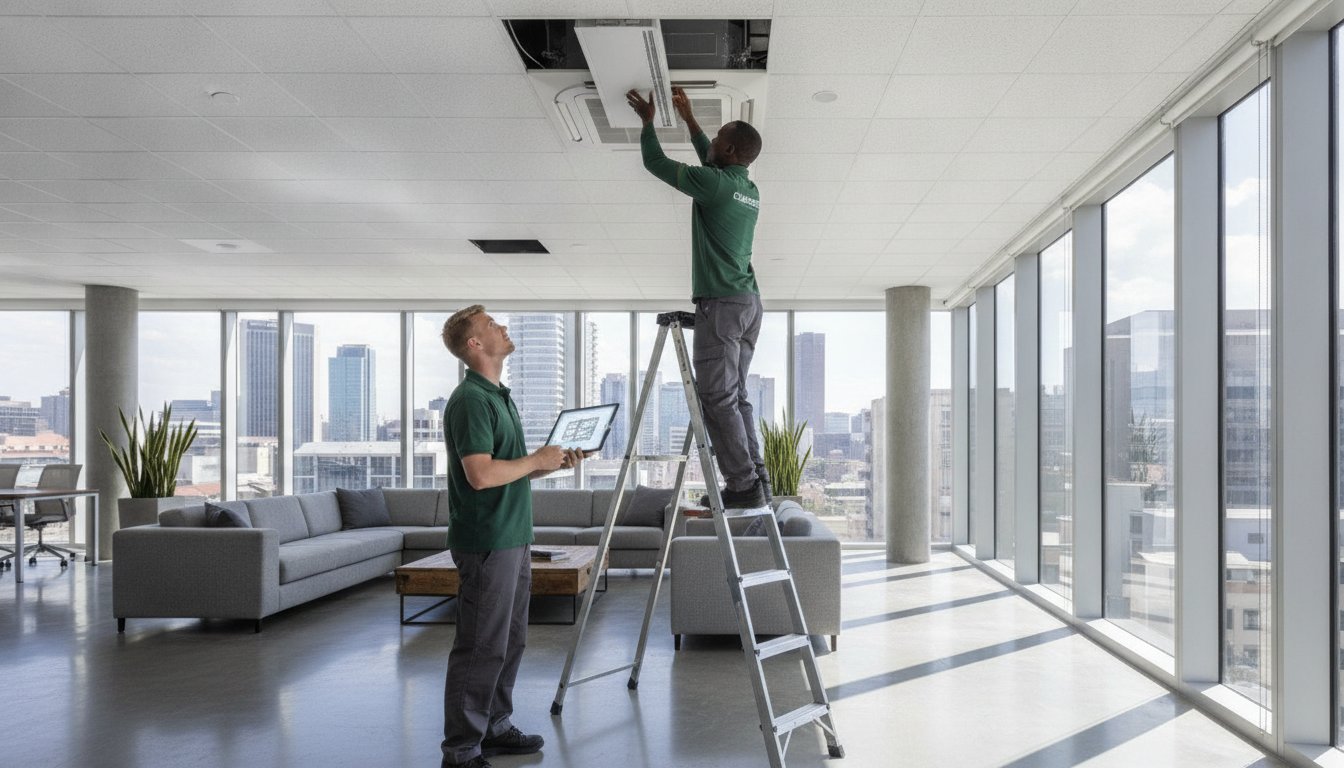
The most effective climate control system in a modern Gauteng office is often the one you barely notice at all. You’ve likely experienced the frustration of hot spots in a large boardroom or felt that a bulky wall-mounted unit detracts from your home’s minimalist aesthetic. It’s a common challenge for property owners across Sandton and Pretoria who require powerful cooling without the visual clutter. Discover how a professional ceiling cassette air conditioning installation can transform your commercial or residential space into a perfectly tempered environment with discreet, high-performance technology.
This 2026 guide provides a methodical look at the installation process, from assessing ceiling void requirements to achieving uniform air distribution. We’ll examine why these systems are the tactical middle ground of HVAC, offering the power of ducted systems with the flexibility of split units, whilst ensuring long-term reliability through expert local support. By the end of this article, you’ll understand exactly how to achieve a sleek, professional-looking interior that remains energy-efficient throughout the year.
Key Takeaways
- Learn why ceiling cassettes are the preferred climate control solution for large, open-plan commercial and residential spaces across Gauteng.
- Identify the critical ceiling void measurements and BTU requirements needed to ensure your system effectively manages peak summer temperatures in Sandton and Pretoria.
- Understand the performance and aesthetic advantages of a ceiling cassette air conditioning installation compared to traditional wall-mounted split systems.
- Discover the methodical steps involved in a professional installation, from the initial structural site survey to the design of efficient condensate drainage routes.
- Recognise how regular maintenance and BMS integration can safeguard your investment, optimise energy efficiency, and prevent costly operational downtime.
Understanding Ceiling Cassette Air Conditioning: A Premier Cooling Solution
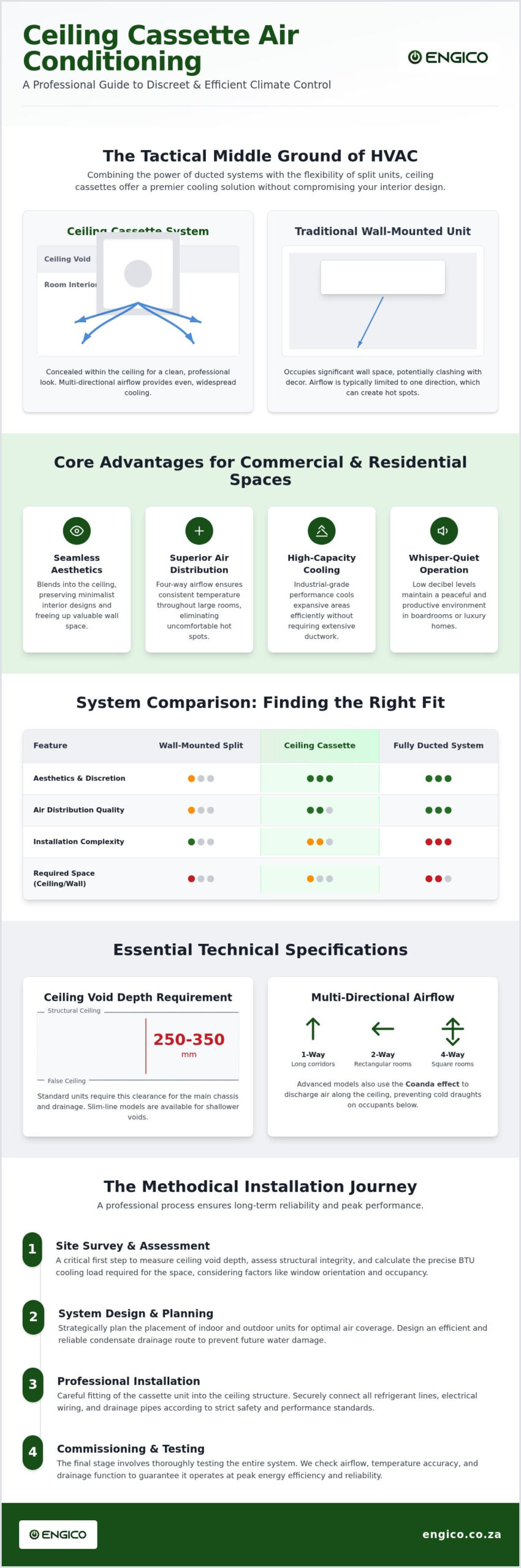
A ceiling cassette is a highly efficient indoor unit that remains largely concealed within the ceiling structure. Unlike traditional split systems that occupy significant wall space, these units are installed into the ceiling void, leaving only a slim, decorative fascia panel visible. This design aligns with the broader technical definition of What is Air Conditioning? by providing controlled cooling through a compact, space-saving interface. It’s a sophisticated choice for those who value performance without compromising on aesthetics.
In high-traffic areas like Sandton showrooms or open-plan offices, maintaining a consistent temperature is often difficult. Ceiling cassettes solve this by using a methodical four-way airflow pattern. The unit draws warm air from the centre and distributes cooled air in four different directions simultaneously. This approach ensures that every corner of a large room receives equal cooling, preventing the uncomfortable hot spots often associated with smaller wall units. A professional ceiling cassette air conditioning installation ensures these vanes are positioned correctly for maximum coverage and efficiency.
Key Benefits for Commercial and Large Residential Spaces
These systems offer industrial-grade performance without the industrial look. They blend seamlessly with standard ceiling tiles, making them nearly invisible to the casual observer. Because they’re high-capacity units, they can cool expansive areas without the need for the extensive ductwork required by full central systems. This makes them a practical choice for commercial renovations where space is at a premium. They operate at low decibel levels. This whisper-quiet performance is critical for productive boardrooms or peaceful luxury living areas in Midrand and Pretoria.
Aesthetic and Space-Saving Advantages
Modern architecture often features large windows or minimalist walls that simply don’t allow for bulky equipment. A professional ceiling cassette air conditioning installation provides a solution that preserves your interior design whilst delivering powerful results. By positioning the unit centrally, you reduce the number of dead zones where air becomes stagnant. Modern fascia designs are sleek and professional. They ensure the hardware complements your ceiling rather than clashing with it. It’s a clean, disciplined approach to climate control that values both form and function for the long term.
Technical Specifications and Ideal Environments for Cassette Units
Selecting the right hardware requires a methodical assessment of the physical environment. A critical factor in any ceiling cassette air conditioning installation is the ceiling void depth. Standard units typically require between 250mm and 350mm of clearance above the false ceiling to accommodate the chassis and drainage components. If your building has a shallow void, slim-line models are available, but these must be identified during the initial site survey. Inverter technology is now a standard requirement for 2026. It allows the compressor to vary its speed, which reduces energy consumption whilst maintaining a precise temperature without the sudden power spikes of older systems.
Multi-Directional Airflow and 360-Degree Cooling
Cassette units are categorised by their airflow directions. A 4-way cassette is the standard for square rooms, but 1-way or 2-way units are better suited for long hallways or narrow rectangular spaces. Advanced models utilise the Coanda effect. This scientific principle allows air to be discharged horizontally along the ceiling, where it gradually sinks and mixes with the room air. This prevents cold air from dropping directly onto staff, which improves comfort in open-plan offices. For L-shaped rooms, multiple units can be synchronised to ensure there are no stagnant air pockets or dead zones.
Capacity and BTU Ratings for Gauteng Properties
Gauteng experiences significant temperature fluctuations, with summer peaks in Pretoria often exceeding 30 degrees Celsius. Calculating the correct British Thermal Unit (BTU) rating is essential to avoid system strain. When evaluating different Types of HVAC Systems, the cooling load must account for window orientation, insulation quality, and the number of occupants. High-ambient temperatures in areas like Midrand require a disciplined approach to capacity planning to ensure the system doesn’t fail during a heatwave.
- 12,000 to 18,000 BTU: Suitable for small private offices or server rooms.
- 24,000 to 36,000 BTU: Ideal for mid-sized boardrooms or high-end residential lounges.
- 48,000 to 60,000 BTU: Necessary for large retail centres or industrial workshops.
Undersizing a unit leads to constant operation and premature wear. Conversely, an oversized unit will cycle on and off too frequently, which wastes electricity and fails to dehumidify the air properly. Professional guidance ensures your ceiling cassette air conditioning installation is perfectly matched to your specific volume and heat gain requirements. If you’re unsure which capacity fits your floor plan, you can consult with our technical team for a precise load calculation that considers every architectural variable.
Comparing Ceiling Cassettes with Ducted and Wall-Mounted Systems
Choosing the most suitable HVAC system requires a methodical evaluation of performance, budget, and architectural constraints. Whilst ducted systems are often viewed as the ultimate concealed solution, they aren’t always the most efficient choice for every Gauteng property. A professional ceiling cassette air conditioning installation provides a strategic middle ground. It offers the high-performance cooling of a ducted system with the installation flexibility of a split unit. This makes it an ideal candidate for both commercial upgrades and high-end residential projects in Sandton and Pretoria.
Cassette vs. Ducted: Choosing the Right Concealed Solution
Ducted systems excel at cooling multiple small rooms from a single central plant. However, they require extensive ductwork and structural modifications that can complicate a renovation. Cassettes are better suited for large, singular zones like open-plan offices or retail showrooms. Because they don’t require a network of ducts, the installation timeframe is typically much shorter. This reduced complexity often results in a lower total project cost, providing a professional concealed finish without the premium price tag associated with full ducted networks.
Cassette vs. Wall-Mounted Splits: Performance and Aesthetics
Wall-mounted units are the easiest to retrofit, but they can disrupt the visual flow of a carefully curated interior. In rooms wider than 5 metres, a wall unit often struggles to distribute air evenly, leading to hot spots. A ceiling cassette air conditioning installation solves this by being centrally located. It provides superior 4-way distribution that reaches the entire room volume more effectively. Whilst wall units remain the preferred choice for small private offices or individual bedrooms, cassettes are the superior option for professional environments where aesthetics and uniform cooling are paramount.
Maintenance accessibility is another factor where cassettes hold a distinct advantage. Unlike ducted systems, where components might be located in difficult-to-reach ceiling voids, a cassette’s internal filters and drainage pumps are easily accessed through the fascia panel. This simplifies regular servicing and reduces the risk of operational downtime. Additionally, these units offer excellent zoning capabilities. Each unit can be controlled independently, allowing different departments on the same floor to set temperatures that suit their specific comfort levels. This individual control is essential for maintaining productivity in diverse workplace environments.
The Professional Installation Journey: From Site Survey to Commissioning
A successful ceiling cassette air conditioning installation depends on a disciplined, multi-stage process that begins long before any hardware is mounted. Every project in Gauteng requires a unique approach based on the building’s architectural layout and existing infrastructure. By following a methodical journey from the initial survey to final commissioning, property owners can ensure their climate control system operates at peak efficiency for years to come. This structured progression minimises the risk of installation mess and ensures the unit is securely integrated into the building’s fabric.
- Step 1: Methodical Site Survey. We assess the ceiling depth and structural support to confirm the environment can accommodate the specific unit dimensions and weight.
- Step 2: System Design. Our technicians map out the most efficient route for refrigerant piping and condensate drainage to avoid existing services.
- Step 3: Precision Mounting. After precision cutting of the ceiling tiles or plasterboard, the indoor unit is securely suspended from the structural slab.
- Step 4: Outdoor Unit Placement. The condenser is positioned in a well-ventilated area to ensure optimal heat rejection whilst minimising noise transfer to neighbouring spaces.
- Step 5: Commissioning. The entire system undergoes rigorous pressure testing and performance checks to verify that every component meets manufacturer specifications.
Pre-Installation Site Assessment in Gauteng Properties
The initial assessment is perhaps the most critical phase for avoiding complications during the build. Technicians must identify the location of existing electrical conduits, fire sprinklers, and plumbing lines within the ceiling void. Navigating these systems requires technical expertise; for example, the professional approach taken by Inlightec Electrical Solutions ensures that all electrical infrastructure remains compliant and safe in high-end installations. It’s equally important to verify that the overhead beams can support the unit’s weight without causing structural stress. Most standard 600×600 or 900×900 units require a minimum vertical clearance of 250mm to 350mm within the ceiling void to allow for proper insulation and drainage connections.
Managing water removal is a technical priority for any concealed system. Whilst most modern cassettes feature a built-in condensate pump to lift water away from the unit, it still requires a correctly pitched gravity-fed drain line to reach the exterior. Electrically, smaller units often run on a standard single-phase supply, but larger commercial systems typically require a more robust three-phase connection. All wiring must be integrated with the property’s existing safety standards to prevent overloads and ensure long-term reliability. To ensure your project is managed by a seasoned specialist, you can book a professional site survey with our technical team today.
Expert Ceiling Cassette Installation and Maintenance in Johannesburg and Pretoria
Engico Air Conditioning has established a reputation for professional reliability across Johannesburg and Pretoria by focusing on technical precision rather than aggressive sales. Our approach to ceiling cassette air conditioning installation is defined by quiet confidence and a thorough understanding of Gauteng’s unique building requirements. We recognise that commercial environments require a partner who can manage complex projects from inception to completion without causing unnecessary disruption. By choosing a methodical specialist, property owners in Sandton, Menlyn, and Waterfall can ensure their climate control systems are installed according to the highest industry standards.
Engico Air Conditioning’s Methodical Approach to HVAC Excellence
Our project management process is transparent and highly structured. We provide detailed quotes and clear timelines, ensuring that every stakeholder understands the scope of work before the first ceiling tile is removed. Our technicians are highly trained individuals who respect the sanctity of your commercial or residential space. They focus on precise technical execution, from the secure mounting of internal chassis to the neat routing of refrigerant lines. This commitment to professional excellence ensures that every installation provides long-term value and durability whilst maintaining a clean, professional aesthetic.
Preventive Maintenance and Repair Services
The long-term performance of your system relies heavily on consistent care. Utilising professional HVAC maintenance services for Gauteng properties is the most effective way to prevent office downtime and maintain energy efficiency. We offer customised maintenance contracts that include regular filter cleaning, drainage checks, and refrigerant level monitoring. These programmes are designed to extend the lifespan of your ceiling units and prevent the gradual decline in performance that often leads to increased electricity costs.
For larger operations, integrating your units with smart HVAC control for commercial buildings allows for real-time monitoring through a Building Management System (BMS). A BMS can identify subtle efficiency drops or mechanical irregularities before they escalate into costly breakdowns. This forward-thinking method allows for proactive servicing rather than reactive repairs. Should a fault occur, our technicians provide swift repair services across Pretoria and Johannesburg to restore climate stability quickly. Engico Air Conditioning acts as a safe pair of hands, ensuring your investment remains protected through a blend of modern monitoring and traditional mechanical expertise.
Optimising Your Space for Long-Term Climate Performance
A high-performance environment requires a climate control strategy that is both discreet and powerful. By choosing a ceiling cassette system, you’re investing in a solution that provides uniform temperature distribution without compromising your interior’s visual flow. We’ve explored how a professional ceiling cassette air conditioning installation addresses the specific challenges of Gauteng’s high-summer temperatures whilst offering the flexibility of independent zoning and Building Management System integration. These systems represent a methodical choice for property owners who value technical precision and energy efficiency.
Engico Air Conditioning remains a safe pair of hands for commercial and industrial HVAC projects across the Gauteng Province. Our team focuses on delivering reliable results through disciplined installation and custom maintenance programmes that ensure your hardware operates at peak capacity for years. Whether you’re upgrading an open-plan office in Sandton or a luxury showroom in Pretoria, our specialists are ready to manage your project with quiet confidence. Contact Engico Air Conditioning for a professional ceiling cassette installation quote and take the first step towards a more comfortable, productive environment. Your space deserves a climate solution that is as professional as your business.
Frequently Asked Questions
How much ceiling space is required for a cassette air conditioner installation?
Most standard units require a vertical clearance between 250mm and 350mm within the ceiling void. This space is necessary to house the internal chassis, electrical connections, and the condensate pump. It’s essential to verify these measurements during the site survey, as slim-line models can sometimes accommodate shallower voids. A professional ceiling cassette air conditioning installation ensures that the unit sits flush against the ceiling surface whilst maintaining adequate airflow and insulation within the void itself.
Are ceiling cassette units more expensive to install than wall-mounted splits?
The initial installation cost is typically higher than that of a standard wall-mounted unit. This is due to the increased complexity of mounting the unit within a ceiling void and the precision required for cutting and finishing the ceiling surface. However, cassettes offer superior 4-way air distribution and a more professional aesthetic. For larger open-plan environments in Gauteng, the long-term performance and uniform cooling often provide a better return on investment than multiple individual wall units.
Can a ceiling cassette be installed in a residential home with a standard roof?
Installation is possible provided there is a false ceiling or enough depth between the ceiling board and the roof structure. In many modern Gauteng homes, a ceiling cassette air conditioning installation is a popular choice for large living areas or master suites with pitched roofs. If the roof space is limited, a bulkhead may need to be constructed to house the unit. A technical assessment is always required to confirm the structural support and drainage routes.
How often should a commercial ceiling cassette unit be serviced in Gauteng?
Commercial units in high-traffic environments like Sandton or Pretoria should be serviced at least twice a year. If the system operates in a retail showroom or an industrial space with high dust levels, quarterly maintenance is recommended. Regular servicing ensures that the filters remain clean and the condensate pump functions correctly. This disciplined approach prevents operational downtime and maintains energy efficiency, which is vital for managing the high ambient temperatures experienced during the typical Gauteng summer.
Do ceiling cassette units require a special drainage system for condensation?
These units typically include a built-in condensate lift pump that moves water from the internal tray to a drainage line. This pump allows the water to be lifted vertically before it enters a gravity-fed pipe that exits the building. It’s critical that the drainage route is designed methodically to prevent leaks and stagnant water. During installation, technicians ensure that all connections are secure and that the external discharge point doesn’t cause damage to the property facade.
What is the cooling capacity range for typical ceiling cassette models?
Ceiling cassettes are available in a broad range of capacities to suit various room volumes. Smaller units often start at 12,000 BTU, which is ideal for individual offices or small meeting rooms. Larger commercial models can reach up to 60,000 BTU for expansive retail centres or industrial workshops. Selecting the correct capacity depends on factors like window orientation and insulation. A professional load calculation ensures the unit provides reliable cooling without consuming excessive electricity.
Can I control multiple ceiling cassettes through a single building management system?
Yes, modern cassette units are designed to integrate seamlessly with a Building Management System (BMS). This allows facility managers in Johannesburg to monitor and control multiple units from a central interface. You can schedule operating hours, adjust temperature setpoints, and receive alerts for maintenance needs across an entire floor or building. This integration is a forward-thinking method for optimising energy consumption and ensuring consistent climate control across a large commercial property portfolio or high-end residential estate.
Are ceiling cassette units noisy during operation in a quiet office environment?
No, these units are engineered for whisper-quiet operation, making them highly suitable for boardrooms and libraries. Because the mechanical components are largely concealed within the ceiling void, the sound of the fan is significantly muffled. Most high-quality models operate at low decibel levels that don’t disrupt concentration or conversation. When installed correctly by a seasoned specialist, the only indication that the unit is running is the consistent and comfortable temperature of the room environment.
Recent Comments