

Could the condenser’s position matter more to approval than the air conditioner itself? If you’re researching how to get body corporate approval for aircon Waterkloof, start by checking where the unit, pipework and drainage would go. An installation may affect an external wall or another part of the scheme’s common property, and each scheme can have its own rules and application process.
It’s understandable to be unsure which documents apply or what trustees need to assess. Choosing a product alone may not address concerns about appearance, placement, noise or the installation scope. A clear, scheme-specific submission gives trustees practical details to consider, but the relevant scheme decision-makers determine whether to approve it.
This guide covers the first steps, the scheme documents to review and what to include in an aircon proposal, including the condenser position and pipe routes. You’ll also learn why it’s important to wait for written approval and complete any relevant checks before installation. Engico Air Conditioning’s on-site visit, design and quotation can help set out the technical installation plan while you prepare your proposal.
Key Takeaways
- Review your scheme’s registered documents, rules and written application process first. Requirements can differ between properties.
- Check whether the proposed condenser position, pipe route or drainage could affect common property or the building’s appearance.
- For how to get body corporate approval for aircon Waterkloof, prepare a scheme-specific proposal that clearly sets out the equipment and installation scope.
- If trustees raise concerns or set conditions, consider whether revised placement, routing or screening details could address them.
- Wait for written approval, review any conditions and ensure the installation matches the approved proposal before work begins.
Why Waterkloof body corporate approval matters before installing aircon
Body corporate approval is permission given through a scheme’s applicable rules and decision-making process for proposed work. It’s not simply a decision about which air conditioner to buy. Trustees or the body corporate may need to consider where equipment will sit, how it will be installed and whether the work affects common property or the building’s appearance. Requirements depend on the scheme documents and proposal, so don’t assume approval.
An indoor unit installed within a section may have a different impact from an outdoor condenser fixed to an exterior wall. Even if the air conditioner serves one home, its installation may involve drilling through a shared wall, running pipework across a facade or using a shared service route. Those details can affect areas or surfaces managed as common property. A technically suitable system does not, on its own, establish that its proposed location and installation meet the scheme’s requirements.
Which parts of an aircon installation may affect common property?
Consider the full installation route, not just the visible indoor unit. Depending on the property and design, the condenser might be proposed for a balcony, external wall, facade, roof area or another shared space. Pipework may pass through a wall or follow an exterior route, while drainage and trunking can affect shared surfaces or the building’s appearance. Compare the proposed locations and routes with your scheme plans and rules to identify potential concerns before applying.
For example, a plan showing an indoor unit in a living room may not explain where the condenser will go or how the pipes will reach it. A clearer proposal identifies both units and the route between them. This gives the scheme a fuller picture of the work and avoids leaving important effects on shared areas open to interpretation.
Why Waterkloof owners should check scheme rules first
Waterkloof is part of the Pretoria-area context, not a separate legal jurisdiction with one approval process for every property. A sectional title scheme, estate or other community scheme may have its own current conduct rules, architectural guidelines and application procedure. Find the documents that apply to your property and check who receives applications, what information is required and whether there are rules for external equipment.
Start with the scheme’s current documents rather than treating a neighbour’s installation as proof that the same arrangement will be accepted. Different positions, pipe routes or building features can lead to different considerations. If you’re researching how to get body corporate approval for aircon Waterkloof, this scheme-specific check is a practical first step. Consider City of Tshwane or other municipal requirements only where they have been verified as relevant to the particular work. This information is general guidance, not legal advice.
What South African scheme rules may require for aircon approval
There isn’t one aircon application process for every property in Waterkloof. Requirements depend on the scheme’s registered documents, current rules, written policies and the proposed work. A scheme may specify who considers applications, what information to provide and whether particular locations or installation methods are acceptable. Get the applicable process in writing before preparing your submission.
For sectional title schemes, the Sectional Titles Schemes Management Act 8 of 2011 provides a framework for scheme management, including rules and the body corporate’s functions. The Community Schemes Ombud Service Act 9 of 2011 establishes the Community Schemes Ombud Service (CSOS), which deals with community-scheme disputes. These laws don’t determine the outcome of a specific aircon application. The scheme documents and proposal matter, and this overview isn’t legal advice.
Use South African sources for a South African property. An Australian guide may refer to “strata” rules and procedures, but it cannot establish the requirements for a Waterkloof scheme. If you’re working out how to get body corporate approval for aircon Waterkloof, rely on the documents and written process for your own property, not terminology or examples from another country.
Which documents should you review before requesting permission?
Gather the scheme’s current conduct rules, architectural guidelines and any written air-conditioning policy. Check relevant plans and, where available, previous approvals that could clarify how the scheme handles external equipment or shared areas. Then obtain the application form, submission route, decision process and list of supporting documents specified by the body corporate or managing agent. A previous installation can provide context, but it doesn’t automatically establish permission for a different proposal.
Ask the body corporate or managing agent to confirm in writing where to submit the application and which documents to include. This gives you a clear starting point and helps avoid relying on an informal conversation or outdated form.
Can trustees refuse an aircon installation?
The outcome depends on the applicable scheme documents, the proposed work and the decision process. Don’t assume trustees can always refuse an application, or that a refusal is automatically invalid. If the decision raises questions, request the reasons and the rule or policy relied on in writing. This record can help you understand whether a revised proposal might address the concern.
If you believe a decision conflicts with the scheme’s documents, get advice from a South African legal professional before deciding on next steps. For the technical side, Engico’s residential aircon installation planning can help describe equipment position and installation scope for a proposal. Scheme approval remains a separate decision.
How to handle body corporate conditions, objections or refusal
A suitable air conditioner doesn’t automatically meet a scheme’s requirements. Trustees may assess the proposed position, appearance and installation details as well as the equipment itself. If they raise concerns, treat them as specific points to resolve rather than a judgement on the whole project. A clear, measured response keeps the discussion focused on the proposal.
For owners considering how to get body corporate approval for aircon Waterkloof, keep the application and any revisions aligned. Don’t arrange installation while approval is pending, disputed or conditional on changes that haven’t been agreed in writing.
How to respond when trustees request changes
First, separate each condition from the others. Identify the drawing, equipment detail or installation method it relates to, then respond to that point. For example, a concern about a condenser’s visibility may call for a different proposed position or screening detail. A question about water discharge may require a clearer drainage route. Don’t assume a verbal discussion has changed the submitted plan.
- Record each trustee condition in clear, neutral wording.
- Note which part of the proposal it affects, such as condenser placement, pipe routing, drainage or attachment method.
- Provide revised drawings or specifications that show the change, and make the updated details easy to identify.
- Send the revised proposal through the scheme’s stated process and request written confirmation that this is the version being considered.
If a condition refers to noise or appearance, respond with relevant information about the proposed location or a practical design adjustment. Avoid broad assurances that aren’t supported by the proposal. A concise, point-by-point reply helps trustees see what has changed and what remains unchanged. Keep copies of the original submission, your response and each revised version to maintain a clear record.
What to do if the application is declined
If the scheme declines the application, request the decision and reasons in writing. Ask which rule, policy or feature of the proposal informed the outcome. This helps distinguish between a concern that could be addressed through a revised design and a decision based on a scheme requirement. Keep the exchange factual and retain the correspondence with your application documents.
Next, review the scheme’s stated process to see whether it allows reconsideration, an amended application or a further submission. A different condenser position, pipe route or screening approach may address a practical objection, but don’t assume a revision will be accepted until the scheme confirms its decision. If the disagreement concerns the interpretation or validity of a rule, seek independent South African legal advice rather than relying on informal online guidance.
Proceed only once you have written approval and understand any conditions attached to it. If the approved scope changes during planning, pause and obtain written direction from the scheme before treating the revised design as authorised. Keeping a careful record helps ensure the eventual installation matches the proposal the scheme considered.
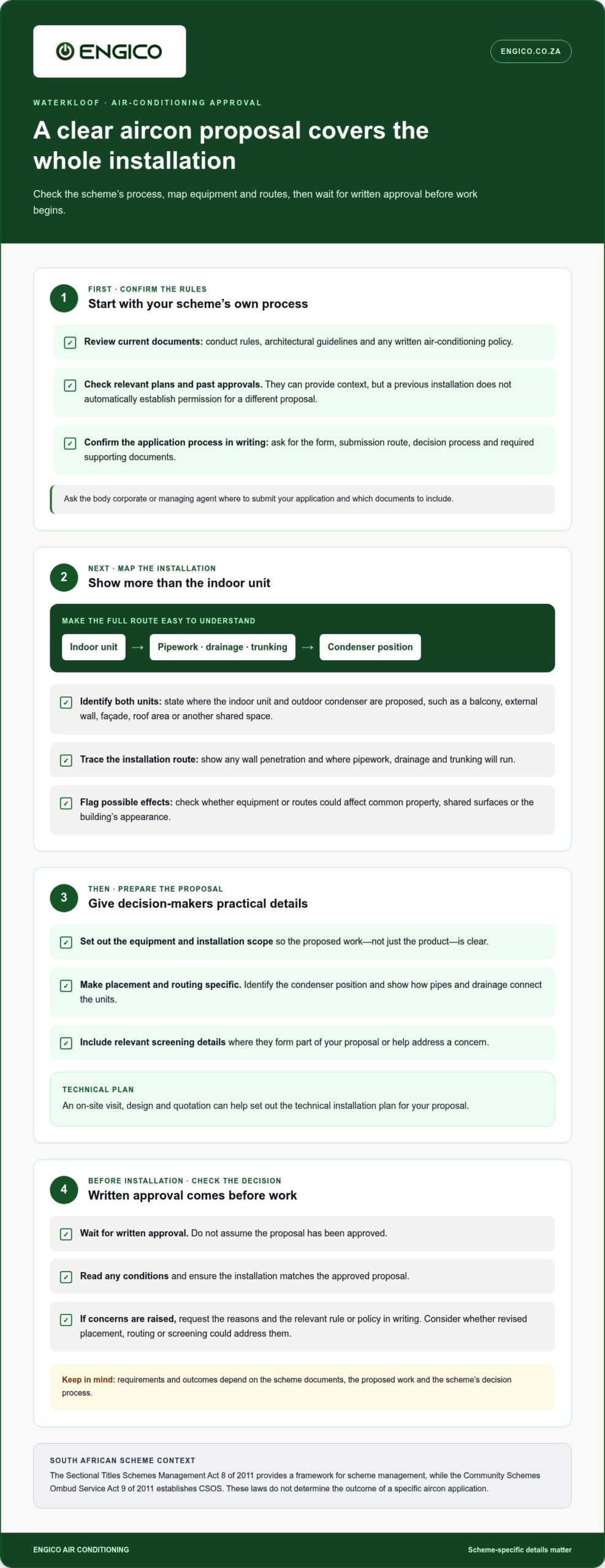
Prepare a complete aircon approval application for a Waterkloof scheme
A well-organised application helps trustees understand the full installation, not just the air conditioner model. Build your submission around your scheme’s requirements and include enough technical detail to show where equipment will go and how the work will be carried out. Include details relevant to your design, and label drawings so they’re easy to follow.
- Review the scheme documents. Check the current conduct rules, architectural guidelines, air-conditioning policy and application instructions for restrictions or required documents.
- Confirm the submission process. Establish the correct recipient, channel and supporting documents with the body corporate or managing agent, following the scheme’s stated procedure.
- Define the installation scope. State the unit type, proposed indoor and outdoor locations, equipment dimensions and work involved. Clarify whether the design includes external pipework, trunking, wall penetrations or fixings.
- Prepare supporting material. Include a site photograph or marked-up sketch showing the equipment in context. Add a written installation quotation where available, with the proposed pipe route and drainage destination described.
- Submit and retain a record. Send the complete application through the scheme’s stated channel, keep copies of every attachment and save the written decision and any conditions.
What technical details make the request easier to assess?
Show the condenser’s proposed position in relation to neighbouring windows, balconies and shared spaces. Mark the pipe route, any trunking and wall penetrations, and explain how the penetrations will be sealed. Describe where condensate is intended to discharge without assuming one drainage arrangement suits every property. Include relevant sound information for the proposed equipment and explain how its location and visible components relate to the building’s external appearance.
A simple annotated photograph can make the layout easier to interpret. Mark the indoor unit, condenser, pipe path and drainage destination separately. If the scheme has requested particular drawings or specifications, use those requirements to guide your application rather than relying on a generic checklist.
How should you submit and record the request?
Use the scheme’s stated application channel and check that each requested attachment is included before sending. Keep the submitted version together with the supporting quotation, drawings, photographs and correspondence. When a decision arrives, save it with the application and note any conditions against the relevant installation detail. This creates a clear reference for the approved scope and makes it easier to spot whether later design changes need to be submitted for consideration.
Engico’s on-site visit, design and quotation can help set out the technical scope for a residential installation proposal. Arrange aircon installation planning for your Waterkloof project, then submit the relevant details through your scheme’s approval process.
From written approval to professional aircon installation in Waterkloof
Written approval is the handover point between planning and installation, not a reason to skip final checks. Read the decision carefully and compare its conditions with the approved proposal. Confirm that the equipment position, visible finish, pipe route and installation scope still match. If the final design has changed, or a condition is unclear, resolve the difference with the scheme before work begins.
Approval may also set practical requirements for access, timing, drainage or reinstatement. Record these clearly so everyone involved in the installation works from the same authorised plan. The aim is a controlled handover: the scheme’s written decision informs the installation plan, and the work follows that plan.
What to check in the written approval before work begins
Review the approval alongside your submitted drawings, photographs and quotation. Check that the locations and visible finish of the indoor and outdoor equipment are consistent with the approved version, and that pipework follows the agreed route. Note any conditions about access to shared areas, work timing, drainage or making good affected surfaces. If the approval describes a detail differently from the final installation scope, pause and request written clarification from the scheme before scheduling work.
Keep the approval and its conditions with the installation documents. This gives you a useful reference during project planning and helps prevent an unintended change to the authorised arrangement.
How Engico supports the installation stage
Once you understand and have obtained scheme approval, Engico’s managed process can take the project from initial contact through an on-site visit, design and quotation. Installation, project management and training follow project planning. The approved submission remains the reference for equipment position and work scope. Engico plans and carries out the installation, while the scheme makes its own decision about consent.
After installation, planned upkeep can help you manage the system over time. The HVAC maintenance services for Gauteng properties guide provides related information on maintenance planning.
Plan the next step for your Waterkloof property
Before discussing the installation, gather the scheme’s relevant documents, written approval and any conditions, along with your proposed equipment details and installation plan. This makes it easier to align technical planning with the scheme’s decision and identify changes that need written agreement. If you’re researching how to get body corporate approval for aircon Waterkloof, keep approval and installation planning distinct, while ensuring the final scope connects them.
When you’re ready to discuss the installation for your property, discuss your Waterkloof aircon installation with Engico.
Turn your approved plan into a well-managed installation
Once your scheme has confirmed its decision, use the approved plan as the working brief for installation. Keeping the equipment position and agreed scope clear maintains continuity between the approval discussion and the work on site. If a change becomes necessary, address it with the scheme before treating the revised arrangement as approved.
If you’re considering how to get body corporate approval for aircon Waterkloof, connect a scheme-ready proposal with practical installation planning. Engico supplies and installs residential wall-mounted split and multi-split air conditioning systems. Its managed process includes an on-site visit, design and quotation, installation, project management and training, providing a structured path from project planning to handover.
Engico serves customers in Waterkloof and across Pretoria, Johannesburg, Centurion, Menlyn, Farie Glen, Silverton, Gezina, Doringkloof, Midrand, Waterfall, Sunninghill, Woodmead, Sandton, Randburg, Roodepoort, Fourways and Gauteng Province.
Have your scheme documents, written decision and proposed installation details ready for a focused discussion. Discuss your Waterkloof aircon installation with Engico and take the next step with a clear plan.
Frequently Asked Questions
Do I need body corporate approval to install air conditioning in a Waterkloof flat?
Written scheme approval is often needed if the installation affects an external wall, facade, balcony or shared area, but the applicable rules and proposed work determine the process. For how to get body corporate approval for aircon Waterkloof, begin with the documents for your own property rather than relying on what another flat owner has done. An indoor unit alone may have a different impact from a condenser mounted outside.
Can a body corporate refuse an air conditioner in South Africa?
A request may be declined, but the outcome depends on the scheme’s applicable documents, the installation proposal and its decision process. A concern about the proposed condenser position, for example, may differ from a general objection to air conditioning. Request the decision and reasons in writing, and check the rule or policy cited. If you dispute how a rule is interpreted or applied, seek independent South African legal advice.
What documents should I submit for body corporate aircon approval?
Follow the scheme’s application instructions, since required documents differ between properties. A useful submission may include the completed application, a description of the aircon system, equipment dimensions, proposed indoor and outdoor positions, and a marked-up photograph or sketch. Add the proposed pipe route, drainage details and installation quotation where available. Label the documents with the property and application date, and keep the exact submitted versions for your records.
Can I install an air conditioner before the trustees approve it?
Don’t begin installation while the application is pending or disputed. Wait for written approval and read any conditions before arranging work, even if the equipment has been purchased or an installation schedule is being discussed. Starting early could leave you with work that doesn’t match the scheme’s requirements. If trustees request a change, obtain a written decision on the revised proposal before treating that design as approved.
What do trustees consider when reviewing an aircon application?
Trustees may assess how the proposed installation affects shared property and the building, as well as practical details of the work. These can include the condenser’s visibility, its position near neighbouring windows or balconies, sound, pipework, drainage, wall penetrations and fixings. They may also consider whether the proposal fits the scheme’s written guidelines. A clearly labelled plan helps connect each detail to its location on the property.
How long does body corporate approval for air conditioning take?
There’s no single timeframe for every scheme. The wait may depend on its stated procedure, when applications are considered and whether the submission is complete or needs clarification. Ask the managing agent or body corporate to confirm the expected process and any relevant submission dates in writing. Sending the requested documents together can reduce avoidable follow-up, but it can’t guarantee when a decision will be made.
Does body corporate approval replace municipal approval for air conditioning?
No. Scheme permission and any municipal requirements are separate considerations. Whether municipal approval applies depends on the specific work and requirements relevant to the property. Don’t assume body corporate consent settles that question. For a Waterkloof installation, check the applicable City of Tshwane requirements for the proposed scope before work starts. If the project involves changes beyond the aircon installation itself, clarify the requirements for that work too.
Recent Comments