

The lowest replacement quote may not be the best fit for your building. The cost to replace commercial HVAC unit Centurion businesses face depends on more than the equipment itself. System selection, installation requirements and how the work fits around business operations all shape the project.
Recurring faults can make replacement seem inevitable, but a repair may still be appropriate. Disruption to staff, customers and day-to-day work is another concern, particularly when proposals include different equipment or installation tasks. To compare options fairly, first define what the building needs and check exactly what each quotation covers.
This guide explains the main factors that influence a commercial HVAC replacement quotation and how to weigh repair against replacement. It also covers how to compare project scopes, choose between multi-split, ceiling cassette, ducted and air-handling systems, and plan installation around operational needs. Engico Air Conditioning supplies and installs commercial HVAC systems in Centurion, with maintenance, service, repairs and building management system integration available to support ongoing system needs.
Key Takeaways
- The cost to replace commercial HVAC unit Centurion businesses face depends on the building, equipment and project scope. A site-specific assessment is the practical starting point for budgeting.
- Consider recurring faults, the system’s overall condition and future operating needs before deciding whether to repair or replace.
- Compare proposals by checking that each clearly describes the equipment and installation work included.
- Plan access, communication with occupants and business continuity early to help manage installation disruption.
- Ducted, multi-split, ceiling cassette and air-handling systems suit different commercial building layouts and requirements.
When Should a Centurion Business Replace Its Commercial HVAC Unit?
When a commercial HVAC unit is failing, what should you budget, and is replacement more sensible than another repair? The cost to replace commercial HVAC unit Centurion businesses need to plan for depends on the work required. Start with an assessment of the equipment, the areas it serves and the existing system, rather than relying on the unit’s age or a generic estimate.
Commercial HVAC replacement cost is the project-specific scope of supplying and installing replacement equipment, including any work needed to suit the building and its existing systems. Replacing one unit may be a contained project. Replacing or redesigning a wider system can involve several units, distribution components and controls, making the scope substantially different.
What signs suggest a commercial HVAC unit is nearing replacement?
Recurring repairs, unstable indoor temperatures and equipment downtime are reasons to assess a system, not proof that replacement is the only answer. A fault may be repairable, but repeated failures warrant a broader review of equipment condition and reliability. Keep a record of faults, repairs, affected areas and periods when the unit was unavailable. This makes it easier to distinguish an isolated problem from an ongoing operational issue.
The impact depends on the premises. In an office, uneven comfort across work areas can affect the working environment. In a retail space, unreliable cooling may make conditions less comfortable for customers and staff. Other businesses may have rooms with specific operating requirements. Note which areas are affected, how often disruption occurs and whether the system meets current needs. No single symptom determines the decision. The repair history and effect on daily operations provide useful context.
What does replacing a commercial HVAC unit involve?
A replacement project generally covers equipment supply and installation. A like-for-like change replaces a unit within the existing arrangement, if that arrangement still suits the building. A wider redesign may change the system layout or equipment configuration, for example when the current system no longer serves the spaces effectively or the building’s needs have changed.
Clarify the boundaries of the work. Consider existing ductwork, controls and connections to the wider building system, as these can affect the scope. The building layout, access to equipment and areas it serves also matter when planning. These details help establish whether a proposal covers only the unit or includes changes to the surrounding system.
Age is one factor to review, not a decision rule. An older, well-maintained unit may still suit its role, while a newer unit with repeated faults may need investigation. Base the decision on condition, repair history, reliability and operational requirements, then specify exactly what is being replaced. This gives you a clearer basis for comparing repair and replacement options and understanding each project quotation.
Repair or Replace? Assess the Commercial HVAC System Before Deciding
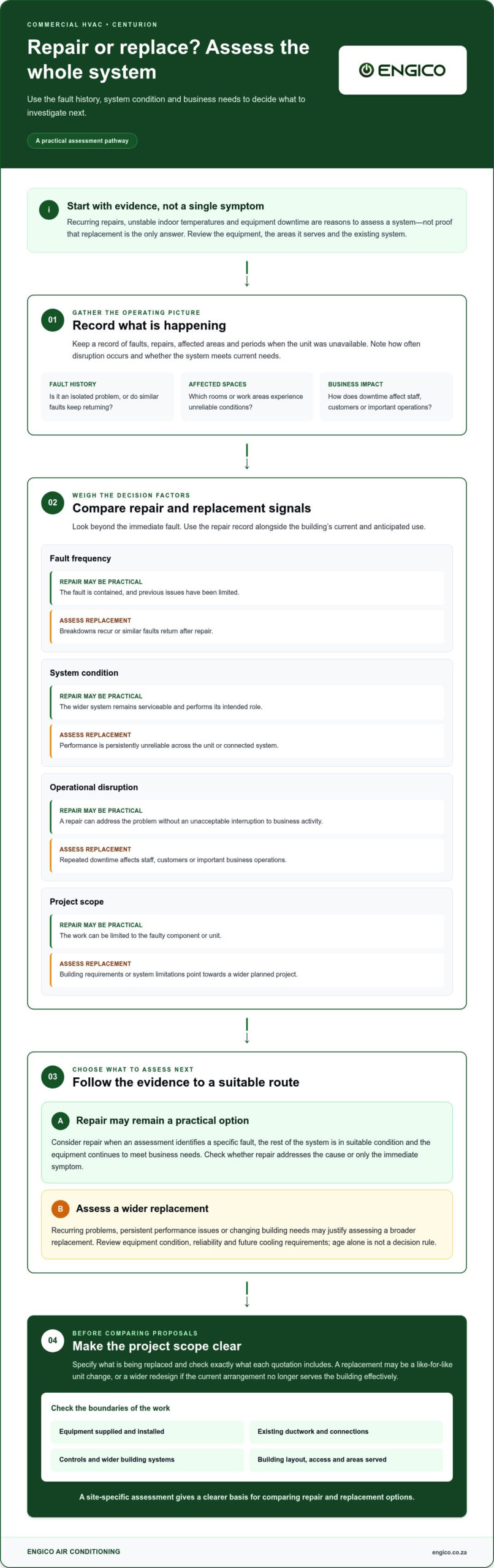
Replacement is not automatically the better choice. A contained fault in a system that otherwise meets the building’s needs may be resolved through repair. Recurring problems or persistent performance issues may justify assessing a broader replacement. Consider the repair history, current system condition and future cooling requirements, rather than making the decision based only on the latest fault.
Use this comparison to organise the assessment. It is a practical guide, not a substitute for a technical inspection.
| Consideration | Repair may be practical | Assess replacement |
|---|---|---|
| Fault frequency | The fault is contained, and previous issues have been limited. | Breakdowns recur or similar faults return after repair. |
| System condition | The wider system remains in serviceable condition and performs its intended role. | Performance is persistently unreliable across the unit or connected system. |
| Operational disruption | A repair can address the problem without an unacceptable interruption to business activity. | Repeated downtime affects staff, customers or important business operations. |
| Project scope | The work can be limited to the faulty component or unit. | Building requirements or system limitations point towards a wider planned project. |
Look beyond the immediate fault. A repair record can show how often the system has needed attention, which areas are affected and whether the same issue keeps returning. Compare this history with the building’s current and anticipated use. A layout change, newly occupied space or different operating schedule may alter cooling requirements, even if the equipment can still be repaired.
When may repair remain a practical option?
Repair can make sense when an assessment identifies a specific fault, the rest of the system is in suitable condition and the equipment continues to meet business needs. Consider the unit’s history and the practical effect of taking it out of service. A technical assessment can help establish whether repair addresses the cause or only the immediate symptom, and whether the system can continue to serve the building reliably.
When should a business assess full replacement?
Repeated breakdowns, unresolved performance issues or changing building requirements are reasons to consider replacement as a project option. Compare the pattern and operational impact of ongoing faults with the disruption involved in a planned installation. This does not guarantee that replacement will save money. It gives you a way to weigh continued repairs against a defined scope of work without relying on a universal age threshold.
Before deciding, document the affected areas, repair history, operating needs and any planned changes to the premises. A site assessment can then consider the existing system alongside the building’s cooling requirements. Engico provides commercial HVAC repairs and maintenance as well as supply and installation, supporting an informed assessment of the available options.
What Drives the Cost to Replace a Commercial HVAC Unit in Centurion?
There is no universal price for commercial HVAC replacement. The cost to replace commercial HVAC unit Centurion businesses should plan for depends on the equipment selected, the building it must serve and the work needed to install and integrate it. A useful quotation starts with a site assessment and a defined scope, rather than selecting equipment based only on the existing unit.
For a fair comparison, establish whether each proposal covers one unit or a wider system. Then clarify what equipment supply, removal, installation, controls and commissioning involve. This makes differences in project scope easier to understand.
How do equipment and building requirements affect the quotation?
System type and capacity should match the building’s cooling requirements. Ducted systems distribute conditioned air through ductwork, while ceiling cassette units may suit particular open or shared areas. Multi-split systems connect multiple indoor units within a system, and air-handling units serve wider air-conditioning arrangements. These options are not interchangeable. The suitable choice depends on how the premises are laid out and used.
Occupancy, room arrangement and the areas that need cooling all influence equipment selection. A business with separate rooms may have different requirements from one with a large open floor, even if both are in Centurion. Properties in the same area can differ in layout, existing infrastructure and operating needs, so location alone does not determine the specification.
Which installation and operational factors change project scope?
The condition and arrangement of existing infrastructure can affect the amount of installation work required. Consider access to equipment, removal of the old unit, the route for bringing in replacement equipment and any required modifications. Existing ductwork and controls may also influence the work, particularly if the project changes how the system serves different spaces.
Controls and commissioning should also be addressed in the project scope. Specify what control integration is required and what checks will be completed when the replacement is installed. Where building management system integration suits the building’s control requirements, it can form part of the project.
- Access and removal: Check where the equipment is located and how the existing unit will be removed.
- Infrastructure: Identify any changes needed to ductwork, controls or the wider system.
- Business operations: Account for working hours, affected areas and whether installation needs to be phased.
- Completion: Define commissioning and the checks required before the system returns to normal operation.
Business hours and phasing can shape the installation plan. Work across several occupied areas may need a different approach from a single-unit change. Consider access and communication alongside the technical work. The main cost drivers are equipment type and capacity, installation complexity, existing infrastructure, controls, commissioning and the phasing needed to suit business operations. A detailed, site-specific scope gives decision-makers a practical basis for understanding and comparing quotations.
How to Plan a Commercial HVAC Replacement Project in Centurion
A well-planned replacement starts with clear requirements, followed by scope definition, proposal comparison and installation planning. This sequence helps decision-makers consider what the building needs and how work can be carried out while managing disruption to staff, customers and business activities.
- Record current conditions. Note affected areas, operating hours, comfort concerns, known faults and repair history. Describe how different spaces are used, since an office, retail floor or other business area may have distinct cooling needs.
- Set out operational requirements. Describe access constraints, activities that must continue during installation, and any performance or control needs. Identify affected occupants and areas so they can be considered when planning the work.
- Define and compare the project scope. Review proposed equipment, installation tasks, commissioning, exclusions and ongoing support against the same building requirements.
- Plan implementation and communication. Decide how access will be managed, whether work needs to be phased and how affected occupants will be informed about timing and changes to their spaces.
What information helps define a replacement project?
Prepare a practical site brief before comparing proposed solutions. Identify which areas need attention, when they are occupied, what comfort issues have been reported and what is known about the system’s history. Add constraints such as restricted equipment access or business activities that cannot be interrupted. Set out control and performance requirements clearly, so the proposed system can be assessed against the way the building operates.
This preparation gives the project team a consistent picture of the requirements. It also helps distinguish essential needs from preferences that can be considered during system selection.
How can a business compare replacement proposals fairly?
Compare each proposal against the same brief, not just its headline description. Check the equipment type and proposed capacity, installation scope, commissioning arrangements and stated exclusions. If one proposal includes modifications to existing infrastructure while another does not, understand the difference before comparing the overall project. Check whether each option accounts for access limits and the operational constraints in the brief.
Ongoing maintenance and service support also belong in lifecycle planning. A replacement is a long-term building decision, so consider how the system will be maintained after installation. Engico’s commercial HVAC maintenance support can form part of that planning alongside supply and installation.
Operational continuity needs active planning. Identify which areas may be affected, who needs access and how staff or customers will be kept informed. If a project involves several areas, phasing may help organise the work, but the sequence should reflect the building’s use and installation scope.
For a Centurion business, a clear brief makes it easier to understand the cost to replace commercial HVAC unit Centurion premises require, because proposed equipment and work can be compared against defined needs. Use the brief to organise the assessment and project plan. Plan your commercial HVAC replacement with Engico.
Commercial HVAC Replacement with Engico: From System Selection to Installation
A commercial replacement project should suit the way a building is occupied and operated, rather than simply reproduce the old equipment. Engico supplies and professionally installs commercial HVAC systems, with selection shaped around the property’s layout, cooling requirements and operational needs. For businesses assessing the cost to replace commercial HVAC unit Centurion premises rely on, a defined project scope connects equipment choice to the installation work involved.
The right approach may be a replacement unit within the existing arrangement or a system suited to a different building requirement. Engico works with ducted, multi-split, ceiling cassette and air-handling systems. These options can be considered in relation to the areas served and how occupants use them.
How does Engico approach commercial system selection?
System selection starts with the building context. A ducted system may serve multiple areas through ductwork, while ceiling cassette or multi-split systems may suit different room layouts and distribution needs. Air-handling systems are another option for commercial requirements. The intended use of each space, existing infrastructure and operational priorities all inform the project scope. No single system type suits every property.
Engico considers supply and professional installation together so the selected equipment aligns with the work required at the premises. Where centralised monitoring or control suits the building, Engico can also integrate the HVAC system with a building management system. This is a project consideration, not an automatic addition to every replacement.
What are the next steps for a Centurion replacement?
To begin a useful project discussion, gather details about the property, existing system and business requirements. Include the areas served, known performance concerns, operating patterns and access constraints. These details help shape an assessment of what should be replaced and whether the work concerns one unit or a wider system. Engico tailors the equipment and installation scope to the building and project requirements.
Include ongoing support in lifecycle planning. Engico provides maintenance, service and repairs for air-conditioning systems. These are support options to plan for, rather than assumed inclusions in a replacement installation. Considering how the equipment will be maintained after installation helps businesses plan beyond the initial project.
Clear information about the site and its needs gives the replacement discussion a practical starting point. Engico serves businesses in Centurion, Pretoria, Johannesburg, Menlyn, Farie Glen, Silverton, Waterkloof, Gezina, Doringkloof, Midrand, Waterfall, Sunninghill, Woodmead, Sandton, Randburg, Roodepoort, Fourways and Hyde Park, as well as across Gauteng Province. Supply, installation and ongoing HVAC support can be considered as part of the project.
Discuss your Centurion commercial HVAC replacement with Engico.
Make Your HVAC Replacement a Long-Term Building Decision
A replacement project can shape how a building is managed well beyond installation day. Before proceeding, consider how the new system will fit future occupancy, planned changes to the premises and facilities management. Recording these considerations alongside the project decision gives your team a useful reference for future reviews, rather than treating replacement as an isolated equipment change.
The phrase cost to replace commercial HVAC unit Centurion has no single answer for every property. A clear, building-specific brief is the practical basis for discussing the right scope and planning the next stage. Engico works on commercial HVAC projects from equipment selection and installation through to ongoing system support, with requirements tailored to the property.
To progress your plans, discuss your commercial HVAC replacement project with Engico. A considered next step can help your business move towards a system that fits its needs and supports day-to-day operations.
Frequently Asked Questions
How much does it cost to replace a commercial HVAC unit in Centurion?
There is no single figure for every commercial building. The cost to replace commercial HVAC unit Centurion businesses face depends on the equipment and capacity, site access, existing infrastructure, controls and installation requirements. For a clearer budget, define which areas and units are included, then compare proposals against the same scope. Engico supplies and installs commercial HVAC systems for Centurion properties.
What affects the cost of replacing a commercial HVAC system?
System type, building requirements and installation work all influence the project scope. Replacing equipment in an accessible plant area may involve different work from replacing units in several occupied rooms. Modifications to existing infrastructure, controls, access and the installation sequence can also affect what is required. Review the scope and exclusions in each proposal so you compare equivalent work, not just headline figures.
Should I repair or replace a commercial air-conditioning unit?
Base the decision on the fault, wider system condition, repair history and the building’s needs. A fault affecting one component may be repairable, particularly if the rest of the system performs as required. If the same areas keep losing cooling or repairs have not resolved the problem, assess replacement as well. A technical inspection can help distinguish a contained repair from a broader system concern.
How long does it take to replace a commercial HVAC unit?
There is no single duration for every project. Work may be more straightforward for an accessible unit with limited installation changes than for a project involving several areas, existing-system modifications or control integration. Before setting a programme, identify access restrictions, the equipment being replaced and which business activities rely on affected spaces. This gives the installation plan a realistic basis for the Centurion property.
Can a commercial HVAC unit be replaced without closing a business?
Some replacement work may be planned around normal business operations, but whether the premises can remain open depends on the work area and installation requirements. A project limited to one section may be organised differently from work affecting several occupied areas. Identify essential activities, staff and customer access, and spaces that must remain available. Phasing and clear communication can help manage disruption, but cannot guarantee that none will occur.
What should a commercial HVAC replacement quotation include?
A useful quotation makes the proposed equipment and work easy to understand. Check for the system type, installation tasks, changes to existing infrastructure, commissioning and clearly stated exclusions. It should also reflect site constraints that could affect access or the sequence of work. If one proposal includes work another leaves out, note the difference before comparing them. This clarifies what each scope delivers beyond its headline price.
Does replacing a commercial HVAC unit improve energy efficiency?
Replacement may create an opportunity to select equipment better suited to the building, but efficiency gains or savings depend on the specific project and should not be assumed. Review relevant performance information for the proposed equipment and consider how controls, system operation and maintenance relate to the building’s needs. Building management system integration may be appropriate where centralised control suits the property. Base the replacement decision on requirements, not an assumed energy outcome.
Recent Comments