
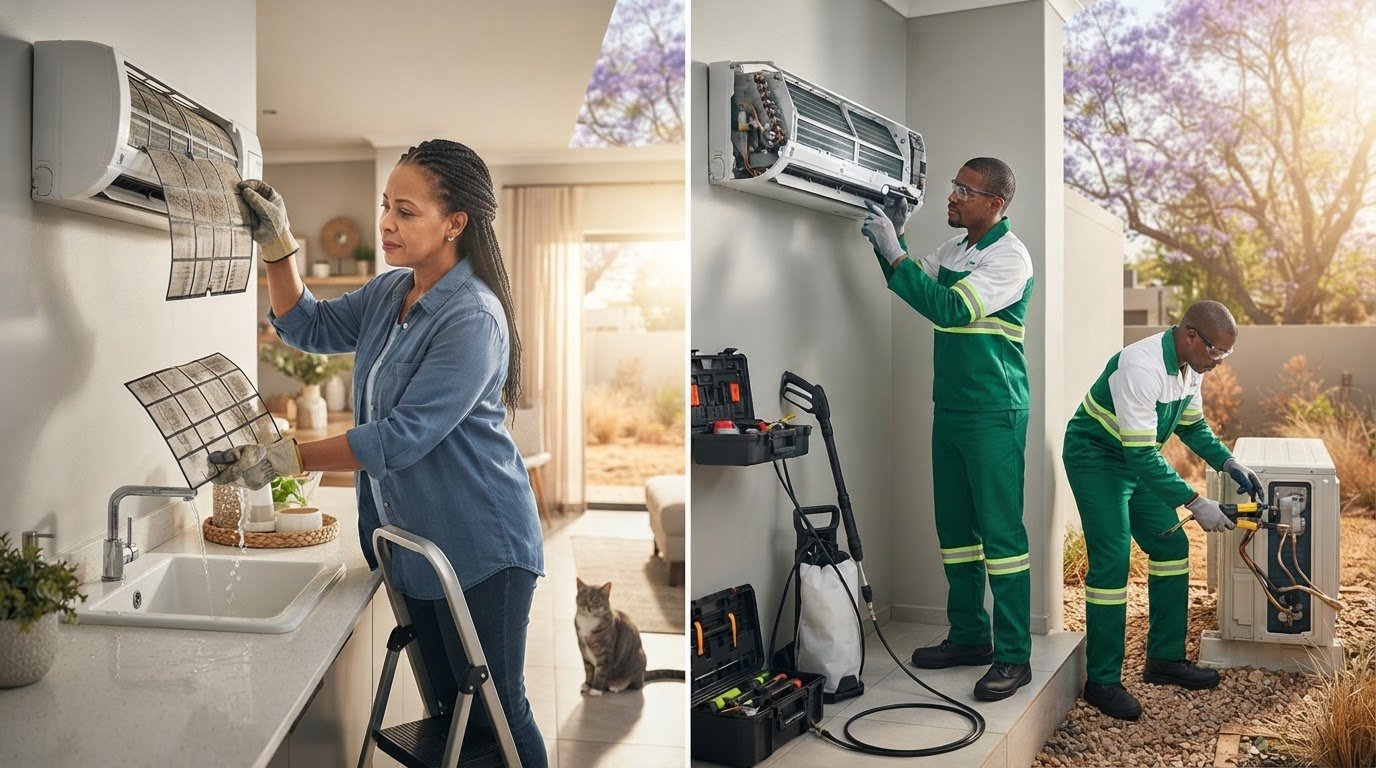
Could a quick filter clean solve an aircon problem, or is dirt you can’t reach why cooling still feels weak? Choosing between professional aircon cleaning vs DIY depends on which parts are accessible and whether your system needs more than routine care. Cleaning a removable filter or wiping the casing may be straightforward, but recurring odours, visible grime or poor cooling can make the next step less obvious.
It’s sensible to handle simple upkeep yourself, provided you follow the unit manual and avoid opening panels or disturbing internal components. Gauteng’s dry, dusty winters can also leave outdoor units needing attention, but cleaning beyond accessible surfaces involves different considerations.
This article explains what you can safely clean, which signs may point to a need for professional servicing, and what servicing can address beyond basic user maintenance. You’ll also see how to weigh the next step for a home split system or a commercial installation, where system type and building use can affect maintenance needs.
Key Takeaways
- Use the unit manual to guide routine care, and switch the aircon off before carrying out permitted user maintenance.
- Keep DIY cleaning to accessible tasks. Avoid opening panels or attempting to clean internal components.
- With professional aircon cleaning vs DIY, recurring odours, visible dirt or reduced cooling are reasons to investigate further, not assume a filter clean will resolve the issue.
- Consider access, safety and recurring symptoms when deciding whether routine upkeep is enough or professional servicing is the more practical option.
- For a useful maintenance discussion, note the system type and concerns such as unusual noises or signs of leakage.
Professional Aircon Cleaning vs DIY: What Does Each Option Actually Cover?
Basic user care and professional servicing address different needs. DIY cleaning is limited to parts the manufacturer identifies as user-accessible. Professional aircon servicing can assess and attend to areas beyond routine access. The right option depends on the unit’s design, condition and manual, not simply how dusty its visible surfaces look.
Aircon cleaning can mean anything from wiping the casing to attending to internal components. An air conditioning system also includes parts that work together to condition and circulate air, as outlined in this overview of Heating, ventilation, and air conditioning (HVAC). Cleaning accessible parts is useful routine care, but it isn’t a full system assessment.
| Consideration | DIY user care | Professional servicing |
|---|---|---|
| Task scope | Accessible filters and exterior surfaces, where the manual permits. | Assessment and cleaning of areas beyond routine user access, depending on the unit and its condition. |
| Access and safety | Limited to safe, reachable parts. Switch the unit off and follow the manual. | Suitable for work requiring technical assessment or access to internal components. |
| Tools and time | Usually requires suitable cleaning materials and time for the permitted task. | Tools and work depend on the system type and service required. |
| Fault detection | May reveal visible dirt, but won’t establish the cause of a fault. | Allows a technician to inspect the system and assess reported concerns. |
What does DIY aircon cleaning usually involve?
Where the manual allows, user maintenance may include removing and cleaning an accessible filter, then refitting it as instructed. You can also gently wipe reachable exterior surfaces with a suitable material. Switch the unit off first and follow the manufacturer’s instructions for your model. If the manual doesn’t describe a task, leave it to a technician rather than trying to access hidden parts.
What can professional aircon servicing address?
A technician can assess areas that aren’t intended for routine user access and determine what cleaning or inspection is appropriate. The scope can differ between a wall-mounted split, ceiling cassette or ducted system, and depends on the unit’s condition. Servicing can help investigate concerns, but the work and findings depend on the system and are not a guaranteed result.
DIY maintenance does not replace professional servicing. It covers permitted, accessible upkeep. Servicing provides a broader assessment when the system’s needs go beyond those tasks. That distinction is central to deciding between professional aircon cleaning vs DIY.
Which Air Con Cleaning Tasks Are Safe to Do Yourself?
Keep DIY care to tasks the unit’s manual clearly describes as user maintenance. Before starting, switch the aircon off and follow the manufacturer’s instructions for your specific model. A wall-mounted split unit may have an accessible filter, while a ceiling cassette or ducted system can have different access points and maintenance requirements.
A cautious routine checklist may include:
- Removing and cleaning an accessible filter only as directed in the manual.
- Letting the filter dry completely before refitting it.
- Gently wiping reachable exterior surfaces with a suitable material.
- Looking for visible damage or changes without removing covers or attempting repairs.
Filter care is one part of maintaining an aircon. The US Environmental Protection Agency’s guidance on improve your indoor air quality discusses air filters and indoor air quality. For your unit, the manufacturer’s instructions remain the guide to cleaning and refitting its filter.
How to clean an accessible aircon filter
Check the manual before removing a filter. It should explain whether the filter can be cleaned, how to remove it and which method to use. Follow its directions for drying, and don’t reinstall the filter until it’s fully dry. There isn’t one cleaning interval that suits every property. Use, dust exposure and the manufacturer’s guidance all matter.
In Gauteng, a home aircon may have different usage and exposure from equipment serving a busy workplace. Dust around the property, operating patterns and system type can affect how often it’s useful to inspect accessible filters. Use those conditions to inform your checks, not to override the manufacturer’s instructions.
What should you leave untouched during DIY cleaning?
Don’t open sealed panels, electrical compartments or sections containing refrigerant components. Avoid pressure washing, harsh chemicals and improvised cleaning products, which may be unsuitable for the unit. Stop if a filter or cover resists removal, or if the task appears to require force, specialist tools or unfamiliar disassembly. Switching the unit off doesn’t make internal components suitable for DIY work.
If routine care doesn’t address your concern, or the system needs attention beyond accessible user maintenance, professional air conditioner maintenance and servicing can provide a practical next step. Engico Air Conditioning services residential and commercial air conditioning systems, including split, ceiling cassette and ducted units. Find out more about air conditioner maintenance and servicing.
When Is Professional Aircon Cleaning Better Than DIY?
Professional attention is worth considering when the issue goes beyond an accessible filter or exterior surface. Visible dirt inside the unit, recurring odours or reduced cooling are reasons to investigate further, not proof of a particular fault. A technician can assess the system and help distinguish a cleaning requirement from a problem that may need aircon repairs.
Signs that basic cleaning may not be enough
If an odour returns after permitted user care, or cooling remains reduced, stop repeating the same DIY steps and arrange an assessment. An odour alone doesn’t prove mould or a health hazard; it can have more than one cause. Visible dirt also doesn’t show how far it extends or whether it explains the system’s behaviour.
Unusual noises and signs of leakage also call for assessment. Don’t remove covers or try to investigate internal components yourself. Cleaning and repair are different needs: a service may identify an issue, but a fault may require separate repair work. Note what you’ve noticed, when it occurs and whether it persists.
Why system type and building use matter
A wall-mounted split unit may have straightforward access to a user-serviceable filter, but that doesn’t make its internal components suitable for DIY cleaning. Ceiling cassette and ducted systems can have less accessible parts, so the work required depends on the unit’s design and condition. If access is difficult, professional assessment is more appropriate than attempting disassembly.
In a workplace with several units, maintenance planning may need to account for how the building is used and how systems serve different areas. A concern affecting one room may need a different response from an issue across multiple units. Engico maintains and services residential, commercial and industrial air conditioning systems. For a broader view of building maintenance, see the guide to HVAC maintenance services for Gauteng properties.
For professional aircon cleaning vs DIY, the practical boundary is clear: keep DIY to permitted, accessible tasks, and seek professional assessment when symptoms persist, access is difficult or the system behaves unusually. Describe what you’ve observed instead of trying to diagnose it. That helps direct attention towards cleaning, servicing or possible repair.
How to Compare DIY and Professional Aircon Cleaning for Your Property
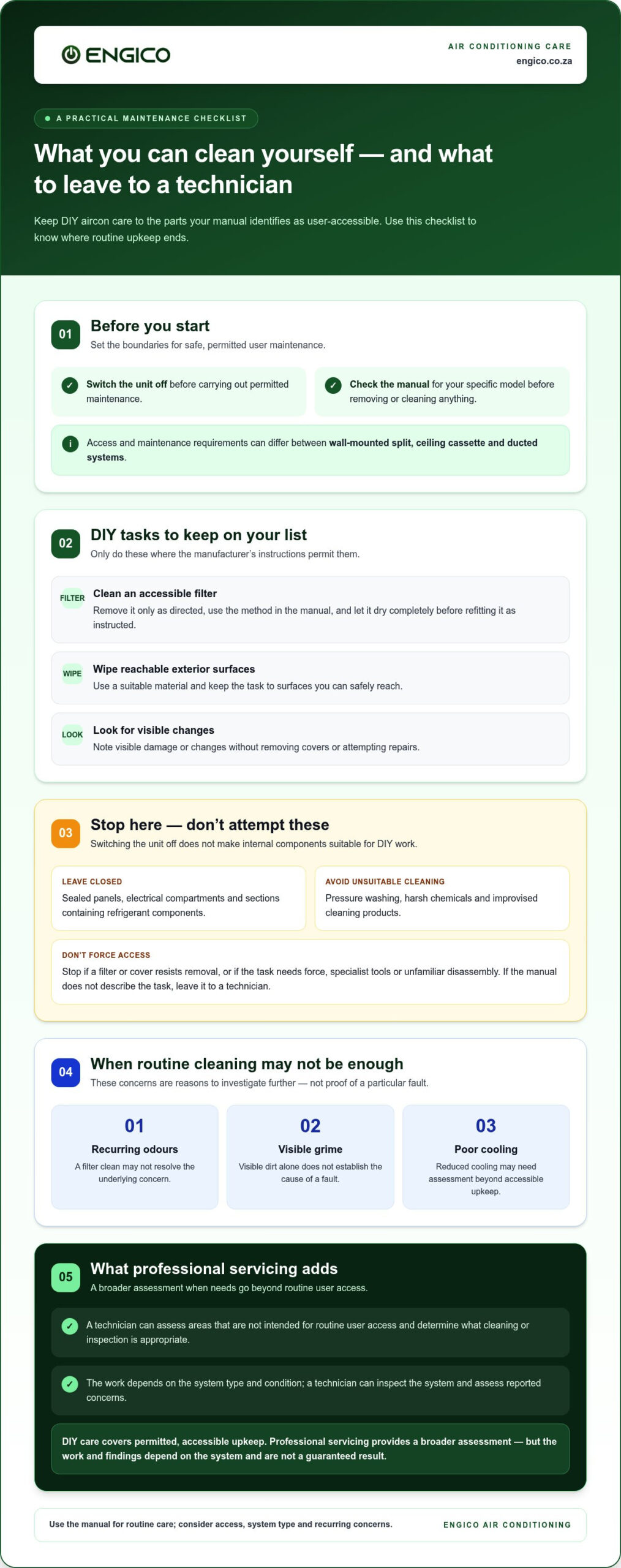
Use the task, access and symptoms to guide your choice rather than assuming every unit needs the same approach. DIY is reasonable when the manual clearly permits the task, the relevant part is safely accessible and there are no warning signs. Consider professional servicing if cleaning requires internal access, concerns persist after basic care or several systems need attention.
| Factor | DIY may be suitable | Professional assessment is prudent |
|---|---|---|
| Task scope | The manual describes the task as routine user maintenance. | The work goes beyond the instructions or involves internal components. |
| Access | The filter or surface is clearly accessible without force. | Access is difficult, elevated or requires removing unfamiliar parts. |
| Safety | The task can be done with the unit off and as instructed. | It involves electrical sections, refrigerant components or specialist tools. |
| Time and scale | It’s a straightforward task on an individual unit. | Several units or a workplace system need coordinated attention. |
| Repeat symptoms | No warning signs are present and routine care is sufficient. | Odours, reduced cooling or other concerns persist or return. |
A simple decision checklist for homes and workplaces
Before cleaning, ask whether the unit manual explicitly permits the task, whether the part is safely accessible and whether any symptoms continue after basic care. A homeowner with an accessible split-unit filter and no other concerns may be able to carry out the instructed upkeep. A ceiling cassette or ducted system can present different access considerations.
For Gauteng businesses, consider how many systems are involved and the practical effect of taking equipment out of use for attention. Planning maintenance around building operations can help clarify the appropriate scope. The decision should still reflect the system’s condition, not simply the number of units.
How to plan ongoing aircon care
Keep a simple record of filter cleaning, recurring concerns and professional service visits. Use the manufacturer’s guidance alongside what you observe. Dust exposure and system use can differ between a home, office and other workplace, so a universal timetable may not fit every property. If you manage a business site, this guide to commercial HVAC maintenance in Sunninghill offers relevant planning context.
This practical framework makes professional aircon cleaning vs DIY easier to assess without treating a symptom as a diagnosis. If your system needs attention beyond routine user care, arrange air conditioner maintenance and servicing with Engico.
Professional Aircon Servicing in Gauteng: Practical Next Steps
Use a simple sequence to decide what to do next: check the unit manual, note what you’ve observed, then choose a task that stays within safe user maintenance. If the manual permits a straightforward filter clean and there are no warning signs, follow its instructions. If concerns continue, access is difficult or the work would involve internal components, professional servicing is a practical next step.
This is the useful boundary in professional aircon cleaning vs DIY. You don’t need to diagnose the cause before arranging an assessment. A clear account of what the system is doing can help focus a maintenance discussion on the right unit and concern.
What information to prepare before arranging servicing
Before discussing maintenance, note the system type and, if known, its approximate age. Record which rooms or areas are affected, what you’ve noticed and when it happens. If an odour, reduced cooling or another concern returns after permitted filter care, mention that too. These observations provide useful context without assuming a cause.
For a commercial property, identify the units or building areas needing attention. If several systems are involved, a simple list can help distinguish a concern affecting one space from a wider pattern. There’s no need to open equipment or carry out extra cleaning to gather this information.
How Engico supports aircon maintenance needs
Engico provides maintenance, servicing and repair for residential and commercial air conditioning systems in Pretoria, Johannesburg, Centurion, Menlyn, Farie Glen, Silverton, Waterkloof, Gezina, Doringkloof, Midrand, Waterfall, Sunninghill, Woodmead, Sandton, Randburg, Roodepoort, Fourways and Hyde Park, in Gauteng Province. Supported systems include wall-mounted split, multi-split, ceiling cassette and ducted air conditioning. The appropriate work depends on the system and the concern, so describe what you’ve observed and which areas are affected.
For a home, that may mean describing an issue with a split system in a particular room. For a workplace, identify the units or areas they serve. This gives a clearer starting point for discussing air conditioner maintenance or repair without presuming that cleaning alone will address the concern.
If your aircon needs professional support, explore Engico’s air conditioning services for maintenance, servicing and repairs in Gauteng.
Choose the Right Care for Your Aircon
The practical choice in professional aircon cleaning vs DIY comes down to the task and the system’s condition. Follow the unit manual for safe, accessible upkeep, and leave internal work or difficult access to professional servicing. If odours, poor cooling or other concerns persist, describe what you’ve noticed rather than trying to diagnose the cause.
Usage and system type matter too. A home split unit and a commercial property with several systems may have different maintenance needs. Keeping a record of recurring concerns can help you decide when routine care is no longer enough.
Engico provides air conditioner maintenance, servicing and repairs for residential and commercial systems in Pretoria, Johannesburg, Centurion and wider Gauteng. If your aircon needs attention beyond permitted user maintenance, explore Engico’s air conditioning maintenance and service options.
With clear observations and the right level of care, you can take a considered next step for your system.
Frequently Asked Questions
Can I clean my aircon myself?
Yes, you can carry out basic maintenance if the unit manual identifies the task as suitable for users. This may include cleaning an accessible filter or gently wiping reachable exterior surfaces. Switch the system off first, follow the model-specific instructions and let a cleaned filter dry completely before refitting it. Don’t open electrical or sealed sections, handle refrigerant components or force access to parts you can’t easily reach.
Is professional aircon cleaning better than DIY?
Neither option is always better; they address different tasks. DIY is appropriate for accessible maintenance clearly permitted by the manual. Professional aircon cleaning vs DIY becomes a practical choice when work goes beyond user access. A technician can assess the system and determine what servicing may be appropriate based on its type and condition. Persistent odours or reduced cooling should be investigated rather than treated as proof that deeper cleaning is needed.
How often should I clean my aircon filter?
Follow the cleaning interval and method in your aircon’s manual, as there isn’t one schedule that suits every unit or property. How often the system runs and its exposure to dust can affect how quickly a filter becomes dirty. In Gauteng, conditions may differ between homes and workplaces, so check the filter as the manufacturer directs. If removal or cleaning instructions aren’t clear, avoid guessing or forcing the filter out.
What happens if I do not clean my aircon filter?
A dirty filter may restrict airflow and can contribute to reduced cooling, but the exact effect depends on the system and its condition. A filter that looks dirty doesn’t automatically explain every performance concern. Check and maintain it according to the manual, then observe whether the issue continues. If cooling remains poor after permitted filter care, arrange an assessment rather than repeatedly cleaning the filter or attempting to inspect internal components.
Can DIY aircon cleaning damage the unit?
Yes, an unsuitable cleaning method or attempt to access internal parts can damage the unit. For example, forcing a cover or filter, using harsh chemicals or applying water where it isn’t intended may create problems. Keep DIY work to tasks the manufacturer’s instructions clearly permit. Don’t pressure-wash the system, open electrical sections or disturb refrigerant components. Stop if the task requires force, specialist tools or unfamiliar disassembly.
Does professional aircon cleaning improve energy efficiency?
Professional servicing may help identify dirt or other conditions that could affect operation, but it can’t guarantee an efficiency improvement. The result depends on the system’s condition and the cause of any performance issue. Cleaning an accessible filter as directed is useful routine care, but persistent high energy use or poor cooling may have another cause. A technician can assess the system and advise whether maintenance or repair is appropriate.
When should I call an aircon professional instead of cleaning it myself?
Arrange professional attention if concerns persist after permitted user care, if the unit is difficult to access, or if you notice unusual noises or signs of leakage. These are reasons for assessment, not a diagnosis. Engico provides air conditioner maintenance, servicing and repairs across Gauteng, including Pretoria, Centurion, Menlyn, Midrand, Sandton, Randburg, Fourways and Johannesburg areas such as Hyde Park. Note which system and rooms are affected when describing the concern.
Recent Comments