

The inverter may not be the better aircon for every room. If you’re weighing the inverter vs non-inverter aircon pros and cons, the higher purchase cost of an inverter model may leave you wondering whether its everyday benefits justify the outlay.
That concern makes sense, but the right choice depends on more than the unit’s label. How often you run the aircon, how long it operates and the conditions in the room all affect which type may suit you best. With electricity costs a practical consideration for South African households, look beyond the purchase price and consider how the system will work in your space and routine.
This guide explains how inverter and non-inverter air conditioners operate, compares their advantages and limitations, and outlines where each may be a better fit. It also covers why correct sizing and professional installation matter, and what to ask an installer about your room, usage patterns and local conditions before choosing.
Key Takeaways
- Understand how inverter and non-inverter compressors operate differently, even though both cool the air.
- Use the inverter vs non-inverter aircon pros and cons to compare comfort, efficiency potential and practical considerations without assuming one type always performs better.
- Match your choice to how often and how long you’ll use the aircon, as well as the room’s exposure and conditions.
- Ask an installer to assess the room and recommend suitable cooling capacity before choosing a unit.
- Consider how professional installation and ongoing maintenance may affect your system’s performance over time.
Inverter vs non-inverter aircon: what is the difference?
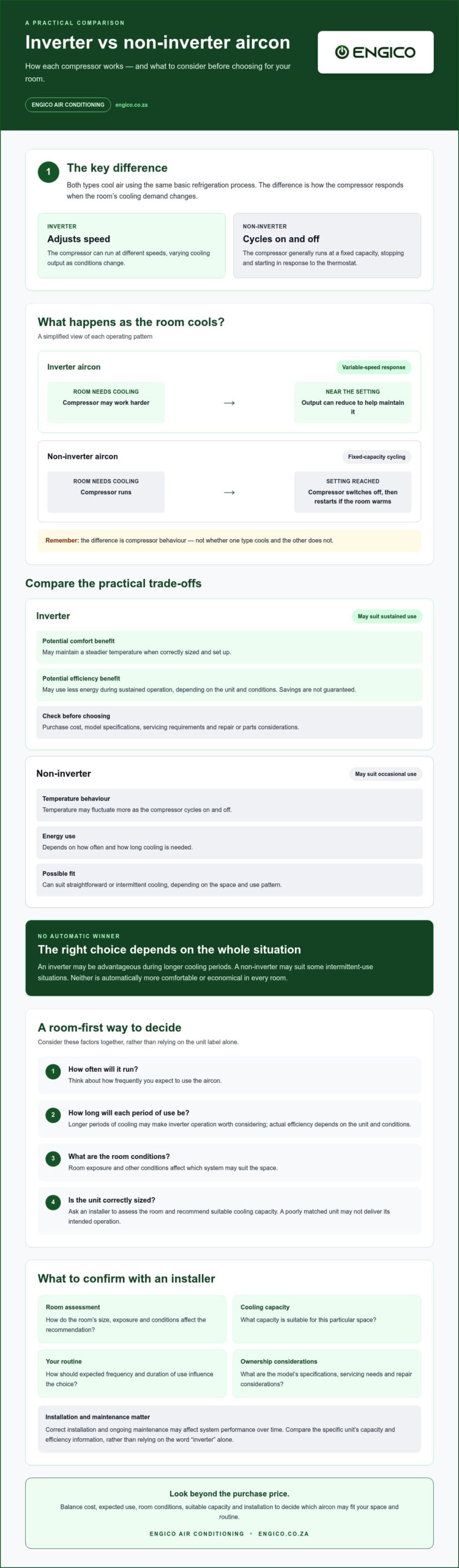
An inverter air conditioner varies its compressor speed to adjust cooling output, whilst a non-inverter air conditioner generally runs its compressor at a fixed capacity and cycles it on and off. Both types cool a room using the same basic refrigeration process. The difference is how the compressor responds to changing cooling demand, not whether one type cools and the other does not.
This distinction is central to understanding the inverter vs non-inverter aircon pros and cons. Inverter operation may help a unit adapt its output as room conditions change, but it doesn’t guarantee lower electricity bills or better comfort in every setting. The result also depends on the unit’s capacity, temperature setting and operating conditions.
How an inverter aircon controls its compressor
An inverter compressor can run at different speeds rather than switching only between full operation and off. When a warm room first needs cooling, the compressor may work harder to bring the temperature towards the setting. As the room approaches that temperature, the unit can reduce its output to help maintain it. This variable-speed approach is the basis of inverter compressor technology.
How well it works depends on correct sizing, suitable settings and the room conditions. A unit that’s poorly matched to the space may not deliver the intended operation, regardless of its compressor type. When comparing models, check the specified capacity and efficiency information for each unit rather than relying on the word “inverter” alone.
How a non-inverter aircon cycles on and off
A conventional non-inverter compressor generally operates at a fixed capacity when it’s running. The aircon cools the room until it reaches the thermostat setting, then the compressor switches off. If the room warms again, the thermostat signals it to start cooling once more. This repeated pattern is known as cycling.
Both aircon types use other components and controls to circulate air and manage cooling. The fan, thermostat and other functions may differ between models, so check the specific unit’s features rather than assuming they’re identical. In short, an inverter adjusts compressor speed, whilst a non-inverter controls cooling demand mainly by starting and stopping the compressor. Which behaviour suits a room depends on how the aircon will be used and the conditions it needs to manage.
Inverter aircon pros and cons compared with non-inverter units
The main trade-off is between a compressor that can adjust its output and one that operates at a fixed capacity while running. An inverter may be advantageous during longer periods of cooling, while a non-inverter model may suit some intermittent-use situations. Neither type is automatically more comfortable or economical in every room.
| Consideration | Inverter aircon | Non-inverter aircon |
|---|---|---|
| Operation | Adjusts compressor speed as cooling demand changes. | Generally runs the compressor at a fixed capacity, cycling it on and off. |
| Temperature control | May maintain a steadier temperature when correctly sized and set up. | Temperature may fluctuate more as the compressor cycles. |
| Efficiency potential | May use less energy during sustained operation, depending on the unit and conditions. | Energy use depends on how often and how long cooling is needed. |
| Practical considerations | Compare the purchase cost, model specifications and repair requirements. | Can be suitable for straightforward or occasional cooling, depending on the space and use pattern. |
Potential advantages and limitations of inverter aircons
By reducing start-stop operation, an inverter can help limit temperature swings and maintain the selected setting more consistently. This may be useful in a room that needs cooling for extended periods, such as a home office used throughout the working day. Efficiency benefits are possible during sustained use, but aren’t guaranteed. Room conditions, unit capacity, settings and installation all influence energy consumption.
The initial purchase cost and the complexity or cost of a repair vary by model and fault. Before deciding, check the specific unit’s features, servicing requirements and parts availability. Hitachi also outlines general inverter aircon pros and cons, although model-specific details should be confirmed with the manufacturer or supplier.
Potential advantages and limitations of non-inverter aircons
A non-inverter unit’s fixed-speed operation may be adequate if cooling is only needed occasionally or for short periods. For instance, a room used briefly at certain times may not benefit as much from variable-speed operation as a space cooled for much of the day. The right fit still depends on the room and its cooling demand.
Repeated compressor cycling can contribute to less consistent temperatures and may affect energy use, particularly when cooling demand is frequent. However, non-inverter units aren’t always cheaper to buy or maintain. Compare the specifications and expected use rather than relying on the technology label alone. If you’re weighing options for a Gauteng room, discuss its conditions and usage with Engico Air Conditioning before settling on a system.
Does an inverter aircon save energy in real-world use?
It can, but the result depends on how the aircon is used and the conditions it has to manage. An inverter’s efficiency potential is generally more relevant when a room needs sustained cooling than when the unit runs briefly from time to time. That distinction matters more than the technology label alone when considering the inverter vs non-inverter aircon pros and cons.
Energy use is also affected by the room. A larger space, weak insulation, strong sun exposure, frequent door opening or several occupants can increase cooling demand. A low temperature setting may also make the system work harder. These factors apply whether you’re comparing units for a Gauteng home or workplace.
When inverter operation may offer a practical advantage
An inverter may be worth considering for a regularly occupied room that needs cooling for extended periods, such as a living area used throughout the afternoon or an office occupied for much of the working day. Rather than repeatedly cooling from a warmer temperature after the compressor stops, the system can adjust its output as demand changes. This may help it maintain conditions more steadily, depending on the room and equipment.
The result still depends on choosing a suitable capacity and installing the unit correctly. A system that’s poorly matched to the room may not operate as intended, even if it uses inverter technology. Ask the installer how the recommended unit’s capacity and efficiency specifications relate to your room and typical hours of use.
When the efficiency difference may matter less
If you only cool a room occasionally or switch the aircon on for short periods, there may be less opportunity for variable-speed operation to provide a practical advantage. In that situation, the length and timing of use, the room’s exposure to sun and the temperature setting may influence energy consumption as much as the compressor type.
Before choosing, compare the manufacturers’ efficiency information for the specific units you’re considering, using equivalent product specifications where possible. Tell the installer when the room is occupied, how long you expect to run the aircon and whether it gets strong afternoon sun. These details help establish whether sustained cooling is likely and which system may be suitable.
There’s no universal winner. For a room that needs consistent cooling over long periods, an inverter may be a practical option to assess. For brief or occasional use, compare the whole system and its suitability rather than assuming its technology will determine the outcome. Correct sizing, room conditions, settings and installation all shape real-world performance.
How to choose the right aircon for a Gauteng home or workplace
Choose an aircon around the room and how it will be used, then compare inverter and non-inverter options. Gauteng summer heat can make room exposure and cooling demand important considerations, but the right system depends on the specific property, not just the region.
Assess room size, heat load and daily use
Before requesting a recommendation, note the details that affect how much cooling the space may need:
- Room dimensions and ceiling height: record the floor area and whether the ceiling is unusually high.
- Windows and sun exposure: note their size, direction and whether the room receives strong afternoon sun.
- Insulation and occupancy: consider how well the room retains cool air and how many people typically use it.
- Operating pattern: record when cooling is needed and approximately how long the aircon will run.
Don’t select capacity from floor area alone. Two rooms of similar size can have different cooling demands because of their windows, insulation, occupancy and exposure. Ask an installer to assess the space and recommend a suitable capacity, rather than choosing a unit based only on a general room-size guide. This assessment can also help you apply the inverter vs non-inverter aircon pros and cons to your actual usage.
For a workplace, include occupancy patterns and operating hours in the assessment. A room that’s busy throughout the day may have different requirements from one used intermittently. Larger or multi-room premises may also need consideration of the wider cooling system, rather than a decision based on a single unit in isolation.
Check installation, power and ongoing maintenance
Discuss where the indoor and outdoor units could be positioned, and ask whether site conditions may affect drainage, airflow or the installation plan. Confirm the electrical and installation requirements with appropriately qualified professionals before work begins. A suitable system can still perform poorly if its capacity, location or installation doesn’t match the property.
Plan for upkeep as part of the decision, and ask what maintenance the selected system requires. Engico supplies, installs, maintains and repairs air-conditioning systems across Pretoria, Johannesburg, Centurion, Menlyn, Farie Glen, Silverton, Waterkloof, Gezina, Doringkloof, Midrand, Waterfall, Sunninghill, Woodmead, Sandton, Randburg, Roodepoort, Fourways, Hyde Park and the wider Gauteng Province. Discuss your room and aircon requirements with Engico to consider system suitability alongside your usage pattern and installation needs.
Choosing and installing an inverter or non-inverter aircon with Engico
The inverter or non-inverter decision is only one part of selecting an aircon. Consider how often the space needs cooling, its exposure and occupancy, the unit’s suitable capacity, and whether the installation can support the system’s intended operation. A well-chosen unit still needs a suitable installation to work as intended.
Questions to ask before confirming an aircon installation
Before proceeding, ask the installer to explain how the recommended system suits your room or workplace. Useful questions include:
- How was the proposed cooling capacity selected for this space?
- Which site conditions could affect the installation location, airflow or drainage?
- What installation work is included, and what site or electrical requirements should be confirmed?
- What maintenance does the system need, and how often should it be assessed?
For a commercial property, also clarify how the system will serve different occupied areas and operating hours. If building controls are relevant, review a guide to smart HVAC control for commercial buildings and ask how control integration may fit the wider system.
Discuss your air-conditioning requirements with Engico
Engico supplies, installs, maintains and repairs air-conditioning systems, including wall-mounted split, multi-split, ceiling cassette and ducted units. Its service coverage includes Pretoria, Johannesburg, Centurion and other Gauteng locations. Before choosing a system, discuss the room conditions, expected operating pattern and proposed capacity so the technology choice is considered alongside the practical installation requirements.
The inverter vs non-inverter aircon pros and cons depend on the space and how it will be used, so there’s no need to decide by label alone. A conversation about your requirements can help clarify which system options are appropriate for your property. Discuss your air-conditioning requirements with Engico.
Make your aircon choice with confidence
The inverter vs non-inverter aircon pros and cons come down to how the system will be used, not the technology label alone. An inverter may suit sustained cooling, while a non-inverter can be appropriate for some shorter or occasional operating patterns. In either case, room conditions, suitable capacity and installation quality are central to making a sound choice.
Consider how often the space needs cooling, then ask an installer to assess the room and explain why a particular system is recommended. This helps you compare options against your actual requirements rather than relying on general claims about efficiency or comfort.
Engico supplies and professionally installs air-conditioning systems, and provides maintenance and repair services. Its coverage includes Pretoria, Johannesburg, Centurion and other Gauteng locations. Discuss your air-conditioning requirements with Engico to explore what may suit your space and operating needs.
With the right assessment, you can move ahead with a system chosen for your property and how you use it.
Frequently Asked Questions
Is an inverter aircon better than a non-inverter aircon?
Neither type is better for every room or operating pattern. An inverter adjusts compressor speed as cooling demand changes, which may suit a room used for extended periods. A non-inverter unit may be suitable for straightforward or occasional cooling. To weigh the inverter vs non-inverter aircon pros and cons, consider room conditions, how often the system will run, its capacity and installation requirements.
Does an inverter aircon use less electricity?
An inverter aircon may use less electricity during sustained operation, but lower consumption isn’t guaranteed. The result depends on the specific unit, its capacity, settings and the space it cools. For example, a sun-exposed room with frequent occupancy may have a different cooling demand from a shaded, rarely used room. Compare the manufacturers’ efficiency specifications and ask an installer to consider your intended usage.
Are non-inverter aircons cheaper to run?
Not necessarily. Running costs depend on the unit’s energy performance, how long it operates and the cooling demand in the room. A non-inverter model may suit occasional, brief use, but repeated compressor cycling can affect energy consumption. An inverter may offer efficiency potential during longer operating periods. Compare the specific units and expected usage rather than assuming either technology will always cost less to run.
Can an inverter aircon cool a room faster?
Not automatically. Initial cooling speed depends on the unit’s capacity, the room’s heat load and conditions such as sun exposure and occupancy. An inverter may adjust compressor output as demand changes, but that doesn’t mean every inverter model will cool a room faster than every non-inverter model. Ask an installer to assess the room and compare suitable units, rather than choosing by compressor type alone.
Is an inverter aircon worth it for occasional use?
It may be, but occasional use can reduce the practical value of variable-speed operation compared with a room that needs sustained cooling. Consider how often you’ll use the unit, how long each session lasts, the room’s cooling demand and the purchase cost of the specific options. If you mainly cool a room briefly, compare its specifications with a suitable non-inverter model before deciding.
Do inverter aircons need more maintenance than non-inverter units?
Not necessarily. Maintenance needs depend on the specific model, its installation and its operating environment, so follow the manufacturer’s recommendations for either type. Inverter models have variable-speed control components, and repair requirements can differ by unit and fault. Ask what routine maintenance is recommended, what servicing involves and whether suitable repair support is available. Regular attention can help identify issues before they affect operation.
Will an inverter aircon work during a power cut in South Africa?
No, not on its own. “Inverter” describes how the aircon controls its compressor, not a built-in backup power supply. Like a non-inverter unit, it needs electricity to operate. A compatible external backup system may be an option, but its capacity and compatibility must be assessed for the aircon and installation. Ask an appropriately qualified professional what equipment would be required before relying on backup power.
What should I ask an installer before choosing an inverter aircon?
Ask how the recommended capacity was calculated using room dimensions, ceiling height, sun exposure, insulation and occupancy, and whether it suits your typical operating hours. Confirm installation scope, power requirements, airflow, drainage and maintenance recommendations. Engico supplies and installs air-conditioning systems in Pretoria, Johannesburg, Centurion, Menlyn, Farie Glen, Silverton, Waterkloof, Gezina, Doringkloof, Midrand, Waterfall, Sunninghill, Woodmead, Sandton, Randburg, Roodepoort, Fourways, Hyde Park and the wider Gauteng Province. Check current availability for your location.
Recent Comments