
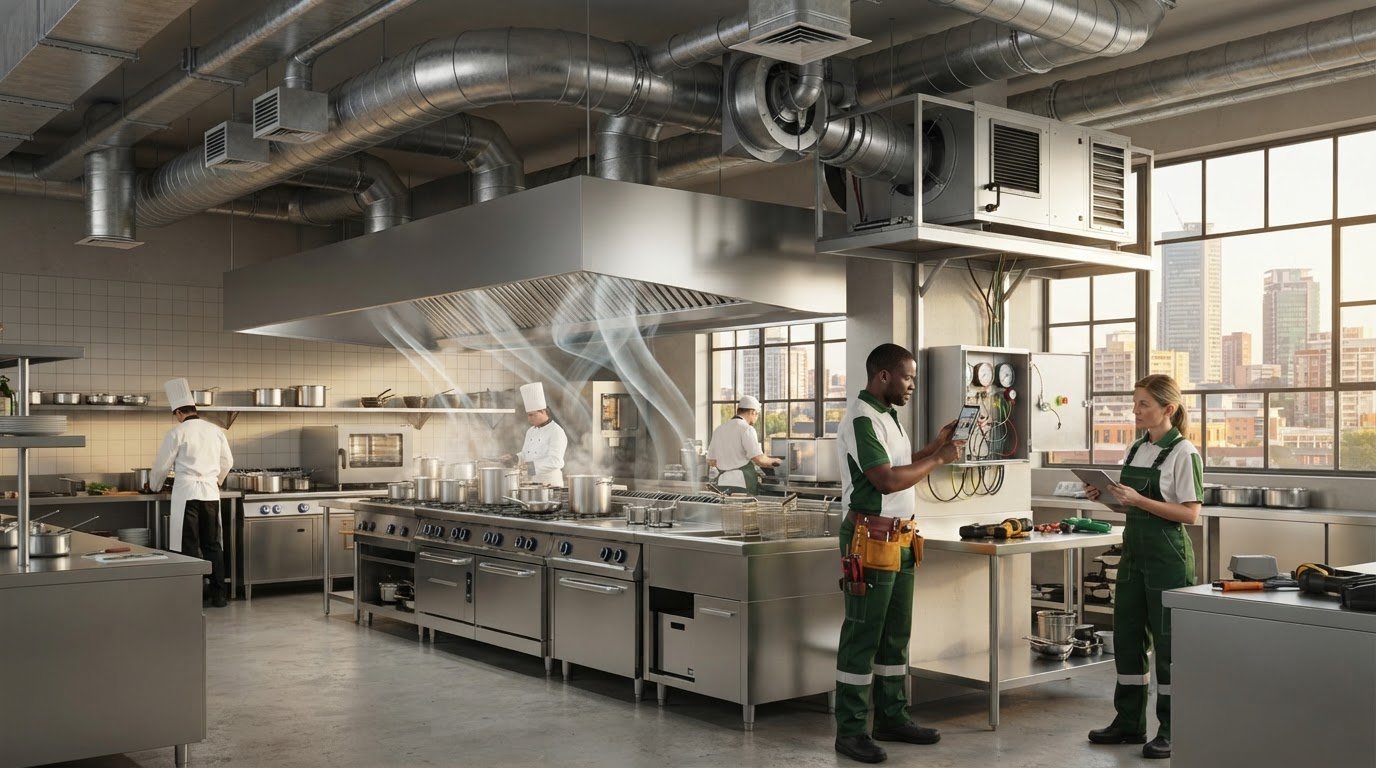
The biggest extraction fan isn’t necessarily the right answer for a hot, smoky kitchen. Restaurant ventilation works when extraction, make-up air and controls are considered together. Choosing restaurant ventilation systems Johannesburg operators can rely on therefore starts with the site, not a product description.
Kitchen heat, smoke and odours can affect staff comfort and the dining environment. It can also be difficult to judge the required airflow or spot missing components from a quote alone. Assessing the cooking equipment, kitchen layout and installation scope helps you compare proposals and reduce the risk of costly changes later.
This guide explains the main system components and site factors to discuss with a professional, then sets out practical criteria for comparing performance, maintenance and project scope. Engico serves Johannesburg and surrounding Gauteng locations, with industrial ventilation fans, louvres and air handling units among its confirmed HVAC offerings. Restaurant-specific extraction components may require a separate scope check, so confirm what each supplier will provide before deciding how to proceed.
Key Takeaways
- Assess extraction, replacement air and circulation as connected parts of a system, matched to your kitchen’s cooking activity and layout.
- Use the same kitchen layout and equipment schedule to compare restaurant ventilation systems Johannesburg proposals, including their airflow assumptions, equipment suitability and maintenance access.
- Before installation, document site conditions and agree responsibilities for access, duct routes, power interfaces and coordination with other building services.
- Ask suppliers to clarify which specialist kitchen-extraction components are included, and confirm applicable standards and approval requirements for your site.
- Engico’s confirmed HVAC capabilities include industrial ventilation fans, louvres and air handling units. Discuss your project to check what falls within scope.
What should a restaurant ventilation system in Johannesburg achieve?
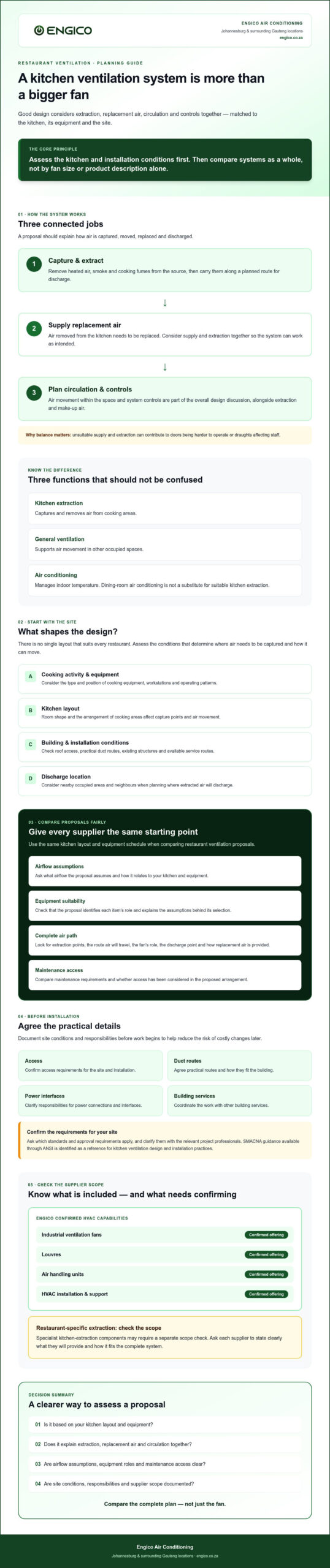
A restaurant ventilation system coordinates the removal of heated or contaminated air, the supply of replacement air and air movement within the space, according to the kitchen’s equipment and layout. For restaurant ventilation systems Johannesburg operators are considering, the aim is to manage cooking fumes, heat and odours while supporting workable conditions for staff. Assess the system as a whole rather than choosing by fan size or product description alone.
Kitchen extraction serves a different purpose from general dining-area ventilation and comfort air conditioning. Extraction captures and removes air from cooking areas; general ventilation supports air movement in other occupied spaces, whilst air conditioning manages indoor temperature. These functions may interact, but one doesn’t automatically replace the others. A dining-room air conditioner, for example, isn’t a substitute for suitable kitchen extraction.
The design depends on what happens in the kitchen. The type and position of cooking equipment, the room’s shape, the location of workstations and the restaurant’s operating patterns all affect where air needs to be captured and how it should move. A kitchen with changing cooking activity may have different needs from one where equipment operates steadily throughout service. This overview of kitchen ventilation systems can help explain the basic principles, but the site still needs a project-specific assessment.
How kitchen extraction and replacement air work together
Extraction draws heated air, smoke and cooking fumes away from the source and carries them along a planned route for discharge. Because air is removed, replacement air must also be considered. If supply and extraction aren’t balanced for the space, doors may be harder to operate, draughts may affect staff, or the system may not work as intended. The design should account for both what leaves the kitchen and what enters it.
Why Johannesburg site conditions matter
There’s no single layout that suits every Johannesburg restaurant. A site assessment should consider the building arrangement, roof access and practical duct routes, as well as nearby occupied areas and neighbours when locating discharge points. Existing structures and available service routes can affect what is feasible. Check these details before agreeing on equipment and installation responsibilities.
Which components should a Johannesburg restaurant ventilation proposal include?
A useful proposal explains how air will be captured, moved, replaced and discharged, rather than listing equipment without showing how the parts work together. When comparing restaurant ventilation systems in Johannesburg, ask for a clearly defined scope that connects the proposed components to your kitchen layout and cooking equipment.
Look for a description of the extraction points, the route air will travel through, the fan’s role and where extracted air will discharge. The proposal should also explain how replacement air is provided and how it is intended to work alongside extraction. A fan cannot be assessed in isolation: the route, installation conditions and air supply all affect the design. The SMACNA guidance available through ANSI offers a reference for industry best practices in kitchen ventilation design and installation.
Fans, louvres and air handling units
Fans move air through a system; louvres can form part of an air intake or discharge arrangement; and air handling units manage air as it is supplied to a space. These components have different roles, and the right selection depends on the required airflow, building layout, operating hours and installation conditions. The proposal should identify what each item does and explain the assumptions behind its selection, rather than relying on a generic equipment list. This warehouse ventilation design guide outlines broader airflow-planning principles for another building type.
Engico’s confirmed offering includes industrial ventilation fans, louvres and air handling units, alongside HVAC installation and support. Whether these items suit a restaurant project, and how they relate to specialist kitchen extraction, depends on the site assessment and confirmed scope.
Confirm specialist kitchen-extraction scope
Check explicitly whether the proposal includes the kitchen canopy, grease-rated ductwork and discharge arrangement, or whether these are assigned to another supplier. These items are distinct from general ventilation equipment. Ask for written confirmation of who is responsible for each component, how the work will coordinate with other building services, and who will confirm fire-safety components and any related approvals required for the specific site. Don’t assume an item is included simply because it appears in a drawing or was mentioned during a site discussion.
Before accepting a proposal, make sure its inclusions, exclusions and responsibilities are documented. To discuss your site and check which ventilation equipment may fall within Engico’s scope, review your ventilation requirements with Engico.
How can you compare restaurant ventilation systems in Johannesburg?
Compare proposals using the same kitchen layout, cooking-equipment schedule and operating pattern. If suppliers have priced different scopes or made different assumptions, their proposals aren’t directly comparable. For restaurant ventilation systems Johannesburg operators are assessing, ask each supplier to explain how its design responds to your kitchen and building, not just name the equipment selected.
Review the stated airflow assumptions and whether the proposed equipment suits the cooking processes and site constraints. Consider noise in occupied areas, access for inspection and maintenance, and how the system can be serviced over time. Ask suppliers to document exclusions, interfaces with other building services and who will coordinate specialist kitchen-extraction components. A proposal with a simpler equipment list may leave important responsibilities unclear, so compare the complete scope and support arrangements rather than equipment descriptions alone.
What technical evidence should a supplier provide?
Request the design basis, including the assumptions used for airflow, equipment selection and duct routing. Ask how the proposal accounts for the kitchen’s cooking activity and physical constraints, and what testing and commissioning process is included. Have the supplier explain how results will be checked and recorded, and verify that the proposed method suits the project. Clear written evidence makes it easier to understand what the system is designed to do and what remains outside the scope.
| Comparison criterion | Evidence to request | Questions for each supplier |
|---|---|---|
| Design basis | Layout, equipment schedule and stated assumptions | Are these based on the same kitchen and operating needs? |
| Airflow and equipment | Airflow assumptions and equipment schedule | How does the selection suit the cooking processes and site? |
| Noise and access | Equipment locations and maintenance-access details | Can equipment be accessed for inspection and servicing? |
| Scope and interfaces | Written inclusions, exclusions and responsibilities | Who coordinates specialist components and building-service interfaces? |
| Testing and support | Commissioning approach and follow-up support details | What will be tested, documented and supported after installation? |
How to assess local supplier capability
Ask about relevant experience with comparable commercial sites and the equipment categories proposed. Confirm who coordinates installation, commissioning and follow-up support, and whether specialist work is assigned to another provider. Engico’s confirmed HVAC offering includes industrial ventilation fans, louvres and air handling units, but restaurant-specific extraction scope should be confirmed directly. Ask which components it can supply or assess for your project, and whether specialist subcontracting is needed.
What should you check before installing restaurant ventilation in Johannesburg?
Reduce the risk of scope gaps by working through the project in sequence: document the kitchen’s needs, survey the site, confirm the design, then agree who is responsible for each part. This gives suppliers a shared brief and helps identify constraints before installation begins. For restaurant ventilation systems Johannesburg businesses are planning, verify current standards, municipal approval needs and landlord requirements for the specific property with qualified professionals. These depend on the site and proposed work, so don’t assume one approval pathway applies everywhere.
Prepare for a site assessment
Bring together the information an assessor needs to understand how the kitchen operates. Useful preparation includes:
- Kitchen plans and details of the cooking equipment, including its position.
- Operating hours and any known issues with airflow, heat, smoke or odours.
- Information about existing ductwork, access restrictions and possible discharge locations.
- Details of relevant power interfaces and other building services that may affect the installation.
Ask the assessor to record assumptions, physical constraints and matters requiring specialist review. A roof route that appears straightforward on a plan, for example, may need further checking for access or coordination with other services. Clear notes help turn site observations into a design that can be reviewed and priced consistently.
Agree installation, commissioning and compliance responsibilities
Before work starts, confirm in writing who supplies and installs each component, who coordinates interfaces, and who tests and commissions the completed system. Establish which commissioning records and operating guidance will be handed over, and what follow-up support is included. If separate providers are involved, identify the lead contact and how responsibilities are divided so that important tasks aren’t left between scopes.
Plan for maintenance at the design stage, not just after handover. Check that equipment and relevant parts of the system can be accessed for inspection and servicing, and clarify what routine care is expected. Engico’s commercial HVAC maintenance guidance offers a useful prompt for considering maintainability alongside equipment selection.
Engico supplies, installs and maintains HVAC equipment, including industrial ventilation fans, louvres and air handling units. Restaurant-specific extraction components and responsibilities should be confirmed for each project. Discuss your site and ventilation requirements with Engico to clarify which equipment and project elements may fall within its scope.
Choosing a Johannesburg ventilation partner and planning your next step
A sound decision rests on a complete, documented design that suits both the kitchen and the building. Compare what the supplier has confirmed it can provide with the specialist kitchen-extraction work your project may require, and make sure the division of responsibilities is clear before you proceed. This matters especially when separate providers need to coordinate equipment, installation and handover.
Engico serves Johannesburg and surrounding Gauteng locations, supplying, installing and maintaining HVAC equipment. Its confirmed offering includes industrial ventilation fans, louvres and air handling units. These capabilities may be relevant to a wider restaurant project, but the specific equipment and scope must be confirmed for your site. Ask directly whether specialist kitchen-extraction work is included or needs to be arranged separately.
Questions to ask Engico before requesting a proposal
Prepare a concise project brief so the discussion can focus on your kitchen’s needs. Include the restaurant’s location, cooking equipment, operating hours, site constraints and main concern, such as heat, fumes or odours. Then ask:
- Which of Engico’s confirmed equipment and HVAC services may suit this project?
- Does the proposed scope cover restaurant-specific extraction, or are specialist components excluded?
- If other providers are involved, who will coordinate the interfaces and confirm responsibilities?
Clear answers help you understand whether the proposed scope addresses the whole project or only selected equipment. Request inclusions and exclusions in writing before comparing the proposal with alternatives.
How ongoing maintenance supports system reliability
Ask what routine inspections and servicing the proposed equipment may need, who is responsible for each task, and how maintenance access will be preserved. Confirm what records and operating guidance will be provided at handover, and clarify which provider to contact for ongoing HVAC maintenance or service. Planning these details early helps prevent uncertainty after installation. For further reading, see this commercial HVAC maintenance guide for Sunninghill.
For restaurant ventilation systems Johannesburg operators are assessing, the practical next step is to share the site details and establish which equipment and project elements the supplier can cover. Contact Engico to discuss your Johannesburg restaurant ventilation project and clarify the relevant scope, including any specialist extraction requirements.
Take the next step towards a well-planned ventilation system
A strong proposal for restaurant ventilation systems Johannesburg businesses can use should address the kitchen and building as one site-specific project. Compare how extraction and replacement air are planned, check that equipment suits the kitchen’s needs, and get inclusions, exclusions and responsibilities documented before installation.
Engico serves Johannesburg and surrounding Gauteng locations, with confirmed capabilities in industrial ventilation fans, louvres, air handling units, HVAC installation and building management system integration. Specialist kitchen-extraction components may sit outside these offerings, so clarify the required scope and responsibilities for your project directly.
Share your site details and main ventilation concerns to start a practical discussion. Contact Engico to discuss your restaurant ventilation requirements. With a clear brief and confirmed scope, you can move towards an informed next step.
Frequently Asked Questions
What does a restaurant ventilation system include?
A restaurant ventilation system brings together air capture, extraction, replacement air and, where needed, air handling and controls. Depending on the kitchen and project scope, a proposal may cover extraction points, duct routes, fans and discharge arrangements. Specialist kitchen components, such as canopies, grease-rated ductwork or fire-protection systems, should be listed separately and confirmed in writing. Check that the proposal explains how its components work together for the specific site.
How do I choose a restaurant ventilation system in Johannesburg?
Choose based on a site assessment, not a product description alone. Provide suppliers with the kitchen layout, cooking equipment and operating pattern, then compare their airflow assumptions, equipment selection, maintenance access, exclusions and responsibilities. The phrase restaurant ventilation systems Johannesburg covers projects with different building constraints, so ask for a design suited to your premises. Engico serves Johannesburg and surrounding Gauteng locations, including Pretoria, Centurion, Midrand, Sandton, Randburg, Roodepoort, Fourways, Sunninghill, Waterfall, Woodmead, Menlyn, Farie Glen, Silverton, Waterkloof, Gezina, Doringkloof, Hyde Park and Gauteng Province.
Does a restaurant kitchen need make-up air?
Replacement, or make-up, air should be considered whenever kitchen air is extracted. Removing air without planning how it will be replaced can affect comfort and the intended operation of the system. The appropriate provision depends on the kitchen, extraction design and building conditions. Ask the designer to explain how replacement air is accounted for, where it will enter and how it relates to the proposed extraction, rather than assuming the room will draw air in adequately.
Can air conditioning replace kitchen extraction?
No. Air conditioning and kitchen extraction perform different functions. Air conditioning manages indoor temperature, while extraction removes heated or contaminated air from cooking areas. Cooling a kitchen doesn’t, by itself, capture and discharge cooking fumes, smoke or odours. A proposal should treat these needs distinctly and explain how comfort air conditioning interacts with ventilation. Engico supplies air conditioning systems and ventilation equipment, but confirm directly which equipment and specialist kitchen-extraction work are included in a particular project.
What should a restaurant ventilation quote include?
A clear quote should describe the design basis, airflow assumptions, proposed equipment and how the system relates to the kitchen layout and cooking schedule. Check for duct routes, discharge arrangements, replacement-air provisions, maintenance access and any testing or commissioning records included. It should also state exclusions, interfaces with other building services and who is responsible for specialist components. Ask suppliers to price the same documented scope so you can compare proposals consistently.
Which Johannesburg requirements apply to restaurant kitchen ventilation?
Requirements depend on the site and proposed work, so confirm current standards, municipal approvals and landlord conditions with qualified professionals before installation. South African references to discuss include SANS 1850:2014 for commercial kitchen ventilation and Regulation R638 of 2018, which covers hygiene requirements for food premises, including a Certificate of Acceptability. Also ask whether City of Johannesburg building, public health or fire-related requirements affect your project. Don’t assume the same approvals apply to every property.
Recent Comments