
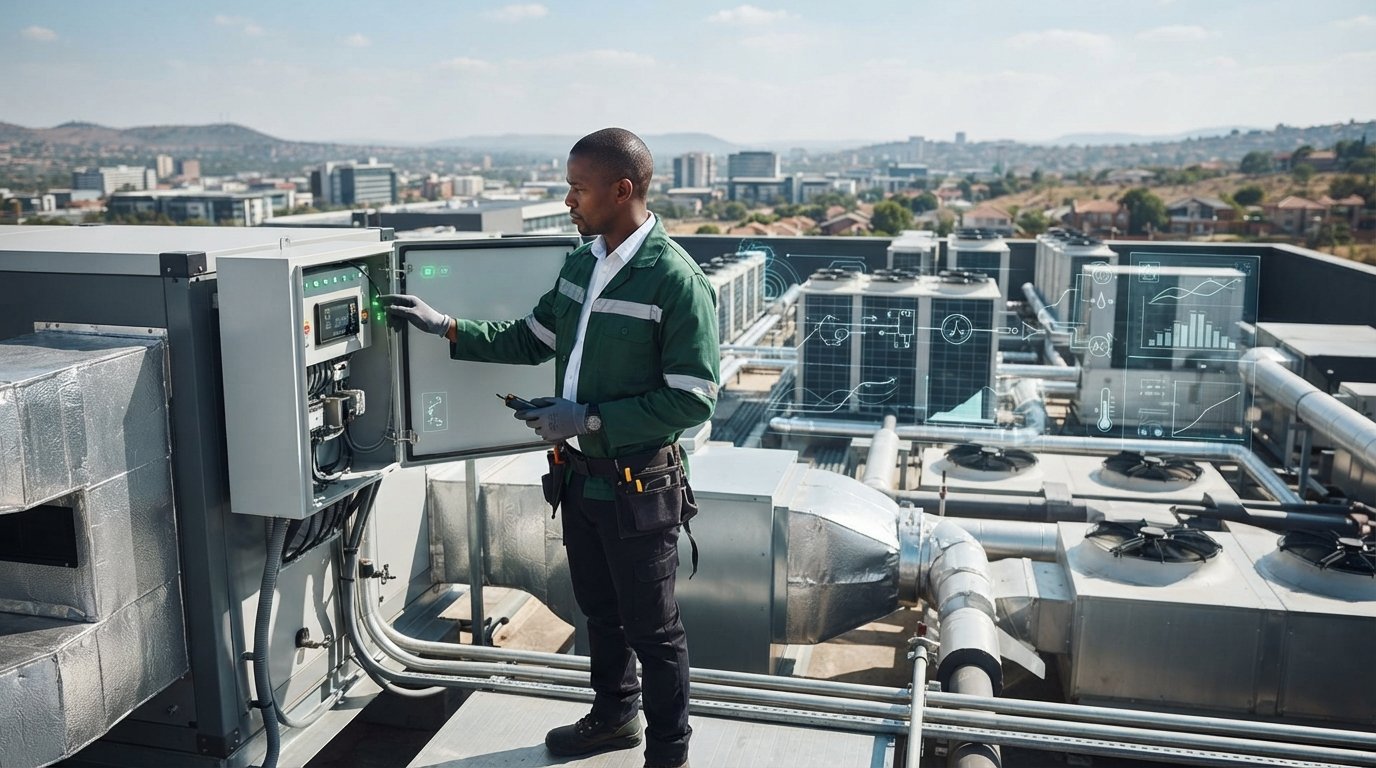
HVAC operations account for up to 60% of a commercial property’s total electricity consumption in South Africa. When paired with the City of Tshwane’s 8.8% municipal tariff increase and the summer heat trapped within the Moot valley, uncoordinated cooling plants quickly erode operating margins. Implementing building management system HVAC optimization Gezina commercial facilities rely on transforms passive machinery into resilient, demand-responsive infrastructure.
Balancing tenant comfort against erratic voltage fluctuations and steep utility rates is a familiar headache for local facility managers, particularly along Steve Biko Road’s commercial and medical corridors. You shouldn’t have to compromise stable indoor conditions to maintain control over operational overheads. Discover how building management system HVAC optimisation reduces commercial energy expenditure, stabilises indoor climate control, and protects facilities across Gezina. This guide examines the open communication protocols, automated setpoint controls, and plant monitoring strategies that slash peak demand whilst securing long-term equipment reliability.
Key Takeaways
- Learn how automated scheduling and demand-controlled ventilation eliminate wasted run-time across central chillers and ducted systems.
- Discover how synchronised climate controls counteract severe diurnal temperature swings in Pretoria’s Moot basin to maintain stable indoor conditions.
- Understand how targeted building management system HVAC optimization Gezina facilities adopt slashes municipal peak demand charges without requiring complete equipment replacements.
- Compare open communication protocols such as BACnet and Modbus against closed systems to protect your facility against restrictive vendor lock-in.
- Explore how pairing intelligent supervisory controls with routine maintenance for air handling units reliably extends mechanical plant lifespans.
What Is Building Management System HVAC Optimisation in Commercial Properties?
A building management system (BMS) acts as the central nervous system for commercial climate plant. Rather than relying on disconnected machinery, it unites ducted air conditioning systems, air handling units, and ventilation fans into a unified operational network. Optimisation goes beyond simple scheduling; it actively harmonises sensor inputs, variable-speed drives (VSDs), and motorized dampers to match thermal output with real-time occupancy. For property owners investing in building automation systems, this dynamic adjustment ensures precise environmental control whilst curbing unnecessary kilowatt-hour consumption.
Commercial facilities in the Moot valley face distinct microclimatic pressures. Trapped between the Magaliesberg ridge and central Pretoria, daytime ambient conditions can climb past 34°C, only to drop sharply during clear winter evenings. Achieving sustainable building management system HVAC optimization Gezina commercial sites require means orchestrating heating and cooling plants to automatically adjust before these ambient temperature swings strain mechanical components.
The Core Components of an Integrated BMS Architecture
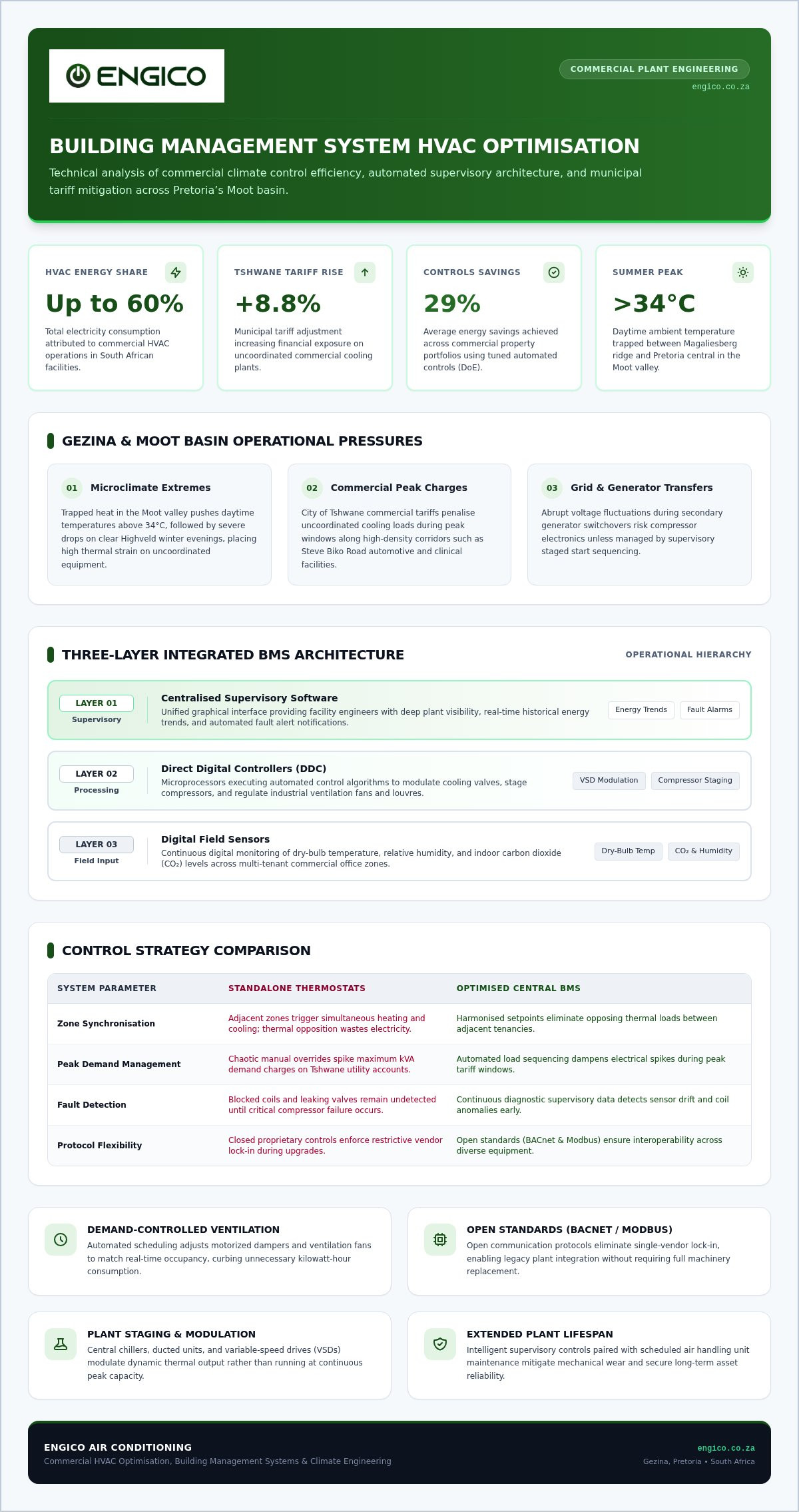
A fully integrated architecture relies on three distinct layers working in unison:
- Field Sensors: Digital probes continuously monitor dry-bulb temperature, relative humidity, and indoor carbon dioxide levels across different office zones.
- Direct Digital Controllers (DDC): Microprocessors receive incoming environmental data, executing automated control algorithms to modulate cooling valves, stage compressors, and adjust industrial ventilation fans and louvers.
- Centralised Supervisory Software: A unified graphical interface gives facility engineers deep visibility into plant performance, historical energy trends, and automated fault alerts.
Why Standalone Thermostats Fail in Commercial Facilities
Decentralised control methods consistently degrade commercial equipment. When multi-tenant buildings rely on standalone wall controllers, adjacent units frequently end up competing against one another. One office space calls for cooling whilst an adjoining boardroom activates heating, wasting substantial electrical power through simultaneous thermal opposition.
Manual adjustments by occupants cause erratic temperature swings that spike peak maximum demand charges on Tshwane municipal utility accounts. Unmonitored direct expansion systems also conceal early mechanical failures. Without continuous BMS supervisory data, minor issues like blocked cooling coils, drifting calibration sensors, or leaking bypass valves go unnoticed until the compressor fails entirely. Centralised building management system HVAC optimization Gezina facilities implement removes human guesswork, substituting chaotic manual overrides with coordinated, data-backed operational discipline.
How HVAC Optimisation Solves Gezina Operational and Climate Challenges
Operating commercial property across Gezina involves distinct financial and operational hurdles. The suburb combines high-traffic automotive dealerships along Steve Biko Road, retail shopping centres, and multi-tenant clinical suites near the Steve Biko Academic Hospital corridor. Because the City of Tshwane structures commercial tariffs around high peak demand charges, running uncoordinated cooling machinery during peak tariff windows severely inflates monthly utility accounts. A U.S. Department of Energy study on building controls established that properly tuned automated controls achieve average energy savings of 29% across commercial portfolios. Implementing building management system HVAC optimization Gezina facilities need turns continuous electricity drains into predictable, controlled operating expenses.
Grid instability adds another operational burden. When power transfers between municipal supply and secondary generators, abrupt voltage swings and sudden load steps risk damaging delicate compressor electronics. BMS supervisory controls sequence equipment restarts in orderly stages, avoiding current spikes that trip generator breakers.
Adapting to Pretoria Highveld Temperature Shifts
Pretoria’s Highveld weather swings between crisp winter mornings and sweltering summer afternoons, requiring dynamic plant responses rather than static setpoints. Tailored building management system HVAC optimization Gezina properties adopt leverages smart economiser cycles to exploit these shifts. During cool early mornings, the system opens motorized fresh air dampers to flush the building, delaying mechanical cooling cycles until ambient temperatures rise.
As midday solar radiation strikes northern and western facades, dynamic BMS algorithms modulate chilled water valves and variable refrigerant flow to balance thermal loads. Pre-cooling spaces before municipal peak tariff windows allows the plant to throttle down during expensive rate intervals without sacrificing tenant comfort.
Safeguarding Sensitive Commercial and Healthcare Environments
Medical consultancies and clinical laboratories along Gezina’s healthcare strip cannot tolerate temperature drift or air quality lapses. Air handling units linked to supervisory controllers maintain precise air-exchange rates and positive room pressurisation to protect sterile spaces. These controllers balance supply and extract air whilst actively managing relative humidity to curb mould growth and electrostatic hazards.
If fan drive belts slip or filter pressure drops exceed safe thresholds, the system immediately dispatches digital alerts to facility teams. Consulting with specialists experienced in building management system integration ensures commercial plants remain fully compliant with indoor environmental safety standards.
Key Strategies for Building Management System HVAC Optimisation
Effective plant automation requires moving beyond simple on-off timers. Real energy reductions emerge when dynamic supervisory algorithms adjust mechanical effort to match instantaneous building demand. Integrating open communication infrastructure based on the ASHRAE BACnet protocol standard allows central plant hardware, variable refrigerant systems, and air distribution ductwork to communicate seamlessly across a single network. Applying comprehensive building management system HVAC optimization Gezina commercial sites need unlocks lower operational overheads through three core control interventions.
Dynamic Scheduling and Variable Speed Drive Control
Constant-speed fans and circulating pumps waste immense electrical energy under partial load conditions. Integrating variable speed drives (VSDs) on supply fans modulates air volume dynamically based on duct static pressure sensors. Because fan power follows affinity laws, reducing motor speed by 20% can lower power consumption by nearly 50%.
Pairing VSD modulation with optimal morning start algorithms prevents large chiller and compressor surges during peak electrical rate windows. Exploring advanced smart HVAC control for commercial buildings allows facility managers to shift heavy thermal loads off-peak whilst preserving indoor comfort before business hours begin.
Demand-Controlled Ventilation and Economiser Sequencing
Conditioning unneeded outside air during hot Highveld afternoons heavily penalises operating efficiency. Demand-controlled ventilation (DCV) utilises indoor carbon dioxide sensors to position fresh air dampers precisely according to actual room occupancy:
- Occupancy Modulation: Dampers close to code-mandated minimums when rooms are empty, expanding fresh air intake only as CO₂ levels rise.
- Free-Cooling Economisers: When outdoor ambient conditions drop below internal return air temperatures, the BMS opens motorized dampers to pull in unconditioned night air, resting primary compressors.
- Industrial Louvers: Properly engineered industrial ventilation fans and louvers maintain balanced air intake velocity while preventing rainwater ingress during sudden Highveld summer thunderstorms.
Predictive Fault Detection and Equipment Diagnostics
Mechanical wear rarely happens overnight. Direct digital controllers continuously track operating differentials, flagging dirty air filters, failing actuators, or drifting thermal expansion valves before catastrophic breakdowns occur. Automatic run-hour equalisation routines rotate duty cycles across multiple ducted compressor units and pumps, preventing premature wear on isolated machines.
Implementing targeted building management system HVAC optimization Gezina facilities rely on converts reactive crisis management into structured preventative care. Combining automated diagnostic telemetry with proactive commercial HVAC maintenance ensures cooling plants operate at peak thermodynamic efficiency throughout their intended operational lifecycle.
Evaluating BMS HVAC Options: Legacy Upgrades vs Modern Protocols
Navigating commercial plant upgrades requires a calculated balance between upfront capital expenditure and long-term operational adaptability. Many commercial properties in Gezina operate on aged pneumatic controls, isolated direct-expansion systems, or outdated proprietary electronics. When planning building management system HVAC optimization Gezina facility executives must decide whether to execute full mechanical replacements or retrofit intelligent communication gateways onto existing machinery. Selecting open, non-proprietary standards ensures mechanical plant remains adaptable as operational requirements evolve.
BACnet and Modbus Protocols vs Proprietary Systems
Proprietary automation systems lock property owners into single-supplier servicing agreements, inflating ongoing maintenance costs and restricting component choices. Modern mechanical automation prioritises open, interoperable protocols:
- BACnet (IP and MS/TP): Unifies diverse equipment, allowing rooftop package units, ceiling cassettes, and central chillers from different manufacturers to communicate on a shared network.
- Modbus Integration: Bridges power sub-meters and variable speed drives directly into the central supervisory dashboard for accurate energy accounting.
- Long-Term Flexibility: Open architectures allow facility teams to source replacement field controllers from competitive suppliers without overhauling core software.
Retrofitting Existing Mechanical Plant vs Full Replacement
A full plant tear-out isn’t always the most economical path, especially if heavy chillers, ductwork, and structural air handling units remain mechanically sound. Integrating digital direct controllers, electronic expansion valves, and intelligent dampers can restore precise control to older air handling infrastructure at a fraction of the cost of new equipment.
Engineering assessments must verify compressor compression ratios, coil cleanliness, and structural fan integrity before connecting advanced automation. Retrofitting intelligent controls onto mechanically worn equipment will not resolve fundamental thermodynamic inefficiencies. Phased cutovers enable technical specialists to install and commission DDC panels incrementally during off-peak hours, avoiding operational downtime for commercial tenants and healthcare suites. To assess whether your equipment is suitable for protocol migration or targeted retrofits, request a mechanical building assessment from our engineering team.
How Engico Delivers Integrated HVAC and BMS Solutions in Gezina
Bridging physical mechanical machinery with digital supervisory automation requires a unified engineering approach. Many building operators face friction when control programmers and mechanical contractors work in isolation, leading to miscalibrated valves, sensor communication drops, and uncoordinated plant logic. Engico resolves this disconnect by uniting mechanical HVAC supply, equipment installation, and direct digital integration under one disciplined scope of work. Executing building management system HVAC optimization Gezina commercial facilities demand ensures your mechanical assets and automated algorithms function as a single, cohesive unit.
Our engineering teams focus on practical, measurable outcomes rather than theoretical models. Grounded experience across Pretoria, Centurion, and wider Gauteng commercial hubs allows us to tailor automation sequences to local grid behaviour, municipal demand structures, and regional ambient realities.
Comprehensive Mechanical and Automation Capabilities
We supply, install, and commission complete commercial climate systems tailored to the architectural profiles found throughout the Moot valley:
- Direct-Expansion Cooling: Expert deployment of multi-split, ceiling cassette, and heavy-duty ducted air conditioning systems configured for multi-zone commercial applications.
- Air Handling and Industrial Air Movement: Turnkey balancing of air handling units, industrial ventilation fans, and weather-rated louvers designed to maintain precise airflow and static pressure.
- Open Protocol Supervisory Integration: In-house integration of BACnet and Modbus controllers, pairing field sensors, motorized actuators, and supervisory dashboards for transparent operational oversight.
Structured Maintenance and Ongoing Performance Support
Initial commissioning is only the baseline for long-term plant efficiency. Over time, mechanical components encounter wear, sensor calibrations drift, and cooling coils collect atmospheric dust, slowly degrading thermodynamic performance. Our structured post-installation service routines protect your capital investment through continuous verification. Technicians inspect actuator travel, verify temperature and pressure sensor accuracy, clean heat exchangers, and test safety interlocks across all ducted machinery.
Subscribing to professional HVAC maintenance services ensures automated sequencing preserves lower kilowatt-hour metrics year after year. Partnering with Engico provides dependable building management system HVAC optimization Gezina property owners and facility managers can rely on to safeguard indoor air quality, meet regulatory demands, and secure predictable lifecycle costs.
Securing Long-Term Commercial HVAC Efficiency in Gezina
Operating commercial facilities in the Moot valley requires a shift away from reactive repairs and disconnected controls. Unifying ducted air conditioning, air handling units, and industrial ventilation into an automated open-protocol network provides the most reliable defence against rising municipal tariffs and grid instability. Strategic building management system HVAC optimization Gezina property owners implement transforms vulnerable cooling plant into a resilient, cost-efficient asset.
With an established engineering footprint across Pretoria, Gezina, and greater Gauteng, Engico combines comprehensive mechanical HVAC supply with specialised supervisory automation. Our specialists ensure your mechanical plant, air handlers, and motorized louvers operate with balanced precision, protecting tenant comfort whilst keeping kilowatt-hour consumption strictly controlled. Speak to Engico Air Conditioning to optimise your commercial HVAC building management system and secure a dependable, high-performing climate strategy for your facility.
Frequently Asked Questions
How much energy can building management system HVAC optimisation save in a commercial building?
Commercial facilities typically achieve energy reductions between 20% and 30% through coordinated building automation. Because heating and cooling machinery accounts for up to 60% of commercial electricity usage in South Africa, eliminating operational waste yields substantial utility savings. Centralised systems lower consumption by dynamically aligning plant output with actual zone occupancy, trimming supply fan speeds, and scheduling pre-cooling cycles before expensive peak municipal tariff windows take effect.
Can an older commercial building in Gezina be retrofitted with a modern building management system?
Yes, older commercial properties across Gezina can be successfully retrofitted without replacing sound mechanical infrastructure. Specialized engineers install open-protocol direct digital controllers, motorized control valves, and electronic actuators directly onto existing ducted systems and air handling units. This phased modernisation provides the targeted building management system HVAC optimization Gezina property owners need to lower operating costs without incurring the capital expense of total plant replacement.
What is the primary difference between a building management system and a programmable thermostat?
A programmable thermostat controls a single air conditioning unit using basic time schedules and local temperature readings, whereas a BMS synchronises the entire facility. Building management platforms process inputs from carbon dioxide sensors, duct static pressure probes, and ambient weather stations across multiple zones. They execute supervisory control algorithms that prevent simultaneous heating and cooling between adjacent rooms, which standalone wall controllers can’t resolve.
How does a building management system handle load shedding and power outages in Pretoria?
A BMS manages grid disruptions by executing automated pre-cooling strategies and controlled equipment staging during power transitions. When transitioning between municipal supply and secondary generators, supervisory controllers stage compressor start-ups sequentially to prevent severe inrush currents from tripping breakers. Automated load-shedding routines drop non-essential ventilation zones first, protecting primary chillers from damaging voltage fluctuations common across Tshwane’s municipal grid.
What communication protocols are best for commercial HVAC building management integration?
Open, non-proprietary standards like BACnet and Modbus provide the most reliable framework for commercial climate automation. BACnet allows rooftop units, air handling systems, and multi-split air conditioners from different manufacturers to interoperate seamlessly across a shared network. Modbus links energy sub-meters and variable speed drives to central dashboards. Adopting open standards prevents vendor lock-in and eliminates expensive proprietary software fees.
How often should building management system HVAC sensors and dampers be recalibrated?
Field sensors, motorized actuators, and damper linkages should be inspected and recalibrated every six to twelve months. Highveld dust and seasonal thermal expansion cause temperature probes and carbon dioxide sensors to drift over time. Periodic verification of sensor accuracy and physical damper travel ensures automated sequences execute correctly, safeguarding indoor air quality and preventing energy penalties caused by miscalibrated controls.
Will HVAC building automation work with existing rooftop package units and split systems?
Yes, modern supervisory platforms integrate directly with standard rooftop package units, ducted systems, and ceiling cassettes. Dedicated communication gateways bridge decentralised direct-expansion units into the central supervisory network. Implementing this integrated building management system HVAC optimization Gezina properties benefit from turns fragmented, unmonitored air conditioning units into a unified, demand-responsive cooling infrastructure without requiring new cooling machinery.
Recent Comments