
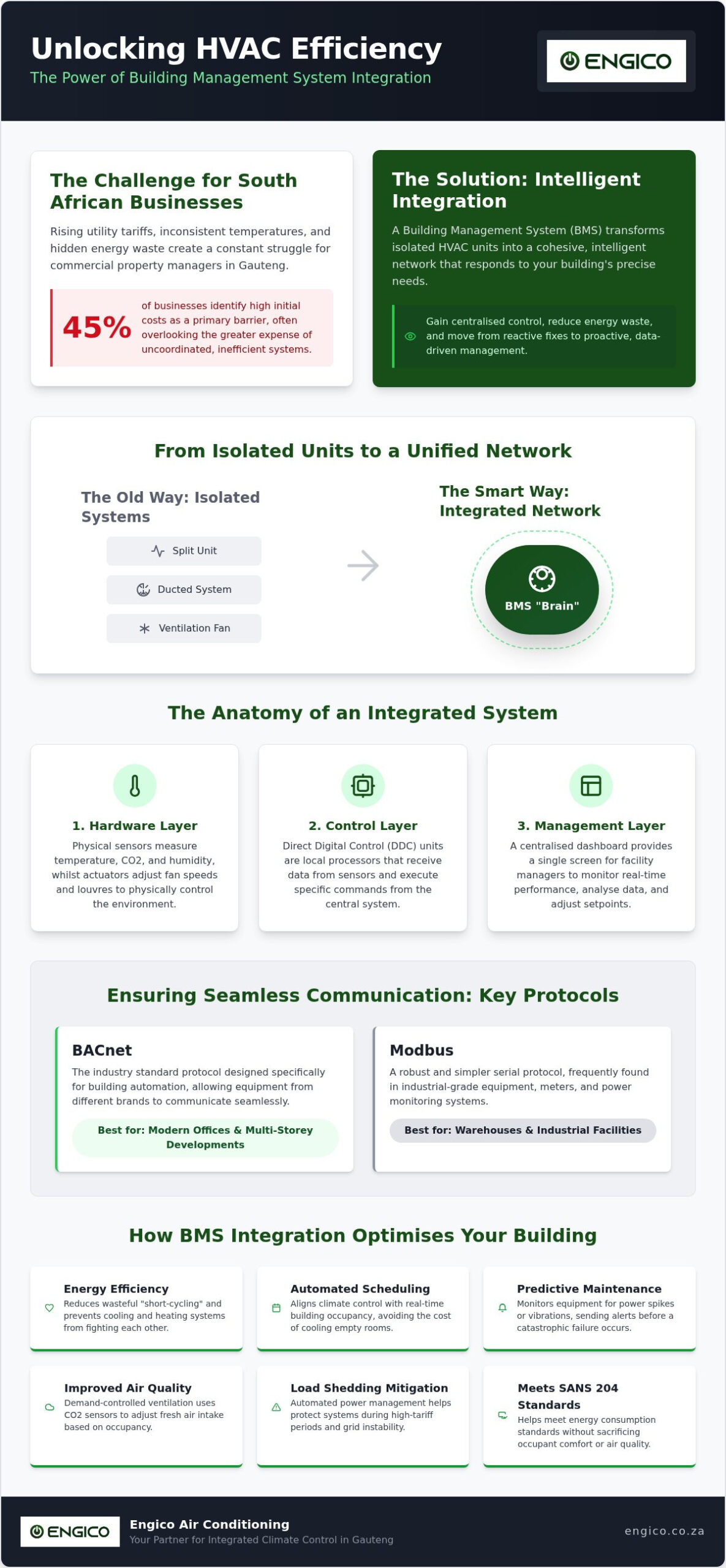
Over 45% of South African businesses identify high initial costs as the primary barrier to energy efficiency, yet the real expense often lies in the hidden waste of uncoordinated systems. You’ve likely felt the pressure of rising utility tariffs whilst managing tenant complaints about inconsistent office temperatures. It’s a common frustration in the Gauteng commercial sector, where balancing comfort with strict energy demand limits feels like a constant struggle. Implementing building management system integration HVAC protocols allows you to bridge this gap, transforming isolated units into a cohesive, intelligent network that responds to your building’s specific needs.
This guide explores how moving beyond manual adjustments can significantly lower your monthly bills and improve operational reliability across multiple floors. We’ll examine how centralised dashboards and predictive maintenance alerts help you meet SANS 204 energy consumption standards without sacrificing indoor air quality. By the end of this article, you’ll understand how a methodical approach to climate control can protect your equipment from catastrophic failure and ensure long-term value for your commercial property. Discover how to turn your HVAC system into a strategic asset that manages peak loads with precision and quiet confidence.
Key Takeaways
- Learn how connecting your climate control hardware to a central digital “brain” allows sensors and controllers to communicate effectively for precise regulation.
- Discover how building management system integration HVAC protocols reduce energy waste by aligning cooling schedules with actual building occupancy and air quality.
- Understand how to mitigate the impact of load shedding and high peak-tariff periods in Gauteng through automated power management and system protection.
- Identify if your current ducted or split units are ready for automation by conducting a thorough audit of existing hardware and connectivity ports.
- Recognise why a methodical approach that combines mechanical reliability with digital integration is essential for long-term system performance and durability.
What is Building Management System Integration for HVAC?
Building management system integration HVAC represents the transition from isolated mechanical units to a unified digital network. At its core, this process connects your Heating, Ventilation, and Air Conditioning hardware to a centralised “brain” that monitors and manages environmental conditions in real-time. This isn’t merely a remote control. It’s a sophisticated “handshake” where sensors, controllers, and software exchange data to regulate airflow and temperature with precision. In the South African commercial sector, this connectivity is becoming the standard for any facility aiming to balance tenant comfort with strict energy demand limits.
The Core Components of an Integrated System
A successful integration relies on three distinct layers of technology working in unison. The hardware layer consists of physical sensors that measure temperature, CO2, and humidity, alongside actuators that physically adjust louvers or fan speeds. These components provide the raw data and the physical response needed to maintain a stable environment. The middle layer features controllers, specifically Direct Digital Control (DDC) units. These are the local processing units that receive data from sensors and execute specific commands from the central server. Finally, the user interface provides a dashboard where facility managers in Johannesburg or Pretoria can monitor real-time performance and adjust setpoints from a single, organised screen.
Common Communication Protocols: BACnet vs Modbus
For different components to “speak” to one another, they must use a shared language or protocol. Protocol compatibility is often the first hurdle in any building management system integration HVAC project. BACnet is the industry standard for interoperability, designed specifically to allow equipment from different HVAC brands to work together seamlessly. It’s the preferred choice for most modern office developments. In contrast, Modbus is a robust, simpler protocol frequently found in industrial-grade equipment and power monitoring systems. Whether you are managing warehouse ventilation design or a multi-storey office block, selecting the right protocol ensures that your automation is reliable and scalable for future upgrades.
How BMS Integration Optimises HVAC Performance
Efficient HVAC management requires more than just high-quality hardware. It demands precise coordination between every component in the building. Building management system integration HVAC allows for a level of operational oversight that manual systems cannot match. Unlike generic remote-access tools, true integration involves the physical synchronisation of air handling units (AHUs) and industrial ventilation fans with the central logic of the building. This methodical approach ensures that every motor and actuator works in harmony, rather than in isolation.
Automated scheduling is a primary benefit of this coordination. Whilst many buildings rely on basic timers, a truly integrated system uses real-time occupancy data to adjust setpoints dynamically. This prevents the waste of cooling empty boardrooms or corridors. Furthermore, demand-controlled ventilation uses CO2 sensors to adjust AHU speeds based on the number of people in a space. This ensures fresh air is provided exactly when needed. By monitoring motor behaviour, the system can also identify erratic vibrations or power spikes. This predictive maintenance allows facility managers to address issues before they lead to a total system failure.
Energy Efficiency and Operational Savings
Integration is a powerful tool for reducing “short-cycling” in split and ducted systems. Short-cycling occurs when a unit turns on and off too frequently, which spikes energy demand and wears out the compressor. A BMS manages these cycles to maintain efficiency. It also identifies “energy leaks” where cooling and heating systems might be fighting each other in different zones. Studies in commercial building automation suggest that integrated sensors can reduce energy consumption by up to 30% through more precise environmental control. To maintain these gains, combining professional HVAC maintenance with BMS monitoring ensures your system remains calibrated for peak performance.
Enhanced Occupant Comfort and Air Quality
Maintaining a consistent environment across large Sandton office floorplates is a significant challenge. Temperature gradients can lead to “hot spots” that trigger tenant complaints. Integrated systems use load balancing to distribute the cooling effort across multiple units, ensuring a stable climate throughout the building. This control extends to humidity management, which is vital for preventing mould growth and protecting sensitive electronic equipment. For industrial sites, linking ventilation fans and louvers to the BMS allows for automated smoke clearance and air purification, creating a safer and more productive workspace for all occupants.
BMS HVAC Strategy in the South African Context
Operating commercial property in South Africa requires a strategy that goes beyond standard efficiency. The local energy landscape is defined by instability, making building management system integration HVAC a critical tool for equipment protection. When load shedding occurs, an unmanaged HVAC system faces the risk of severe power surge damage upon the return of the grid. A sophisticated BMS provides a controlled shutdown and restart sequence, ensuring that compressors and air handling units aren’t subjected to sudden electrical stress. This methodical approach preserves the lifespan of expensive hardware whilst maintaining operational continuity.
Financial savings in Gauteng are often driven by peak shaving. Municipal electricity tariffs spike during specific morning and late-afternoon windows. By using BMS logic, facility managers can pre-cool a building during lower-tariff periods and reduce HVAC output during expensive peaks. This is particularly effective in the Highveld climate of Pretoria and Johannesburg, where diurnal temperature swings are extreme. The system can manage the rapid transition from cold winter mornings to hot afternoons without manual intervention. Additionally, syncing high-consumption cooling periods with peak solar generation allows businesses to maximise their investment in renewable energy and improve off-grid resilience.
Resilience for Critical Infrastructure
Certain environments cannot afford even a brief fluctuation in temperature. Maintaining HVAC for data centres in South Africa requires 24/7 BMS monitoring to prevent hardware overheating. The integration allows for redundancy logic; if a primary cooling unit fails, the system automatically engages a backup unit and sends a real-time alert to the facility team. This fail-safe mechanism is essential for protecting sensitive server infrastructure from catastrophic heat spikes.
Local Compliance and Standards
Modern developments must align with strict energy demand limits set by SANS 204. Implementing smart HVAC control for commercial buildings is often the most direct path to meeting these legal requirements and achieving ESG targets. A BMS provides the necessary data logging to document energy savings, which is vital for securing Green Building Council South Africa (GBCSA) certifications. This transparency builds trust with stakeholders and demonstrates a commitment to sustainable property management in a challenging economic environment.
Implementation Guide: Is Your Building Ready for Integration?
Transitioning to a smarter facility is a methodical process that requires more than just software. Building management system integration HVAC is not a “plug and play” solution; it’s a technical evolution that begins with a thorough audit of your existing assets. You must first assess the physical condition of your ducted systems, air handling units, and split units. A system with mechanical deficiencies, such as worn bearings or refrigerant leaks, won’t become efficient simply because it’s connected to a digital dashboard. Reliability at the mechanical level is the prerequisite for successful automation.
Connectivity is the next critical hurdle. We must determine if your current equipment possesses the necessary communication ports, such as RS485 or Ethernet. Without these physical connection points, the hardware cannot exchange data with the central BMS. Additionally, your building needs a stable network backbone to handle real-time data transmission. Before starting the technical work, you should define your primary objectives. Are you prioritising energy savings through peak shaving, or is your main goal reducing tenant complaints through better comfort control? Clear goals ensure the automation logic is programmed to deliver the specific outcomes your business requires.
Evaluating Legacy HVAC Systems
Older “non-smart” units don’t always require immediate replacement. Many legacy systems can be retrofitted with smart controllers that act as a bridge to the BMS. However, if a unit has reached the end of its operational lifespan, a full upgrade may be more cost-effective than attempting integration. Consistent commercial HVAC maintenance in Sunninghill is essential during this evaluation phase. It allows technicians to identify which components are worth automating and which require repair or replacement before the integration project begins. Layering advanced logic over a failing mechanical system is a recipe for frustration.
The Integration Roadmap
A structured approach ensures that the transition to an integrated system is seamless and effective. We typically follow a three-phase roadmap to guarantee results. Phase 1 involves a detailed site survey and a comprehensive mechanical health check. Phase 2 focuses on the selection of appropriate communication protocols and the installation of hardware gateways and sensors. Finally, Phase 3 is the commissioning stage. This is where technicians fine-tune the automation logic to ensure the system responds correctly to environmental changes. If you’re ready to evaluate your facility’s potential, you can contact Engico for a professional HVAC audit to begin your integration journey with a safe pair of hands.
Engico: Your Partner for Integrated Climate Control in Gauteng
Engico Air Conditioning serves as a dependable partner for businesses across Gauteng, offering a technical depth that spans the entire HVAC lifecycle. Our expertise extends from the initial warehouse ventilation design to the ongoing management of complex office cooling systems. We understand that building management system integration HVAC is more than a software installation; it is a commitment to operational excellence. Our methodical approach ensures that your mechanical plant is in peak health before we layer on automation, preventing the common mistake of digitising a failing system.
Our local presence in Johannesburg, Pretoria, and Midrand allows us to provide rapid response times for on-site support. This regional focus is vital for maintaining the reliability of integrated systems, especially when managing the unique electrical challenges found in the South African grid. By combining our HVAC maintenance services with real-time BMS monitoring, we provide a comprehensive solution that prioritises long-term value and energy resilience. We don’t just install hardware; we build sustainable systems that grow with your facility.
Why Choose Engico Air Conditioning for Your BMS Project?
Selecting a partner for your automation project requires trust in their technical ability and project management standards. Engico Air Conditioning positions itself as a “safe pair of hands” for complex commercial and industrial environments, where precision is non-negotiable. We have extensive experience with leading HVAC brands and modern communication protocols like BACnet and Modbus, ensuring your system is built on a stable, interoperable foundation. Our team maintains transparent communication throughout every project phase, offering grounded solutions that address specific facility challenges without unnecessary complexity or technical jargon.
Contact Us for a Facility Audit
The first step toward a more efficient building is a professional assessment of your current infrastructure. We invite property owners and facility managers to book a comprehensive audit to determine the integration readiness of their HVAC plant. Following this assessment, we provide customised integration proposals that align with your building’s specific occupancy patterns and energy goals. To begin your transition to smarter climate control, contact Engico Air Conditioning for a BMS HVAC integration consultation. Our specialists are ready to help you reduce costs and improve performance through methodical, data-driven management.
Securing Your Facility’s Operational Future
Implementing building management system integration HVAC represents a strategic investment in your property’s longevity and energy resilience. By moving away from reactive adjustments and toward data-driven automation, you protect your air handling units from electrical surges whilst significantly lowering operational overheads. A successful transition relies on the balance between mechanical integrity and digital precision. This ensures your climate control system responds accurately to the specific environmental demands of the Highveld.
Since 2022, Engico has established itself as a trusted specialist in the Gauteng commercial landscape. We provide full-service maintenance and high-performance industrial ventilation support to ensure your infrastructure remains robust. Whether you are managing a single office floor or a large industrial site, our team offers the technical expertise needed to manage complex integrations with quiet confidence. Optimise your building’s efficiency with Engico’s BMS integration services; you’re taking the first step toward a more reliable, cost-effective facility. We look forward to helping you achieve a smarter, more sustainable climate control strategy.
Frequently Asked Questions
Can any HVAC system be integrated into a Building Management System?
Most modern systems are compatible with integration, but older legacy units may require specific retrofitting. Successful connectivity depends on the availability of communication ports like RS485 or Ethernet and support for industry protocols such as BACnet or Modbus. If a unit lacks these native features, a smart controller can often act as a bridge between the mechanical hardware and the digital network.
How much can I expect to save on energy bills after BMS integration?
While savings vary based on building size and usage patterns, integrated sensors can reduce energy consumption by up to 30% according to industry research. These gains are primarily achieved through automated scheduling and demand-controlled ventilation. These functions prevent the system from cooling unoccupied spaces or running at full capacity unnecessarily, ensuring your monthly utility bills remain as low as possible without compromising comfort.
What is the difference between a BAS and a BMS in South Africa?
In the South African commercial market, Building Automation Systems (BAS) and Building Management Systems (BMS) are often used interchangeably. Technically, a BAS focuses specifically on controlling mechanical and electrical systems like HVAC and lighting. A BMS is a broader platform that manages these automation functions whilst also providing data logging, reporting, and high-level facility oversight from a single, centralised dashboard.
Will integrating my HVAC system cause downtime for my business?
Integration projects are typically phased to minimise operational disruptions for tenants and staff. Much of the technical work, such as installing gateways and sensors, can be performed whilst the units remain operational. Final commissioning and fine-tuning may require brief, scheduled windows of downtime. These are carefully managed to avoid peak business hours or periods where temperature stability is most critical.
What happens to the BMS settings during a load shedding event?
A properly configured building management system integration HVAC setup includes non-volatile memory to preserve settings during power loss. When the grid returns, the BMS executes a controlled restart sequence. This prevents power surge damage by staggering the activation of compressors and air handling units rather than allowing all equipment to draw current simultaneously. This sequence is vital for protecting your hardware in the South African energy landscape.
How long does the typical HVAC-BMS integration project take?
A standard project for a commercial office block usually spans four to eight weeks from the initial audit to final commissioning. This timeline depends on the complexity of the existing infrastructure and the total number of units being connected. Larger industrial sites with extensive ventilation networks may require a longer, phased implementation to ensure each component is calibrated for maximum mechanical reliability.
Do I need to replace my existing air conditioners to get a BMS?
Replacement is generally not required unless your equipment is at the end of its operational lifespan or physically incompatible with modern controllers. Many existing ducted and split systems can be successfully retrofitted with communication modules to allow for remote monitoring and control. A professional audit determines whether a retrofit or a strategic upgrade is the most cost-effective path for your facility’s long-term efficiency.
Can a BMS monitor industrial ventilation fans and air handling units too?
Yes, comprehensive integration covers all mechanical ventilation components, including industrial fans, louvers, and air handling units (AHUs). Connecting these to the central network allows for automated smoke clearance, air purification, and precise pressure control. This is particularly beneficial for industrial environments where air quality and temperature stability are critical for safety and production. A unified dashboard provides real-time oversight of every fan and motor.
Recent Comments