By September 2026, the regulatory landscape for South African workplaces undergoes its most significant shift in decades as the Physical Agent Regulations replace outdated 1987 standards. For facility managers across Gauteng, this means that basic extraction is no longer sufficient to manage the stifling heat of a local summer or the accumulation of hazardous manufacturing fumes. Implementing sophisticated industrial ventilation solutions Midrand requires a transition towards integrated, data-driven systems that prioritise both worker safety and equipment longevity.
You’ve likely experienced the frustration of rising energy bills paired with inefficient units that struggle to keep pace with heavy production demands. This 2026 procurement guide provides the technical clarity needed to navigate these new legal requirements whilst reducing your operational overheads. We’ll examine how engineered fans, specialised louvres, and Building Management System (BMS) integration work together to create a stable, compliant environment. By focusing on modern indoor air quality standards and proactive maintenance, you can ensure your facility remains a safe, productive, and cost-effective hub for years to come.
Key Takeaways
- Learn how Midrand’s specific altitude and seasonal temperature shifts impact air density and the overall performance of your cooling infrastructure.
- Identify the ideal hardware for your facility by comparing the applications of axial and centrifugal fans within the context of robust industrial ventilation solutions Midrand.
- Evaluate the trade-offs between natural, mechanical, and hybrid systems to find the optimal balance between energy efficiency and precise environmental control.
- Ensure long-term operational safety by integrating your ventilation systems with fire protection standards and mandatory maintenance schedules to meet 2026 OHS requirements.
- Optimise operational costs through Building Management System (BMS) integration, allowing for automated airflow adjustments and centralised climate monitoring.
The Midrand Industrial Landscape: Why Ventilation is Critical
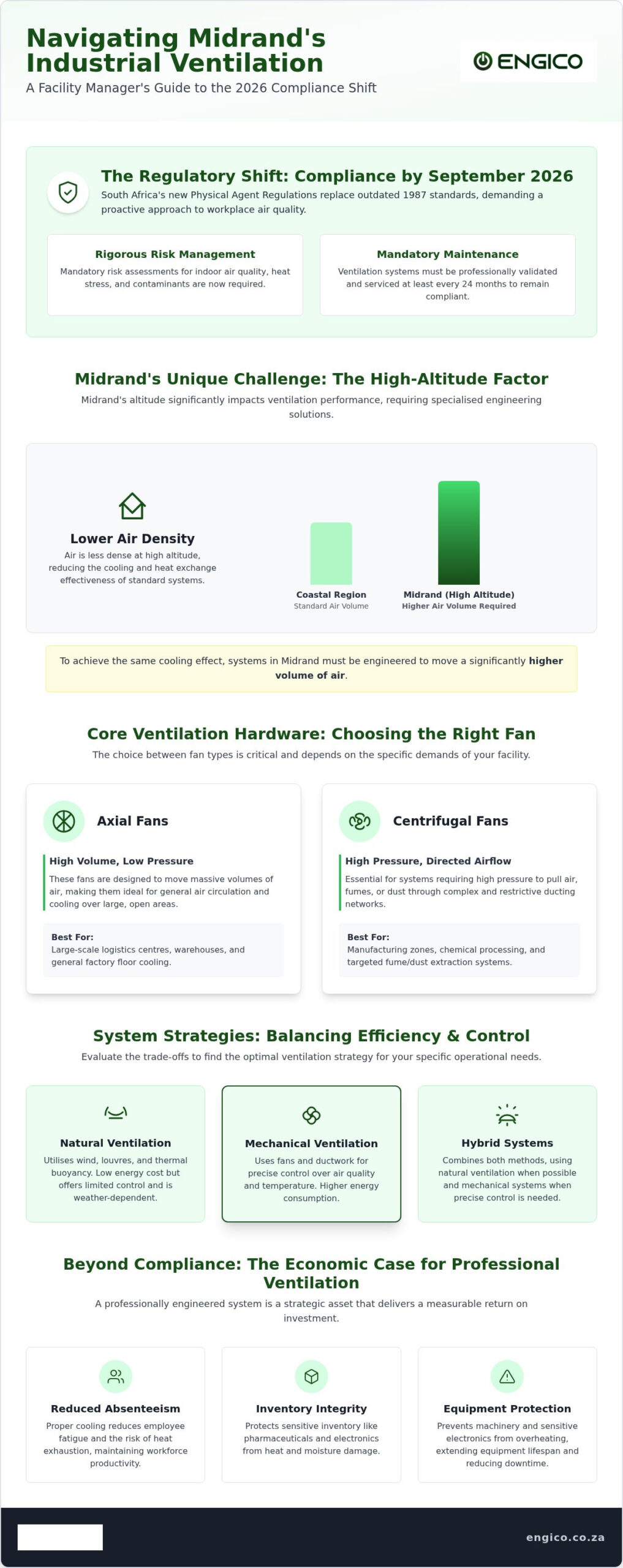
Industrial ventilation acts as a strategic asset for any facility, directly influencing both safety and productivity. In a high-altitude region like Midrand, air density is significantly lower than in coastal provinces. This physical reality means that industrial ventilation solutions Midrand must be engineered to move a higher volume of air to achieve the same cooling effect. Heat stagnation stops production. During the intense Gauteng summer, a lack of adequate airflow creates an environment where both workers and machinery struggle to perform.
The regulatory environment is also evolving rapidly. By September 2026, the new Physical Agent Regulations will fully replace the 1987 Environmental Regulations for Workplaces. This shift mandates a more rigorous risk management approach to indoor air quality. Employers in Midrand must now ensure their systems are validated and maintained at least every 24 months to remain compliant. Compliance is a legal necessity. Without these measures, large-scale logistics hubs often fall victim to “Sick Building Syndrome,” where poor air circulation allows CO2 and airborne contaminants to accumulate, causing chronic health complaints amongst the workforce.
Midrand’s Industrial Growth and Air Quality
The rise of sprawling data centres and massive warehouses in the Waterfall and Corporate Park corridors has changed the local air quality profile. Data centres require constant, high-volume heat extraction to prevent hardware failure, whilst manufacturing zones must manage heavy dust and fume loads. Standard, off-the-shelf extraction units often fail in these high-density industrial zones because they aren’t calibrated for the specific thermal loads or the local atmospheric pressure. To maintain a safe environment, facilities require a bespoke mix of Natural, Mechanical, and Hybrid Systems tailored to their specific architectural layout.
The Economic Case for Professional Ventilation
Professional climate control is a financial necessity rather than a luxury. By maintaining a stable internal temperature, businesses can see a measurable impact on their bottom line:
- Reduced Absenteeism: Proper cooling reduces employee fatigue and the risk of heat exhaustion, which keeps production lines moving.
- Inventory Integrity: Engineered airflow protects sensitive inventory from heat damage and moisture, which is vital for pharmaceutical and electronics storage.
- Equipment Protection: Consistent thermal regulation prevents sensitive electronics and heavy machinery from exceeding their operational limits, thereby extending the lifespan of the equipment.
Core Components of High-Performance Industrial Ventilation
High-performance industrial ventilation solutions Midrand rely on more than just high-speed fans. A truly effective system coordinates air intake, filtration, and extraction into a single, cohesive network. This integrated approach ensures that every square metre of a facility receives adequate air changes per hour, preventing the stagnant pockets of air that lead to heat build-up. When hardware components work in synergy, the system operates with greater energy efficiency and provides a more stable internal climate for both personnel and sensitive machinery.
Industrial Fans and Extraction Units
The choice between axial and centrifugal fans depends entirely on the specific requirements of the facility. Axial fans are the workhorses of large-scale logistics centres because they move massive volumes of air at low pressure, which is ideal for general cooling. Conversely, centrifugal fans are essential in manufacturing zones where high-pressure extraction is required to pull fumes or dust through complex ducting. Adhering to international OSHA ventilation standards helps engineers determine the precise blade pitch and motor capacity needed for these demanding environments. Durability is non-negotiable, so we prioritise motor configurations with dust-sealed bearings to withstand the industrial conditions of the Gauteng region.
Ventilation Louvers and Intake Systems
Louvers act as the primary defence against the elements whilst allowing for controlled air intake. Fixed louvers provide constant airflow, whereas adjustable variants allow facility managers to fine-tune intake based on seasonal weather patterns. In Midrand, where summer thunderstorms are frequent and intense, selecting high-quality, corrosion-resistant finishes is vital for long-term reliability. These components must be carefully integrated into the broader warehouse ventilation design South Africa to ensure that intake points don’t inadvertently create negative pressure zones. If intake and exhaust aren’t balanced, extraction fans will work harder than necessary, leading to premature wear and increased energy costs.
Air Handling Units (AHUs) and precision ducting complete the system. AHUs allow for the regulation of humidity and temperature, which is critical for pharmaceutical storage or precision electronics manufacturing. A well-designed ducting network ensures that this treated air is distributed uniformly across the floor, eliminating “dead zones” where heat or contaminants might otherwise collect. If you are looking to upgrade your facility’s infrastructure, a professional ventilation assessment can identify the specific hardware configuration required to meet your operational goals.
Choosing Between Natural, Mechanical, and Hybrid Systems
Selecting the correct airflow strategy is a critical decision that impacts a facility’s long-term operational costs and safety profile. In the Gauteng region, where atmospheric pressure is lower due to altitude, the efficiency of natural airflow is naturally reduced. Facility managers must decide whether to rely on passive pressure, high-powered mechanical extraction, or a sophisticated hybrid approach. Each method offers distinct advantages depending on the building’s geometry and the nature of the industrial work being performed inside. A well-designed system doesn’t just move air; it manages the internal environment to ensure consistent compliance and comfort.
Natural ventilation leverages thermal buoyancy, often called the stack effect, where hot air rises and escapes through roof-mounted vents whilst cooler air enters through wall louvres. It’s a low-cost solution with zero energy consumption, yet it lacks the precision required for high-density manufacturing. On the other end of the spectrum, mechanical systems provide total control over air change rates. While the initial capital expenditure for mechanical industrial ventilation solutions Midrand is higher, the ability to maintain specific temperature and purity levels often justifies the investment through improved worker output and reduced equipment failure.
When to Opt for Mechanical Extraction
Mechanical extraction is non-negotiable for high-risk environments such as chemical storage areas, welding bays, and heavy manufacturing plants. These zones produce concentrated fumes and particulate matter that natural wind pressure cannot reliably clear. By using high-performance centrifugal or axial fans, you can ensure that contaminants are removed at the source. This precision helps facilities meet OSHA ventilation standards and local OHS requirements, which mandate specific air change rates for hazardous zones. Mechanical systems are also the only way to overcome airflow “dead zones” in complex building layouts where structural partitions block natural cross-ventilation.
The Benefits of Hybrid Ventilation
Hybrid solutions are increasingly viewed as the gold standard for modern Midrand facilities. These systems combine the energy-saving benefits of natural intake with the reliability of mechanical exhaust. By using internal sensors to monitor temperature and CO2 levels, a hybrid system only activates mechanical fans when natural airflow is insufficient. This intelligent response drastically lowers energy bills compared to purely mechanical setups. Furthermore, hybrid systems are designed for seamless integration with smart HVAC control for commercial buildings, providing a centralised platform for climate automation. This approach ensures that your facility remains energy-efficient during cooler nights whilst providing robust cooling during the peak of the Gauteng summer.
Installation and Maintenance: Ensuring Long-Term Reliability
The transition from a technical design to a physical installation requires meticulous planning to avoid operational disruption. A professional site assessment serves as the foundation for this process, ensuring that the chosen hardware is compatible with the building’s structural and electrical capacity. When implementing industrial ventilation solutions Midrand, engineers must account for the specific load-bearing limits of warehouse roofs and the existing electrical distribution. A poorly planned installation can lead to structural strain or frequent circuit trips, both of which are costly to rectify after the fact.
Safety integration is equally vital. Your ventilation system must communicate with existing fire safety and smoke extraction protocols. Under SANS 10400 Part T, smoke ventilation is a critical component for occupant safety during a fire event. Ensuring these systems are synchronised prevents conflicting airflow patterns that could otherwise compromise safety during an emergency. For busy logistics centres, we manage system downtime by implementing phased upgrades. This methodical approach ensures that critical zones remain ventilated whilst work progresses on other sections of the facility.
Professional Installation Standards
Successful installation involves more than just mounting hardware. Roof-mounted fans require specific structural reinforcements to manage weight and operational vibration over time. Similarly, wall-mounted louvres must be sealed correctly to prevent moisture ingress during intense Gauteng thunderstorms. Post-installation testing is a non-negotiable step in our process. We measure airflow velocity and noise levels at various points across the floor to verify that the system meets the original design specifications and regulatory noise limits. This data-driven validation provides peace of mind that the environment is both safe and compliant.
Preventative Maintenance Programmes
Routine maintenance is a financial strategy rather than a mere chore. Quarterly inspections are essential for commercial HVAC maintenance Sunninghill and Midrand businesses to identify early signs of mechanical fatigue. Technicians focus on belt tensioning, bearing lubrication, and motor temperature checks to prevent unexpected failures. Identifying a strained motor early can save thousands in emergency repair costs and prevent production downtime. Furthermore, keeping louvres clean and blades balanced ensures the system maintains its peak energy efficiency rating, directly reducing your monthly utility expenditure. If your system hasn’t been serviced recently, consider booking a professional ventilation maintenance check to ensure your facility remains operational and efficient.
Engico Air Conditioning’s Integrated Approach to Midrand Industrial Projects
Engico Air Conditioning specialises in delivering comprehensive industrial ventilation solutions Midrand for complex environments. We don’t just supply hardware; we provide a turnkey service that encompasses design, equipment supply, and professional installation. This methodical approach is particularly beneficial for the large-scale logistics and manufacturing hubs found in Midrand’s industrial parks. By acting as a single point of contact, we eliminate the coordination gaps that often lead to project delays or technical inconsistencies. Our team manages every phase of the project, ensuring that your facility’s airflow is optimised from the first day of operation.
As Midrand becomes a central node for digital infrastructure, the demand for specialised HVAC for data centres in South Africa has intensified. These facilities require extreme precision in temperature and humidity control to protect high-value server hardware. Our solutions are custom-engineered to meet these specific thermal loads whilst maintaining the energy efficiency required by modern green building standards. We provide the technical expertise needed to manage these sensitive environments without compromising on reliability.
Smart Integration with Building Management Systems
Centralising your facility’s climate control through Building Management System (BMS) integration allows for a level of oversight that manual systems cannot match. A well-integrated BMS provides real-time monitoring of air quality and temperature across the entire floor. If a sensor detects a rise in CO2 levels or a drop in airflow velocity, the system automatically adjusts fan speeds to compensate. This demand-controlled ventilation ensures you only use the energy you need, significantly lowering operational costs. Automated fault detection also triggers maintenance alerts before a minor issue becomes a critical failure, keeping your facility compliant with the latest OHS standards.
Partnering with Engico Air Conditioning in Midrand
We position ourselves as a reliable partner for businesses that value technical excellence and long-term stability. Our expertise in managing large-scale industrial ventilation fans and louvres ensures that your project is handled with the precision it deserves. We understand the unique atmospheric challenges of the Gauteng highveld and design our systems to thrive in this environment. Whether you are developing a new warehouse or upgrading an existing manufacturing plant, our team provides the grounded, solution-oriented guidance needed to optimise your airflow. We invite you to contact Engico Air Conditioning for a professional site audit of your Midrand facility to identify opportunities for improved efficiency and safety.
Securing Your Facility’s Future with Engineered Airflow
Optimising your facility’s environment requires a transition from basic extraction to a comprehensive, risk-managed strategy. As the 2026 Physical Agent Regulations mandate stricter indoor air quality standards, selecting the right industrial ventilation solutions Midrand becomes a cornerstone of operational compliance and worker safety. By integrating high-performance fans and louvres with intelligent automation, you can effectively manage Gauteng’s unique thermal challenges whilst significantly reducing energy expenditure.
Engico Air Conditioning serves as a dependable partner for large-scale projects, offering expert installation of industrial fans and louvres across Gauteng. Our approach prioritises long-term value through specialised BMS integration for maximum energy efficiency and proactive HVAC maintenance services for Gauteng properties. These systems protect your hardware and ensure your workforce remains productive in a stable climate. We invite you to Enquire about Engico Air Conditioning’s Industrial Ventilation Solutions to secure a methodical, high-standard assessment for your site. With the right infrastructure in place, your facility is well-positioned to thrive in Midrand’s competitive industrial landscape.
Frequently Asked Questions
What are the legal ventilation requirements for factories in Midrand?
The primary legal framework is the Physical Agent Regulations 2024, which replaces the Environmental Regulations for Workplaces 1987 in September 2026. This regulation requires employers to maintain a Physical Agent Programme, which includes the documented validation of ventilation systems every 24 months. Additionally, facilities must adhere to SANS 10400 Part T for fire safety and smoke extraction standards.
How often should industrial ventilation fans be serviced?
Industrial ventilation fans should undergo a professional inspection at least once every three to six months in high-production environments. Routine maintenance ensures that belt tension, bearing lubrication, and motor performance remain within safe operational limits. For general storage warehouses with lower contaminant levels, an annual service is the minimum standard to prevent unexpected downtime and maintain energy efficiency.
Can I integrate my ventilation system with my existing air conditioning?
Integration is highly effective when managed through a Building Management System (BMS) or specialised Air Handling Units (AHUs). This allows your industrial ventilation solutions Midrand to work in tandem with ducted or cassette air conditioning. The system can automatically increase fresh air intake when the air conditioning is off or bypass cooling during milder weather to reduce overall energy consumption.
What is the difference between an extractor fan and a supply fan?
An extractor fan is designed to remove stale, hot, or contaminated air from the building, whilst a supply fan introduces fresh outdoor air into the facility. In manufacturing zones, extractor fans are critical for fume removal. Supply fans are often used to create positive pressure, which prevents dust and unfiltered air from entering through doors or gaps in the building structure.
How do ventilation louvres improve energy efficiency?
Ventilation louvres improve efficiency by regulating the volume of air entering or exiting the building without requiring electrical power. Properly positioned louvres ensure that extraction fans don’t have to work against high negative pressure, which reduces motor strain and wear. Adjustable louvres allow facility managers to restrict airflow during winter nights to retain heat, further lowering climate control costs.
Is natural ventilation enough for a large warehouse in Gauteng?
Natural ventilation is often insufficient for large-scale Gauteng facilities due to the region’s high summer temperatures and lower air density at altitude. While thermal buoyancy helps, it cannot provide the consistent air change rates required for manufacturing or high-density logistics. Most modern warehouses require a hybrid system that uses mechanical fans to assist natural airflow during peak heat periods.
What happens if my industrial ventilation system fails?
Failure leads to rapid heat accumulation, which triggers equipment thermal shutdowns and increases worker fatigue. Beyond productivity losses, a failed system can result in legal non-compliance with the 2026 Physical Agent Programme standards. In facilities handling hazardous materials, a lack of extraction allows airborne contaminants to reach dangerous concentrations, posing a significant risk to health and safety.
How much does it cost to install industrial ventilation in Midrand?
The total cost depends on the facility’s volume, the required air changes per hour, and the complexity of the ducting network. Large-scale industrial projects require bespoke engineering to account for Midrand’s specific climate and building layouts. We recommend a professional site audit to determine the most cost-effective hardware configuration for your specific operational needs and regulatory compliance.
Recent Comments