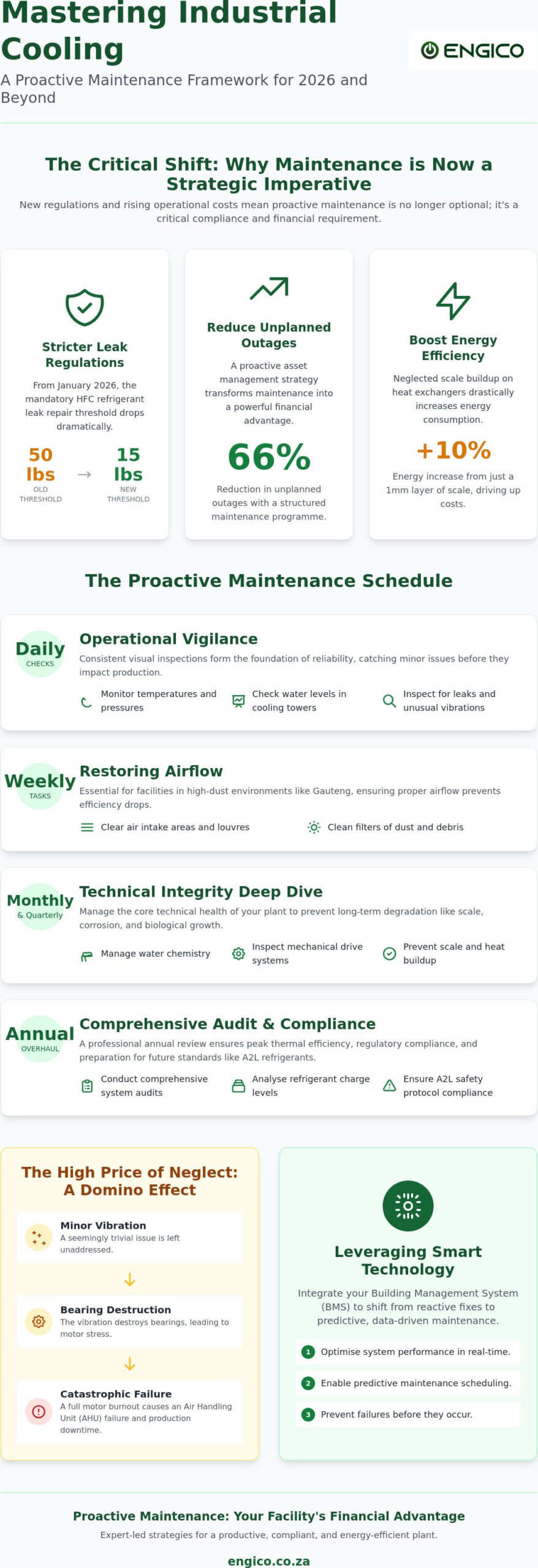
Did you know that as of January 2026, the threshold for mandatory leak repairs has dropped from 50 pounds to just 15 pounds of HFC refrigerant? This regulatory shift, combined with the industry-wide transition to A2L refrigerants, means that industrial cooling system maintenance is no longer just a routine task; it’s a critical compliance requirement. For South African industrial sectors, where rising energy costs and biological growth in cooling towers are persistent challenges, staying ahead of these changes is essential for operational stability.
It’s understandable if the complexity of modern HVAC standards feels overwhelming, especially when a single hour of unplanned downtime can cost your facility thousands in lost productivity. We’re here to help you navigate these technical requirements with a structured approach that prioritises long-term value. This article provides a comprehensive, expert-led framework to help you master your facility’s efficiency and prevent costly equipment failures. You’ll find a clear, actionable schedule that covers everything from BMS integration and A2L safety protocols to local health and safety compliance, ensuring your plant remains both productive and energy-efficient whilst meeting your environmental responsibilities.
Key Takeaways
- Recognise how a proactive asset management strategy reduces unplanned outages by 66%, transforming maintenance into a strategic financial advantage.
- Learn to implement daily and weekly visual inspections that identify vibrations and leaks before they escalate into major failures.
- Master the technical integrity of your plant by managing water chemistry and mechanical drive systems to prevent scale, corrosion, and heat buildup.
- Discover how to optimise performance by integrating Building Management Systems, allowing for a shift towards predictive industrial cooling system maintenance.
- Prepare for the 2026 regulatory landscape with comprehensive annual audits and refrigerant charge analysis to ensure peak thermal efficiency.
Why Industrial Cooling System Maintenance is Critical in 2026
In 2026, industrial cooling system maintenance has evolved from a reactive chore into a sophisticated asset management strategy. Facility managers who treat cooling infrastructure as a “run-to-fail” component often face catastrophic financial consequences. Data from the IEEE suggests that structured, proactive maintenance programmes can reduce unplanned outages by as much as 66%. This reliability is vital for maintaining production quotas and protecting expensive machinery from thermal stress during peak operation cycles.
Environmental responsibility also plays a larger role than ever before. Optimised heat exchange reduces the carbon footprint of a facility by ensuring that fans and compressors don’t work harder than necessary. In regions like Gauteng, local environmental factors increase the difficulty of operation. The high ambient temperatures in Pretoria and the seasonal dust levels in Johannesburg industrial zones mean that equipment must be kept in peak condition to avoid rapid efficiency drops. Dust acts as an insulator on coils, forcing fans to run at higher speeds for longer periods. If you are currently researching What is an Industrial Chiller? to understand your plant’s infrastructure, remember that its efficiency is entirely dependent on its maintenance state. A well-maintained system handles these local environmental stresses without the risk of an emergency shutdown.
The High Price of Neglect: Downtime and Degradation
For a large-scale factory, a single hour of production downtime can result in substantial financial losses. Beyond the immediate loss of output, neglect often triggers a cascading failure effect. A minor vibration in a ventilation fan might seem trivial; however, if left unaddressed, it can destroy bearings and eventually lead to a motor burnout that damages the entire Air Handling Unit (AHU). This creates a domino effect where one small part causes the failure of a much larger, more expensive assembly. Poor water management in cooling towers also invites biological growth, such as Legionella. This creates a significant health risk and exposes facility managers to severe legal liabilities under South African health and safety standards, particularly amongst ageing infrastructure.
Energy Efficiency as a Revenue Driver
Electricity tariffs are a constant concern for industrial operations across South Africa. Research indicates that even a 1mm layer of scale buildup on heat exchanger surfaces can increase energy consumption by 10% or more. Keeping coils clean and ensuring fans are properly balanced allows the system to meet cooling demands with minimal electricity draw. This focus on performance is a hallmark of professional HVAC maintenance services for Gauteng properties, where every kilowatt saved contributes directly to the bottom line. By standardising your maintenance routine, you transform a technical necessity into a clear financial advantage.
The Daily and Weekly Routine: Operational Vigilance
Consistent vigilance is the foundation of effective industrial cooling system maintenance. It prevents minor anomalies from evolving into catastrophic failures. In industrial hubs like Silverton or Gezina, the high concentration of airborne dust and particulate matter necessitates a more frequent inspection cycle than in cleaner environments. A daily walkthrough ensures that your team identifies issues before they impact production schedules. This routine isn’t just about ticking boxes; it’s about developing an intuitive understanding of how your equipment behaves under varying load conditions.
Daily checks should focus on monitoring operating temperatures and pressures against baseline “normal” ranges. When these figures deviate, it often signals an underlying efficiency drop. Monitoring water levels in cooling towers is equally critical to prevent pump cavitation or overflow, which can cause immediate mechanical damage. These simple checks form the core of chiller maintenance best practices, ensuring the system operates within its designed thermal parameters without unnecessary strain on the pumps.
Weekly assessments should target air intake areas and louvers. In Gauteng, seasonal winds and industrial activity can rapidly clog filters and intake mesh with organic debris or grit. Clearing these areas restores proper airflow and prevents the motor from overworking. If you notice a persistent buildup of debris, it may be time to consult a specialist about our maintenance of air conditioners and ventilation systems to ensure your filtration strategy is appropriate for your specific site conditions.
Visual and Auditory Inspections
High-performance ventilation fans possess a rhythmic, low-frequency hum when operating correctly. Any introduction of high-pitched squealing or grinding usually indicates early-stage bearing wear. Identifying these sounds early allows for a planned bearing replacement rather than an emergency seizure that could halt operations. Operators should also scan for refrigerant oil stains around joints and valves. These greasy patches are often the first visible sign of a small leak that could eventually lead to a total loss of charge and system shutdown. Understanding what a thorough professional aircon servicing visit entails can help your team know exactly which internal components require the closest scrutiny during these walkthroughs.
Recording and Documentation
Maintaining a meticulous logbook, whether digital or physical, creates a vital audit trail for your facility. Consistent data entry allows you to spot slow performance drifts that automated sensors might occasionally overlook. For example, a gradual increase in discharge pressure over several weeks might indicate a fouling issue that hasn’t yet triggered a high-pressure alarm. Effective industrial cooling system maintenance relies on this historical data to predict when components are nearing the end of their functional life. Engico’s maintenance programmes include structured reporting frameworks that help organise this data into actionable insights, ensuring your maintenance history is transparent and accessible for technical audits.
Monthly and Quarterly Deep Dive: Technical Integrity
Transitioning from daily observations to structured technical intervals ensures the long-term reliability of your infrastructure. Monthly and quarterly deep dives allow for intrusive checks that require partial system shutdowns or specialised equipment. This phase of industrial cooling system maintenance focuses on the mechanical and chemical variables that dictate the system’s lifespan. By addressing these factors at set intervals, you prevent the slow degradation of components that often goes unnoticed during a standard walkthrough.
Mechanical drive systems require precise calibration to maintain efficiency. Inspecting drive belts for correct tension is a priority; belts that are too loose will slip and lose power, whilst those that are too tight place excessive load on bearings. Use a tension gauge to ensure accuracy rather than relying on feel alone. Pulleys must be checked for alignment to prevent lateral wear and vibration. Additionally, lubrication protocols should be strictly followed. Over-greasing is a common error that causes heat retention and can damage motor seals. Methodical application of the correct lubricant ensures moving parts operate with minimal friction.
In Gauteng’s dusty industrial corridors, monthly Air Handling Unit (AHU) filter replacements are non-negotiable. High particulate levels quickly saturate standard filters, leading to increased static pressure and unnecessary motor strain. Changing these filters on a strict monthly cycle protects the downstream coils and ensures the ventilation system maintains its designed flow rates.
Water Treatment and Quality Control
South African industrial sites often operate in regions with “hard water” containing high mineral concentrations. This chemistry facilitates rapid scale formation on heat exchange surfaces, which acts as an unwanted insulator. Monthly testing of pH, conductivity, and biocide levels is essential to counteract this. Whilst automated dosing systems manage routine chemistry, manual verification ensures that the system remains within safe operating parameters. Testing for Legionella and other pathogens is a legal requirement for health and safety compliance. Maintaining a biocide residual that is high enough to kill bacteria but low enough to prevent pipe corrosion is a delicate balance that requires consistent monitoring.
Mechanical Components and Ventilation
Industrial ventilation louvers must be inspected for smooth movement and a proper seal when closed. If louvers stick due to grit or lack of maintenance, the system cannot regulate airflow effectively, leading to temperature fluctuations. Evaporator and condenser coils should be cleaned using appropriate non-corrosive agents to remove stubborn grime without damaging the delicate fins. Finally, fan blades require a close visual inspection for stress fractures or signs of imbalance. A fan that is even slightly out of balance creates vibrations that can loosen mounting hardware and damage the motor housing over time.
Leveraging BMS and Automation for Predictive Maintenance
The landscape of industrial cooling system maintenance is undergoing a significant transformation as facilities move away from purely preventive schedules toward predictive models. Whilst preventive maintenance relies on fixed time intervals, predictive maintenance uses real-time sensor data to forecast exactly when a component might fail. This is the next level of operational efficiency. By analysing data from vibration sensors and pressure transducers, the system can flag a failing bearing weeks before an audible squeal develops, allowing for scheduled repairs during off-peak hours.
Modern Building Management Systems (BMS) serve as the central nervous system for your facility. These platforms identify subtle efficiency drops that are often invisible to the naked eye. For instance, a BMS can detect a 5% increase in energy draw from a compressor, which might indicate a refrigerant restriction or a failing valve. Remote monitoring capabilities now allow HVAC specialists to diagnose complex issues in Sandton or Midrand without the delay of a site visit. This immediate oversight ensures that technical experts can guide on-site teams through troubleshooting steps, significantly reducing the mean time to repair.
Integrating your cooling infrastructure with broader building automation allows for intelligent energy load balancing. In a large-scale industrial environment, the BMS can shift cooling loads between different units based on real-time demand and electricity tariffs. This coordination prevents multiple high-draw components from starting simultaneously, which protects your electrical switchgear and avoids peak-demand penalties from the utility provider.
Smart Sensors and Alarm Management
The accuracy of your predictive model depends entirely on the quality of the data it receives. Regularly calibrating sensors is essential to ensure the BMS isn’t reacting to “ghost” readings or ignoring genuine faults. Automated alerts for out-of-range parameters can save thousands in repair costs by triggering an immediate response to low-flow or high-temperature conditions. BMS integration streamlines maintenance for large-scale air handling units by providing centralised control and real-time performance feedback across multiple zones.
Energy Optimisation Through Data
BMS logs provide a wealth of information that can be used to identify peak usage patterns and adjust cooling cycles accordingly. By matching cooling output to the actual thermal load of the facility, you eliminate the waste associated with over-cooling. Variable Speed Drives (VSDs) play a crucial role here, as they allow motors and fans to respond dynamically to real-time demand rather than running at a constant, inefficient speed. At Engico, we specialise in Building Management System Integration to help Gauteng businesses turn their raw operational data into significant energy savings and extended equipment lifespans.
Annual Overhaul and Professional Partnership
The annual overhaul represents the most intensive phase of industrial cooling system maintenance. It serves as a comprehensive reset for the entire plant, ensuring that every component is prepared for the high-demand cycles of the coming year. Unlike the routine checks discussed in previous sections, the annual service involves a top-to-bottom evaluation of every mechanical and electrical component. This is the window where technical teams perform deep-system audits that aren’t feasible during standard production hours, providing a clear picture of the system’s overall health.
A critical component of this overhaul is the refrigerant charge analysis. With the 2026 regulations now in full effect, ensuring your system is leak-free is a legal necessity. Specialists verify that the system is operating at peak thermal efficiency whilst conducting thorough leak detection on all joints and valves. Electrical integrity checks are equally vital. Technicians test contactors for pitting, tighten all terminals, and perform insulation resistance tests to identify potential motor winding breakdowns before they cause a short circuit. This data is then used to update your long-term asset management plan, allowing you to budget for future repairs based on actual performance trends rather than guesswork.
The Role of Professional HVAC Specialists
Certain tasks within a cooling plant require specialised training and legal certification. Handling refrigerants, particularly the newer A2L variants, is restricted to certified technicians who understand the specific safety and environmental protocols involved. Relying on generalists or “cowboy” contractors exposes your facility to significant risk, as poor repairs often lead to recurring failures and voided warranties. Understanding the cost of aircon maintenance plan South Africa providers offer is an important step in selecting a qualified partner who can protect your manufacturer warranty and ensure all work is performed to current SANS standards. A recurring maintenance contract with an industrial cooling specialist like Engico provides peace of mind. It ensures your facility receives priority service and that all work is performed to current SANS standards by a partner who understands the weight of your operational requirements. For a detailed breakdown of what a thorough service visit should cover, our professional aircon servicing guide for Gauteng owners outlines the full scope of a compliant, high-quality maintenance visit.
Planning for the Future: Retrofits and Upgrades
Every piece of equipment has a finite lifespan. Part of a professional audit is identifying the tipping point where the cost of ongoing repairs exceeds the value of the asset. When a system consistently fails to meet efficiency targets or requires frequent, expensive spare parts, it’s time to consider a retrofit. Modern, energy-efficient ducted air conditioning and AHU technology can offer significant electricity savings compared to ageing infrastructure. These upgrades often pay for themselves through reduced operational costs within a few years, whilst also improving the facility’s overall carbon footprint.
Contact Engico for a professional maintenance audit of your industrial system to ensure your facility is future-proofed for the years ahead.
Securing Your Facility’s Operational Future
Effective industrial cooling system maintenance is no longer just a technical requirement; it’s a strategic necessity for any high-performance facility. By integrating daily vigilance with advanced Building Management Systems and structured annual overhauls, you can significantly reduce the risk of unplanned downtime. These methodical approaches ensure your equipment operates at peak efficiency whilst meeting the rigorous environmental and regulatory standards of 2026.
Since 2022, Engico has served as a dependable partner for Gauteng businesses, providing specialised expertise in complex industrial ventilation and BMS integration. Our team offers comprehensive services across the region, from the commercial hubs of Sandton to the industrial zones of Pretoria. We understand the technical demands of your environment and are committed to delivering long-term value through precision and reliability. You don’t have to manage these complexities alone.
Request a Professional Maintenance Consultation from Engico and take the first step towards a more resilient, energy-efficient cooling strategy. We look forward to helping you optimise your facility’s performance and equipment lifespan.
Frequently Asked Questions
How often should industrial cooling systems be serviced?
Industrial cooling systems require a tiered service approach consisting of daily visual checks, monthly technical inspections, and a comprehensive annual overhaul. Whilst internal teams can manage basic operational vigilance, a professional technical deep dive should occur at least once every quarter to maintain peak performance. This frequency ensures that small issues, such as belt tension or filter saturation, are addressed before they cause a system shutdown.
What are the signs that my industrial cooling system needs urgent maintenance?
Urgent maintenance is required if you notice unusual vibrations, high-pitched grinding noises, or visible refrigerant oil stains around joints. Sudden spikes in operating temperatures or discharge pressures also indicate an immediate need for intervention. These symptoms suggest that a component is nearing failure, and delaying a service could lead to a cascading breakdown of the entire Air Handling Unit.
Can I perform industrial cooling maintenance in-house?
General operational tasks, such as cleaning air intake areas and recording logbook data, can be performed by trained in-house staff. However, technical industrial cooling system maintenance involving refrigerant handling, electrical integrity testing, and BMS calibration must be conducted by certified specialists. This ensures compliance with local health and safety standards and prevents the accidental voiding of equipment warranties through incorrect handling.
How much does industrial cooling system maintenance cost in South Africa?
The cost of a maintenance programme depends on several variables, including the number of units, the complexity of the system, and the age of the equipment. Industrial systems typically require more intensive labour and specialised tools than standard commercial units, which influences the total investment. For an accurate assessment, it is best to request a site audit where a specialist can evaluate your specific infrastructure and compliance requirements.
What is the most common cause of industrial cooling system failure?
The most frequent cause of failure is neglected water chemistry, which leads to scale buildup and corrosion within the heat exchanger. This degradation forces the system to work harder, eventually causing motor burnouts or compressor seizures. Secondary causes include saturated filters and poor lubrication, both of which are easily preventable through a structured maintenance framework that prioritises early detection.
How does a Building Management System (BMS) help with maintenance?
A BMS provides real-time data that allows for a transition from reactive to predictive maintenance. It monitors parameters like energy draw and pressure levels, triggering automated alerts when performance drifts outside of normal ranges. This integration allows specialists to diagnose issues remotely, ensuring that repairs are targeted and efficient whilst optimising the overall energy load of the facility.
What regulations govern cooling tower maintenance in Gauteng?
Maintenance is governed by local SANS health and safety standards, which mandate regular testing for pathogens like Legionella. Additionally, new 2026 regulations have lowered the threshold for mandatory refrigerant leak repairs to 15 pounds for HFC systems. Facility managers in Gauteng must keep meticulous records of these tests and repairs to ensure they remain compliant during technical audits.
How do I choose between a repair and a full system replacement?
The decision usually depends on the age of the unit and the frequency of ongoing repairs. If a single repair costs more than 50% of the value of a new unit, or if the system uses obsolete refrigerants, a replacement is often the more economical choice. Modern AHUs and ducted systems offer superior energy efficiency, which can lead to significant long-term savings on electricity tariffs.
Recent Comments