

A cheaper air conditioner can cost more to own over time, but a higher Daikin price doesn’t automatically mean lower bills. The total cost of ownership Daikin vs cheaper brands depends on the specific models and how they’re selected, installed and used.
Upfront prices are easy to compare, whilst energy use, installation requirements, servicing and repairs are harder to estimate. In Gauteng, electricity tariffs and usage patterns also shape running costs. An incorrectly sized system can affect value regardless of its brand.
This guide explains how to compare purchase and installation costs, electricity consumption and planned maintenance over an air conditioner’s working life. You’ll learn which model-specific information to use, how inverter technology and efficiency ratings can inform estimates, and why correct sizing and ongoing care belong in the calculation. The aim is a like-for-like comparison that helps you decide whether a Daikin model’s higher initial cost makes sense for your needs, or whether a cheaper alternative offers better overall value.
Key Takeaways
- Build a whole-life comparison that includes purchase, installation, electricity use, maintenance and potential repairs, not just the invoice price.
- Compare models with the same capacity and system type, then assess their published efficiency data and warranty terms side by side.
- Estimate running costs using realistic operating hours, building conditions and the electricity tariff that applies to your Gauteng home or business.
- Compare the total cost of ownership Daikin vs cheaper brands using model-specific evidence rather than assuming one brand is always better value.
- Plan for suitable system selection, professional installation and ongoing maintenance to support dependable performance over time.
Why total cost of ownership matters when comparing Daikin with cheaper brands
The invoice shows only part of an air conditioner’s cost. A lower-priced unit may cost more over the period you own it if installation, electricity, maintenance or repairs add substantially to the initial price. Equally, a higher-priced model isn’t automatically the more economical choice. The result depends on the specific systems and how they’ll be used.
Total cost of ownership is the combined cost of buying, installing, operating and maintaining an air conditioning system throughout the period you own it. This approach reflects the broader idea of Total Cost of Ownership (TCO), which considers direct and indirect expenses across a product’s life cycle. When comparing the total cost of ownership Daikin vs cheaper brands, it shifts attention from the brand badge to the costs that matter in your circumstances.
Which costs belong in an air conditioner ownership comparison?
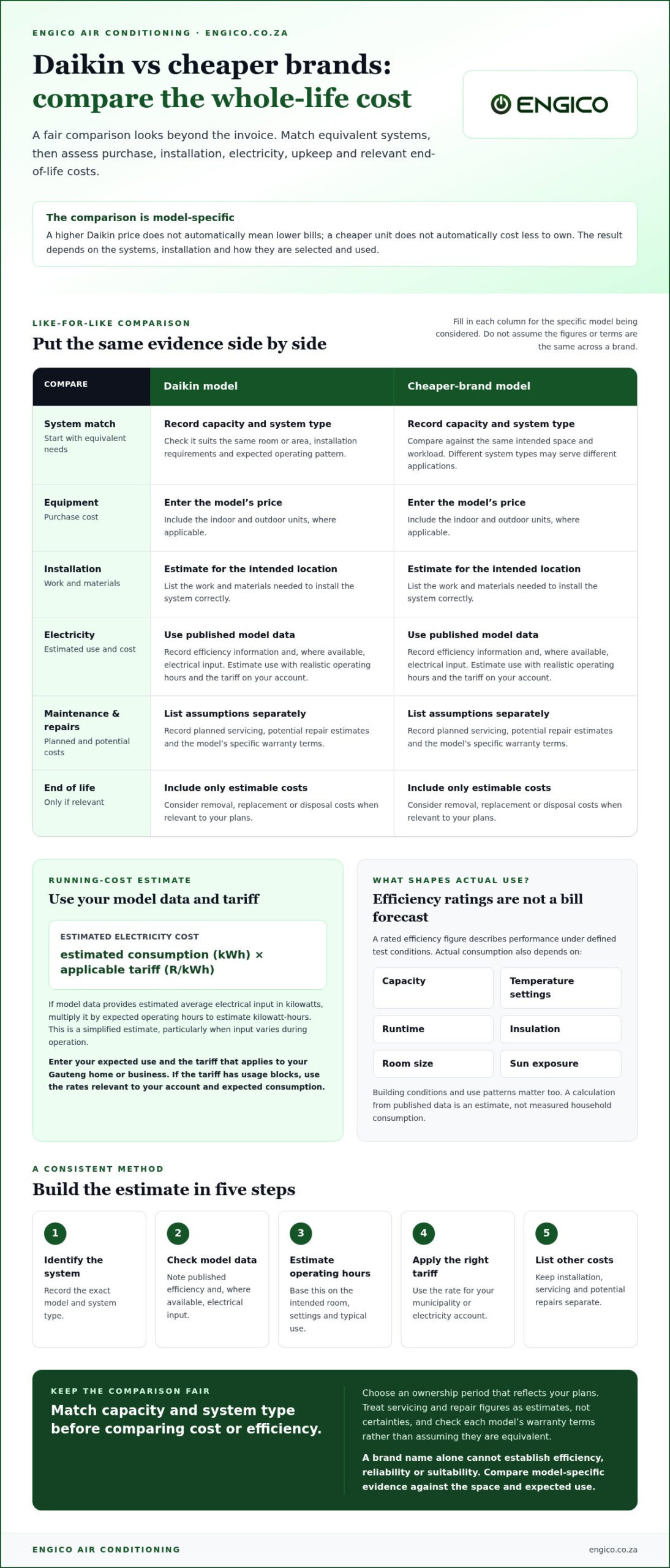
Separate costs into categories before comparing options. This makes your assumptions visible and stops the purchase price from dominating the decision.
- Equipment: the price of the indoor and outdoor units, where applicable.
- Installation: the work and materials required to install the system correctly in its intended location.
- Electricity: estimated consumption over the ownership period, based on expected use and the tariff on your account.
- Maintenance and repairs: planned servicing and estimated repair costs. These are estimates, not certainties.
- End-of-life costs: include removal, replacement or disposal expenses only when they’re relevant and can be estimated for your plans.
Choose an ownership period that reflects your plans, rather than treating every possible future cost as certain. Warranty coverage can affect the comparison, but terms vary by model. Record the specific terms for each system instead of assuming they’re equivalent or counting on a repair being covered.
Why compare equivalent systems rather than brand names alone?
Start with systems suited to the same need. Match cooling capacity and system type, then consider the room or area, installation requirements and expected operating pattern. A wall-mounted split unit and a ducted system, for example, serve different applications. Comparing their purchase prices alone won’t show which is better value for a particular property.
An unlike-for-like comparison can make a model appear cheaper or more efficient simply because it’s designed for a different workload. Compare model-specific information, including efficiency data and warranty terms, alongside expected costs. A brand name alone can’t establish a system’s efficiency, reliability or suitability. A sound decision weighs comparable evidence against the space’s requirements and the ownership period.
How energy use, installation and upkeep shape lifetime air conditioning costs
Use a consistent method to estimate running costs. Start with the exact model and its verified technical data, then estimate how it’s likely to operate in the property. Apply the electricity tariff on your account and record separate assumptions for installation, planned servicing and potential repairs. This gives you a transparent estimate to compare, not an unsupported promise of savings.
- Identify the model and system type being assessed.
- Record its published efficiency information and, where available, electrical input data.
- Estimate operating hours based on the intended room, settings and typical use.
- Use the tariff that applies to your municipality or electricity account.
- List installation, maintenance and potential repair assumptions separately.
A rated efficiency figure describes performance under defined test conditions, not the electricity bill a household will receive. Actual consumption also depends on the system’s capacity, temperature settings, runtime, insulation, room size, sun exposure and other building conditions. A unit running for long periods in a poorly insulated room may use electricity differently from the same model in a smaller, shaded space.
How to estimate electricity use without inventing savings
Use verified technical information for the specific model, not a brand-wide assumption. If the model data provides an estimated average electrical input in kilowatts, multiply it by expected operating hours to estimate kilowatt-hours. This is a simplified estimate, particularly for systems whose input varies during operation. The U.S. Energy Information Administration’s explanation of energy efficiency standards for air conditioners offers useful context on efficiency ratings, but its US standards aren’t South African requirements.
Use this template and label the result as an estimate:
Estimated electricity cost = estimated consumption (kWh) × applicable tariff (R/kWh)
Enter your own expected kWh and tariff rather than relying on a generic figure. If your tariff has different usage blocks, use the rates relevant to your account and expected consumption. A calculation based on published data isn’t the same as measured household consumption. Actual bills reflect all electricity use and the tariff structure.
How installation and maintenance affect the comparison
The system’s capacity should suit the space and its cooling requirements. An unsuitable selection can affect comfort and operating behaviour, whilst professional installation helps the system operate as intended. Include installation as a separate line in your comparison instead of assuming the equipment price covers every project requirement.
Budget for planned maintenance and potential repairs separately. Their timing and cost can’t be predicted precisely, so state your assumptions and use the same planning period for each model. Engico supplies, installs and maintains air conditioning systems for residential and commercial properties across Gauteng. Discuss an air conditioning solution tailored to your property.
Daikin vs cheaper air conditioner brands: compare evidence, not assumptions
A fair comparison puts two systems designed for the same job side by side. Brand reputation and shelf price can help you shortlist options, but neither proves which model will cost less to own. For the total cost of ownership Daikin vs cheaper brands, use current documentation for each exact model and make the assumptions behind your estimates visible.
Which model specifications are fair to compare?
Start with models of comparable cooling capacity and the same system type, such as wall-mounted split units intended for similar spaces. A model designed for a different application or workload isn’t a sound benchmark. Compare efficiency information on the same rating basis and note any test conditions or limitations stated in the technical documentation. Performance organisations such as the Air-Conditioning, Heating, and Refrigeration Institute (AHRI) publish technical standards and certification resources. These provide context, but don’t replace checking the relevant model data and applicable South African information.
Compare warranty terms document by document. Record the coverage period, which components are included and any stated exclusions or conditions. Don’t assume models from the same brand, let alone different brands, have identical terms. If a detail isn’t clear in the documentation, leave it out of the calculation rather than treating it as a benefit.
Use the table below as a practical template. Fill it with verified figures for the models under consideration, not general claims about a brand.
| Comparison item | Daikin model | Lower-priced alternative |
|---|---|---|
| Capacity and system type | Record model-specific details | Record comparable details |
| Efficiency data and rating basis | Enter verified documentation | Enter verified documentation |
| Equipment and installation outlay | Use the relevant quotation | Use the relevant quotation |
| Estimated electricity use | Apply your stated use assumptions | Apply the same assumptions |
| Warranty, maintenance and repairs | Record terms and estimates separately | Record terms and estimates separately |
When could a lower-priced model offer better overall value?
A lower-priced model may compare favourably if it suits the space, has suitable verified efficiency data and will be used for relatively modest operating hours. In that situation, the difference in purchase outlay may weigh more heavily in the ownership estimate than it would where the system runs for long periods or more frequently. Test this possibility with evidence rather than treating it as a general rule about cheaper brands.
Likewise, a Daikin model’s higher purchase price isn’t automatically recovered through electricity savings. Estimate each model’s operating costs using consistent assumptions, then add installation, planned servicing and potential repairs as separate items. The result may favour different models for different usage patterns. A specification-led comparison is more useful than assuming either brand category is always more efficient, reliable or economical.
Apply the total cost framework to homes and businesses across Gauteng
Estimated running costs are useful only when they reflect how a property is occupied. A household in Pretoria may use cooling mainly in selected rooms during warmer periods, whilst an office in Johannesburg may run systems during set working hours across several occupied areas. These different operating patterns call for different estimates. Seasonal use matters too: base the calculation on expected cooling hours across the year, rather than assuming the system runs at the same rate every month.
What changes between a Gauteng home and a commercial property?
For a home, note which rooms need cooling, when they’re occupied and whether the system is used overnight. For an office, record business hours, staff occupancy, equipment and which zones need cooling at different times. A commercial property may have longer schedules or several separately controlled areas, while a household may use one room intermittently. These details affect estimated runtime and should shape the comparison.
Tariffs also vary by electricity account and municipality. Use the tariff that applies to your property, not a rate taken from another household or business. For example, City Power residential prepaid customers and City of Tshwane domestic customers have different tariff structures, and some tariffs use usage blocks. If your rate changes with consumption, reflect the relevant blocks in your estimate instead of multiplying all expected use by an unsuitable flat rate.
How to make a practical comparison before selecting a system
Keep a short record for every option. Apply the same operating assumptions to each model so the comparison remains consistent, then update them if the intended use differs.
- Property: note the location, type of building and room or area to be cooled.
- Usage: record occupancy, likely operating schedule, seasonal use and preferred settings.
- Model: note the exact system type, capacity and verified efficiency information.
- Tariff: use the rate structure on the relevant municipal or electricity account.
- Upkeep: record planned maintenance and potential repair assumptions separately.
This makes the total cost of ownership Daikin vs cheaper brands more relevant to the property than a national average or broad brand claim. It also helps you identify uncertainty. If operating hours or future maintenance needs are estimates, label them as such and see how the comparison changes under different reasonable assumptions.
Efficiency is only one part of managing energy use. Building conditions, correct system selection and consistent care also affect how well equipment serves its intended space. Include planned servicing in your ownership plan, and consider energy-saving air conditioning technology and HVAC maintenance for Gauteng properties as part of the wider decision. Engico supplies, installs and maintains systems for homes and businesses in Pretoria, Johannesburg, Centurion, Menlyn, Farie Glen, Silverton, Waterkloof, Gezina, Doringkloof, Midrand, Waterfall, Sunninghill, Woodmead, Sandton, Randburg, Roodepoort, Fourways, Hyde Park and across Gauteng Province. Discuss a tailored air conditioning solution for your property and its operating needs.
Choose and maintain an air conditioning system with Engico
A sound purchase decision starts with the property, not a preferred brand. Define the rooms or areas that need cooling, how often they’re occupied and how the system is expected to operate. Then compare suitable systems using model-specific information and consistent ownership-cost assumptions. This is more useful than a general claim that one brand always costs less or performs better.
Include professional installation and ongoing care in the decision. Engico supplies, installs and maintains air conditioning systems for residential and commercial applications across Gauteng, bringing equipment selection, installation and maintenance into the same practical discussion. The right system depends on the property and its operating requirements.
How Engico supports a well-grounded system decision
Different spaces call for different system arrangements. A wall-mounted split system may suit a particular room, whilst multi-split, ceiling cassette or ducted systems may suit other layouts and applications. Choose based on the intended area and how it will be used, rather than starting with a brand name alone.
Installation is part of the ownership picture because the system needs to suit the site and its intended application. Engico also provides maintenance and repair services to support ongoing system care. Include these in your planning, while recognising that no service plan can establish in advance exactly what work a system may need over time.
What information to prepare for a useful consultation
A clear brief helps focus the discussion on what the property needs. Gather details that affect system choice, operation and cost estimates, and distinguish known information from assumptions.
- Property and spaces: note whether it’s a home or business, which rooms or zones need cooling, and any relevant layout details.
- Typical use: describe occupancy patterns, usual operating hours and seasonal requirements.
- Existing system: share its type, any known capacity or model information, and what you’d like to change or improve.
- Comparison evidence: bring the exact model details, verified efficiency information and warranty documents for the options you’re considering.
- Electricity account: note the applicable municipal or account tariff and any usage-block structure that affects your estimate.
With these details, you can assess the total cost of ownership Daikin vs cheaper brands against your actual operating pattern, rather than a generic household or business estimate. Engico can discuss a tailored residential or commercial solution, including equipment supply, professional installation and ongoing maintenance, guided by your property’s requirements.
Discuss your air conditioning requirements with Engico and take the next step towards a well-informed system decision.
Make your next air conditioning decision with confidence
A useful ownership estimate is a planning tool, not a promise of exactly what a system will cost. Keep your model information, tariff assumptions and expected operating schedule together, then revisit them if the property’s use changes. This gives you a practical basis for future maintenance or replacement decisions, rather than relying on the original purchase price alone.
The right recommendation should fit the building and its daily requirements. Engico brings together equipment supply, professional installation, maintenance and repair services for residential, commercial and industrial HVAC applications in Gauteng. That keeps the discussion focused on the system’s intended use, rather than a blanket claim about Daikin or any lower-priced brand.
Take the next step with a clear brief about your property and what you need the system to do. Discuss the total cost of ownership Daikin vs cheaper brands in relation to your requirements, and discuss a professionally selected and installed air conditioning solution with Engico. A considered choice gives you a practical basis for managing your property’s cooling needs.
Frequently Asked Questions
Is Daikin always cheaper to run than lower-priced air conditioner brands?
No. A Daikin model may use less electricity than a lower-priced alternative in a particular application, but the brand name alone can’t establish that. Compare equivalent capacities and system types, then consider verified efficiency data, installation and operating patterns. A rarely used guest room and a regularly occupied living area create different running profiles, even if both systems carry the same brand name.
Can a cheaper air conditioner have a lower total cost of ownership?
Yes. A cheaper unit can have a lower total ownership cost if it suits the property and its verified efficiency, installation, servicing and repair assumptions remain favourable over the period considered. For the total cost of ownership Daikin vs cheaper brands, compare like-for-like models using the same tariff and usage schedule. A lower invoice is a starting advantage, not proof of a lower final cost.
How much electricity does an air conditioner use per hour?
There isn’t one reliable hourly figure for every air conditioner. Find the model’s rated electrical input in its technical documentation. If it’s expressed in kilowatts, multiplying that figure by one hour gives a simple full-input estimate in kilowatt-hours. Actual electricity use can vary as the system operates and with site conditions, so treat this calculation as a guide, not a household meter reading.
What happens if I use the wrong cooling capacity when comparing air conditioners?
A capacity mismatch makes the comparison unfair because the systems may not be meeting the same cooling demand. An undersized unit may struggle to maintain the desired comfort, whilst an oversized system may operate differently from one correctly matched to the space. Recheck the room or area, occupancy and expected use before comparing costs. Otherwise, differences in runtime may reflect a capacity mismatch rather than model efficiency.
Where can I find the electricity tariff to estimate air conditioning costs in Gauteng?
Use the tariff shown on your electricity account, or consult current tariff information from the municipality or supplier serving the property. This applies across Pretoria, Johannesburg, Centurion, Menlyn, Farie Glen, Silverton, Waterkloof, Gezina, Doringkloof, Midrand, Waterfall, Sunninghill, Woodmead, Sandton, Randburg, Roodepoort, Fourways and Hyde Park. Apply the same tariff structure to each model estimate, including any usage blocks.
Should I replace a working air conditioner solely to reduce running costs?
Not necessarily. Compare the existing system’s remaining maintenance or repair needs with verified energy information for a suitable replacement, then include replacement and installation costs in the assessment. Consider how often the current unit runs and whether the property’s use has changed. If it’s used occasionally, projected energy savings may not justify replacement on their own. A like-for-like estimate can help clarify the trade-off.
Recent Comments