
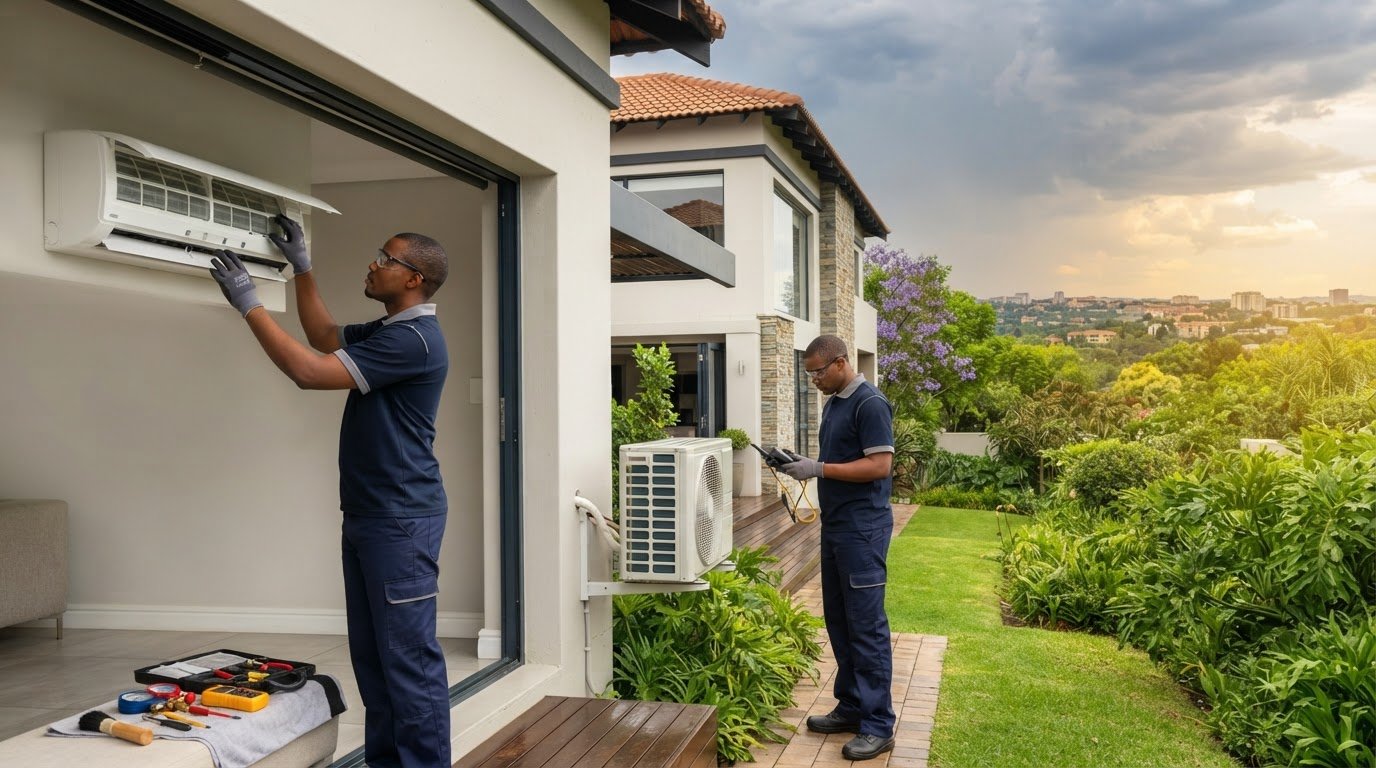
What if your air conditioner’s first proper test of the season comes during a Gauteng heatwave? Preparing your air conditioning for a Gauteng summer before temperatures rise gives you time to spot reduced airflow, drainage concerns or unusual noises before cooling demand increases. Summer rain also makes it sensible to check that the outdoor unit and the area around it are clear.
It’s understandable to want reassurance that your system will work when you need it, while knowing which checks are safe to do yourself. This checklist explains what to inspect at home or work, from accessible filters and vents to the unit’s surroundings, and which warning signs call for professional attention.
You’ll also learn when routine maintenance or a repair may be the right next step. Whether you have a wall-mounted split system, a multi-split, a cassette or ducted air conditioning, a careful pre-summer check can help you approach the hotter months with greater confidence.
Key Takeaways
- Preparing your air conditioning for a Gauteng summer starts with checking for issues before regular cooling demand sets in.
- Use a simple visual checklist to assess accessible parts of your system and the area around the outdoor unit.
- A unit switching on doesn’t necessarily mean it’s cooling or operating as it should. Note any concerns during a test.
- Keep routine visual checks separate from technical work that needs professional air-conditioning maintenance or repair.
- Follow a clear inspect, test and record sequence, then arrange maintenance if you find a concern. Engico supports residential, commercial and industrial air-conditioning requirements across Gauteng.
Why prepare your air conditioning before a Gauteng summer?
A system that runs today may still need seasonal attention before the first sustained spell of summer heat. Dust or a developing fault can affect airflow, while drainage concerns may become more noticeable during regular operation. Checking early gives you time to identify visible issues and plan maintenance before demand rises. Preparing your air conditioning for a Gauteng summer is a practical step, not a guarantee against every breakdown.
Gauteng summers bring hot weather and seasonal rainfall, although conditions can differ between locations and from one day to the next. Longer or more frequent cooling periods make it useful to notice how the system performs, while rain and outdoor exposure are reasons to check for visible changes around the outdoor unit or signs of drainage problems. Air conditioning is part of the broader Heating, ventilation, and air conditioning (HVAC) system in a building. Its operation depends on both the equipment and the spaces it serves.
Pre-summer preparation means inspecting accessible parts of the system, cleaning only as directed, and arranging timely maintenance where needed. It helps you distinguish simple, visible concerns from signs that need professional attention.
Why check an air conditioner before the first hot spell?
Higher cooling demand can make an existing problem harder to overlook. A room that cools slowly, uneven airflow or an unfamiliar change in operation may become more apparent when the system runs for longer periods. A brief check before the hottest days helps you record what you notice and arrange planned maintenance if needed, rather than waiting until the system is under sustained demand. It can reduce uncertainty, but it can’t guarantee uninterrupted operation.
Which Gauteng properties benefit from seasonal preparation?
Homes, offices and commercial premises can all benefit, though their needs differ. A household may use its system mainly in occupied rooms, while an office or commercial space may have changing occupancy through the day. System type, building layout and how air moves through each space all affect what needs attention. Engico supplies, installs and maintains air-conditioning systems for residential, commercial and industrial requirements across Gauteng, including Pretoria, Johannesburg and Centurion.
For larger premises, the check may involve more than one unit or area. Note exactly where cooling seems different rather than relying on a single overall impression. These observations provide a useful starting point for the practical checklist that follows.
How Gauteng summer weather can affect air-conditioning performance
Gauteng’s summer heat can mean longer cooling periods, making it useful to check how a system operates before regular demand builds. A unit may switch on yet struggle to keep a particular room comfortable. Dust or debris near an air inlet or outlet can also obstruct airflow, so include visible airflow paths in your inspection without opening the equipment.
Clear airflow paths help an air-conditioning system circulate conditioned air through the space it serves. Keep furniture and other obstructions away from indoor vents, and note any areas where air seems weaker than usual. Rain and outdoor exposure are another reason to look around the system: visible debris, pooling water or changes near the outdoor unit may warrant attention. Conditions vary across Gauteng, so base your observations on what you can see at your property rather than assuming every location is affected in the same way.
What to watch for during hot weather
During a test, notice whether airflow feels weak, the system makes an unfamiliar sound, or a room remains uncomfortable while the unit is running. These signs can have several causes, so treat them as observations, not a diagnosis. Record when the issue occurs, which rooms are affected and whether it happens consistently or only in particular conditions. That information can help make a professional assessment more focused.
Pay attention to changes rather than expecting every room to feel identical. Occupancy, room layout and vent positions can influence how cooling is experienced. If an issue appears during a hot spell, note whether it began gradually or suddenly. Avoid repeatedly changing settings to compensate before recording what you observe.
Why inspect the outdoor unit after seasonal weather?
Look around the outdoor unit for leaves, litter or other visible debris, but don’t remove panels or open its casing. Keep the surrounding area clear in accordance with the manufacturer’s guidance, and note anything that appears damaged or out of place. After rainfall, observe any persistent drainage concern from a safe position. Don’t attempt technical work yourself.
Weather-related observations can help distinguish routine housekeeping from a problem that needs professional attention. If you notice visible damage, persistent drainage concerns or a change in operation, arrange an assessment rather than assuming the weather is the only cause. Engico provides air-conditioning maintenance and repairs for residential, commercial and industrial systems across Gauteng.
Your Gauteng pre-summer air-conditioning checklist
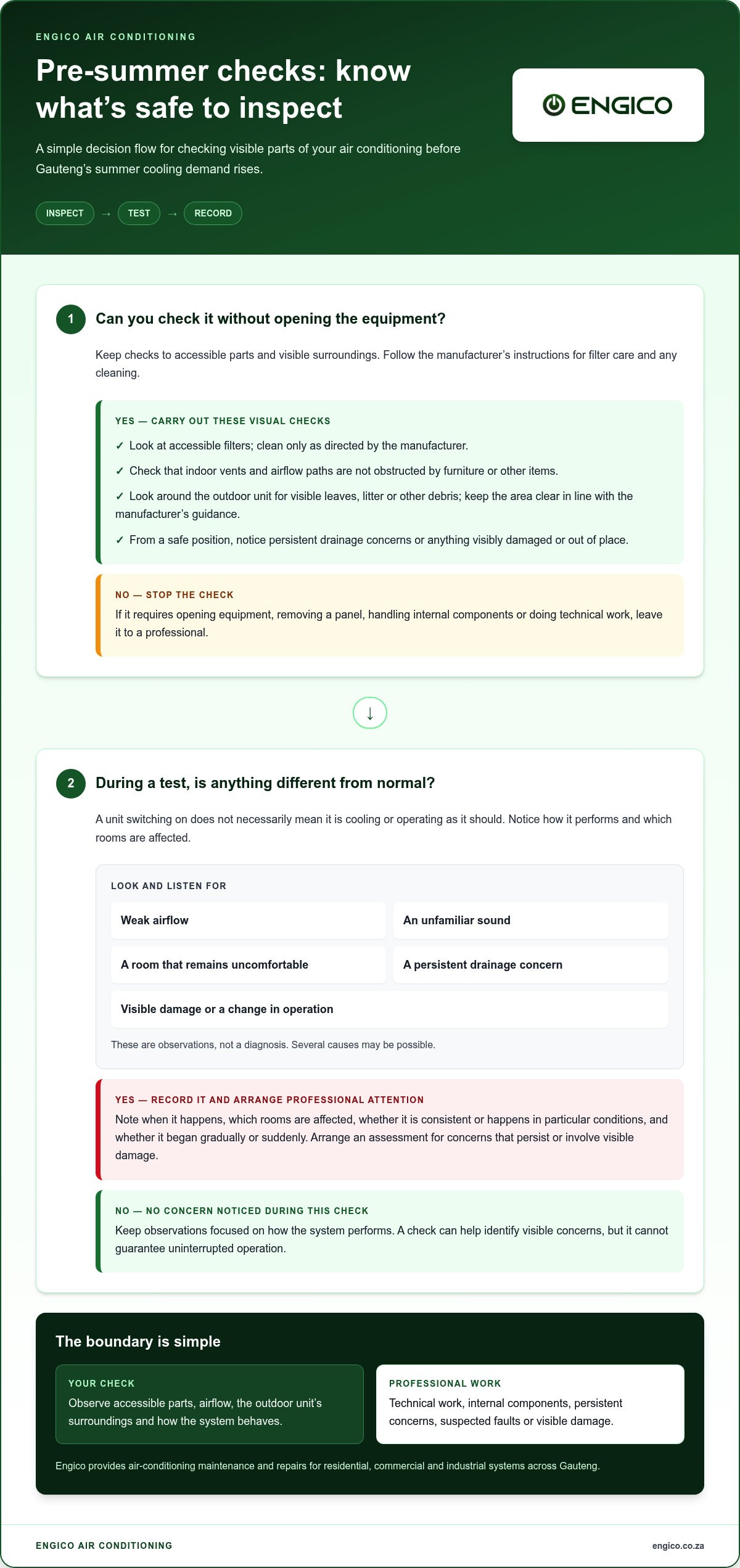
Work through these visual and user-level checks before regular summer use. Follow the manufacturer’s instructions for any cleaning or filter care, and stop if a check requires opening equipment or handling internal components. Preparing your air conditioning for a Gauteng summer means knowing what you can safely observe and when to leave technical work to a professional.
- Check accessible filters. Use the unit manual to find out whether the filters are user-accessible and need attention. Follow its cleaning or care instructions. Don’t force a filter out or reach into the equipment if access is unclear.
- Look at the indoor vents. Check that accessible supply and return vents aren’t covered by curtains, furniture or stored items. Make a note of any vent that appears damaged or has noticeably weaker airflow than others.
- Review the remote-control settings. Check the selected mode and temperature settings, then test whether the system responds to the controls. Keep the settings consistent during the test so you can observe its operation clearly.
- Run a brief, supervised test. Notice whether the system starts and whether air comes through the accessible vents. Record unusual sounds, weak airflow or areas that remain uncomfortable. A system starting up doesn’t by itself establish that everything is working correctly.
- Inspect the outdoor surroundings. From a safe position, look for visible leaves, litter or other debris near the outdoor unit, along with anything that appears damaged. Don’t open its casing or attempt to clean internal parts. Keep the surrounding area clear in accordance with the manufacturer’s guidance.
- Write down concerns. Note when a problem occurs, which room or area is affected, and what you observed. These details can help a technician assess the reported performance issue.
Which checks are for a technician?
Keep DIY checks to visual observation, accessible user controls and cleaning or filter care described in the manual. Don’t open the unit, attempt electrical work or handle refrigerant. Those are not checklist tasks for an untrained user.
A technician can assess the system’s condition and operation, and investigate concerns such as persistent weak airflow, unusual sounds or inadequate cooling. The findings help determine whether the system needs servicing or a repair. These are distinct needs: servicing addresses maintenance, while repairs address identified faults. Engico provides air-conditioning maintenance, servicing and repairs for residential, commercial and industrial systems across Gauteng.
DIY checks or professional air-conditioning maintenance in Gauteng?
A unit switching on doesn’t prove it’s cooling effectively or operating correctly. Basic checks can help you notice a change, but they can’t establish the condition of the whole system. Use this distinction to decide whether to keep observing or arrange an assessment.
| Safe to check yourself | Leave to a technician |
|---|---|
| Look at accessible filters and follow the manufacturer’s care instructions. | Open the unit or inspect internal components. |
| Check that accessible vents aren’t blocked and observe how the system responds to its controls. | Investigate persistent poor cooling, unusual noises or repeated shutdowns. |
| Look for visible debris or damage around the outdoor unit without opening its casing. | Assess leaks, drainage concerns, electrical components or refrigerant-related issues. |
When are basic homeowner checks enough?
Keep DIY checks to visible observations and tasks the manufacturer describes as user-accessible. A single test can show whether the unit starts, but it can’t confirm its full condition or explain a recurring fault. If you notice a symptom, record when it happens and which area is affected. Don’t dismantle the equipment to investigate further.
When should you arrange professional servicing or repairs?
Arrange a professional assessment if poor cooling persists, you hear unusual noises, see a leak or visible damage, or the system shuts down repeatedly. These symptoms can have different causes, so they need assessment rather than guesswork. Routine servicing addresses maintenance needs; repair work responds to a fault identified in the system. The right next step depends on its condition and reported behaviour.
For more detail about the distinction and available support, read about air-conditioner maintenance and repairs. Engico provides air-conditioning maintenance for Gauteng properties. If you’ve found a concern whilst preparing your air conditioning for a Gauteng summer, explore Engico’s air-conditioning maintenance as a practical next step.
A simple summer-readiness plan for Gauteng homes and workplaces
Turn your observations into a straightforward plan: inspect the accessible parts of the system, test its response, record any concerns, then arrange maintenance or repairs if needed. Preparing your air conditioning for a Gauteng summer before sustained seasonal use gives you time to act on recurring issues without treating a basic check as a full technical assessment.
- Inspect: Look over accessible filters, vents, controls and the area around the outdoor unit, following the manufacturer’s instructions.
- Test: Run the system and observe whether it starts and responds as expected. Notice any changes in cooling, airflow or sound.
- Record: Write down the affected rooms or areas, what you noticed and when it happens.
- Arrange attention if needed: Use your notes to explain recurring symptoms or visible concerns when arranging professional maintenance or repairs.
How should homes plan ahead?
Householders can test their cooling before the hottest part of the season and note rooms that remain uncomfortable or systems that behave differently from usual. This applies to wall-mounted split and multi-split systems, as well as other installed air-conditioning types. The number of units, room layout and how the home is used can all shape what you observe, so record specific rooms rather than describing the whole house as simply “not cooling”.
How should workplaces prepare their systems?
Property teams can document which areas are affected, when the system is used and whether the concern appears during particular occupancy or operating patterns. Larger or more complex systems may need planned professional attention, particularly if observations point to recurring performance concerns. Engico supplies, installs and maintains air-conditioning systems for residential, commercial and industrial requirements across Gauteng. For a workplace-focused example, see commercial HVAC maintenance in Sunninghill.
A written record turns a general concern into useful information for maintenance or repair. It also makes it easier to track whether an issue returns after the system has been checked. Engico provides air-conditioning maintenance across Gauteng for homes and workplaces, with support suited to different property types and systems.
For planned support ahead of summer, arrange air-conditioning maintenance with Engico.
Get your cooling ready for the season ahead
A simple check before regular summer use can help you spot changes in airflow, cooling or drainage early. Keep visual checks within the manufacturer’s guidance, and leave technical concerns or recurring faults for professional assessment. This approach to preparing your air conditioning for a Gauteng summer gives you a clearer next step without assuming that a system switching on is proof it’s working as it should.
Make a note of any affected rooms, unusual sounds or changes in operation, then arrange maintenance or repairs if needed. Engico supports residential, commercial and industrial air-conditioning requirements across Gauteng, with maintenance, servicing and repair capabilities for different system needs.
Arrange air-conditioning maintenance with Engico and take a measured step towards summer readiness. With concerns recorded and the right support in place, you can approach the warmer months with greater confidence.
Frequently Asked Questions
How do I prepare my air conditioning for summer in Gauteng?
Start with the checks permitted by your unit’s manufacturer: inspect accessible filters, keep vents clear and test the controls. Look around the outdoor unit for visible debris, but don’t open its casing. Note unusual sounds, leaks or poor cooling rather than trying to diagnose them yourself. If symptoms persist, arrange professional maintenance or repairs so the system can be assessed before regular summer use.
When should I service my air conditioner before summer?
Arrange a check before you expect to rely on cooling regularly, leaving time to address any concerns identified. The appropriate timing depends on factors such as the system, how often it operates and its surroundings. Follow the manufacturer’s guidance and keep a record of previous servicing. If you’ve noticed a change in performance, seek an assessment rather than waiting for a planned service date.
Can I clean my air-conditioner filter myself?
You may be able to clean or replace an accessible filter if the manufacturer’s instructions allow it. Follow the manual, switch the unit off as directed and don’t force parts or reach into the equipment. Filter care doesn’t replace a professional service. If the filter is damaged, difficult to access or the system continues to perform poorly afterwards, arrange an assessment rather than attempting further work.
Why is my air conditioner running but not cooling properly?
Several issues can cause weak cooling, including restricted airflow, incorrect settings or a fault requiring technical assessment. Check the controls and accessible vents, and look for obvious obstructions around the outdoor unit. If the problem continues, record when it occurs and which rooms are affected. A unit switching on doesn’t confirm that it’s cooling correctly. Don’t open the equipment or attempt electrical or refrigerant work.
What should be included in an air-conditioning summer check?
Start with user-accessible items: filters, vents, controls and visible conditions around the outdoor unit. Follow the manufacturer’s instructions for filter care and note any unusual sounds, leaks or poor cooling. A professional assessment can consider system operation and the concerns you’ve recorded. The work required depends on the equipment and its condition, so don’t assume that every system needs identical maintenance.
Is it safe to use an air conditioner after heavy rain?
Rain alone doesn’t establish whether an air conditioner is safe or damaged. Before using it, look for visible damage or unusual conditions around the unit without touching internal components. If it appears damaged, behaves differently or repeatedly shuts down, stop using it and arrange a professional assessment. Don’t open the equipment or attempt electrical repairs. Report what you observed so the concern can be assessed appropriately.
How do I know whether my air conditioner needs maintenance or repair?
Maintenance is planned attention to assess and care for an operating system, whilst repair addresses an identified fault. Persistent weak cooling, unusual sounds, visible leaks or repeated shutdowns are reasons to arrange an assessment. Record when symptoms occur and which areas are affected. Engico provides maintenance, servicing and repairs across Gauteng Province, including Pretoria, Johannesburg, Centurion, Menlyn, Farie Glen, Silverton, Waterkloof, Gezina, Doringkloof, Midrand, Waterfall, Sunninghill, Woodmead, Sandton, Randburg, Roodepoort, Fourways and Hyde Park.
Recent Comments