

An office can feel stuffy even when the air conditioner is running, because temperature control alone doesn’t guarantee fresh, well-circulated air. Working out how to improve office air quality for employees starts with identifying when and where problems occur, then checking possible causes such as ventilation, filtration, moisture or indoor pollution.
If staff report stale air, discomfort or changing temperatures, it can be difficult to tell whether the issue is poor ventilation, humidity or uneven cooling. The right response isn’t always new equipment. Reviewing occupancy patterns, airflow, filters and potential pollutant sources can help facilities teams prioritise practical steps and limit disruption.
This guide explains how to identify patterns behind complaints, distinguish air quality concerns from temperature and humidity issues, and improve ventilation and filtration as part of a wider maintenance plan. It also covers when an HVAC or ventilation assessment may be appropriate, including where air handling units, ventilation fans or building controls could be relevant.
Key Takeaways
- Learn how to improve office air quality for employees by identifying likely causes before choosing a solution.
- Use a room-by-room walk-through to check airflow routes, vents, filters and signs of moisture.
- Match the response to the issue: address pollution sources, ventilation, filtration or maintenance as appropriate.
- Gather employee feedback and keep a record of observations and actions to assess what changes are working.
- Know when recurring complaints, poor airflow or persistent moisture may call for an HVAC or ventilation assessment.
How to improve office air quality for employees: start by finding the cause
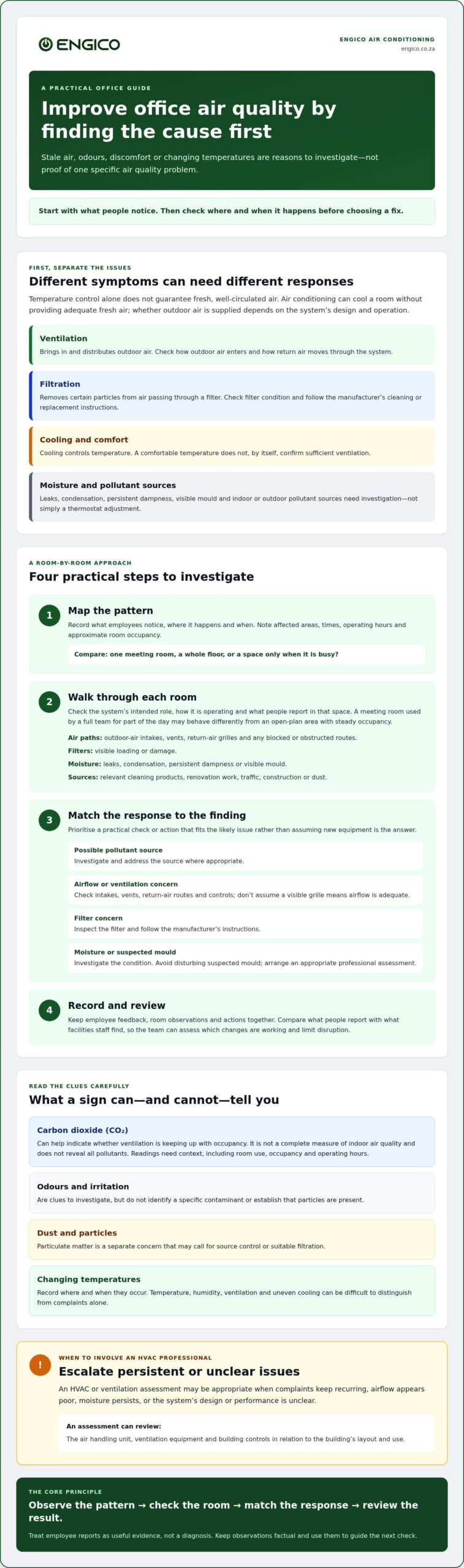
Stale air, persistent odours, irritation or discomfort are reasons to investigate, not proof of a particular air quality problem. Possible causes include inadequate fresh-air supply, particles, moisture, temperature or a pollutant source. When considering how to improve office air quality for employees, first record what people notice, where it happens and when. Changing the thermostat alone may not address the cause.
Indoor air quality (IAQ) describes the condition of the air inside a building, including ventilation, pollutants, particles, odours, temperature and moisture. The Indoor air quality (IAQ) overview explains common indoor pollutants and approaches such as ventilation and filtration. These factors can interact, but each may need a different response.
Ventilation brings in and distributes outdoor air; filtration removes certain particles from air passing through a filter; cooling controls temperature. Air conditioning can make a room cooler without providing adequate fresh air. Whether outdoor air is supplied depends on the system’s design and operation, so a comfortable temperature alone doesn’t confirm sufficient ventilation.
What does good office air quality involve?
Good office air is clean and comfortable for the people using the space, but no single reading captures every aspect of it. Carbon dioxide (CO2) can help indicate whether ventilation is keeping up with occupancy. It isn’t a complete measure of air quality and doesn’t reveal all pollutants. Particulate matter, such as dust, is a separate concern that may call for source control or suitable filtration. Odours are clues to investigate, but they don’t identify a specific contaminant or establish that particles are present.
Which office conditions should be investigated first?
Look for patterns before selecting equipment or changing system settings. Record the affected areas, times, operating hours and approximate room occupancy. Note whether concerns occur in one meeting room, across a floor or only when a space is busy. This helps distinguish a local issue from a broader pattern.
Then consider possible influences inside and outside the building. Depending on the site, nearby traffic, construction or dust may affect incoming air. Ask facilities staff to note recent renovations, cleaning activities or equipment faults, and compare these with when concerns began. Keep observations factual: they can guide further checks but don’t confirm the cause on their own.
Assess office ventilation, filtration, and moisture before choosing a fix
Before changing equipment or operating settings, carry out a room-by-room walk-through. Record what the system is designed to do, how it is operating and what employees report in each space. A conference room used by a full team for part of the day may behave differently from an open-plan area with steady occupancy. Note possible pollution sources inside and outside the building, such as cleaning products, renovation work, traffic or dust, where relevant.
How can you check whether an office is adequately ventilated?
Check how outdoor air enters the building and how return air moves through the system. Look for blocked outdoor-air intakes, obstructed vents or altered controls, but don’t assume that a visible grille confirms adequate airflow. When reviewing available carbon dioxide readings and employee feedback, note room use, occupancy and operating hours. A sensor provides one piece of evidence, not a complete assessment of indoor air.
If the system’s design or performance is unclear, ask a qualified HVAC professional to assess it. They can review the air handling unit, ventilation equipment and controls in relation to the building’s layout and use.
What should you check in filters, moisture, and air pathways?
Inspect filters for visible loading or damage, and check that cleaning or replacement follows the manufacturer’s instructions. Look for leaks, condensation, persistent dampness or visible mould. These conditions need investigation rather than being treated as a ventilation setting alone. Avoid disturbing suspected mould; arrange an appropriate professional assessment to establish the cause and next steps.
Also check whether furniture, storage or closed vents are blocking supply or return-air pathways. For example, a cabinet placed in front of a grille can interfere with air distribution in that part of the room. Record what you find and where, so the facilities team can compare observations across rooms.
For a useful walk-through, note:
- the location and condition of outdoor-air intakes, vents and return-air grilles;
- filter condition and the relevant manufacturer guidance;
- visible obstructions, moisture or suspected mould; and
- room occupancy and system operating times alongside any monitoring results.
Interpret measurements in context. A reading taken in an empty office may not reflect conditions during a busy meeting, while a single carbon dioxide result cannot identify every pollutant or confirm overall air quality. Before applying numerical targets or citing standards, verify that they are current and appropriate for the South African context. This helps prevent an overseas benchmark from being mistaken for a local requirement.
This evidence-led process is a practical starting point for how to improve office air quality for employees. Where checks indicate an equipment or airflow concern, facilities teams can review relevant commercial air conditioning and ventilation equipment as part of a wider assessment, rather than choosing a product before understanding the cause.
Which office air quality improvements should you prioritise?
Match each action to an observed problem. Start by controlling an identified source, such as a strong-smelling cleaning product or dust from renovation work. Then consider whether ventilation, filtration or equipment maintenance is needed. A filter can capture suitable particles, but it won’t remove every gas, odour or pollutant, and it can’t resolve a source that continues to release contaminants.
Adjust ventilation when evidence points to insufficient outdoor-air delivery or poor air distribution. However, bringing in more outdoor air isn’t automatically the right answer. Facilities teams should consider local outdoor conditions, including dust or pollution near the building, and confirm that the existing system can handle a change in airflow. Filter upgrades also need compatibility and system-capacity checks, since an unsuitable filter may affect system operation.
Match the action to the issue
| Improvement | Likely use | Limitation and when to seek advice |
|---|---|---|
| Source control | Identified odours, dust or emissions from products and activities. | Find and reduce the source; seek specialist advice if it’s unclear or cannot be controlled. |
| Ventilation adjustment | Evidence of inadequate outdoor-air delivery or uneven distribution. | Account for outdoor conditions and system capacity. Ask an HVAC professional to assess design or operating changes. |
| Filtration | Suitable airborne particles that can be captured by the selected filter. | It won’t address every pollutant. Check filter compatibility and equipment capacity before upgrading. |
| Maintenance | Dirty or damaged filters, equipment faults or restricted airflow. | Follow manufacturer guidance and arrange appropriate servicing if a fault persists. |
Address products, dust and moisture at source
Ask facilities staff to review how cleaning products are stored and used, and whether cleaning schedules coincide with employee concerns. Reduce avoidable dust through routine housekeeping. For renovation or construction, plan suitable controls to limit dust spreading into occupied areas. Persistent dampness or suspected mould needs assessment by qualified building specialists, rather than simply masking an odour or increasing filtration.
Prioritise actions using the evidence gathered in your building. Address an identified source first, then assess whether ventilation adjustments, suitable filtration or maintenance are also needed. If the cause or appropriate intervention remains uncertain, a qualified professional can help assess the building and its HVAC system.
How to put an employee-focused office air quality plan into action
A clear process helps facilities teams respond consistently, explain what is being investigated and check whether changes make a difference. Assign a facilities lead to coordinate reports, assessments, maintenance records and follow-up. The aim is to identify patterns and act on building conditions, not to diagnose health concerns or promise a particular outcome.
How should employers involve employees?
Give staff a straightforward way to report concerns. Ask them to note the room or area, time, nature of the issue and whether it occurs during a particular activity or occupancy pattern. Share updates on what is being checked and when employees can expect a progress report. Review trends across rooms and work schedules, and keep records focused on the workplace rather than unnecessary personal information.
How can facilities teams monitor results over time?
Use a consistent record so observations before and after an intervention can be compared. The facilities lead can log actions, dates, maintenance visits, filter changes, system settings, occupancy and follow-up feedback. If instruments are used, follow their instructions and record where and when readings were taken. Interpret results alongside how the space was being used; a measurement on its own may not explain a recurring concern.
A practical sequence is:
- Gather feedback: Record the location, timing and nature of employee concerns.
- Review patterns: Compare reports with room use, occupancy, operating schedules and relevant building records.
- Assess: Arrange suitable HVAC or ventilation investigation if the evidence points to a system issue.
- Act and document: Record the change, responsible person and date, including any planned HVAC maintenance services for Gauteng properties.
- Follow up: Recheck the same areas and gather feedback using the same reporting approach.
Where ongoing system information is available, facilities teams can compare operating conditions with occupancy and reported concerns. Building management system integration may support this oversight. Monitoring should guide investigation, not replace it.
A documented plan gives teams a practical way to work out how to improve office air quality for employees and review the effect of each action. To discuss planned air conditioning maintenance or servicing, explore Engico’s HVAC maintenance services.
When to involve an HVAC professional in improving office air quality
Bring in an HVAC professional when concerns continue despite straightforward checks, airflow seems weak or uneven, or moisture problems keep returning. Recurring issues may involve system operation, air distribution, controls or maintenance. Changing a setting without understanding the cause could affect other areas of the building. Persistent dampness or suspected mould may also require assessment by a suitably qualified building specialist.
A professional review can help facilities teams understand whether the HVAC system is contributing to the concern and what should happen next. It should consider the building’s use and reported patterns, rather than treating one reading or one employee report as a complete diagnosis.
What should an office HVAC assessment cover?
Before the assessment, gather available maintenance records, a summary of employee concerns and details of room use, occupancy and operating schedules. Note relevant changes such as renovations, altered layouts or equipment faults. Ask the professional to review system operation, air distribution, filters and controls, then explain which recommendations are practical actions and which involve equipment or system changes. This makes it easier to plan work and communicate next steps to staff.
How can ongoing controls and maintenance support better indoor air?
Building management system integration can support HVAC monitoring and control by bringing relevant system information together. It doesn’t replace investigation or confirm air quality on its own, but it can help facilities teams understand system operation alongside occupancy and feedback. Planned maintenance, servicing and repairs can also help identify equipment issues and support reliable operation over time.
Engico supplies, installs and maintains commercial air conditioning and ventilation equipment, including air handling units, industrial ventilation fans and louvers. Its services also include building management system integration and air conditioner maintenance, servicing and repairs. These may form part of a wider air quality plan, but equipment alone shouldn’t be treated as a guaranteed solution to every indoor air concern.
For Gauteng offices, organise your observations and clarify the assessment scope and service availability directly. If you’re considering how to improve office air quality for employees, you can discuss your office HVAC requirements with Engico and determine whether its commercial air conditioning or ventilation services fit your needs.
Take a practical next step towards healthier office air
Improving office air quality starts with evidence, not assumptions. Record where and when concerns arise, inspect ventilation, filters and moisture, then prioritise actions that address the likely cause. Review the results with employees and facilities staff so changes can be assessed over time.
That practical sequence is central to understanding how to improve office air quality for employees. Cooling alone may not provide fresh air, and filtration cannot address every pollutant. Where concerns persist or airflow remains poor, an HVAC assessment can help clarify whether ventilation, system controls or maintenance need attention.
Engico supplies and installs commercial ventilation and air handling equipment, and provides HVAC maintenance, servicing and building management system integration. These capabilities can support a wider air quality plan when they suit the building’s needs. Discuss your office ventilation and HVAC requirements with Engico to consider a measured next step. With clear observations and a considered plan, your team can work towards a more comfortable office environment.
Frequently Asked Questions
How can I improve office air quality for employees?
Start by recording employee concerns and identifying where and when they occur, then check likely sources, ventilation, filters and signs of moisture. Address identified pollutant sources before relying on filtration alone, and avoid changing system settings without understanding their effect. Compare follow-up observations with the original reports. If concerns recur, airflow is poor or dampness persists, arrange an appropriate HVAC or building assessment to help determine the next step.
Does air conditioning improve indoor air quality?
Air conditioning can support a comfortable indoor environment, but cooling alone doesn’t guarantee adequate fresh air or remove every pollutant. What it does depends on the system’s design, filtration and operation. Some systems primarily cool and recirculate indoor air, whilst others may be connected to ventilation equipment. Check how outdoor air is supplied and distributed, and whether filters suit the system. Persistent odours or stale air may need investigation beyond temperature adjustments.
How often should office air conditioning filters be changed?
There isn’t one replacement interval suitable for every office system. Follow the equipment and filter manufacturer’s instructions, and have facilities staff check filter condition as part of planned maintenance. Dust levels, operating hours and building use can affect how quickly a filter needs attention. Record inspections and replacements. If a filter is damaged, heavily loaded or difficult to access, ask an HVAC professional to confirm the correct replacement and whether the system needs servicing.
Can office plants improve air quality for employees?
Plants can add greenery to an office, but they shouldn’t be treated as a replacement for source control, ventilation or appropriate filtration. A few pots can’t reliably resolve inadequate outdoor-air supply, persistent odours or dust from building work. Plant containers can also introduce moisture if overwatered. If employees report air quality concerns, investigate the location, timing and possible sources, then choose actions that address the cause rather than relying on plants to clean the office air.
What does high carbon dioxide in an office mean?
A higher carbon dioxide reading can indicate that ventilation may not be keeping up with occupancy, particularly in a busy or enclosed room. Interpret it alongside the number of people present, room use, operating hours and employee feedback. A single reading doesn’t measure every pollutant or provide a complete picture of indoor air quality. If elevated readings recur in occupied spaces, review ventilation operation and seek professional advice where system performance is unclear.
Can poor office ventilation make employees feel unwell?
Poor ventilation may contribute to discomfort or symptoms such as stuffiness and irritation, but these experiences don’t prove that ventilation is the cause. Temperature, humidity, odours, particles and other building conditions may also be relevant. Record when and where concerns occur, and look for patterns rather than making a diagnosis. Recurring reports, especially alongside poor airflow or persistent moisture, are a reason to investigate the workplace and consider suitable professional assessment.
Who can assess office air quality in Gauteng?
For ventilation or HVAC concerns, consult a qualified professional and confirm that the assessment matches your needs. Engico Air Conditioning supplies and installs commercial ventilation equipment and air handling units, and provides HVAC maintenance and servicing. Its local focus includes Gauteng, with locations such as Pretoria, Johannesburg, Centurion, Menlyn, Farie Glen, Silverton, Waterkloof, Gezina, Doringkloof, Midrand, Waterfall, Sunninghill, Woodmead, Sandton, Randburg, Roodepoort, Fourways and Hyde Park. Confirm the assessment scope directly.
Recent Comments