
How many project delays and budget overruns are caused by a simple lack of coordination between your mechanical designer, the equipment supplier, and the installation team? It’s a common challenge for facility managers who find themselves caught between disparate contractors whilst attempting to meet strict energy efficiency targets. You likely recognise that managing multiple points of contact often leads to technical gaps and unforeseen costs. Opting for a professional turnkey HVAC installation South Africa resolves these issues by consolidating the entire lifecycle of your climate control system under one expert partner.
This 2026 guide demonstrates how a turnkey approach streamlines your commercial project from initial design to long-term maintenance. We’ll explore how integrated solutions, including ducted systems and Building Management System (BMS) integration, ensure your facility remains compliant with South African National Standards (SANS). You’ll discover practical ways to mitigate the risks of local climate extremes and high operational costs through a methodical, single-source engineering strategy. This article provides the clarity needed to transition from a fragmented service model to a reliable, energy-efficient HVAC solution.
Key Takeaways
- Learn why a turnkey HVAC installation South Africa model provides a single point of accountability, eliminating the friction of managing multiple independent contractors.
- Understand the engineering principles behind heat load assessments to ensure your system is perfectly sized for your specific commercial footprint without wasting energy.
- Discover how integrating industrial ventilation fans and louvers improves air quality and operational safety in large-scale warehouse and factory settings.
- Explore how Building Management System (BMS) integration transforms your HVAC equipment into a smart asset capable of real-time energy optimisation.
- Identify the importance of partnering with a specialist who understands SANS compliance and the unique environmental demands of Gauteng’s commercial centres.
Understanding Turnkey HVAC Installation in the South African Context
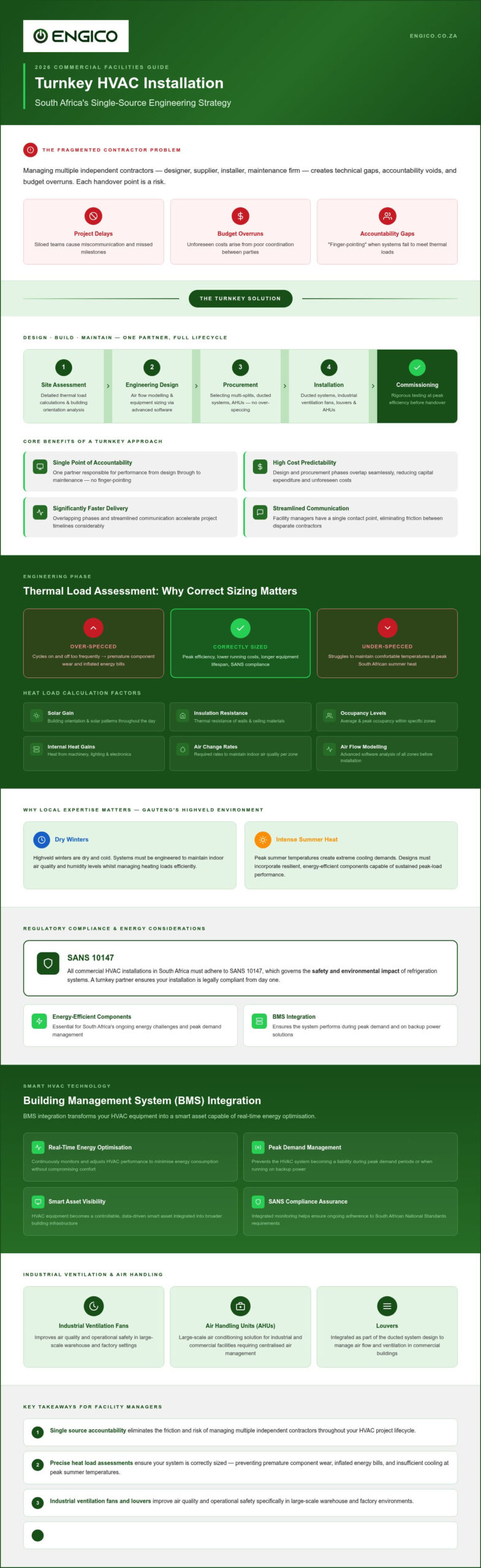
A turnkey HVAC installation South Africa model represents a shift from traditional, fragmented construction methods to a holistic “design-build-maintain” approach. In a standard project, a client might hire an independent consultant for the design, a separate contractor for the installation, and yet another firm for ongoing maintenance. This division often creates technical gaps and accountability issues. A turnkey solution eliminates these silos by placing the entire lifecycle of the system under a single engineering partner. It’s a method that prioritises long-term system health over short-term savings.
South African businesses are increasingly moving away from fragmented contracting due to the high risk of project delays and cost escalations. When the designer and the installer are the same entity, the responsibility for performance rests on one pair of hands. This single point of accountability reduces the likelihood of “finger-pointing” if a system fails to meet its specified thermal loads. The primary benefits include high cost predictability, streamlined communication, and significantly faster delivery times, as procurement and design phases can overlap seamlessly. This unified project delivery is an established industry standard internationally as well, where specialised commercial contractors such as J3 Mechanical Services manage installation, replacement, and new construction services to ensure end-to-end accountability.
The Components of a Turnkey Solution
The process begins with a detailed site assessment. Engineers perform precise thermal load calculations to determine the exact requirements of the space. This prevents the common mistake of over-speccing equipment, which leads to unnecessary capital expenditure and high running costs. Once the requirements are clear, the procurement phase involves selecting the most appropriate hardware, whether that includes multi-split units, ducted air conditioning systems, or large-scale Air Handling Units (AHUs). The final stage is commissioning, where the system is rigorously tested to ensure it operates at peak efficiency before handover.
Why Local Expertise Matters in Gauteng
Designing for the South African climate requires more than just standard equipment. In Gauteng, systems must handle the Highveld’s specific environmental profile, characterised by dry winters and intense summer heat. A turnkey partner with local experience understands how to adapt designs for these temperature ranges whilst maintaining indoor air quality. It’s not just about comfort; it’s about engineering resilience into the building’s infrastructure.
Compliance is another critical factor. All commercial installations must adhere to South African National Standards, specifically SANS 10147, which governs the safety and environmental impact of refrigeration systems. Furthermore, with the ongoing energy challenges in the region, modern designs must incorporate energy-efficient components and Building Management System (BMS) integration. This ensures the HVAC system doesn’t become a liability during peak demand periods or whilst running on backup power solutions. By choosing a turnkey HVAC installation South Africa specialist, facility managers ensure their infrastructure is both legally compliant and operationally robust.
The Engineering Phase: Designing for Efficiency and Scale
The engineering phase serves as the technical foundation for any successful turnkey HVAC installation South Africa project. It’s during this stage that methodical planning prevents the common pitfall of over-speccing equipment. When a system is excessively large for its environment, it cycles on and off too frequently, which leads to premature component wear and inflated energy bills. Conversely, an undersized system will struggle to maintain comfortable temperatures during the peak of a South African summer. A professional design process ensures that equipment capacity is perfectly aligned with the building’s actual thermal requirements.
Calculating Thermal Loads for South African Buildings
Accurate heat load assessments are essential for modern commercial spaces. Engineers must carefully analyse the building’s orientation to determine solar gain patterns throughout the day. They also evaluate the thermal resistance of insulation materials in walls and ceilings. Several factors contribute to the final calculation:
- Average and peak occupancy levels within specific zones.
- Internal heat gains produced by machinery, lighting, and electronics.
- Required air change rates to maintain indoor air quality.
By utilising advanced software for air flow modelling, designers ensure that every component meets international HVAC engineering standards. This level of precision ensures the system operates within its most efficient performance range from the day it’s commissioned.
Selecting the appropriate technology is a decision that impacts operational costs for years. Variable Refrigerant Flow (VRF) systems offer high efficiency for multi-zone office blocks, whilst large-scale ducted air conditioning systems are better suited for open-plan warehouses. Incorporating energy-saving features, such as inverter technology and heat recovery systems, into the initial blueprint ensures that the building remains efficient as energy costs rise. This forward-thinking approach reduces the total cost of ownership by minimising waste from the outset.
Selecting Equipment for Longevity
Durability is a priority in the local environment. HVAC hardware must withstand high ambient temperatures and the significant dust levels common in Gauteng’s industrial areas. For modular office environments, wall mounted split air conditioners offer a flexible and dependable cooling solution. These units are particularly effective in segmented spaces where individual temperature control is required for different teams. Choosing high-quality components at the outset ensures that the system remains a reliable asset rather than a maintenance burden. If you’re looking to upgrade your facility, it’s often helpful to discuss your requirements with a specialist who understands the nuances of local climate demands.
Industrial Ventilation and Air Handling: The Turnkey Difference
Industrial environments present unique challenges that go beyond simple temperature control. In large-scale factories and warehouses, managing air quality and heat dissipation requires a coordinated effort between active cooling and mechanical ventilation. A turnkey HVAC installation South Africa partner ensures these systems are synchronised. This prevents the inefficiency of cooling systems fighting against unmanaged internal heat loads or poor air circulation. By integrating these elements from the design phase, businesses avoid the technical friction that occurs when ventilation and air conditioning are treated as separate projects.
The primary goal in industrial settings is to maintain a stable environment that supports both worker productivity and machinery health. Stagnant air leads to heat pockets and the accumulation of airborne particulates, which can compromise safety. A turnkey provider manages the selection and placement of high-performance fans, louvers, and Air Handling Units (AHUs) to create a cohesive airflow strategy. This methodical approach ensures that the ventilation system scales with the facility’s operational demands whilst remaining energy efficient.
High-Performance Ventilation Solutions
High-performance fans and louvers are the workhorses of industrial spaces. They facilitate passive cooling by exhausting hot air and drawing in cooler ambient air, which reduces the load on active refrigeration systems. For detailed technical standards, facility managers should consult specific resources on warehouse ventilation design South Africa. In manufacturing plants, maintaining positive or negative air pressure is often critical for safety and product integrity. Turnkey providers integrate these mechanical components into the broader building design to ensure consistent circulation across massive floorplates without creating disruptive drafts.
Custom Air Handling Units (AHUs)
Air Handling Units (AHUs) are essential when precise filtration or humidity control is required. Unlike standard residential units, custom AHUs can be scaled to meet the demands of high-infrastructure environments. Their role is particularly vital in specialised sectors, such as HVAC for data centres in South Africa, where equipment longevity depends on strict environmental parameters. By scaling ventilation for massive commercial footprints, a turnkey specialist ensures that every square metre of a facility remains within its operational threshold. This integrated approach mitigates the risk of stagnant zones where air becomes trapped, ensuring the entire system functions as a unified asset.
Optimising Performance with Building Management Systems (BMS)
Integration of a Building Management System (BMS) is what distinguishes a high-performance turnkey HVAC installation South Africa from a standard hardware setup. It’s a strategic move that transforms your climate control infrastructure into a smart asset that communicates with other building utilities. A BMS acts as a central nervous system, collecting data from sensors across the facility to adjust cooling, airflow, and ventilation levels based on actual occupancy and ambient conditions. This level of automation significantly reduces the burden on facility managers whilst ensuring that indoor environments remain consistent throughout the day. It moves the system from a reactive mode to a proactive one.
Choosing a turnkey HVAC installation South Africa provider that includes BMS ensures your hardware is future-proofed against rising energy costs. By centralising the control of your heating and cooling, you gain a level of transparency that’s impossible with manual thermostats. This visibility allows for data-driven decisions that impact both the comfort of your tenants and your bottom line.
Energy Efficiency and Cost Control
Utility costs represent a substantial portion of commercial operational overheads in South Africa. By implementing smart HVAC control for commercial buildings, owners can precisely manage their energy footprint. In Gauteng, where peak-demand tariffs and power availability are constant concerns, a BMS allows for sophisticated load-management strategies. The system can be programmed to pre-cool a building during off-peak hours or reduce output in non-essential zones when sensors detect no activity. The return on investment for such automated temperature regulation is typically realised through lower utility bills and an extended lifespan for the mechanical equipment.
Long-Term System Reliability
Long-term reliability is maintained through continuous, granular oversight. BMS software monitors the health of fans, compressors, and air handling units, providing predictive alerts before a minor issue becomes a critical failure. This data-driven approach is a core component of commercial HVAC maintenance in Sunninghill and other growing business hubs. Instead of relying solely on calendar-based servicing, technical teams use real-time performance metrics to prioritise repairs. For organisations managing multi-site commercial portfolios, centralised control allows for uniform climate standards and energy reporting across all locations from a single interface. If you’re ready to modernise your facility’s infrastructure, you can enquire about our BMS integration services to start optimising your climate control today.
Executing Your Turnkey Project: Why Partner with Engico?
Engico presents itself as a methodical specialist, providing a seamless transition from engineering blueprints to a fully operational climate control system. By choosing a partner that manages every phase of a turnkey HVAC installation South Africa, businesses eliminate the technical risks and communication gaps associated with fragmented service delivery. We operate as a reliable extension of your facility management team, ensuring that every ducted system or air handling unit is installed with precision. Our deep expertise in Gauteng’s primary commercial centres, including Sandton, Midrand, and Pretoria, allows us to provide localised support that understands the specific infrastructure requirements of these high-density hubs.
Comprehensive Installation Services
The execution phase is where technical planning meets practical logistics. Managing large-scale ducted and multi-split installs requires a disciplined approach to ensure project timelines are met without compromising on engineering quality. We prioritise minimal disruption to your daily business operations by organising work schedules that respect your facility’s peak activity periods. This methodical progression continues through to the final handover, where we conduct thorough system commissioning and provide comprehensive staff training on new digital controls. This ensures your team is confident in operating the system to its full potential from the moment we depart.
Maintenance and After-Sales Support
A turnkey partnership doesn’t end at the point of installation. Long-term value is secured through the selection of durable equipment and a commitment to recurring professional care. We offer customised HVAC maintenance services for Gauteng properties, designed to protect your significant capital investment. These scheduled interventions are critical for ensuring ongoing compliance with SANS 10147 regulations, which govern safety and environmental standards for refrigeration and air conditioning in commercial environments.
Our commitment to delivering a high-quality turnkey HVAC installation South Africa rests on our ability to provide forward-thinking maintenance programmes. These focus on extending equipment life and maintaining high energy efficiency whilst reducing operational costs. Should a component fail, our technical teams provide a rapid response to prevent total system downtime and protect your building’s infrastructure. By consolidating your maintenance needs with the same partner that designed and installed your system, you benefit from a deep familiarity with your building’s specific thermal profile. This holistic approach ensures your HVAC infrastructure remains a stable, high-performing asset that supports your business’s growth and environmental responsibility.
Securing Your Commercial Infrastructure for 2026 and Beyond
Transitioning to an integrated climate control model is a strategic investment in your building’s operational resilience. By consolidating design, procurement, and maintenance under one engineering partner, you eliminate the technical friction that often leads to project delays. A professional turnkey HVAC installation South Africa ensures that your facility benefits from precise thermal load calculations and seamless Building Management System (BMS) integration. These elements work together to lower utility costs whilst maintaining strict compliance with South African National Standards.
Engico provides the methodical expertise required for complex commercial environments across Sandton, Pretoria, and Midrand. Our focus remains on delivering durable, energy-efficient systems supported by comprehensive maintenance programmes that protect your infrastructure investment. Whether you’re managing a high-density office block or a massive industrial warehouse, our team is equipped to handle the logistics of large-scale installs and ongoing technical support. To begin optimising your facility’s performance, request a turnkey HVAC consultation with Engico today. Investing in a unified engineering approach is the most reliable way to ensure your environment remains productive and cost-effective for years to come.
Frequently Asked Questions
What does a turnkey HVAC installation include in South Africa?
A turnkey HVAC installation South Africa package includes the entire project lifecycle from initial thermal load assessments to final system commissioning. It covers the design and supply of equipment such as ducted air conditioning systems or air handling units. By placing the project under a single point of accountability, facility managers ensure that every mechanical component is synchronised. This holistic model typically includes post-installation support and Building Management System (BMS) integration to maintain long-term efficiency.
How long does a commercial turnkey HVAC project typically take?
Project timelines vary based on the building’s footprint and the complexity of the required infrastructure. A standard commercial installation in Gauteng might range from a few weeks for segmented offices to several months for large-scale industrial warehouses. The turnkey approach often accelerates delivery because the design and equipment procurement phases happen concurrently. This streamlined coordination reduces the risk of the project delays that frequently occur when managing multiple independent contractors for a single site.
Are turnkey HVAC solutions more expensive than traditional contracting?
Whilst the initial capital expenditure for a turnkey solution may appear higher, it’s often more cost-effective over the system’s lifespan. Traditional fragmented contracting frequently leads to expensive over-speccing or technical gaps that require costly retrofitting. A turnkey HVAC installation South Africa provides high cost predictability through a consolidated quote. It prevents the financial risk of “finger-pointing” between designers and installers, ensuring you receive a system that’s engineered specifically for your building’s thermal profile.
Does Engico provide HVAC services for server rooms in Midrand?
Yes, we provide specialised climate control solutions for high-infrastructure environments like server rooms throughout Midrand and the wider Gauteng region. Our technical teams understand the strict temperature and humidity parameters required to protect sensitive data hardware. We focus on implementing redundant systems and high-performance air handling units to ensure continuous uptime. Our local presence in Midrand allows for rapid technical support and methodical maintenance to prevent any environmental risks to your digital assets.
What South African regulations apply to commercial HVAC installations?
Commercial installations must comply with several key South African National Standards, most notably SANS 10147. This regulation governs the safety and environmental impact of refrigeration systems and heat pumps. Additionally, designs must adhere to local building regulations regarding ventilation and energy efficiency standards. A professional turnkey partner ensures all documentation and equipment meet these legal requirements, protecting your business from liability whilst ensuring a safe environment for your staff and tenants.
Can an existing HVAC system be integrated into a new BMS?
Many existing commercial systems can be successfully integrated into a modern Building Management System (BMS), provided the hardware supports digital controls. This integration allows for real-time monitoring of energy consumption and automated temperature regulation. If your current equipment is older, we assess the feasibility of adding sensors and controllers to bridge the gap to modern standards. This optimisation helps transform legacy hardware into a smart asset, significantly lowering operational overheads without requiring a full system replacement.
Why is industrial ventilation important for South African warehouses?
Industrial ventilation is critical in South Africa to manage the Highveld’s intense summer heat and prevent stagnant air pockets in large floorplates. High-performance fans and louvers facilitate passive cooling by exhausting hot air and drawing in cooler ambient air. This reduces the workload on active air conditioning systems, which lowers utility bills. Proper circulation also removes airborne particulates and fumes in manufacturing environments, ensuring your facility remains compliant with health and safety regulations whilst protecting machinery.
What maintenance is required after a turnkey installation?
Post-installation maintenance typically involves scheduled technical inspections to ensure all components operate at peak efficiency. This includes cleaning filters, checking refrigerant levels, and verifying the calibration of BMS sensors. Methodical servicing prevents minor technical issues from developing into critical failures that cause system downtime. We provide customised maintenance contracts for Gauteng properties that include regular performance reporting, helping to extend the lifespan of your equipment whilst maintaining high indoor air quality standards throughout the year.
Recent Comments