
Did you know that heating, ventilation, and air conditioning systems can account for as much as 60% of the total electricity consumption in South African commercial buildings? This significant figure represents both a substantial operational challenge and a major opportunity for property managers across Gauteng. With Eskom’s standard tariffs having increased by an average of 8.76% in April 2026, the financial burden of maintaining inefficient legacy cooling systems is becoming unsustainable for many businesses.
You are likely already feeling the pressure to comply with the latest Energy Performance Certificate (EPC) standards and the Physical Agents Regulations. It’s a complex landscape to navigate, but reducing the HVAC carbon footprint in commercial buildings does not always require a total system overhaul. By focusing on high-efficiency hardware and smart integration, you can achieve measurable energy savings and improve indoor air quality for your tenants. This strategy outlines practical, high-impact methods to lower your emissions and operational costs. We will examine how professional maintenance, modern building management systems, and the Section 12L tax incentive can work together to secure your building’s long-term value and environmental compliance.
Key Takeaways
- Learn why transitioning to inverter technology and multi-split systems is a foundational step in modernising your cooling infrastructure for long-term efficiency.
- Discover how intelligent ventilation design and industrial fans can naturally reduce the mechanical cooling load required for large commercial spaces.
- Explore the role of Building Management Systems (BMS) in reducing HVAC carbon footprint commercial buildings through automated climate control and real-time energy monitoring.
- Understand the impact of scheduled maintenance programmes in preventing hidden energy waste caused by dirty filters and undetected refrigerant leaks.
- Gain insights into aligning your facility with 2026 environmental regulations whilst leveraging available tax incentives for verified energy savings.
Understanding the HVAC Carbon Footprint in South African Commercial Property
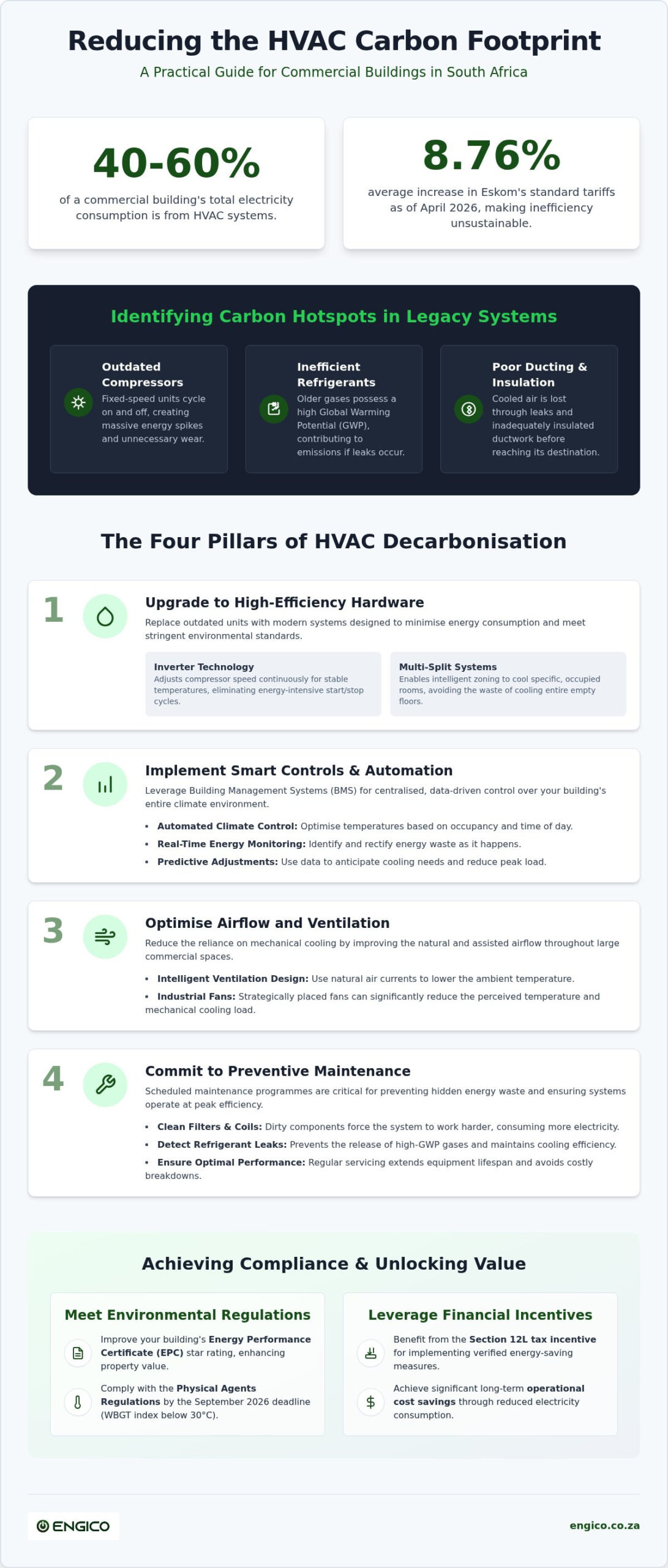
In the context of Gauteng’s commercial property sector, Heating, ventilation, and air conditioning (HVAC) systems represent the most significant opportunity for meaningful decarbonisation. These systems often account for between 40% and 60% of a commercial building’s total electricity consumption. In a region where summer temperatures frequently necessitate intensive cooling, the energy demand places a heavy load on both the national grid and a building’s operational budget.
When we discuss reducing HVAC carbon footprint commercial buildings, we primarily focus on operational carbon. This refers to the emissions generated during the daily running of the equipment. Whilst embodied carbon, which includes emissions produced during the manufacturing and disposal of units, is a relevant factor, the immediate priority for property owners is the high-impact reduction of energy waste. With the Eskom tariff hike of 8.76% in April 2026, the financial incentive to modernise has become a practical necessity for maintaining profitability.
The Role of Energy Performance Certificates (EPCs)
South African regulations require specific building categories to publicly display an Energy Performance Certificate. This rating provides a transparent disclosure of energy efficiency per square metre. Because HVAC systems are such high-energy consumers, their performance directly dictates your building’s star rating. A poor rating doesn’t only affect your environmental profile; it can lead to non-compliance penalties and diminished property value in a market that increasingly rewards sustainable infrastructure. Improving system efficiency is the most direct route to a better EPC grade.
Identifying Carbon Hotspots in Legacy Systems
Many older office blocks in Sandton or Pretoria still rely on legacy cooling technology that was designed when electricity was inexpensive. These systems often contain ‘carbon hotspots’ that quietly drain budgets. Common issues include:
- Outdated Compressors: Fixed-speed compressors that lack inverter technology are forced to cycle on and off, wasting significant energy in the process.
- Inefficient Refrigerants: Older systems often use gases with high Global Warming Potential (GWP) that contribute significantly to emissions if leaks occur.
- Ducting and Insulation: Energy waste is frequently found in ducted air conditioning systems where poor insulation allows cooled air to escape before reaching its destination.
Addressing these inefficiencies is essential for meeting the September 2026 compliance deadline for the Physical Agents Regulations. These rules mandate stricter controls for thermal stress in the workplace, ensuring that the Wet-Bulb Globe Temperature (WBGT) index doesn’t exceed 30°C. By identifying these hotspots, you can target your investment toward the most impactful upgrades. Furthermore, many commercial facilities combine hardware overhauls with onsite renewable generation to offset high cooling demands; to explore how commercial solar installations support broader decarbonisation strategies, visit Tally Energy Group.
High-Efficiency Hardware: Upgrading to Modern Cooling Systems
Upgrading to high-efficiency hardware is the most tangible step toward reducing HVAC carbon footprint commercial buildings. While maintenance is vital, older units often reach an efficiency ceiling that servicing cannot overcome. Modern systems utilise advanced components specifically designed to reduce commercial building energy consumption and meet the rigorous environmental standards of 2026.
Transitioning from fixed-speed units to inverter technology is a primary objective for many Gauteng property owners. Traditional compressors operate on an “all or nothing” basis; they start at full power and shut down completely once the target temperature is reached. This cycle creates massive energy spikes and unnecessary wear. Inverters use variable speed drives to adjust the motor speed continuously, maintaining stable temperatures without energy-intensive restarts.
Multi-split air conditioners offer further carbon benefits through intelligent zoning. Instead of cooling an entire floor, these systems allow for individual control of specific offices or meeting rooms. By avoiding the cooling of unoccupied spaces, property managers can drastically lower their operational emissions. Modern installations also prioritises low-GWP (Global Warming Potential) refrigerants, which are far less harmful to the atmosphere if a leak occurs.
Inverter Technology and Multi-Split Benefits
Variable speed drives don’t just save energy; they extend equipment lifespan by reducing mechanical stress. When switching from a central plant to a multi-split configuration, many businesses report a more stable climate control experience. This transition allows for granular management of energy use across different departments. If you are planning an upgrade, a professional assessment of your current air conditioning installation can identify the most efficient hardware for your specific floor plan.
Ceiling Cassette and Ducted System Efficiency
Ceiling cassette units are particularly effective in open-plan Johannesburg offices. They distribute air in four directions, which reduces the workload on the compressor by achieving the desired temperature quickly. For larger buildings, modern ducted air conditioning systems utilise advanced insulation to prevent thermal loss within the ceiling void.
Correct sizing is critical during the installation phase. A system that is too large will experience “short-cycling,” where it turns on and off too frequently, wasting power and failing to dehumidify the air properly. A correctly sized system runs for longer, more efficient cycles. This precision is a cornerstone of any successful strategy for reducing HVAC carbon footprint commercial buildings while maintaining tenant comfort.
Optimising Airflow and Ventilation for Reduced Energy Waste
Efficient climate control involves more than just cooling the air; it requires a strategic approach to how that air moves through a space. By improving natural and mechanical ventilation, property managers can significantly lower the load placed on primary cooling units. This integrated approach is a cornerstone of reducing HVAC carbon footprint commercial buildings, as it allows for comfortable indoor environments with less reliance on energy-intensive compressors.
Intelligent ventilation design focuses on removing stagnant heat and introducing fresh air without overworking the system. In large Gauteng facilities, the cost of cooling can be mitigated by using passive elements that work in tandem with mechanical systems. This synergy ensures that the building doesn’t just fight the heat but manages it through smarter circulation patterns.
Industrial Fans and Louvres for Passive Cooling
High-volume industrial fans are a highly effective tool for managing perceived temperatures in large open-plan offices or warehouses. These fans create a “breeze effect” that can make occupants feel significantly cooler without actually lowering the ambient temperature. Because these fans consume a fraction of the power required by a standard air conditioner, they allow for higher thermostat settings whilst maintaining compliance with thermal stress regulations.
Strategic louver placement further enhances this effect by facilitating natural cross-ventilation. Industrial louvres allow for a constant exchange of air even when the building is secured, which is particularly useful for night-time cooling. Flushing out accumulated daytime heat during the cooler night hours ensures the HVAC system starts the following morning from a much lower thermal baseline. This simple mechanical advantage reduces the initial energy spike typically seen during the morning startup.
Air Handling Units (AHUs) and Heat Recovery
Air Handling Units (AHUs) serve as the lungs of a commercial building, managing the intake of fresh outdoor air and the exhaust of stale indoor air. Modern AHUs can be equipped with heat recovery ventilation (HRV) systems. These systems capture the cooling energy from the exhaust air and use it to pre-cool the incoming fresh air. This process reduces the temperature differential that the cooling coils must handle, leading to substantial carbon savings over time.
In the dusty environments often found in Pretoria and Johannesburg, the efficiency of an AHU depends heavily on the condition of its filtration system. Clogged filters increase static pressure, forcing the fan motors to work harder and consume more electricity to maintain the required airflow. Regular cleaning and replacement of filters within these units are essential for maintaining peak efficiency and ensuring that the system contributes to a healthier, lower-carbon indoor environment.
Building Management Systems (BMS) and Smart HVAC Control
Modernising the physical components of a cooling system is a vital step, but the intelligence governing those components determines the actual energy savings achieved. A Building Management System (BMS) acts as the central nervous system of a facility, shifting the focus from manual adjustments to automated precision. This transition is a core pillar of reducing HVAC carbon footprint commercial buildings, as it eliminates the human error and inefficiency often associated with traditional thermostat management.
Data from industry studies indicates that the implementation of a BMS can reduce HVAC-related electricity usage by up to 26%. This improvement is achieved by moving away from static cooling schedules toward dynamic, real-time adjustments. By integrating legacy hardware with modern smart HVAC control for commercial buildings, property owners can gain sophisticated oversight of their climate control without the immediate need for a total system replacement.
Automating Temperature and Occupancy
Occupancy-based cooling is perhaps the most effective way to eliminate operational carbon waste. Sensors detect when a room is vacant and automatically adjust the air conditioning to a more efficient setting. In large Gauteng office blocks, boardrooms and meeting spaces are frequently cooled whilst empty, which represents a significant energy leak. Automated ‘eco-modes’ ensure that cooling is scaled back during after-hours and weekends, protecting the operational budget. For facilities managers overseeing multiple sites across Johannesburg and Pretoria, remote management tools provide a unified view of energy consumption from a single interface.
Data Analytics and Predictive Maintenance
Real-time monitoring allows for the immediate identification of efficiency drops that might otherwise go unnoticed for months. If a specific unit starts drawing more power than its established baseline, the BMS alerts the maintenance team to investigate the cause before a total failure occurs. This proactive approach ensures high carbon reporting accuracy, which is essential for maintaining a building’s star rating on its Energy Performance Certificate (EPC).
The link between data and sustainability is clear: you cannot manage what you do not measure. Engico Air Conditioning provides professional Building Management System integration to help businesses bridge the gap between their physical infrastructure and digital control systems. This integration ensures that every component of your HVAC system operates at its peak efficiency, providing a stable and cost-effective environment for your tenants.
The Critical Role of Preventive Maintenance in Decarbonisation
Whilst modern hardware and smart controls provide the foundation for efficiency, the physical condition of the system ultimately dictates its performance. Preventive maintenance is often the most cost-effective strategy for reducing HVAC carbon footprint commercial buildings. Without regular intervention, even the most advanced inverter-driven units will succumb to “energy creep,” where small inefficiencies compound into significant carbon waste.
In the Gauteng region, environmental factors like high pollen counts in Pretoria and industrial dust in Johannesburg play a significant role. These particulates settle on filters and coils, creating a physical barrier that restricts airflow and reduces heat exchange efficiency. When a system struggles to move air, the motor must draw more current, leading to a direct increase in operational carbon. By maintaining equipment longevity through professional care, property owners also reduce the “embodied carbon” associated with the manufacturing and transport of replacement units.
Reducing Energy Creep Through Regular Servicing
A system that loses just 10% of its efficiency due to neglect will see a disproportionate rise in energy consumption. This inefficiency adds up quickly over the thousands of operating hours required by a commercial facility. Regular coil cleaning and filter changes are not just operational tasks; they’re vital environmental interventions. Establishing a structured commercial HVAC maintenance programme ensures that your infrastructure remains within its design specifications, preventing the silent accumulation of carbon emissions.
Refrigerant Management and Leak Prevention
Refrigerant gases have a Global Warming Potential (GWP) thousands of times higher than carbon dioxide. Even a minor leak in a ducted system or a multi-split unit can have a devastating environmental impact. South African law mandates strict protocols for the handling and disposal of these substances, requiring that only qualified professionals manage the process.
Professional repairs focus on identifying and sealing the source of a leak rather than simply performing a “quick-fix” re-gas. This methodical approach is better for the planet and ensures that your building remains compliant with the latest environmental regulations. Choosing a partner who values precision over speed prevents the atmospheric release of harmful gases and protects your building’s long-term sustainability goals. To see how experienced commercial HVACR providers manage complex cooling and refrigeration systems with this level of technical rigour, discover Abbott Mechanical Services LLC.
Securing Your Building’s Future Through Efficient Climate Control
The path toward reducing HVAC carbon footprint commercial buildings requires a methodical blend of modern hardware and data-driven oversight. Transitioning to high-efficiency inverter systems and optimising airflow can drastically lower operational costs whilst ensuring your facility remains compliant with South Africa’s evolving EPC standards. These technical improvements don’t just protect the environment; they enhance the long-term value of your property assets in a competitive Gauteng market.
Achieving these results depends on a partnership built on technical precision and reliability. Engico offers expert BMS integration and comprehensive maintenance programmes specifically tailored for the unique environmental challenges of Johannesburg and Pretoria. By addressing inefficiencies today, you can avoid the rising costs of energy waste and provide a superior indoor environment for your tenants. Request a professional HVAC efficiency audit from Engico today to begin your transition toward a more sustainable and cost-effective cooling strategy. Taking these steps now ensures your building remains resilient and efficient for years to come.
Frequently Asked Questions
What is the fastest way to reduce my building’s HVAC carbon footprint?
Immediate gains come from adjusting thermostats and ensuring regular maintenance. However, the most significant technical fix is installing a Building Management System (BMS) to automate climate control. This prevents units from running in empty boardrooms or after-hours in Sandton offices. Simply cleaning dirty coils can restore up to 10% efficiency almost instantly, providing a quick win for reducing HVAC carbon footprint commercial buildings.
How do Energy Performance Certificates (EPCs) affect commercial HVAC requirements?
Energy Performance Certificates measure the energy efficiency of a building per square metre and must be publicly displayed in certain South African commercial properties. Since HVAC systems are the largest energy consumers, their efficiency determines your star rating. To achieve a high rating by the 2026 deadline, property owners in Johannesburg must ensure their cooling systems meet modern efficiency standards, as a poor rating can negatively impact property value.
Can I retrofit a Building Management System to an older HVAC unit?
It is often possible to integrate modern Building Management Systems with existing HVAC hardware. This integration allows for smarter control over legacy ducted or split systems without the cost of a full replacement. By adding sensors and automated controllers, facilities managers in Pretoria can monitor energy usage in real-time. This data identifies specific areas where energy waste occurs, allowing for targeted improvements that extend the life of older infrastructure.
Is it better to repair an old AC unit or replace it for carbon savings?
The decision depends on the age and technology of the unit. If a system is over 10 years old and lacks inverter technology, replacing it with a modern multi-split or ducted system usually offers the best long-term carbon savings. Newer models use significantly less power and more eco-friendly refrigerants. However, if the unit is relatively modern, a professional repair and a comprehensive maintenance programme are often more sustainable for the planet.
Do industrial ventilation fans actually help reduce carbon emissions?
Industrial ventilation fans play a vital role in reducing carbon emissions by lowering the mechanical cooling load. These fans improve air circulation and create a cooling effect that allows you to set air conditioning thermostats several degrees higher without sacrificing comfort. In large warehouses or open-plan offices in Midrand, using fans in conjunction with louvres for passive cooling can reduce the workload on your primary HVAC compressors, leading to measurable energy savings.
What role does refrigerant gas play in a building’s carbon footprint?
Refrigerant gases have a major environmental impact because many have a high Global Warming Potential (GWP). If a system leaks, these gases contribute significantly more to global warming than carbon dioxide. Modern systems use low-GWP refrigerants that are less harmful to the atmosphere. Proper refrigerant management, including leak detection and lawful disposal, is essential for reducing HVAC carbon footprint commercial buildings and ensuring your facility meets South African environmental standards.
How often should commercial HVAC systems be serviced for peak efficiency?
Commercial HVAC systems in Gauteng should be serviced at least twice a year, though quarterly maintenance is recommended for high-usage environments. The dusty conditions in Johannesburg and Pretoria mean that filters and coils can become clogged quickly. Regular servicing ensures that components like fans and compressors don’t have to work harder than necessary. This proactive approach prevents energy waste and maintains the system’s efficiency throughout the peak summer months.
Are there specific HVAC regulations for commercial buildings in Gauteng?
Commercial buildings in Gauteng must adhere to national standards like SANS 10400-XA for energy efficiency and SANS 10400-O for ventilation. Additionally, the Physical Agents Regulations mandate that the Wet-Bulb Globe Temperature index in workplaces must not exceed 30°C. These regulations mean property owners in Sandton and Centurion must ensure their climate control systems are capable of maintaining safe thermal conditions whilst meeting strict energy disclosure requirements through EPCs by the 2026 deadline.
Recent Comments