
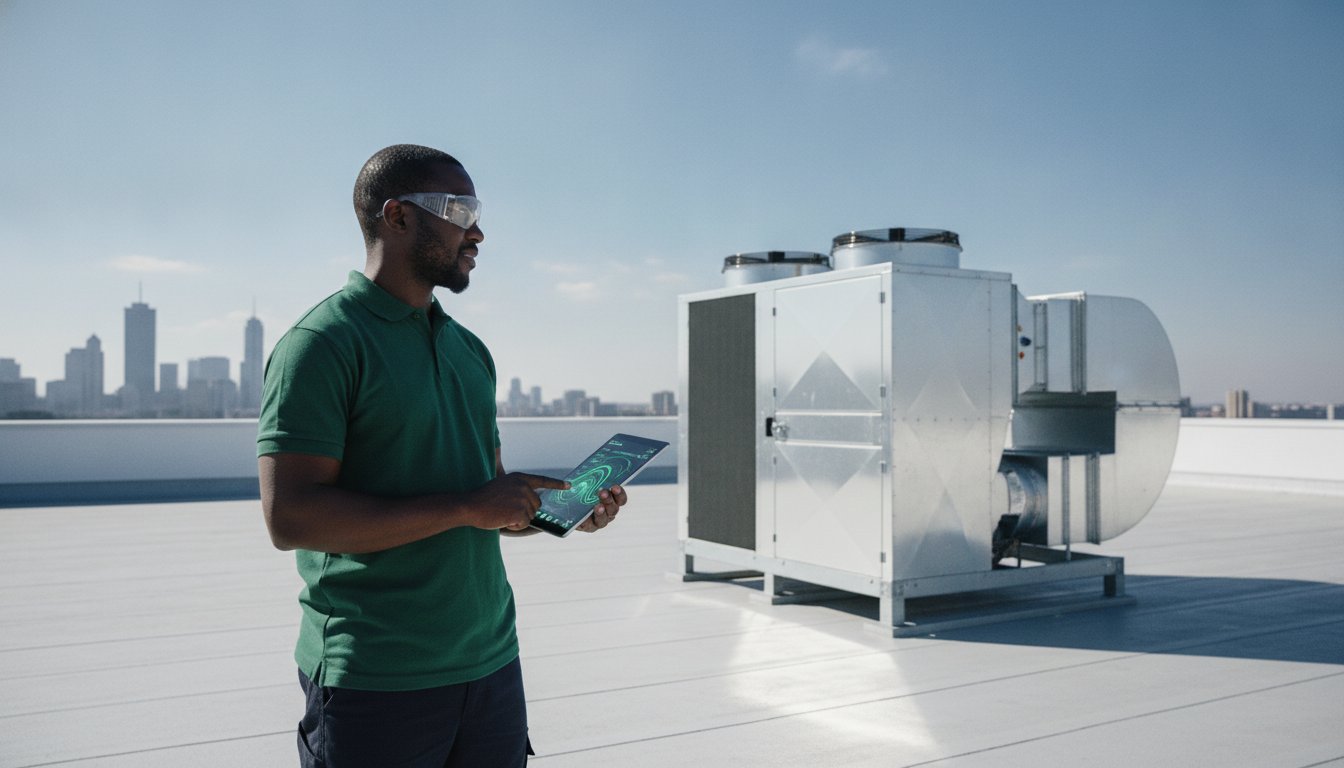
By September 2026, a simple ventilation check is no longer enough to keep your facility compliant. Under the new Physical Agent Regulations, failing to validate your indoor air quality every 24 months could lead to penalties of up to R5 million. As a facility manager, you’re likely already struggling with the rising costs of energy and the recurring stress of system failures during intense Gauteng heatwaves. Managing industrial air handling units South Africa requires more than just mechanical oversight; it demands a strategic approach to climate control and regulatory risk management.
This guide helps you manage the complexities of selecting, installing, and maintaining high-performance air handling units tailored for our unique industrial environments. You’ll discover how to achieve significant energy savings and ensure your systems integrate seamlessly with modern building management systems. We will examine the latest efficiency standards, local air quality mandates, and the specific maintenance protocols that transform your HVAC infrastructure from a liability into a reliable, high-performance asset.
Key Takeaways
- Understand how industrial air handling units function as the central lungs of your facility, managing air conditioning and distribution to maintain precise environmental control.
- Learn how to specify equipment that accounts for South Africa’s unique climate, specifically addressing how Gauteng’s high altitude affects fan motor performance and airflow.
- Discover the benefits of integrating industrial air handling units South Africa with smart Building Management Systems to automate energy efficiency and monitor system health.
- Identify the essential logistical factors for a successful installation, including site selection and the precise alignment of ventilation fans and louvers.
- Recognise the importance of structured maintenance programmes to ensure compliance with the 2026 Physical Agent Regulations and avoid costly operational downtime.
What is an Industrial Air Handling Unit (AHU)?
An industrial air handling unit (AHU) functions as the central lungs of a building’s HVAC system. Its primary purpose involves collecting outside air, conditioning it through various internal stages, and distributing it via ductwork to specific zones. Whilst a standard air conditioner might cool a single room, industrial air handling units South Africa are designed for high-volume environments where air quality and pressure must be strictly maintained. This technology has evolved from basic mechanical ventilation into a sophisticated, intelligent management system that regulates humidity and carbon dioxide levels in real-time. It’s no longer just about moving air; it’s about creating a controlled environment that supports both human health and industrial processes.
Industrial AHUs differ from standard split systems primarily in scale and customisation. A split unit is a closed-loop system with limited filtration, whereas an AHU is a modular powerhouse that can be configured with specific modules for humidification, UV sterilisation, or heat recovery. To understand the technical specifics of What is an Air Handling Unit (AHU)?, one must look at how it integrates with the broader facility infrastructure to ensure consistent airflow and thermal comfort across thousands of square metres.
The Anatomy of a High-Performance AHU
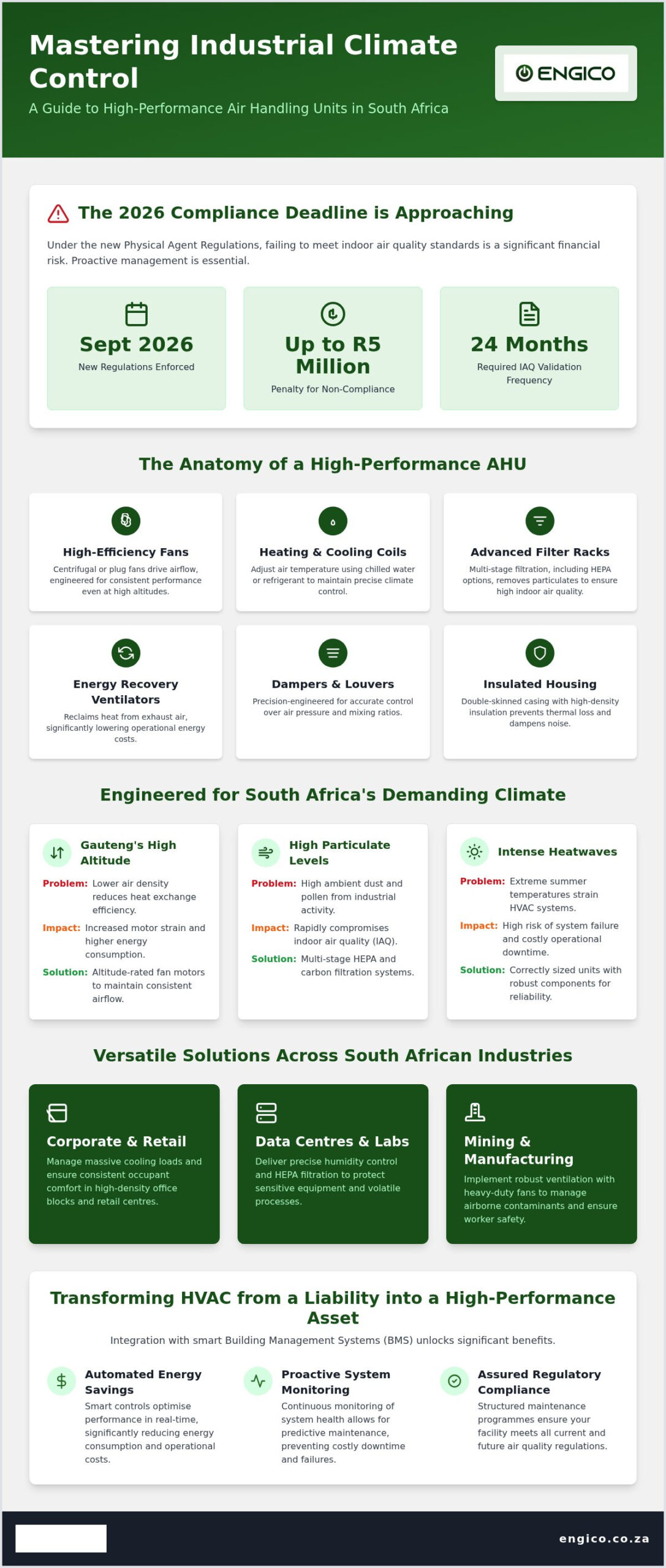
High-performance units rely on a series of critical internal components. High-efficiency centrifugal fans or plug fans drive the airflow, whilst heating and cooling coils adjust the temperature using chilled water or refrigerant. Filter racks are essential for removing particulates, especially in Gauteng where dust levels can be high. Modern units often include Energy Recovery Ventilators (ERVs) to reclaim heat from exhaust air, which significantly lowers operational costs. Precision-engineered dampers and louvers are equally vital; they allow facility managers to control air pressure and mixing ratios with extreme accuracy. The housing itself is usually double-skinned with high-density insulation to prevent thermal loss and dampen mechanical noise.
Common Industrial Applications in South Africa
The versatility of industrial air handling units South Africa makes them indispensable across various sectors. In the high-density corporate hubs of Sandton and Pretoria, large-scale retail centres and office blocks use AHUs to manage massive cooling loads and maintain occupant comfort during summer heatwaves. In contrast, pharmaceutical labs and data centres in Midrand require AHUs with HEPA filtration and precise humidity control to protect sensitive equipment and volatile chemicals. The mining and heavy manufacturing industries rely on robust ventilation systems equipped with heavy-duty fans and louvers to manage airborne contaminants and ensure worker safety in harsh environments. These units must be durable enough to withstand the abrasive dust and high temperatures typical of local industrial sites.
Selecting the Right AHU for the South African Climate
South Africa presents a unique set of meteorological challenges that standard HVAC designs often overlook. When specifying industrial air handling units South Africa, facility managers must look beyond basic cooling capacity. The interaction between local altitude, extreme summer temperatures, and high particulate levels dictates the long-term viability of the installation. A unit that performs well in a coastal European city will likely struggle to meet the demands of a Highveld industrial park without significant modification.
Altitude and Air Density Considerations
The lower air density found across the Highveld necessitates specific fan power adjustments because the thinner atmosphere provides less mass for heat transfer. In cities like Johannesburg and Pretoria, cooling coils exhibit reduced heat exchange efficiency compared to coastal installations at sea level. Standard units often underperform locally because they aren’t calibrated for these atmospheric variations. This discrepancy leads to increased motor strain and higher energy consumption if the system isn’t correctly sized from the outset. Ensuring that fan motors are rated for the specific altitude of your site is critical for maintaining consistent airflow.
Filtration and Indoor Air Quality (IAQ) Standards
South Africa’s dry winters and intensive industrial activity result in high ambient dust and pollen levels, which can quickly compromise indoor air quality. Incorporating multi-stage filtration, including HEPA or carbon filters, is essential for sensitive sectors like healthcare or food production. Maintaining ASHRAE standards whilst managing local pollutants helps prevent Sick Building Syndrome and ensures compliance with the 2026 Physical Agent Regulations. High-quality filtration also protects internal components like coils and fans from abrasive dust, which extends the overall lifespan of the system.
Electricity tariffs continue to rise across the country, making the Energy Efficiency Ratio (EER) a primary metric for any new AHU investment. High-efficiency motors and variable speed drives are no longer optional; they’re vital for maintaining operational budgets during Pretoria’s intense summer heatwaves. Systems that can’t adapt to these peaks often fail when they’re needed most, leading to costly downtime. If you’re unsure about the technical specifications required for your specific location, it’s advisable to consult with a local HVAC specialist to ensure your system is engineered for Gauteng’s specific demands.
Smart Integration: AHUs and Building Management Systems
Modern industrial air handling units South Africa are no longer standalone mechanical assets. They function as critical nodes within a Building Management System (BMS), allowing for a level of precision that was previously unattainable. By integrating these units with a centralised control interface, facility managers can automate airflow based on real-time occupancy and indoor air quality metrics. This is particularly relevant under the 2026 Physical Agent Regulations, which require documented validation of CO2 levels and airborne contaminants. A smart system ensures that ventilation rates increase only when necessary, maintaining compliance whilst avoiding the energy waste associated with constant full-speed operation.
Remote monitoring and fault detection have become standard requirements for large-scale facilities. Integrated sensors provide a continuous stream of operational data, allowing for immediate intervention if a component begins to drift from its performance baseline. This visibility is invaluable for linking AHU performance to broader building energy optimisation goals, ensuring that the cooling system doesn’t work in isolation from lighting or other mechanical services. When your AHU communicates effectively with the BMS, it’s possible to identify inefficiencies before they impact your bottom line.
Energy Efficiency through Automation
The use of Variable Frequency Drives (VFDs) is a cornerstone of smart AHU integration. These drives allow fan motors to adjust their speed dynamically, matching the actual demand of the building rather than running at a fixed, inefficient output. By scheduling cooling cycles to align with off-peak electricity hours, businesses can significantly reduce their monthly utility spend in line with current South African electricity tariffs. For a deeper look at these technologies, refer to our Smart HVAC Control for Commercial Buildings guide.
Predictive Maintenance and Real-Time Data
Moving from a reactive repair model to data-driven predictive maintenance is a major shift for facility managers in hubs like Midrand and Centurion. Smart sensors monitor filter health by measuring pressure drops across the media, sending real-time alerts before the system experiences significant strain. This early warning system prevents the “cascade effect” where a clogged filter leads to motor overheating and eventual system failure. This approach offers several tangible benefits:
- Reduced operational downtime through preemptive component replacement.
- Extended equipment lifespan by avoiding prolonged periods of mechanical stress.
- Lower labour costs by streamlining maintenance schedules based on actual usage data rather than arbitrary calendar dates.
- Improved compliance reporting through automated logging of air quality and system performance.
By leveraging real-time data, you don’t just fix problems; you prevent them. This methodical approach to maintenance ensures that your industrial air handling units South Africa remain a reliable part of your infrastructure for years to come.
Installation and Maintenance Logistics in Gauteng
Selecting a site for your industrial air handling units South Africa involves balancing spatial efficiency with mechanical accessibility. Most facility managers choose between a rooftop installation and a dedicated internal plant room. Rooftop units are popular for saving internal floor space, yet they require robust weatherproofing and specific structural reinforcements to handle the weight and vibration. In Johannesburg, where many industrial structures have specific load-bearing limits, a professional structural assessment is a mandatory first step. Proper alignment of ventilation fans and louvers during this phase is equally critical; incorrect positioning can lead to air recirculation or excessive noise that violates local municipal bylaws.
The physical setup is only half the challenge. High-quality ducting must be installed with precision to prevent static pressure losses that force the system to work harder than necessary. Navigating the environmental regulations for industrial sites in Gauteng also means ensuring that exhaust air doesn’t impact neighbouring properties or pedestrian zones. By addressing these logistical factors during the design phase, you avoid the costly retrofitting that often follows a poorly planned installation.
The Professional Installation Process
A successful installation requires more than just placing the unit on a plinth. It involves ensuring a seamless connection to your building’s chilled water or direct expansion (DX) systems. Once the physical and electrical connections are secure, the commissioning phase begins. This involves performance testing to verify that the airflow, pressure, and thermal outputs match the original engineering specifications. This methodical testing ensures that the system is fully operational and efficient before the final handover, providing a stable foundation for your facility’s climate control.
Lifecycle Maintenance for Long-Term Reliability
Protecting a capital investment of this magnitude requires a commitment to a recurring maintenance schedule. Without regular intervention, even the most advanced AHU will experience a decline in efficiency and air quality. Quarterly filter checks and coil cleaning are the most effective ways to maintain high-performance standards, especially in the dusty environments typical of Pretoria and the East Rand. You can explore our HVAC Maintenance Services for Gauteng Properties to understand how we structure these technical inspections. Professional servicing doesn’t just prevent breakdowns; it can extend the equipment’s operational lifespan beyond 15 years.
Reliability in an industrial setting isn’t a matter of luck; it’s the result of disciplined engineering and consistent care. If you’re looking to secure the future of your facility’s air management, you can request a technical consultation for your AHU installation and maintenance to ensure your systems are handled by experienced specialists.
Optimising Your Facility with Engico Air Conditioning
Engico Air Conditioning positions itself as a methodical specialist in the supply and management of industrial air handling units South Africa. We understand that facility managers in Pretoria and Sandton require more than just equipment; they need a dependable partner who can navigate the technical complexities of the Highveld climate. Our approach is built on professional reliability and a thorough understanding of local engineering requirements. By focusing on long-term value rather than short-term convenience, we ensure that your HVAC infrastructure remains efficient, compliant, and cost-effective.
Working with a local specialist provides the advantage of proximity and expertise. We don’t just supply hardware; we provide a “safe pair of hands” for complex Gauteng industrial projects. From the initial site survey to the final commissioning, our team manages every detail without fuss. This disciplined focus allows you to concentrate on your core operations, knowing that your facility’s air quality is being managed to the highest professional standards.
Tailored Industrial Ventilation Solutions
Every facility has unique airflow requirements. Whether you’re managing a corporate hub in Sandton or a manufacturing plant in the East Rand, we provide customised AHU configurations that suit your specific footprint. Our designs integrate high-performance industrial ventilation fans and louvers to ensure optimal air circulation throughout the building. For those managing large-scale storage facilities, our Warehouse Ventilation Design South Africa guide offers detailed insights into optimising these environments. We prioritise durability and efficiency in every component we select, ensuring that your system can withstand South Africa’s environmental demands.
Partnering for Professional Excellence
Our relationship with clients is a partnership focused on the entire lifecycle of the equipment. We follow a methodical progression from the initial consultation through to recurring maintenance and expert repairs. This structured approach is designed to protect your capital investment and extend the operational life of your industrial air handling units South Africa. By combining technical expertise with a solution-oriented mindset, we help you achieve seamless integration with your existing building management systems. If you’re ready to improve your facility’s performance, Contact Engico for a professional AHU consultation to discuss your specific HVAC requirements.
Securing the Future of Your Facility’s Air Management
Managing a large-scale industrial site requires a disciplined approach to climate control. Successful air management depends on choosing equipment specifically engineered for the Highveld’s altitude and integrating it with intelligent building management systems. These steps don’t just ensure compliance with the 2026 Physical Agent Regulations; they protect your operational budget from rising energy costs and prevent the mechanical strain caused by Gauteng’s extreme temperatures.
Selecting the right industrial air handling units South Africa is a long-term investment in your facility’s productivity. Engico provides the technical expertise needed for specialist BMS integration and comprehensive maintenance contracts that ensure long-term reliability. Our team understands the unique demands of Highveld-specific HVAC engineering, offering you a stable partner for even the most complex projects.
By prioritising methodical maintenance and smart automation, you can transform your HVAC system into a high-value asset. If you’re ready to optimise your building’s environment, Request a Professional Industrial AHU Assessment today. We look forward to helping you achieve a more efficient and reliable facility.
Frequently Asked Questions
How often should an industrial air handling unit be serviced in South Africa?
Industrial units require a basic technical inspection and filter replacement every three months to maintain efficiency in our dusty climate. Under the 2026 Physical Agent Regulations, you must also conduct a comprehensive validation of your indoor air quality and ventilation system at least every 24 months. Regular quarterly servicing prevents the accumulation of Highveld dust on sensitive cooling coils and fan motors.
What is the difference between an AHU and a rooftop packaged unit?
An AHU is a modular component that requires an external source, such as a chiller or boiler, to condition the air it distributes. In contrast, a rooftop packaged unit is a self-contained system that includes all necessary refrigeration components in a single housing. Whilst packaged units are convenient for smaller spaces, industrial air handling units South Africa offer superior customisation for filtration and humidity control.
Can an existing AHU be retrofitted with smart BMS controls?
Most legacy units can be retrofitted with modern sensors and Variable Frequency Drives (VFDs) to allow for Building Management System integration. This process involves installing digital controllers that communicate with your central interface, enabling automated airflow adjustments based on real-time demand. Retrofitting is a cost-effective way to improve energy efficiency without the capital expense of a full system replacement.
How does Gauteng’s altitude affect the motor size of an AHU?
The lower air density at high altitudes, such as in Johannesburg and Pretoria, requires larger fan motors to move the same mass of air as coastal installations. Because the air is thinner, the fan must spin faster or use a more powerful motor to achieve the required cooling capacity. Failure to account for altitude during the design phase often leads to motor overheating and insufficient airflow.
What are the most common causes of AHU failure in industrial environments?
Neglected filter maintenance and motor burnout are the leading causes of system failure in South African industrial sites. When filters become clogged with local particulates, the internal pressure drops, forcing the fan motor to work harder and consume more electricity. This prolonged mechanical stress eventually leads to bearing failure or electrical shorts, resulting in expensive and avoidable downtime.
Are there energy-saving rebates for installing high-efficiency AHUs in South Africa?
Businesses can often access tax incentives under Section 12L of the Income Tax Act, which rewards verified energy-efficiency savings. Whilst specific municipal rebates vary between Johannesburg and Pretoria, most large-scale energy users benefit from reduced peak-demand charges when installing high-efficiency units. It is advisable to consult with a tax professional or energy auditor to confirm the current eligibility criteria for your facility.
What filtration level is required for a commercial office AHU?
Commercial offices generally require a minimum of MERV 13 or a combination of G4 and F7 filters to ensure healthy indoor air quality. These levels are sufficient to capture common pollutants, including pollen and fine dust, whilst maintaining reasonable airflow resistance. For environments with higher safety requirements, such as pharmaceutical labs or food processing plants, HEPA filtration is usually mandatory to meet local health standards.
Does Engico offer AHU maintenance for systems they did not install?
Engico provides comprehensive maintenance, service, and repairs for all brands of industrial air handling units South Africa, regardless of the original installer. We specialise in technical audits and system optimisations for existing infrastructure across Gauteng. Our team can assess your current setup, provide a detailed maintenance schedule, and integrate legacy equipment into modern building management systems for better oversight.
Recent Comments