
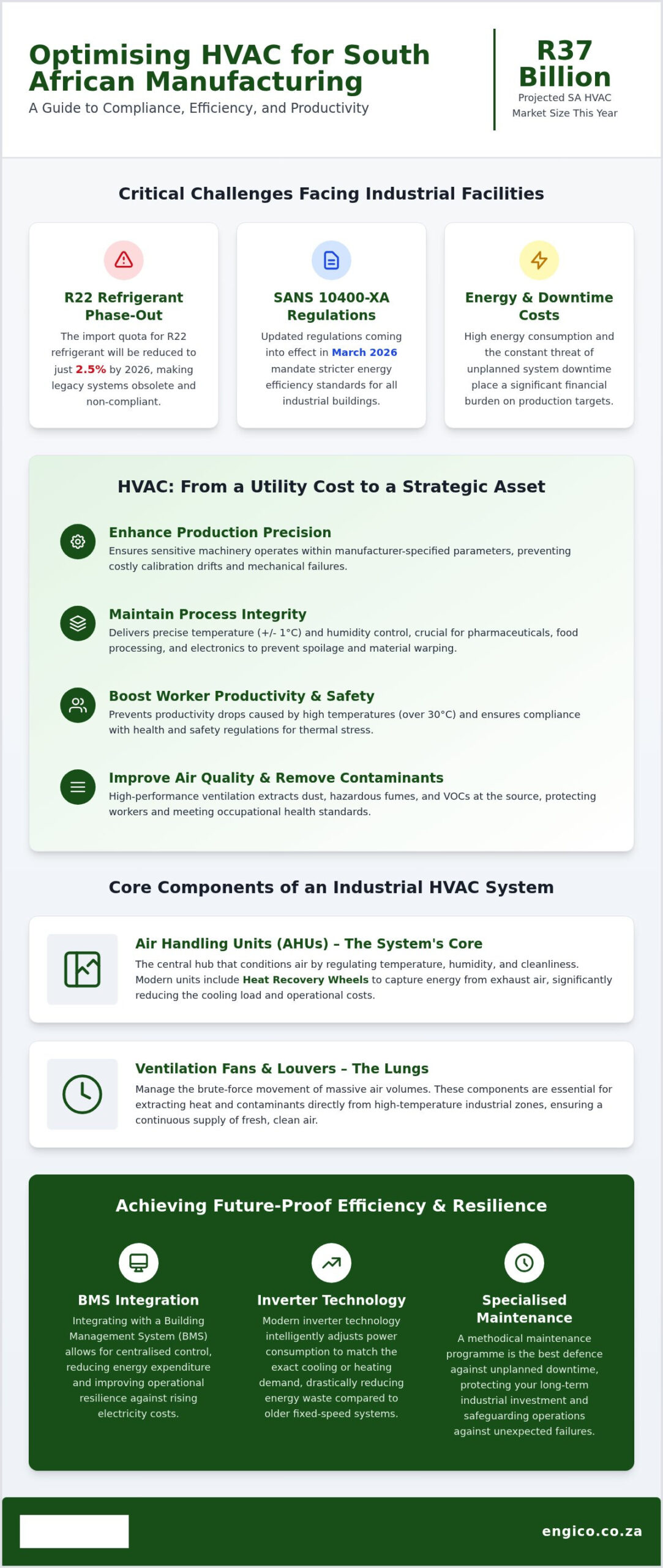
As of 2026, the import quota for R22 refrigerant has been reduced to just 2.5 per cent, leaving many industrial facilities with legacy systems in a precarious position. When you consider that the South African HVAC market is projected to reach nearly R37 billion this year, it’s clear that the transition to modern, efficient technology is no longer optional. Maintaining reliable HVAC for manufacturing plants South Africa requires a methodical approach to both energy resilience and technical compliance.
We recognise that high energy costs and the threat of system downtime are significant burdens on your production targets. This guide explores how to optimise your plant’s climate control for maximum productivity while adhering to the updated March 2026 SANS 10400-XA regulations. We will examine the benefits of industrial-grade ventilation, the role of inverter technology in reducing consumption, and how specialised maintenance programmes can safeguard your operations against unexpected failures.
Key Takeaways
- Understand why high-performance HVAC for manufacturing plants South Africa is essential for maintaining production precision and meeting the latest SANS 10400-XA energy standards.
- Learn how industrial-grade Air Handling Units and ventilation fans work together to manage heat extraction and maintain air quality in demanding environments.
- Discover how Building Management System (BMS) integration can reduce energy expenditure and improve operational resilience against rising electricity costs.
- Identify the importance of specialised maintenance programmes in preventing unplanned downtime and protecting your long-term industrial investment.
- Navigate the 2026 R22 refrigerant phase-out by understanding the transition to sustainable alternatives that ensure future regulatory compliance.
The Critical Role of HVAC for Manufacturing Plants in South Africa
Industrial climate control isn’t merely about keeping staff comfortable during a Highveld summer; it’s a fundamental pillar of operational precision and structural safety. Implementing robust Heating, ventilation, and air conditioning (HVAC) systems ensures that sensitive machinery operates within manufacturer-specified parameters, preventing costly calibration drifts or mechanical failures. For many facilities, HVAC for manufacturing plants South Africa serves as the first line of defence against the environmental variables that threaten production consistency.
High-temperature industrial zones without adequate cooling lead to rapid worker fatigue and a higher risk of accidents. Research into industrial ergonomics suggests that when internal factory temperatures exceed 30°C, labour productivity and cognitive focus can drop significantly. By maintaining thermal comfort, factory managers directly protect their output rates and ensure compliance with South African health and safety regulations regarding indoor air quality and thermal stress. This methodical approach to climate control transforms the HVAC system from a utility cost into a strategic asset.
Temperature and Humidity Control for Process Precision
Precise control is non-negotiable in sectors like pharmaceuticals, food processing, or high-end electronics. These environments often require a +/- 1-degree tolerance to maintain chemical stability or prevent component warping. In Gauteng, seasonal humidity shifts can be dramatic, moving from extremely dry winters to humid summer afternoons. This volatility threatens material integrity and can lead to batch spoilage if not managed by industrial-grade Air Handling Units. Maintaining a consistent relative humidity level prevents moisture from settling on metallic surfaces, thereby inhibiting the chemical reaction that leads to oxidation and surface rust.
Air Quality and Contaminant Removal
Manufacturing processes frequently generate dust, hazardous fumes, and volatile organic compounds (VOCs). Effective HVAC for manufacturing plants South Africa must include high-performance ventilation fans and louvers to extract these contaminants at the source. This isn’t just a best practice; it’s a legal requirement under local occupational health standards to protect workers from long-term respiratory hazards. Quality filtration systems serve several roles:
- Contaminant Extraction: Removing harmful particulates before they settle on sensitive equipment or are inhaled by staff.
- Pressure Management: Maintaining positive pressure in cleanrooms to prevent unfiltered air from entering the space.
- Regulatory Compliance: Meeting SANS 10147 requirements for industrial refrigeration and air conditioning safety.
Ensuring that your facility has a balanced system of fresh air intake and contaminated air exhaust is essential for maintaining a safe, compliant, and productive manufacturing environment.
Core Components of Industrial HVAC and Ventilation Systems
Designing effective HVAC for manufacturing plants South Africa involves selecting specific hardware that can withstand harsh industrial conditions. Unlike standard commercial offices, factory floors require equipment capable of moving massive volumes of air across vast, open floor areas. Ducted air conditioning systems are often the preferred choice for these environments. They provide even distribution of treated air through a network of robust ductwork, ensuring that no pocket of the production floor remains stagnant or overheated during peak summer temperatures.
High-Performance Air Handling Units (AHUs)
Air Handling Units function as the central processing hub for your facility’s climate. They are responsible for conditioning the air by regulating temperature, humidity, and cleanliness before it enters the workspace. In modern South African factories, these units are often customised to include heat recovery wheels. These components capture energy from exhaust air to pre-condition incoming fresh air, significantly reducing the load on the cooling system. This methodical approach to energy management is detailed in our Industrial Air Handling Units: A Complete Guide. Selecting the right AHU requires a precise calculation of the plant’s internal heat load and the required air changes per hour to maintain safety.
Ventilation Fans and Industrial Louvers
While AHUs handle the conditioning, industrial ventilation fans manage the brute force of air movement. Axial fans are typically used for high-volume, low-pressure applications like general warehouse cooling. In contrast, centrifugal fans provide the higher pressure needed to push air through complex ducting or heavy-duty filtration systems. South African Acts and Laws mandate that employers provide a safe working environment, which necessitates these mechanical extraction systems to remove excess heat and airborne pollutants efficiently.
High-performance louvers complement these fans by providing a weatherproof entry and exit point for air. They allow for passive ventilation during milder weather, reducing the reliance on powered cooling and lowering operational costs. For more on how these elements integrate into a cohesive layout, see our guide on Warehouse Ventilation Design South Africa. If you’re planning a new facility or upgrading an existing production line, consulting with a professional HVAC partner ensures your components are sized correctly for long-term reliability and compliance.
Energy Efficiency and Resilience in the Gauteng Industrial Sector
Rising electricity tariffs in South Africa have transformed energy management from a secondary concern into a core operational priority. For large-scale facilities, HVAC for manufacturing plants South Africa represents one of the largest single draws on the electrical grid. Improving the efficiency of these systems directly impacts the bottom line, especially as industrial sectors face ongoing pressure from fluctuating power availability and rising utility costs. Transitioning to modern inverter technology is a significant step in this process. Unlike traditional fixed-speed motors, inverter-driven units adjust their output to match the real-time cooling demand, which prevents the energy spikes associated with frequent compressor cycling.
BMS Integration for Smart Climate Control
A Building Management System (BMS) acts as the brain of an industrial facility, coordinating various components to eliminate unnecessary consumption. Industry benchmarks suggest that proper Smart HVAC Control for Commercial Buildings and industrial sites can reduce energy waste by up to 30 per cent. This is achieved by automating temperature set-points based on specific production shifts and zone occupancy. If a particular production line is inactive, the BMS automatically scales back the airflow and cooling to that area. Real-time monitoring also allows maintenance teams to identify energy leaks, such as a valve that isn’t closing properly or a filter that is so clogged it forces fans to work harder than necessary.
Optimising HVAC for Energy Resilience
Operating in the Gauteng industrial sector requires a strategy for managing load shedding and restricted power periods. Sudden power restoration can cause damaging electrical surges, so we recommend implementing staggered start-up protocols. This methodical approach ensures that heavy-duty fans and compressors don’t all draw maximum current simultaneously when the grid returns. Some facilities are also exploring thermal storage solutions, where they over-cool chilled water or ice during off-peak hours for use when power is expensive or limited. Integrating a BMS facilitates remote HVAC monitoring during power outages, allowing technical teams to verify system status and safety parameters from any location. This level of oversight ensures that when production resumes, the climate control system is ready to support the process without delay.
Maintenance and Repairs: Protecting Your Industrial Investment
Manufacturing environments are significantly more taxing on climate control equipment than standard commercial offices. High concentrations of airborne particulates, chemical fumes, and continuous duty cycles mean that HVAC for manufacturing plants South Africa requires a structured, frequent maintenance regime. Neglecting these systems leads to more than just environmental discomfort; it causes mechanical degradation that can stop a production line entirely. Regular servicing ensures that coils and filters remain clear of industrial dust, which is essential for maintaining the heat exchange efficiency and airflow required for process precision.
Reactive repairs are almost always more expensive than preventative care. When a system fails unexpectedly, the true cost includes the technician’s fee and the substantial lost revenue from unplanned production downtime. We advocate for a methodical approach where technicians perform regular duct inspections to identify leaks or blockages before they strain the ventilation fans. This proactive strategy extends the lifespan of your heavy-duty investment and keeps your facility compliant with local health and safety standards, particularly regarding air quality and thermal stress.
Preventative Maintenance Programmes
A quarterly inspection schedule is the baseline standard for most industrialised spaces in Gauteng. During these visits, technicians focus on the high-wear components of industrial fans and Air Handling Units. Identifying early signs of bearing wear or motor fatigue allows for scheduled replacements during planned facility shutdowns rather than during peak production periods. For those managing mixed-use sites, our resource on Commercial HVAC Maintenance in Sunninghill provides additional insights into balancing office and industrial requirements within a single maintenance contract.
Rapid Repair Services in Gauteng
When mechanical failures occur, proximity to service hubs in Johannesburg and Pretoria is a critical advantage. Accessing specialised spare parts for industrial-grade equipment can be challenging if your service provider isn’t locally based with a robust supply chain. Reducing the ‘Mean Time To Repair’ (MTTR) is vital for protecting your production schedules and minimising the impact of a breakdown. A local partner with a deep inventory of components can restore climate control quickly, ensuring that sensitive processes or raw material stores aren’t compromised by rising internal temperatures. To secure your facility’s operational uptime, you can establish a specialised maintenance programme with Engico Air Conditioning, a partner who understands the unique demands of the South African industrial sector.
Choosing Engico Air Conditioning for Manufacturing HVAC in Gauteng
Selecting a partner to manage HVAC for manufacturing plants South Africa requires more than just technical skill; it demands a deep understanding of local industrial constraints and regulatory requirements. Engico Air Conditioning positions itself as a methodical specialist, providing a “safe pair of hands” for complex climate control projects across the Gauteng Province. We don’t believe in one-size-fits-all hardware. Instead, we begin every project with a comprehensive site survey to evaluate your specific heat loads, production cycles, and energy resilience needs. This grounded approach ensures that the resulting system is not only fit for purpose but also aligned with the latest SANS 10400-XA energy efficiency standards.
Our local expertise is concentrated within the vital industrial hubs of Pretoria, Johannesburg, and Midrand. This geographic focus allows us to provide the rapid response times and consistent oversight that large-scale manufacturing demands. By choosing a partner rooted in the Gauteng industrial corridor, you ensure that your facility benefits from a supply chain and technical team that understands the nuances of the South African climate and the specific challenges of the local energy grid. We focus on long-term value, aiming to build trust through transparency and technical excellence.
Tailored Industrial Solutions
A manufacturing facility is a diverse environment with varying requirements for each zone. Engico Air Conditioning provides tailored configurations that range from wall-mounted split units for administrative offices and sensitive control rooms to heavy-duty ducted air conditioning systems for vast factory floors. A holistic air management strategy must also integrate industrial ventilation fans and louvers to handle heat extraction and passive airflow. Our installation teams prioritise minimal disruption to your operations, often scheduling work to coincide with your existing downtime or shift changes to protect your production targets.
Reliable Partnership and Support
Building trust through professional reliability is central to our service model. We move beyond the initial installation to offer dedicated maintenance programmes designed specifically for the high-dust and high-demand nature of South African manufacturing. These programmes ensure that your system remains an asset rather than a liability, maintaining peak efficiency throughout its lifecycle. Whether you’re upgrading an existing facility or designing a new plant from inception, our team provides the technical weight of experience needed to get the job done right. Contact Engico Air Conditioning for a professional consultation on your manufacturing plant’s HVAC needs and discover how we can optimise your facility’s climate control for the years ahead.
Future-Proofing Your Industrial Climate Strategy
Optimising HVAC for manufacturing plants South Africa is a strategic investment in long-term operational stability. As established in this guide, the intersection of energy resilience, technical compliance, and precise environmental control defines the success of modern production facilities. By adopting advanced inverter technology and integrating Building Management Systems, factory managers can mitigate the risks of rising tariffs and power instability whilst maintaining the strict tolerances required for manufacturing excellence.
Engico Air Conditioning provides the local expertise and methodical support necessary to manage these complex systems. From expert installation across Johannesburg and Pretoria to specialised industrial ventilation and AHU maintenance, we ensure your facility remains productive and compliant. Our proven BMS integration strategies offer the transparency and control needed to navigate the evolving industrial landscape of the Gauteng Province.
Request a professional site assessment for your Gauteng manufacturing facility from Engico Air Conditioning to secure your plant’s climate control and operational uptime. We look forward to partnering with you for a more efficient and reliable industrial future.
Frequently Asked Questions
What are the specific HVAC requirements for manufacturing plants in South Africa?
Industrial facilities must balance temperature, humidity, and air quality to meet the latest SANS 10147 and SANS 10400-XA standards. These environments require robust HVAC for manufacturing plants South Africa that can manage high internal heat loads whilst extracting contaminants like dust or chemical fumes. Systems must be durable enough for continuous duty cycles and precise enough to protect sensitive machinery from environmental fluctuations.
How much does it cost to install an industrial HVAC system in Gauteng?
The cost of an industrial installation in Gauteng depends on the facility’s square footage, internal heat loads, and specific filtration needs. Because manufacturing environments vary significantly from food processing to heavy metalwork, a bespoke site survey is required to determine the necessary equipment capacity. We recommend a professional assessment to identify the most cost-effective configuration for your specific production floor requirements.
How can a Building Management System (BMS) reduce my factory’s energy bills?
A Building Management System reduces energy bills by automating climate control based on real-time production schedules and zone occupancy. It eliminates waste by scaling back cooling in inactive areas and identifying equipment inefficiencies before they become costly failures. This level of smart integration can reduce energy waste by up to 30 per cent, providing significant relief against rising South African electricity tariffs.
What is the recommended maintenance frequency for industrial ventilation fans?
Industrial ventilation fans typically require a quarterly maintenance schedule to ensure long-term reliability in high-dust manufacturing environments. These regular inspections focus on identifying early signs of bearing wear, motor fatigue, and debris build-up that can lead to system failure. Regular servicing prevents the unplanned downtime that often results from motor burnout or mechanical imbalances in heavy-duty extraction units.
Can Engico repair existing industrial air handling units from other manufacturers?
Engico provides comprehensive service and repairs for industrial air handling units and ventilation systems regardless of the original manufacturer. Our technical teams have the expertise to diagnose faults and source high-quality spare parts for a wide range of industrial-grade equipment. This methodical approach helps restore your facility’s climate control quickly and protects your existing mechanical investments from premature failure.
What happens to my HVAC system during load shedding?
During load shedding, HVAC systems face risks from sudden power surges and the loss of environmental control for sensitive processes. We recommend implementing staggered start-up protocols to ensure that heavy-duty compressors and fans don’t draw excessive current when power returns. Integrating a BMS also allows for remote monitoring, enabling your team to verify system status and safety parameters immediately after the grid stabilises.
Is ducted air conditioning or a split system better for a large manufacturing floor?
Ducted air conditioning is generally superior for large manufacturing floors as it provides even air distribution and can be integrated with heavy-duty Air Handling Units. Split systems are better suited for smaller, isolated areas like control rooms or administrative offices where independent temperature control is required. Choosing the right HVAC for manufacturing plants South Africa depends on your plant’s layout and the specific thermal requirements of your production line.
Does Engico provide HVAC solutions for specialised clean rooms or labs?
Engico provides specialised HVAC solutions for clean rooms and laboratories that require stringent contaminant control and air pressure management. These environments utilise high-performance AHUs and advanced filtration systems to meet international cleanroom standards. Our methodical design process ensures that your laboratory maintains the precise temperature and humidity levels necessary for chemical stability and experimental accuracy.
Recent Comments